
OLED vs. Mini-LED: Comparing Premium TV Technologies in 2026
While OLED remains the undisputed king of cinematic dark-room contrast, Mini-LED has closed the gap with blinding brightness and massive screen sizes, making the choice entirely dependent on your living room.
By Factlen Editorial Team
- Cinematic Purists
- Argues that perfect black levels and infinite contrast are the only metrics that matter for true picture quality.
- Bright-Room Viewers
- Values full-screen brightness and glare reduction for daytime sports and casual viewing.
- Value Upsizers
- Prioritizes massive screen real estate (85+ inches) and burn-in immunity over microscopic contrast perfection.
What's not represented
- · Budget-conscious buyers who cannot afford premium technology and rely on standard edge-lit LED displays.
- · Commercial integrators who prioritize digital signage longevity over cinematic contrast.
Why this matters
A premium television is a multi-year investment that dictates how you experience entertainment. Choosing the wrong panel technology for your room's lighting or your viewing habits can mean fighting glare every afternoon or overpaying for cinematic contrast you never actually see.
Key points
- The premium TV market in 2026 is a binary choice between OLED's infinite contrast and Mini-LED's extreme brightness.
- OLED panels turn off individual pixels to achieve perfect black levels, making them the undisputed choice for dark home theaters.
- Mini-LED TVs use thousands of backlight zones to push peak brightness past 4,000 nits, easily overcoming glare in sun-drenched rooms.
- Mini-LED dominates the ultra-large TV category, offering massive 85-inch to 115-inch screens for a fraction of the cost of large OLEDs.
- OLED still carries a slight risk of burn-in from static images, while Mini-LED is entirely immune to permanent image retention.
- The best choice depends entirely on room lighting and viewing habits, rather than one technology being objectively superior.
The premium television landscape in 2026 has crystallized into a two-horse race that leaves many buyers paralyzed at the checkout screen. Gone are the days when simply buying the most expensive LCD guaranteed the best picture. Today, consumers must choose between two fundamentally different display technologies: OLED and Mini-LED. Both command premium prices and promise breathtaking 4K and 8K visuals, but they achieve these results through entirely different engineering philosophies.[1][3]
Understanding this divide is critical because choosing the wrong panel for a specific living room can lead to years of buyer's remorse. A television that looks flawless in a darkened showroom might become an unwatchable mirror in a sun-drenched living room, while a blindingly bright display might look washed out during a midnight movie marathon. The decision no longer hinges on which technology is objectively superior, but rather which set of trade-offs best matches the viewer's environment and habits.[4][7]
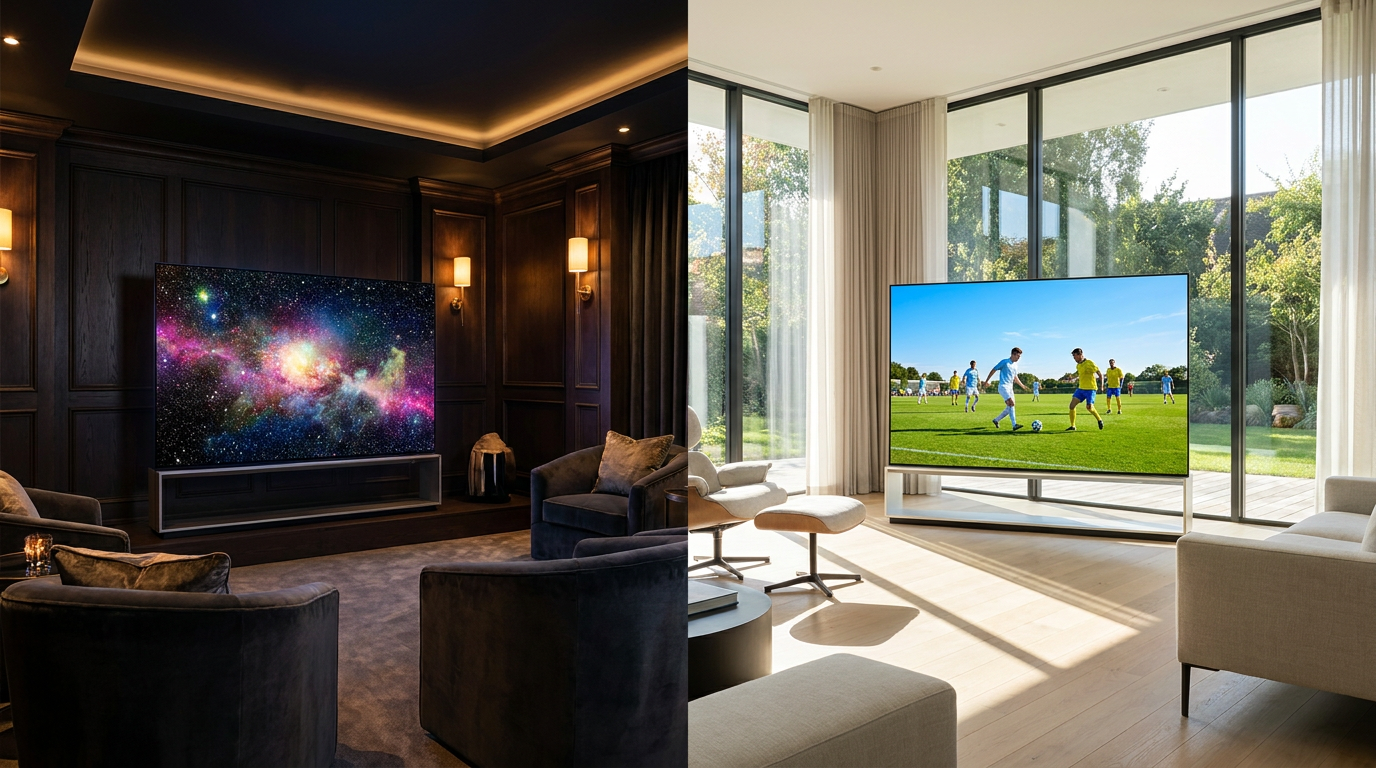
The argument for OLED (Organic Light-Emitting Diode) rests on its self-emissive nature. Because each of its over eight million pixels generates its own light and can turn off completely, OLED achieves perfect, infinite contrast. The evidence for this superiority is most visible in dark-room viewing: a starfield in a sci-fi film appears as piercing pinpricks of light against an inky black void, with zero light bleeding into the surrounding darkness.[1][5]
The primary argument against OLED has historically been its lack of peak brightness and the risk of permanent image retention, or burn-in. However, 2026 models have aggressively countered these flaws. Innovations like LG's Tandem OLED architecture and Samsung's QD-OLED panels have pushed peak HDR highlights past 2,000 nits. Yet, the evidence shows that OLEDs still rely on an Automatic Brightness Limiter (ABL) that dims the screen when a large portion of the image is bright—such as a snow-covered hockey rink—to protect the organic compounds.[2][3]

On the other side of the aisle, the argument for Mini-LED centers on brute-force brightness and immunity to burn-in. Mini-LED televisions are fundamentally LCD panels, but they replace the traditional chunky backlight with thousands of microscopic LEDs divided into independent dimming zones. The evidence of Mini-LED's power is undeniable in a bright room: premium 2026 models can push 4,000 nits of peak brightness, easily overpowering direct sunlight and rendering daytime sports or news broadcasts with punchy, vibrant clarity.[3][5]
The argument against Mini-LED is its inability to completely eliminate "blooming" or "haloing." Because the backlight zones are still larger than individual pixels, illuminating a small bright object on a dark background inevitably causes some light to spill into the adjacent dark areas. While top-tier 2026 models from Sony and TCL utilize highly advanced local dimming algorithms to minimize this effect, side-by-side testing evidence confirms that Mini-LED still cannot match OLED's pixel-perfect precision in a pitch-black room.[1][4]
When evaluating the evidence on screen uniformity, OLED maintains a distinct advantage. Testing reveals that OLED panels display solid colors with near-perfect consistency across the entire screen. In contrast, even the most expensive Mini-LED displays can exhibit a slightly patchier appearance, sometimes known as the "dirty screen effect," which can occasionally be noticed during panning shots over uniform surfaces like a soccer pitch or a blue sky.[1]
When evaluating the evidence on screen uniformity, OLED maintains a distinct advantage.
The value and sizing equation presents another massive divergence between the two technologies. The argument for Mini-LED in the large-format space is overwhelming. Manufacturers are now producing Mini-LED displays at 85, 98, 100, and even 115 inches at surprisingly accessible price points. The evidence is clear at the cash register: buyers can often secure a massive 98-inch Mini-LED for the same price as a 77-inch OLED, making it the undisputed champion for sheer wall-filling scale.[3][6]

Conversely, the argument against OLED in the ultra-large category is its exponential cost curve. While 55-inch and 65-inch OLEDs have become highly competitive in price, scaling the organic manufacturing process up to 83 or 97 inches results in astronomical price tags. For buyers who prioritize cinematic immersion through sheer screen size rather than microscopic contrast perfection, OLED quickly prices itself out of contention.[3][6]
For gamers, the evidence presents a near tie, with distinct situational winners. Both technologies now routinely offer 4K resolution at 120Hz or 144Hz, Variable Refresh Rate (VRR), and Auto Low Latency Mode. The argument for OLED in gaming is its near-instantaneous pixel response time, which eliminates motion blur in fast-paced shooters. The argument for Mini-LED is the absolute peace of mind it offers players who leave static heads-up displays (HUDs) on screen for eight hours a day, completely free from burn-in anxiety.[3][4]
Ultimately, synthesizing the evidence leads to clear, conditional recommendations rather than a single crowned winner. OLED fits well when the television is placed in a light-controlled room, basement, or dedicated home theater. It is the definitive choice for cinephiles who watch movies in the dark, viewers who demand perfect black levels, and gamers who prioritize motion clarity and contrast over daytime visibility.[4][7]
OLED does not fit well when the television is placed in a sun-drenched living room with unshaded windows, or when the household leaves the TV running all day on news channels with static tickers. In these environments, the panel will struggle to overcome glare, and the persistent static images increase the long-term risk of uneven pixel wear.[5][7]

Mini-LED fits well when the television serves as the central hub of a bright, multi-use family room. It is the superior choice for daytime sports viewing, casual background watching, and buyers who want the absolute largest screen possible for their budget. Its blinding brightness cuts through ambient light, ensuring the picture remains vibrant regardless of the time of day.[2][6]
Mini-LED does not fit well when the buyer is a contrast purist building a dedicated, pitch-black home theater. In a completely dark room, the minor haloing around subtitles and the slightly elevated black levels will be noticeable to a trained eye, breaking the cinematic illusion that OLED so effortlessly maintains.[1][5]
How we got here
2013
The first consumer OLED TVs hit the market, establishing a new benchmark for black levels.
2019
Mini-LED technology begins appearing in premium consumer televisions as a high-brightness alternative to OLED.
2022
QD-OLED panels are introduced, significantly closing the brightness gap between OLED and premium LCDs.
2026
Tandem OLED and 4,000-nit Mini-LEDs push both technologies to their absolute limits, offering distinct choices for consumers.
Viewpoints in depth
The Cinematic Purist's view
Argues that perfect black levels and infinite contrast are the only metrics that matter for true picture quality.
For home theater enthusiasts who watch movies in pitch-black rooms, OLED remains the undisputed champion. This viewpoint argues that any amount of light bleed or haloing—no matter how small—breaks the immersion of a film. Because OLED pixels are self-emissive, a starfield against a black sky is rendered with absolute precision. Purists maintain that while Mini-LEDs have improved, their reliance on backlight zones means they will never achieve the microscopic contrast control required for true cinematic perfection.
The Bright-Room Viewer's view
Values full-screen brightness and glare reduction for daytime sports and casual viewing.
This perspective prioritizes real-world living conditions over darkened home theaters. For families with sun-drenched living rooms, the primary enemy of picture quality is glare. Mini-LED advocates point out that OLEDs aggressively dim their screens during bright scenes (like a hockey game or a snowscape) to protect the panel. Mini-LEDs, capable of pushing past 4,000 nits of brightness, can overpower direct sunlight, ensuring that daytime sports and casual viewing remain vibrant and clear without needing to draw the curtains.
The Value Upsizer's view
Prioritizes massive screen real estate (85+ inches) and burn-in immunity over microscopic contrast perfection.
As consumers increasingly demand wall-filling displays, the cost-to-size ratio becomes the deciding factor. This camp argues that the immersive impact of a 98-inch or 100-inch screen far outweighs the subtle contrast benefits of an OLED. Because manufacturing massive OLED panels remains prohibitively expensive, Mini-LED has cornered the ultra-large market. Furthermore, this viewpoint values the peace of mind that comes with Mini-LED's immunity to burn-in, making it the safer long-term investment for households that leave news tickers or video game HUDs on screen all day.
What we don't know
- Whether emerging MicroLED technology will become affordable enough in the next five years to replace both OLED and Mini-LED.
- How long the new Tandem OLED panels will actually last in real-world, high-brightness usage before degrading.
- If manufacturers will eventually hit a ceiling on the number of dimming zones they can pack into a Mini-LED before diminishing returns set in.
Key terms
- Local Dimming Zones
- Specific areas of a Mini-LED backlight that can independently dim or brighten to improve contrast.
- Nits
- A unit of measurement for screen brightness; higher numbers mean the TV can overpower more ambient room light.
- Blooming / Haloing
- A visual artifact where light from a bright object on screen bleeds into the surrounding dark areas.
- QD-OLED
- A hybrid panel technology that uses Quantum Dots with an OLED light source to produce brighter, more saturated colors.
- Automatic Brightness Limiter (ABL)
- A software feature in OLED TVs that dims the entire screen when a large portion of the image is bright, preventing overheating.
Frequently asked
Does OLED still suffer from burn-in?
While modern OLEDs use pixel-shifting and advanced cooling to mitigate burn-in, the risk remains for static elements like news tickers or game HUDs left on for thousands of hours.
What is Tandem OLED?
A new architecture that stacks multiple light-emitting layers, allowing the TV to achieve much higher brightness levels without sacrificing pixel-level contrast.
Is Mini-LED the same as MicroLED?
No. Mini-LED uses tiny backlights behind an LCD panel. MicroLED is a future technology where the microscopic LEDs are the actual pixels, combining the best of OLED and Mini-LED, but it remains prohibitively expensive for consumers.
Which is better for gaming?
Both are excellent. OLED offers faster pixel response times for competitive shooters, while Mini-LED provides burn-in immunity for players who leave static HUDs on screen all day.
Sources
Source coverage
7 outlets
3 viewpoints surfaced







[1]RTINGSCinematic Purists
OLED vs Mini LED: Which is better in 2025?
Read on RTINGS →[2]Data Wire SolutionsBright-Room Viewers
Best TVs for 2026: 10 OLED and Mini-LED Picks
Read on Data Wire Solutions →[3]What Hi-Fi?Value Upsizers
Mini LED vs OLED: which TV screen technology is better?
Read on What Hi-Fi? →[4]The Good GuysBright-Room Viewers
OLED vs Mini LED vs QLED: what's the real difference?
Read on The Good Guys →[5]Digital TrendsValue Upsizers
Is the TCL X11L an OLED killer? Not so fast.
Read on Digital Trends →[6]100% AppliancesValue Upsizers
OLED vs Mini LED: Key Differences
Read on 100% Appliances →[7]Jeff RauseoCinematic Purists
OLED vs. Mini-LED vs. QLED: What's the Best TV for You?
Read on Jeff Rauseo →

More in shopping
See all 59 stories →Wearable Tech
Smart Ring vs. Smartwatch: The 2026 Trade-Off Analysis for Health Tracking
7 sources

Skincare Tech
The Evidence on LED Red Light Therapy Masks: What Clinical Studies Actually Show
8 sources
Electric Bikes
The 2026 E-Bike Buying Guide: How to Choose the Right Electric Bicycle
7 sources

Used EVs
How to Buy a Used EV in 2026: Battery Health, Tax Credits, and What to Look For
6 sources
Every angle. Every day.
Get shopping stories with full source coverage and perspective breakdowns delivered to your inbox.