
Induction vs. Gas Cooktops: The Definitive 2026 Comparison
As induction technology matures and health concerns over gas emissions rise, the choice of cooktop has become a major household infrastructure decision. Here is a comprehensive breakdown of the efficiency, costs, and culinary trade-offs.
By Factlen Editorial Team
- Efficiency & Health Advocates
- Focuses on the thermodynamic superiority and indoor air quality benefits of induction.
- Traditional Culinary Enthusiasts
- Values the tactile control, visual feedback, and versatility of cooking with an open flame.
- Budget & Practicality Focus
- Emphasizes the immediate financial hurdles and infrastructure challenges of switching to induction.
What's not represented
- · Renters who have no control over their kitchen appliances but bear the utility costs
- · Landlords balancing installation costs against property value upgrades
Why this matters
Choosing between gas and induction impacts not only your daily cooking experience and long-term utility bills, but also the indoor air quality your family breathes every day.
Key points
- Induction cooktops use electromagnetic fields to heat pans directly, achieving 85-90% energy efficiency compared to gas's 32-55%.
- Gas stoves emit nitrogen dioxide and benzene, prompting health advocates to push for induction to improve indoor air quality.
- While induction boils water faster and offers precise low-temperature control, gas provides visual flame feedback and works with all cookware materials.
- Switching to induction often requires a 240-volt electrical upgrade, adding hidden installation costs to the higher upfront purchase price.
- The 2022 Inflation Reduction Act offers up to $840 in rebates for qualifying households, helping offset the initial cost of electrification.
The kitchen appliance market in 2026 is undergoing a fundamental transformation. For decades, the debate over the best way to cook was largely a matter of culinary preference, pitting the familiar glow of gas against the slow-to-heat coils of traditional electric ranges. Today, induction technology has matured from a premium niche into a mainstream powerhouse, turning the stove selection process into a complex calculation of thermodynamics, indoor air quality, and long-term economics. As millions of households face appliance upgrades, the choice between gas and induction has become the most consequential infrastructure decision in the modern home.[1][6]
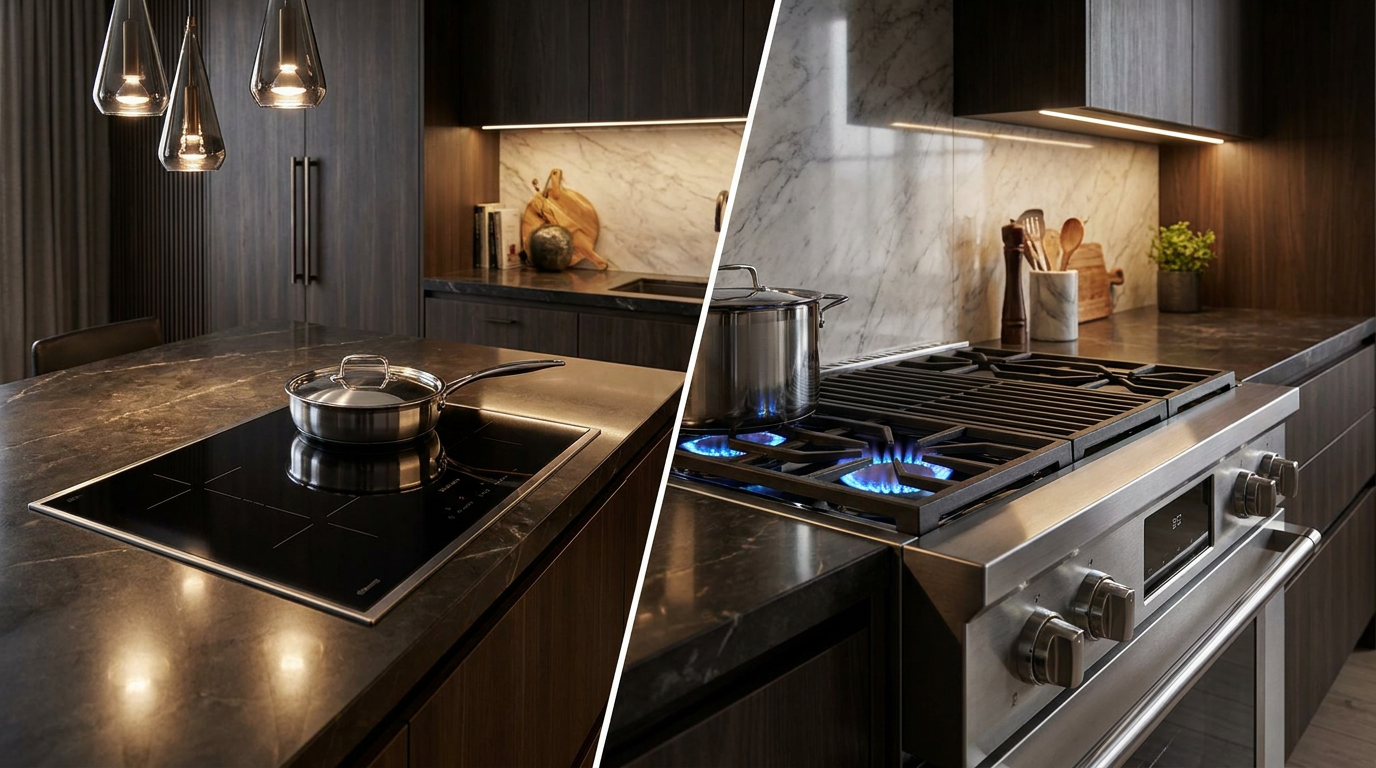
To understand the trade-offs, one must first look at the underlying physics of how each technology generates heat. Gas cooktops rely on the combustion of natural gas or propane, producing an open flame that heats the bottom of a pan and, inevitably, the air around it. Induction cooktops, by contrast, operate essentially as powerful electromagnets. When a compatible pan is placed on the surface, the magnetic field induces electrical currents directly within the metal of the cookware. The pan itself becomes the heater, while the glass surface of the stove remains relatively cool to the touch.[3][5]
This difference in heat transfer dictates the massive efficiency gap between the two platforms. Gas cooking is inherently lossy; a staggering amount of the energy produced escapes around the sides of the cookware. Data from the U.S. Department of Energy indicates that gas cooktops achieve an energy efficiency of roughly 32 to 55 percent. Induction, because it generates heat directly inside the metal, boasts an efficiency rating of 85 to 90 percent. This means that nearly all the energy you pay for is actively cooking your food, rather than forcing your home's air conditioning system to work harder to cool down a sweltering kitchen.[1][5]

For the home chef, this thermodynamic advantage translates directly into speed and precision. High-output induction burners can now deliver up to 7,400 watts of power, allowing them to boil a large pot of water 20 to 40 percent faster than a premium 23,000 BTU gas burner. Furthermore, induction offers a level of temperature control that gas struggles to match at the low end. Because the magnetic field can be adjusted digitally, cooks can hold a delicate sauce at a perfect, unwavering simmer or melt chocolate directly in a pan without the need for a cumbersome double boiler.[3][5]
However, the traditional culinary experience still holds strong arguments in favor of gas. Many professional and enthusiastic home cooks prefer the instant, intuitive visual feedback of a live flame. You can see exactly how much heat is being applied just by looking under the pan. Gas also allows for specific techniques that induction simply cannot replicate, such as charring peppers directly on the grates, flambéing, or effectively using a traditional round-bottomed wok that requires heat to travel up the curved sides.[2][3]
Cookware compatibility is another major dividing line. Gas is universally accommodating; it will heat any vessel you place over the flame, from a heavy cast-iron Dutch oven to a lightweight aluminum skillet or a specialized copper saucier. Induction is strictly limited to ferromagnetic materials. If a magnet does not stick firmly to the bottom of the pan, the stove will not turn on. While cast iron and most modern stainless steel work perfectly, households switching to induction often find themselves needing to replace beloved aluminum, copper, or glass cookware, adding a hidden cost to the transition.[2][4]
Beyond the culinary mechanics, the conversation in 2026 has heavily pivoted toward health and safety. A growing body of peer-reviewed research has highlighted the impact of gas stoves on indoor air quality. Even when turned off, gas ranges can leak trace amounts of methane, and during operation, they emit nitrogen dioxide (NO2) and benzene—pollutants linked to an increased risk of childhood asthma. Because induction relies entirely on electricity and generates no combustion byproducts, it eliminates these specific indoor emissions entirely, making it a focal point for public health advocates.[1][4]
Beyond the culinary mechanics, the conversation in 2026 has heavily pivoted toward health and safety.
Induction also carries inherent physical safety advantages, particularly for households with young children or aging adults. Because there is no open flame and the glass surface only absorbs residual heat from the pan, the risk of severe burns or accidental fires is drastically reduced. Furthermore, induction burners feature automatic shut-offs; if a pan is removed, the heating process stops instantly. However, individuals with pacemakers or implantable cardioverter-defibrillators are advised to consult their doctors and maintain a distance of at least two feet from active induction zones, as the electromagnetic fields can occasionally interfere with these medical devices.[3][5]
When evaluating the financial trade-offs, the upfront purchase price heavily favors traditional gas. In 2026, an entry-level gas range can easily be secured for between $400 and $700. Induction technology, despite recent price drops, still commands a premium, with reliable entry-level models starting around $1,000 and premium units scaling much higher. For a budget-conscious consumer looking for a simple, immediate replacement for a broken appliance, gas remains the path of least financial resistance at the checkout counter.[2][4]
The true cost of adoption, however, often lies in the installation infrastructure. If a kitchen is already plumbed for gas, dropping in a new gas range is a trivial expense. Transitioning that same kitchen to induction requires a dedicated 240-volt electrical circuit. If the home's electrical panel lacks the capacity, upgrading the wiring can add anywhere from $200 to over $600 to the total installation bill. Conversely, building a new home or remodeling a kitchen from scratch without running new gas lines can make the all-electric induction route significantly cheaper from a construction standpoint.[1][2]

Operating costs over the 10-to-15-year lifespan of the appliance introduce another layer of complexity. While induction uses less than half the raw energy of gas to perform the same cooking tasks, electricity is currently more expensive per unit than natural gas in many regions. Depending on local utility rates, the day-to-day cost to run either stove is often a wash, differing by only a few dollars a month. However, federal incentives like the 2022 Inflation Reduction Act, which offers up to $840 in rebates for qualifying households to switch to electric or induction cooking, have fundamentally altered the long-term math in favor of electrification.[2][4]
Maintenance and daily upkeep present a stark contrast in the user experience. Gas cooktops, with their heavy cast-iron grates, burner caps, and crevices, require significant elbow grease to clean, especially when food boils over and bakes onto the hot surfaces. Induction cooktops feature a completely flat, smooth glass surface that rarely gets hot enough to bake on spills. A simple wipe with a damp microfiber cloth is usually sufficient to restore the stove to a pristine condition, saving cooks hours of scrubbing over the appliance's lifetime.[3][6]

Reliability and repairability, however, tell a slightly different story. Gas ranges are fundamentally mechanical devices with relatively simple valves and igniters; when they break, they are often cheap and straightforward to fix. Induction cooktops are highly complex electronic arrays. While industry data shows they have exceptionally low first-year service rates—often under 5 percent—an out-of-warranty failure of an induction motherboard or inverter can be prohibitively expensive to repair, sometimes rivaling the cost of a new unit.[3][6]
Finally, regional infrastructure and edge cases play a crucial role in the decision. In areas prone to frequent winter power outages or rolling blackouts, a gas stove offers a distinct resilience advantage. Most traditional gas burners can still be lit manually with a match when the electricity fails, ensuring a household can boil water and cook warm meals during an emergency. An induction cooktop, entirely dependent on the grid, becomes an inert piece of glass the moment the power goes out.[6]
Ultimately, there is no single universal winner in the 2026 cooktop landscape; the right choice depends entirely on a household's specific conditions. Induction fits perfectly when a homeowner prioritizes maximum energy efficiency, indoor air quality, rapid heating, and effortless cleanup, provided they have the electrical infrastructure and budget to support the initial transition.[1][5][6]
Conversely, gas remains the superior choice when a kitchen is already equipped with a gas line but lacks 240-volt electrical capacity, when the household relies heavily on traditional cookware like copper or woks, or when the tactile, visual feedback of an open flame is deemed essential to the cooking experience. By weighing these concrete trade-offs, consumers can invest in the technology that best aligns with their daily lives and long-term goals.[2][3][6]
How we got here
1970s
Early induction cooktops are introduced to the consumer market but fail to gain traction due to high costs and low reliability.
2010s
Induction technology matures in Europe and Asia, becoming the standard for energy-efficient modern kitchens.
2022
The US passes the Inflation Reduction Act, offering up to $840 in rebates for low-to-moderate-income households switching to electric or induction stoves.
2024-2026
Mounting health studies linking gas stove emissions to indoor air quality issues accelerate the consumer shift toward induction.
Viewpoints in depth
Efficiency & Health Advocates
Focuses on the thermodynamic superiority and indoor air quality benefits of induction.
This camp, heavily backed by environmental groups and public health researchers, argues that the transition away from gas is a moral and ecological imperative. They point to the staggering 85-90% thermal efficiency of induction as a critical tool for reducing household energy waste. Furthermore, they emphasize recent studies linking the nitrogen dioxide and benzene emitted by gas stoves to childhood asthma, arguing that eliminating indoor combustion is essential for a healthy home environment.
Traditional Culinary Enthusiasts
Values the tactile control, visual feedback, and versatility of cooking with an open flame.
For many professional chefs and dedicated home cooks, cooking is a sensory experience that induction struggles to replicate. This perspective argues that the instant visual feedback of a live flame allows for intuitive temperature adjustments that digital buttons cannot match. They also highlight the limitations of induction when it comes to specific culinary techniques—such as charring vegetables directly on the grates, flambéing, or using traditional round-bottomed woks—and lament the inability to use specialized copper or aluminum cookware.
Budget & Practicality Focus
Emphasizes the immediate financial hurdles and infrastructure challenges of switching to induction.
While acknowledging the long-term benefits of induction, this camp focuses on the immediate friction of adoption. They point out that entry-level induction ranges still cost significantly more than their gas counterparts, and the requirement for a 240-volt electrical circuit can add hundreds of dollars in hidden installation fees. Additionally, they argue that in regions with unreliable power grids, the ability to manually light a gas stove during a blackout provides a crucial layer of household resilience that fully electric homes lack.
What we don't know
- How quickly the upfront purchase price of induction ranges will reach true parity with entry-level gas models.
- Whether local electrical grids in older neighborhoods can support a mass simultaneous transition to high-draw electric appliances.
- The long-term availability and funding levels of state-administered IRA appliance rebates.
Key terms
- Electromagnetic heating
- A process where a magnetic field induces an electric current inside a magnetic pot, generating heat directly within the metal.
- Thermal efficiency
- The percentage of energy consumed by the appliance that is actually transferred into the food being cooked.
- BTU (British Thermal Unit)
- A traditional measure of heat output used to rate the power and speed of gas burners.
- Ferromagnetic cookware
- Pots and pans containing iron, such as cast iron or magnetic stainless steel, which are required for induction cooking.
Frequently asked
Do I need to buy all new pots and pans for induction?
Only if your current cookware isn't magnetic. Cast iron and most stainless steel work perfectly; aluminum, copper, and glass will not.
Can I use an induction stove if I have a pacemaker?
Manufacturers generally recommend keeping a distance of at least two feet from the cooktop and consulting your doctor, as the magnetic fields can potentially interfere with some devices.
Does induction really boil water that much faster?
Yes. Because the electromagnetic field heats the pan directly, high-output induction burners can boil water 20% to 40% faster than premium gas burners.
Will a gas stove work during a power outage?
Most traditional gas stoves can be lit manually with a match during a power outage, giving them an edge in areas with unreliable electrical grids.
Sources
Source coverage
6 outlets
3 viewpoints surfaced






[1]Energy SolutionsEfficiency & Health Advocates
Induction vs Gas Cooktops: The Definitive Health, Efficiency & Economic Analysis
Read on Energy Solutions →[2]CNETBudget & Practicality Focus
Gas vs. Electric vs. Induction: Which Stove Is Right for You?
Read on CNET →[3]Yale ApplianceBudget & Practicality Focus
Induction vs Gas 2026: Pros & Cons
Read on Yale Appliance →[4]GristEfficiency & Health Advocates
Are induction stoves really better than gas?
Read on Grist →[5]U.S. Department of EnergyEfficiency & Health Advocates
Better for You, Better for the Environment: Induction Cooking
Read on U.S. Department of Energy →[6]Factlen Editorial TeamTraditional Culinary Enthusiasts
Synthesis by Factlen editorial team
Read on Factlen Editorial Team →
More in shopping
See all 8 stories →Sleep Tech
How Accurate Are Sleep Trackers? The 2026 Evidence Review
0 sources

Display Tech
OLED vs. Mini-LED: The Definitive 2026 Display Trade-Off Analysis
0 sources
Sleep Tech
Evidence Pack: How Accurate Are Smart Rings and Watches at Tracking Sleep?
0 sources

AI Laptops
The 2026 Guide to AI PCs: Why the NPU is the New Standard for Laptops
0 sources

Every angle. Every day.
Get shopping stories with full source coverage and perspective breakdowns delivered to your inbox.