
How Mycelium Leather is Reshaping Luxury Fashion
High-end fashion houses are turning to lab-grown mushroom roots to create sustainable, biodegradable leather alternatives that rival traditional calfskin.
By Factlen Editorial Team
- Bio-Material Innovators
- Startups focused on scaling biotechnology to replace animal and petroleum products.
- Heritage Luxury Houses
- Traditional fashion brands balancing sustainability with uncompromising quality.
- Sustainable Fashion Advocates
- Environmentalists pushing for the total elimination of animal agriculture and plastics in fashion.
- Market Analysts
- Industry observers tracking the economic viability and growth of alternative textiles.
What's not represented
- · Traditional Leather Tanneries
- · Cattle Farmers
- · Mass-Market Apparel Brands
Why this matters
The fashion industry is one of the world's largest polluters. The successful scaling of bio-fabricated materials in the luxury sector paves the way for a broader, industry-wide shift away from both animal agriculture and petroleum-based plastics.
Key points
- Luxury fashion houses like Hermès and Stella McCartney are adopting mycelium (mushroom root) leather as a sustainable alternative to animal hides.
- Unlike synthetic "vegan" leathers made from petroleum-based plastics, mycelium is fully organic, biodegradable, and compostable.
- The bio-fabrication process uses agricultural waste and requires up to 99% less water and 95% fewer carbon emissions than traditional cattle farming.
- The global market for mycelium leather is projected to grow from $12 million in 2024 to over $336 million by 2033.
- Upcoming EU regulations on supply chain transparency are accelerating luxury brand investments in traceable bio-materials.
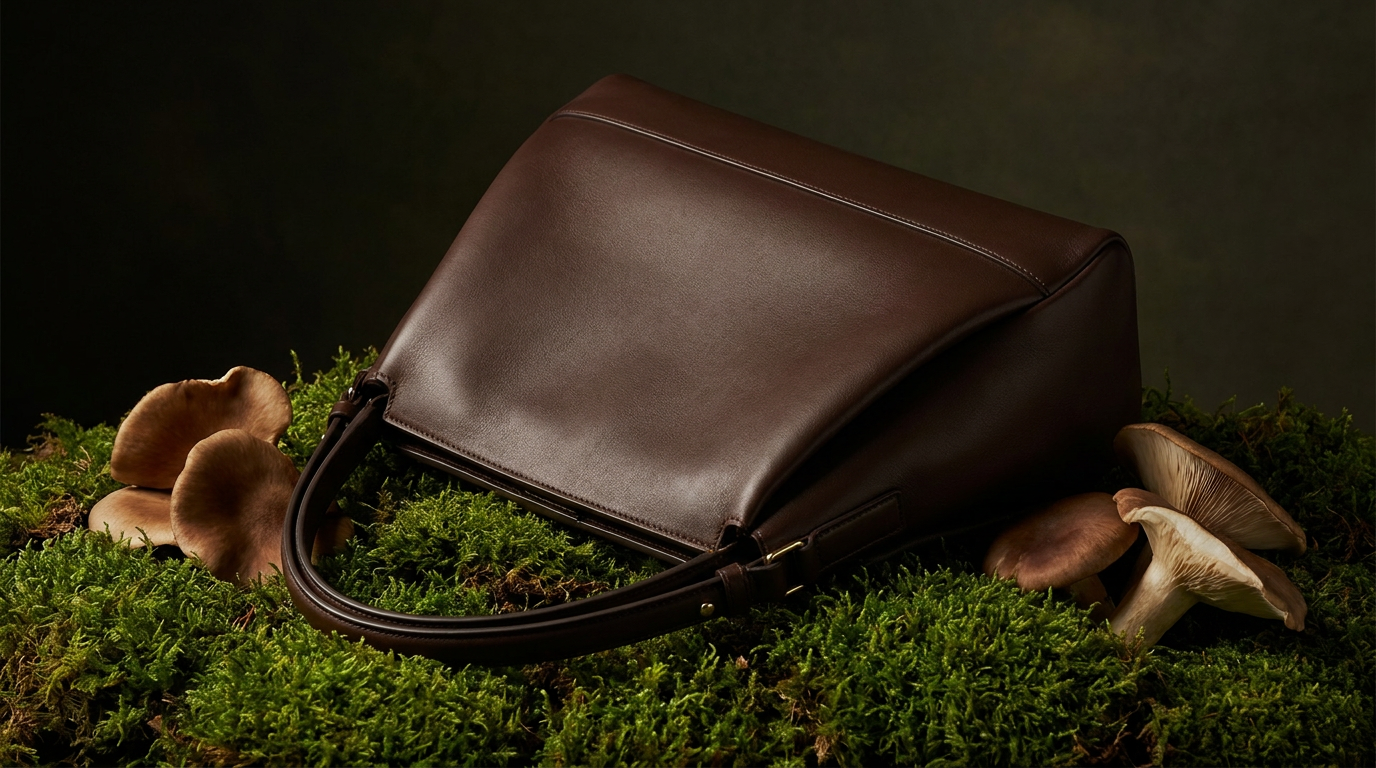
For centuries, the definition of luxury in fashion was inextricably linked to animal hides. From supple calfskin handbags to exotic leather footwear, heritage brands built their empires on the craftsmanship of natural skins. But as global awareness of environmental degradation and ethical consumption mounts, the luxury sector faces a profound crisis of materials. The traditional leather industry is increasingly scrutinized for its massive water consumption, greenhouse gas emissions, and reliance on toxic tanning chemicals like chromium. In response, high-end fashion houses are urgently seeking alternatives that can deliver uncompromising quality without the heavy ecological toll. This search has sparked a quiet revolution in materials science, moving the industry away from the pasture and into the laboratory.[1][4]
Historically, the primary alternative to animal hide has been synthetic "vegan" leather, a solution that has proven equally problematic for the environment. These materials, commonly known as "pleather," are predominantly manufactured from polyurethane (PU) or polyvinyl chloride (PVC). Because they are derived from petroleum, they carry a significant carbon footprint and contribute directly to the global plastic pollution crisis. When a synthetic leather jacket or handbag reaches the end of its life, it does not biodegrade; instead, it fractures into microplastics that contaminate waterways and soil for centuries. As sustainability advocates have pointed out, replacing an animal product with a fossil fuel derivative is merely trading one environmental disaster for another.[3][4]
Enter mycelium, a biological breakthrough that is rapidly emerging as the ultimate sustainable textile. Mycelium is the sprawling, thread-like underground root network of fungi, serving as nature's recycling system by breaking down organic matter in the forest floor. In recent years, biotechnology startups have discovered how to harness this natural growth process to bio-fabricate materials that mimic the exact cellular structure of animal skin. The resulting material offers the tactile luxury, warmth, and durability of traditional leather, but with a fraction of the environmental impact. It represents a paradigm shift from extractive manufacturing to regenerative agriculture.[2][7]
The process of creating mycelium leather begins not in a field, but in a highly controlled laboratory environment. Scientists replicate the damp, nutrient-rich conditions of the forest floor using agricultural waste products as a base substrate. Materials like sawdust, hemp hurds, or sugarcane husks—which would otherwise be burned or discarded—are repurposed as food for the fungal spores. This circular approach ensures that the raw inputs for the leather are entirely renewable and do not require dedicated farmland or excessive water resources to cultivate.[2][6]

Once the spores are introduced to the substrate, the growth phase is remarkably rapid. Using advanced techniques such as liquid air fermentation or submerged fermentation—a process visually similar to brewing beer—the mycelium multiplies exponentially. Within a span of just seven to fourteen days, the microscopic threads knit themselves together into a dense, intertwined mat. This rapid cultivation cycle stands in stark contrast to the years required to raise cattle, offering a highly efficient and scalable model for textile production.[2][3]
After the mycelium mat reaches the desired thickness and density, it is harvested and processed. The raw biological sheet is carefully dried to halt the fungal growth, resulting in a blank canvas that is ready for finishing. Crucially, bio-material startups have recognized that to win over luxury consumers, the final product must feel indistinguishable from premium calfskin. To achieve this, companies are partnering with heritage European tanneries, combining cutting-edge biotechnology with centuries-old craftsmanship.[4][5]
During the finishing stage, the mycelium is treated using proprietary, chrome-free tanning methods and plant-based dyes. This avoids the toxic chemical runoff associated with conventional leather tanning, which has historically devastated waterways in manufacturing hubs. The resulting bio-leather meets or exceeds the furniture and fashion industries' rigorous benchmarks for flexibility, abrasion resistance, colorfastness, and aging. It is a material engineered for longevity, designed to develop a rich patina over time just like its animal-derived counterpart.[2][6]
The environmental mathematics of mycelium leather are staggering and have made it a focal point for sustainability targets. Producing a square meter of bio-leather requires up to 99 percent less water than raising a cow for its hide. Furthermore, the process generates up to 95 percent fewer carbon dioxide emissions. Because the material is grown vertically in indoor trays, it requires a fraction of the land mass, freeing up acreage that would otherwise be devoted to cattle grazing or feed production.[6]

The environmental mathematics of mycelium leather are staggering and have made it a focal point for sustainability targets.
Perhaps most importantly, mycelium leather solves the end-of-life problem that plagues synthetic alternatives. Because it is a 100 percent organic material, it is fully biodegradable and compostable. When a mycelium handbag or jacket is eventually discarded, it can return to the earth, breaking down naturally without leaving behind a legacy of microplastics or toxic residue. This closed-loop lifecycle is the holy grail of circular fashion, offering a blueprint for how the industry can operate in harmony with the planet.[7][8]
The fashion industry's most exclusive and traditional names are taking serious notice of this biological revolution. Hermès, a French luxury house synonymous with peerless leather craftsmanship and the iconic Birkin bag, made international headlines by embracing the technology. In a landmark collaboration, Hermès partnered with California-based startup MycoWorks to develop "Sylvania," a patented Fine Mycelium material. This partnership signaled to the broader market that bio-fabricated textiles could meet the uncompromising standards of haute couture.[1][4]
The culmination of this three-year collaboration was the reimagining of the classic Hermès Victoria travel bag. By integrating Sylvania alongside traditional canvas and calfskin elements, Hermès demonstrated that mycelium could sit comfortably beside the world's most luxurious materials. The raw fungal sheets are grown in MycoWorks' California facility before being shipped to France, where they are tanned and finished by Hermès' own master artisans. This hybrid approach bridges the gap between Silicon Valley innovation and Parisian heritage.[4][8]
Stella McCartney, a long-time pioneer of cruelty-free and sustainable fashion, has also been a driving force behind the mycelium movement. Having never used animal leather or fur in her collections, McCartney was an early adopter of bio-materials. The brand debuted exclusive garments, including a black bustier and utilitarian trousers, made entirely from Mylo—a mycelium leather created by the biotech firm Bolt Threads. More recently, McCartney has expanded her portfolio by partnering with Hydefy to develop new luxury accessories.[1][2]

The economics of the bio-leather sector are shifting rapidly as the technology matures. Startups in the space, including MycoWorks, Ecovative, and Bolt Threads, have collectively raised hundreds of millions of dollars in venture capital to scale their operations. This influx of funding is allowing these companies to transition from small-scale pilot facilities to massive commercial factories. As production volume increases, the cost per square foot of mycelium leather is steadily dropping, bringing it closer to price parity with premium animal hides.[2][3]
Market analysts project explosive growth for the sector over the next decade. The global mycelium leather market, which was valued at roughly $12 million in 2024, is expected to soar past $336 million by 2033. This exponential trajectory is being driven by deepening partnerships with major fashion conglomerates, including Kering and LVMH, who are eager to secure exclusive access to high-quality bio-materials. As these materials become more widely available, they are expected to trickle down from the runway to premium consumer goods and automotive interiors.[2][5]

Regulatory pressures are also accelerating the transition toward traceable, sustainable materials. The European Union is preparing to roll out the Digital Product Passport initiative between 2026 and 2027, which will require brands to transparently disclose the exact environmental footprint and supply chain journey of their products. Under this new regulatory framework, the massive carbon and water costs of traditional leather will become a significant liability, making carbon-neutral alternatives like mycelium highly attractive to corporate compliance teams.[6]
Despite the immense momentum, the bio-fabrication industry still faces significant hurdles. Scaling biological processes is notoriously difficult; living organisms are sensitive to minute changes in temperature, humidity, and nutrients. Consistently producing flawless, millimeter-perfect sheets of mycelium that meet the exacting aesthetic demands of luxury brands requires immense precision and quality control. Furthermore, while costs are decreasing, mycelium leather remains significantly more expensive than mass-market synthetic plastics, limiting its current application to the high-end sector.[2][5]
Yet, the cultural trajectory is undeniable. Consumer preferences are shifting dramatically, with Gen-Z and millennial luxury buyers increasingly prioritizing sustainability and ethical production alongside design and exclusivity. For this new generation of consumers, true luxury is defined not just by how a product looks, but by how it was made. Bio-fabricated materials offer a compelling narrative of innovation and environmental stewardship that resonates deeply with modern values.[6]
Ultimately, the rise of mycelium leather represents a profound shift in the philosophy of manufacturing. By collaborating with nature's own processes rather than extracting resources from the earth, the fashion industry is proving that luxury and sustainability are not mutually exclusive. As these fungal fabrics move from science-fair curiosities to runway staples, they offer a hopeful glimpse into a future where the clothes we wear nourish the planet rather than destroy it.[7][8]
How we got here
2017
Stella McCartney begins experimenting with early iterations of vegan, lab-grown mushroom leather.
March 2021
Hermès announces a partnership with MycoWorks to reimagine its Victoria travel bag using Fine Mycelium.
2022
The first Hermès travel bags featuring mycelium technology are showcased to the public.
2024
The global mycelium leather market reaches an estimated $12 million as production facilities expand.
2026
The EU prepares to implement Digital Product Passports, accelerating luxury brand investment in traceable bio-materials.
Viewpoints in depth
Bio-Material Innovators
Startups focused on scaling biotechnology to replace animal and petroleum products.
Companies like MycoWorks, Bolt Threads, and Ecovative argue that bio-fabrication is the only viable path forward for the materials economy. They emphasize that their goal is not just to mimic leather, but to engineer a superior material that can be customized for strength, thickness, and texture at the cellular level. Their primary challenge is scaling production to bring costs down while maintaining the exacting quality required by luxury partners.
Heritage Luxury Houses
Traditional fashion brands balancing sustainability with uncompromising quality.
For legacy brands like Hermès, the adoption of mycelium is a delicate balancing act. They are eager to future-proof their supply chains and appeal to eco-conscious younger demographics, but they refuse to compromise on the tactile luxury and durability that define their heritage. By treating mycelium sheets in the same historic European tanneries used for calfskin, they aim to legitimize bio-materials as true luxury goods rather than mere novelties.
Sustainable Fashion Advocates
Environmentalists pushing for the total elimination of animal agriculture and plastics in fashion.
Eco-advocates celebrate mycelium as the "holy grail" of textiles because it solves the dual crises of traditional fashion. It eliminates the animal cruelty and massive land/water footprint of cattle farming, while also bypassing the microplastic pollution caused by synthetic polyurethane leathers. They are pressuring fast-fashion and mid-tier brands to follow the luxury sector's lead and subsidize the technology until it reaches mass-market price parity.
What we don't know
- Whether bio-fabricated leather can achieve price parity with mass-market synthetic plastics in the near future.
- How quickly production facilities can scale to meet the massive volume demands of global fast-fashion brands.
- How long-term wear and tear on mycelium leather compares to decades-old heritage calfskin under real-world conditions.
Key terms
- Mycelium
- The sprawling, thread-like underground root network of fungi.
- Bio-fabrication
- The process of using living cells and microorganisms to grow materials, rather than manufacturing them synthetically.
- Submerged Fermentation
- A technique where microorganisms are grown in liquid nutrient broths to rapidly multiply, similar to brewing beer.
- Polyurethane (PU)
- A petroleum-based plastic commonly used to make traditional synthetic "vegan" leathers.
- Digital Product Passport
- An upcoming EU regulation requiring brands to digitally disclose the environmental footprint and supply chain of their products.
Frequently asked
Is mushroom leather as durable as real leather?
Yes, top-tier mycelium leathers meet or exceed luxury industry benchmarks for flexibility, abrasion resistance, and aging.
Does mycelium leather smell like mushrooms?
No. After the harvesting and tanning process, the material loses any fungal scent and can be treated to smell like traditional leather or remain odorless.
Is mushroom leather biodegradable?
Yes. Because it is made from organic matter and tanned without toxic chemicals like chromium, it is fully compostable at the end of its life.
Why is it so expensive right now?
The technology is still scaling up from pilot facilities to commercial factories, making current production runs limited and exclusive to high-end brands.
Sources
Source coverage
9 outlets
4 viewpoints surfaced









[1]Business of FashionHeritage Luxury Houses
Stella McCartney and Hermès introduce mushroom leather into collections
Read on Business of Fashion →[2]TrellisBio-Material Innovators
Hermes and Stella McCartney embrace a leather alternative: fungus
Read on Trellis →[3]Mission MagazineBio-Material Innovators
IS MUSHROOM LEATHER THE FUTURE OF FASHION?
Read on Mission Magazine →[4]LuxebookHeritage Luxury Houses
Hermès and Stella McCartney launch mushroom leather products
Read on Luxebook →[5]OMR GlobalMarket Analysts
Mycelium Leather Market Size, Industry Trends & Forecast to 2031
Read on OMR Global →[6]EcoFashion ReviewSustainable Fashion Advocates
Mushroom Leather Is Having a Moment – And It Might Just Save Fashion
Read on EcoFashion Review →[7]Bow SeatSustainable Fashion Advocates
Mycelium Leather: Fungi, Fashion, and the Future
Read on Bow Seat →[8]Latest MagazineHeritage Luxury Houses
Mushrooms become fashionable with Hermès and Stella McCartney
Read on Latest Magazine →[9]SNS InsiderMarket Analysts
Mycelium Market Size, Share, Trends & Growth Forecast 2033
Read on SNS Insider →
Every angle. Every day.
Get lifestyle stories with full source coverage and perspective breakdowns delivered to your inbox.