
OLED vs. Mini-LED: The Definitive 2026 Display Trade-Off Analysis
The premium TV market has distilled into a direct competition between OLED's infinite contrast and Mini-LED's brute-force brightness. This trade-off analysis breaks down how to match the right display technology to your specific room lighting and viewing habits.
By Factlen Editorial Team
- Cinematic Purists
- Prioritizes infinite contrast, perfect black levels, and absolute shadow detail for dark-room viewing.
- High-Ambient Viewers
- Prioritizes sheer peak brightness and glare reduction to overpower sunlit living spaces.
- Power Users & Gamers
- Balances the need for instantaneous motion clarity against the desire for immunity to permanent burn-in.
What's not represented
- · Budget-conscious buyers
- · Commercial digital signage operators
Why this matters
Choosing the wrong display technology can result in thousands of dollars spent on a premium TV that either washes out in a bright living room or suffers permanent burn-in from heavy gaming. Understanding these hardware trade-offs ensures buyers match the right panel to their specific lighting environment and daily habits.
Key points
- OLED panels deliver infinite contrast and perfect blacks by turning individual pixels completely off.
- Mini-LED displays utilize thousands of inorganic LEDs to achieve massive peak brightness exceeding 3,000 nits.
- OLED is the superior choice for dark rooms, home theaters, and fast-paced competitive gaming.
- Mini-LED excels in sunlit living rooms and productivity setups where static images risk burn-in.
- Tandem OLED architecture has narrowed the brightness gap, while Mini-LED zone counts have reduced blooming.
Buying a premium display in 2026 has largely distilled into a two-horse race, stripping away years of confusing marketing jargon to leave consumers with a clear choice between two distinct flagship architectures. The decision no longer revolves around finding an objectively superior screen, but rather matching the underlying physics of the panel to the specific lighting conditions of the room it will inhabit. Whether outfitting a dedicated home theater or a sun-drenched living room, understanding these hardware differences is the key to maximizing a high-end investment.[7]
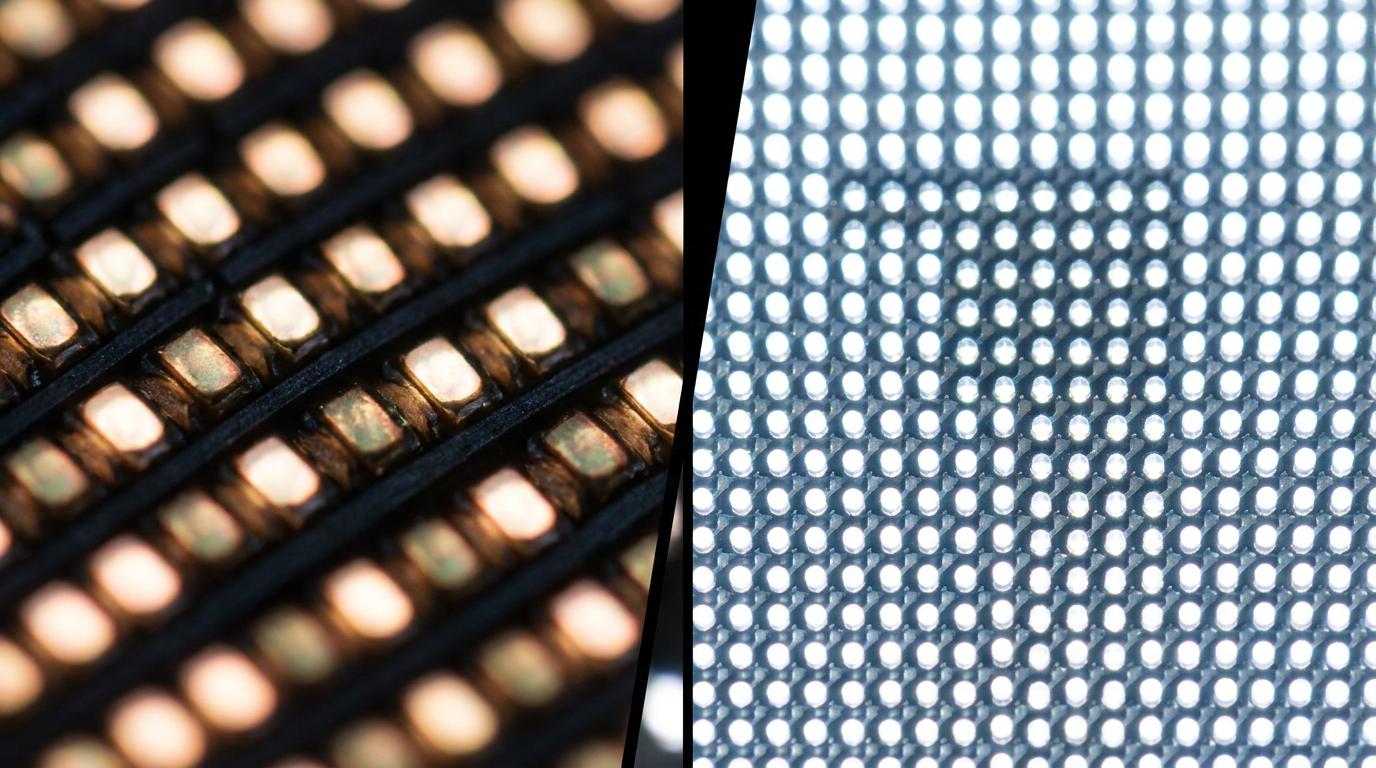
The fundamental divide between these two technologies comes down to how the screens generate light. OLED panels are entirely self-emissive, meaning every single pixel produces its own illumination and color independently without the need for a backlight. In stark contrast, Mini-LED is a highly evolved transmissive liquid crystal display (LCD) that relies on a localized backlight. This backlight is constructed from thousands of microscopic, inorganic light-emitting diodes that shine through a sophisticated color filter to produce the final image you see on the screen.[1][7]
The primary argument for OLED rests on its absolute mastery of black levels and shadow detail. Because an OLED pixel can turn itself off completely when displaying black, it emits mathematically zero nits of light, resulting in a theoretically infinite contrast ratio. This pixel-level precision ensures that a single blindingly bright pixel can sit directly next to a pitch-black one without any light bleeding between them, creating an image with unparalleled depth and a striking sense of three-dimensional realism.[4]
The evidence for OLED's superiority is most obvious in a dark, controlled viewing environment. Cinematic purists heavily favor the technology because it provides a transparent picture quality that perfectly preserves subtle shadow detail in moody, low-light movie scenes. Furthermore, OLED panels maintain perfect color accuracy, gamma consistency, and contrast even when viewed from extreme off-axis angles, ensuring that every seat in a wide home theater arrangement receives the exact same premium visual experience.[2][4]

Conversely, the primary argument for Mini-LED is its sheer, brute-force luminance and ability to overpower ambient light. While traditional OLEDs typically peak between 1,000 and 1,500 nits of brightness, flagship 2026 Mini-LED displays are equipped with high-efficiency inorganic chips capable of pushing peak brightness outputs anywhere from 3,000 to 5,000 nits. This massive surplus of light output fundamentally changes how high dynamic range (HDR) content is rendered, allowing specular highlights like explosions or direct sunlight to carry genuine physical intensity.[4][6]
The evidence supporting Mini-LED becomes undeniable in high-ambient light environments. In a sun-drenched living room or a brightly lit office space, ambient glare naturally washes out shadow detail and raises the viewer's perceived black floor. Mini-LED's massive brightness redundancy allows it to punch through afternoon sunlight effortlessly, ensuring that the image remains vivid, colorful, and highly legible even when the display is fighting against massive bay windows or overhead studio lighting.[3][5]
A critical trade-off against OLED is its reliance on an Auto Brightness Limiter (ABL) to preserve the lifespan of the panel. Because organic compounds degrade when subjected to excessive heat, the display's software automatically dims the entire screen when large areas—such as a snowy landscape, a hockey rink, or a bright commercial—become too bright for too long. This aggressive roll-off can make bright, full-screen content feel unexpectedly muted and flat compared to the piercing highlights the panel is otherwise capable of producing.[4][5]
A critical trade-off against OLED is its reliance on an Auto Brightness Limiter (ABL) to preserve the lifespan of the panel.
Mini-LED does not suffer from this thermal limitation. Built from highly durable semiconductor materials like gallium nitride, the inorganic backlight can be driven hard without the need for aggressive thermal throttling. A premium Mini-LED panel can sustain a full-screen white image at well over 1,000 nits indefinitely, making it the far more predictable and impactful choice for high-luminance sports broadcasts, brightly lit video games, and commercial color grading workflows that demand sustained full-field brightness.[3][4]

However, the strongest argument against Mini-LED is the persistent 'halo effect,' commonly referred to as blooming. Even with modern flagship panels boasting up to 20,000 independent local dimming zones, the physical backlight zones are still significantly larger than the individual pixels they illuminate. When a small, intensely bright object appears on a dark background, the zone illuminating it inevitably spills excess light into the surrounding area, creating a faint but noticeable glowing aura around the object.[1][2]
This blooming artifact is most noticeable when watching letterboxed movies with bright white subtitles sitting in the pitch-black cinematic bars at the top and bottom of the screen. While advanced local dimming algorithms and improved panel contrast have drastically reduced the severity of the halo effect in 2026, it remains a fundamental physical limitation of transmissive displays that can briefly break immersion for critical viewers who are sensitive to backlight fluctuations.[2]
When evaluating gaming performance, OLED holds a distinct and measurable advantage in motion clarity. The self-emissive pixels boast near-instantaneous response times of roughly 0.03 milliseconds, allowing them to transition between colors almost instantly. For competitive esports players and fast-paced action gamers, this translates to zero ghosting and absolute motion clarity during rapid camera pans, providing a tangible competitive edge and a buttery-smooth visual experience that LCD-based technologies simply cannot replicate.[4][5]
The counter-argument against OLED for heavy users is the lingering anxiety of permanent burn-in. While modern pixel-shifting algorithms, logo dimming software, and active cooling heatsinks have drastically mitigated the danger, the underlying physics remain unchanged. Displaying static elements like gaming health bars, desktop taskbars, or news network tickers for thousands of hours can still cause differential aging in the organic materials, eventually leaving a faint, permanent ghost image on the screen.[1][5]

Mini-LED eliminates this workflow friction entirely. Because the inorganic backlight and LCD layer are completely immune to permanent image retention, Mini-LED serves as a stress-free solution for productivity monitors, static text work, and marathon gaming sessions. Users can leave static spreadsheets, video editing timelines, or game lobbies open for 12 hours a day without a second thought, making it the undisputed champion for heavy-duty, mixed-use environments where peace of mind is paramount.[3][5]
In terms of color volume and saturation, both technologies now routinely cover over 98 percent of the DCI-P3 cinematic color gamut, delivering breathtakingly vibrant hues. However, Mini-LED panels enhanced with quantum dot layers maintain their color saturation at much higher brightness levels. This means that intensely bright highlights—like a neon sign or a sports car in direct sunlight—retain their rich color depth on a Mini-LED, whereas they might wash out into pure white on a standard OLED.[6]
The OLED camp has aggressively responded to these brightness deficits with the introduction of Tandem OLED architecture. By stacking multiple red, green, and blue light-emitting layers on top of each other, manufacturers have successfully boosted peak HDR output and overall panel longevity. This engineering breakthrough has significantly narrowed the luminance gap, allowing the newest generation of OLEDs to deliver a far more forceful and punchy HDR image without sacrificing their signature pixel-level black control.[6]

Finally, the sizing and cost realities of the current manufacturing landscape heavily influence the trade-off analysis. While 55-inch and 65-inch OLEDs have reached price parity with premium LCDs, manufacturing massive organic panels without defects remains prohibitively expensive. For buyers seeking highly immersive 75-inch, 85-inch, or even 100-inch displays to anchor a large living room, Mini-LED offers vastly superior value per square inch, making cinematic scale far more accessible.[2][6]
Ultimately, neither technology can claim a universal, unconditional victory in the living room. The optimal choice requires an honest assessment of the viewing environment and the specific content being consumed. Buyers must balance the pursuit of absolute cinematic perfection and infinite contrast against the practical, everyday demands of ambient sunlight, static usage habits, and the desire for massive screen sizes. The best display is simply the one that perfectly matches the room.[3][7]
How we got here
2013
First large-screen OLED TVs enter the consumer market, establishing a new benchmark for contrast.
2019
Mini-LED technology debuts in premium displays, offering a brighter alternative to traditional LCDs.
2024
Mini-LED zone counts cross the 10,000 mark, drastically reducing the halo effect.
2026
Tandem OLED architecture reaches consumer living rooms, significantly boosting organic panel brightness.
Viewpoints in depth
The OLED Use Case
Fits well when prioritizing cinematic perfection in controlled lighting.
OLED is the undisputed choice for dedicated home theaters, dark bedrooms, and competitive gaming. It fits perfectly when the viewer demands infinite contrast, perfect viewing angles, and zero motion blur. However, it does not fit well in sun-drenched living rooms, or for users who leave static news channels or gaming HUDs on screen for 12 hours a day, due to the lingering risk of burn-in and the aggressive dimming of its Auto Brightness Limiter.
The Mini-LED Use Case
Fits well when battling ambient light and static content.
Mini-LED thrives in open-concept, sunlit living rooms and heavy-duty productivity setups. It fits perfectly when the display needs to punch through afternoon glare with 3,000+ nits of brightness, or when a user requires absolute immunity to permanent burn-in. It does not fit well for purists watching letterboxed movies in pitch-black rooms, as the inherent blooming around bright objects and slight off-axis color shifting can break cinematic immersion.
What we don't know
- Whether Micro-LED technology will become affordable enough to replace both OLED and Mini-LED before the end of the decade.
- The exact long-term degradation curve of the new Tandem OLED panels under heavy daily use.
Key terms
- ABL (Auto Brightness Limiter)
- A software feature that automatically dims the screen during sustained bright scenes to prevent overheating and panel degradation.
- Blooming (Halo Effect)
- A visual artifact where light bleeds from a bright object into surrounding dark areas, common on backlit displays.
- Nit
- A measurement of visible light intensity, roughly equivalent to the light of one candle per square meter.
- Local Dimming Zones
- Specific areas of a backlight that can independently dim or brighten to improve contrast and black levels.
- Self-emissive
- A display technology where each individual pixel generates its own light and color, eliminating the need for a backlight.
Frequently asked
Will an OLED TV suffer from burn-in if I play video games?
While modern OLEDs have pixel-shifting technologies that significantly reduce the risk, static elements like health bars can still cause differential aging over thousands of hours.
Is Mini-LED just a marketing term for LCD?
Yes, Mini-LED is a highly evolved LCD technology that uses thousands of microscopic inorganic LEDs for its backlight, rather than organic self-emitting pixels.
Which TV is better for a bright living room with windows?
Mini-LED is the superior choice for bright rooms, as its high sustained brightness easily punches through ambient glare without washing out.
Sources
Source coverage
7 outlets
3 viewpoints surfaced







[1]RTINGSCinematic Purists
OLED vs Mini LED: Which Panel Technology Is Better?
Read on RTINGS →[2]PCWorldCinematic Purists
OLED vs. Mini-LED: Which display tech wins?
Read on PCWorld →[3]ASUSHigh-Ambient Viewers
OLED vs Mini LED: Which Display Technology is Right for You?
Read on ASUS →[4]DisplayModuleHigh-Ambient Viewers
OLED vs Mini LED | Contrast, Brightness & Use
Read on DisplayModule →[5]KTCPower Users & Gamers
Workflow Friction Comparison: OLED vs Mini-LED
Read on KTC →[6]Data Wire SolutionsHigh-Ambient Viewers
Best TVs for 2026: Tandem OLED vs QD-OLED vs Mini-LED
Read on Data Wire Solutions →[7]Factlen Editorial TeamPower Users & Gamers
Synthesis by Factlen editorial team
Read on Factlen Editorial Team →


Every angle. Every day.
Get shopping stories with full source coverage and perspective breakdowns delivered to your inbox.