
How Trackless Trams Work: The Transit Tech Promising Light Rail at a Fraction of the Cost
Autonomous Rapid Transit systems are blending the capacity of light rail with the flexibility of buses, offering cities a cheaper, faster way to upgrade public transit.
By Factlen Editorial Team
- Urban Planners & Proponents
- View trackless trams as a revolutionary, cost-effective mid-tier transit solution that avoids the disruption of light rail construction.
- Transit Skeptics
- Argue the technology is a rebranded heavy bus that still requires expensive road reinforcements and dedicated lanes to be effective.
- Early Adopter Municipalities
- Focused on pragmatic trials to test the vehicles for climate resilience, hydrogen integration, and true autonomous capabilities.
What's not represented
- · Pedestrian & Cycling Advocates
- · Traditional Bus Operators
Why this matters
As cities choke on traffic and struggle to fund billion-dollar light rail projects, trackless trams offer a rapidly deployable, climate-friendly alternative that could drastically improve daily commutes without years of disruptive construction.
Key points
- Trackless trams run on rubber tires and use optical sensors to follow painted lines on the road.
- Proponents estimate they cost roughly $10 million per kilometer, a fraction of traditional light rail.
- The vehicles use multi-axle steering and active suspension to mimic the smooth ride of a train.
- Cities in Australia, the UAE, and Malaysia are currently trialing the technology.
- Critics argue the heavy vehicles require expensive road reinforcements that erode cost savings.
Urban planners face a universal dilemma: growing cities desperately need high-capacity public transit to reduce congestion, but traditional light rail is often prohibitively expensive and highly disruptive to build.[1]
Laying steel tracks through dense urban corridors is a monumental civil engineering task. It frequently requires excavating roads to relocate underground utilities, a process that can take years, paralyze local businesses, and cost upwards of $130 million per kilometer in major metropolitan areas.[1][7]
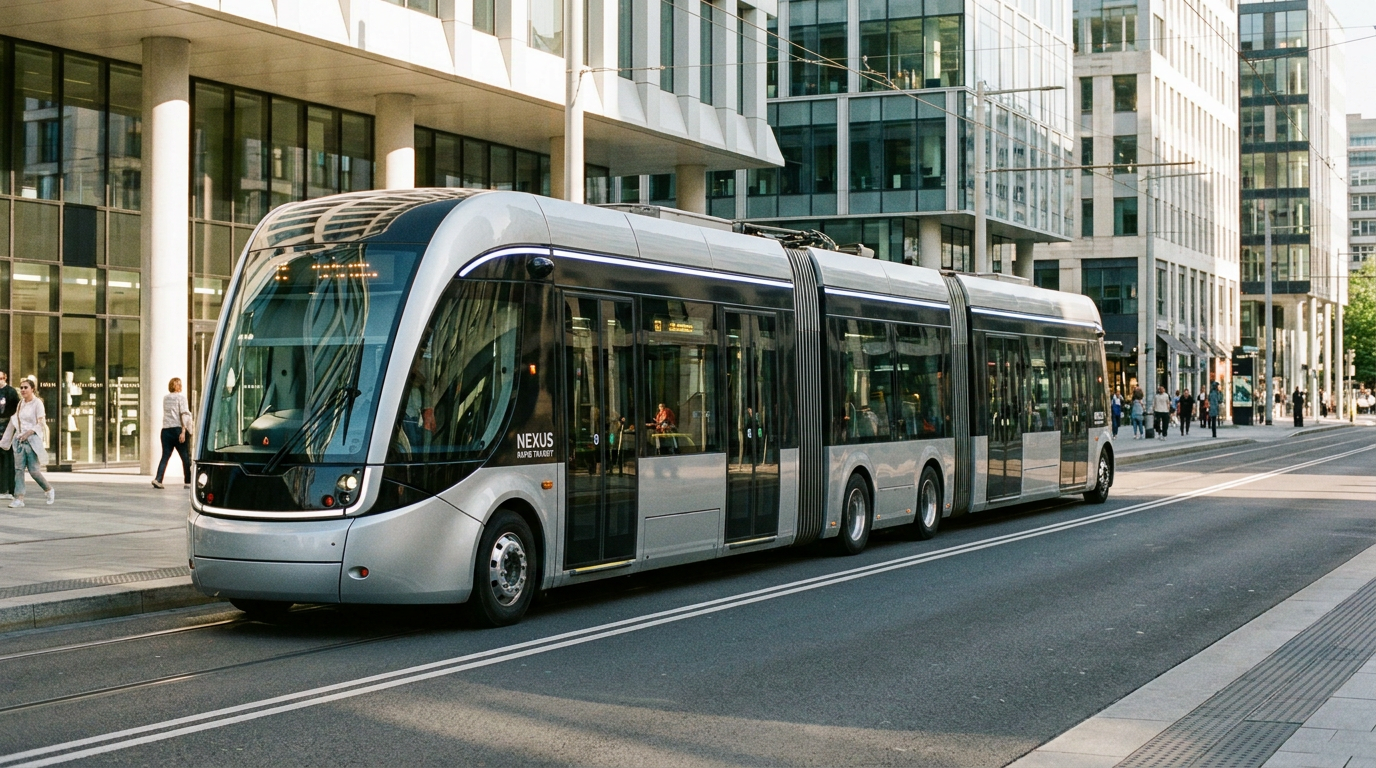
Enter the "trackless tram," officially known as Autonomous Rapid Transit (ART). Developed by the Chinese rolling stock manufacturer CRRC, this hybrid vehicle promises the smooth ride and high passenger capacity of a train, but with the flexibility and lower infrastructure costs of a bus.[1][6]
From Perth to Abu Dhabi, municipalities are increasingly trialing these sleek, bi-articulated vehicles as a "mid-tier" transit solution. They are designed to bridge the crucial gap between standard city buses and heavy rail networks, offering a premium commuter experience without the premium price tag.[2][4]

The most obvious question is how a tram operates without physical tracks. Instead of rolling on steel rails, the ART runs on specialized rubber tires and follows a "virtual track" consisting of dashed lines painted directly onto the asphalt.[6]
The vehicle utilizes a sophisticated array of LiDAR, optical sensors, radar, and GPS to read these road markings. This sensor suite allows the tram's onboard computers to autonomously steer the vehicle along the corridor with centimeter-level accuracy.[6][7]
To replicate the sway-free, gliding sensation of a train, the vehicles utilize active suspension and multi-axle hydraulic steering. As the front carriage navigates a tight urban turn, the trailing wheels automatically counter-steer to follow the exact same path, minimizing the turning radius and preventing the uncomfortable "jerkiness" associated with traditional articulated buses.[6][8]
Standard ART models are entirely electric, which eliminates the need for the unsightly overhead catenary wires that typically accompany light rail. Instead, they rely on high-capacity lithium-titanate batteries mounted on the roof of the carriages.[1][4]
Standard ART models are entirely electric, which eliminates the need for the unsightly overhead catenary wires that typically accompany light rail.
These batteries are specifically engineered for rapid top-ups rather than overnight charging. At designated passenger stations, an overhead pantograph drops down to deliver a massive flash charge in just 30 seconds while commuters board, providing enough energy to easily reach the next stop.[7]

The technology is also evolving to incorporate alternative green fuels. In Malaysia's Sarawak state, the city of Kuching is deploying a fleet of 38 hydrogen fuel cell trackless trams, which are capable of climbing steeper 10 percent gradients and traveling longer distances without the need for frequent charging infrastructure.[3]
The primary allure of the trackless tram, however, remains financial. Proponents, including transit researchers at Australia's Curtin University, estimate that ART systems can be installed for roughly $10 million per kilometer.[1][7]
This represents a fraction of the cost of traditional light rail. Because cities do not need to tear up the street to lay tracks, a new transit route can theoretically be established as fast as the local permitting and road-painting process allows.[1][7]

Driven by these economics, the technology is rapidly moving from concept to reality outside of China. In Western Australia, the City of Stirling recently took delivery of a 30-meter trackless tram to test its viability along the busy Scarborough Beach Road corridor.[2]
Similarly, Abu Dhabi has successfully conducted trial operations of the ART system. The emirate ran a 27-kilometer route connecting major malls and downtown districts to evaluate how the battery-powered vehicles perform in extreme desert heat.[4]
Despite the enthusiasm, the technology is not without its skeptics. Some transit advocates argue that the "trackless tram" is merely a clever marketing rebrand of an optically guided bus—a concept that has existed in various forms for over two decades without revolutionizing transit.[8]
Critics also point out hidden infrastructure costs that erode the promised savings. A fully loaded three-carriage ART vehicle can weigh over 50 tonnes, meaning standard asphalt roads often require significant and costly reinforcement to handle the heavy axle loads without deteriorating.[6][8]

Furthermore, the "autonomous" capabilities of the vehicles are still maturing. In late 2024, Indonesia's new capital city, Nusantara, returned its trial ART unit to the manufacturer after evaluations revealed the autonomous control system required too much manual intervention from the driver to operate safely.[5][6]
Even with these growing pains, the trackless tram represents a compelling evolution in urban mobility. By combining the aesthetic appeal and ride quality of a train with the agility of a bus, it offers a pragmatic, rapidly deployable tool for cities desperate to decarbonize and decongest their streets.[1][6]
How we got here
2017
CRRC unveils the first Autonomous Rapid Transit (ART) system in Zhuzhou, China.
2018
The first commercial ART line enters public service in China.
2023
Abu Dhabi begins trial operations of a 27-kilometer trackless tram route.
Late 2023
The City of Stirling in Perth, Australia, receives its first vehicle for local trials.
2024
Sarawak, Malaysia, begins receiving hydrogen-powered trackless trams for its new urban transit network.
Viewpoints in depth
Urban Planners & Proponents
Advocates focus on the massive cost savings and rapid deployment potential of trackless trams.
For proponents, the trackless tram solves the fundamental math problem of modern urban transit. Because laying steel rail and relocating underground utilities can cost upwards of $130 million per kilometer, many mid-sized cities simply cannot afford light rail. By utilizing optical guidance and rubber tires, ART systems offer the same passenger capacity and premium ride quality for roughly $10 million per kilometer. Advocates argue this allows municipalities to build extensive transit networks in a fraction of the time, avoiding years of disruptive construction that often bankrupts local businesses along the route.
Transit Skeptics
Critics argue the technology is an overhyped bus that hides its true infrastructure costs.
Skeptics frequently dismiss the trackless tram as a 'gadgetbahn'—a flashy technological distraction that offers little functional improvement over a standard Bus Rapid Transit (BRT) system. They point out that a fully loaded three-carriage ART vehicle weighs over 50 tonnes, which is significantly heavier than standard articulated buses. This immense axle load means that standard asphalt roads will quickly deteriorate under the weight, forcing cities to undertake expensive road reinforcement projects. Critics argue that once these hidden infrastructure costs are factored in, the financial advantage over traditional light rail largely evaporates.
Early Adopter Municipalities
Cities trialing the technology are focused on real-world viability, climate resilience, and alternative fuels.
For the cities actually deploying these vehicles, the focus is on pragmatic, real-world testing rather than theoretical debates. Municipalities are pushing the technology to adapt to local needs. In Abu Dhabi, trials are evaluating how the battery systems and optical sensors perform in extreme desert heat and dust. In Malaysia's Sarawak state, the government has bypassed battery-electric models entirely, opting instead to pioneer hydrogen fuel cell variants to align with their regional green energy strategy. Meanwhile, early setbacks—such as Indonesia's new capital returning a unit due to insufficient autonomous capabilities—highlight the iterative learning process these early adopters face.
What we don't know
- How well the optical sensors and virtual tracks will perform in cities with heavy snow or frequent ice.
- The long-term maintenance costs of the specialized multi-axle steering systems compared to standard buses.
- Whether the technology will ever achieve full Level 4 autonomy, removing the need for an onboard driver entirely.
Key terms
- Autonomous Rapid Transit (ART)
- A bi-articulated, rubber-tired transit vehicle that uses sensors to follow a virtual track, blending features of buses and trams.
- LiDAR
- Light Detection and Ranging; a remote sensing method that uses lasers to measure distances and create precise 3D maps of the environment.
- Pantograph
- An apparatus mounted on the roof of an electric transit vehicle to collect power through contact with an overhead charging station.
- Active Suspension
- A computerized system that adjusts the vehicle's suspension in real-time to counteract bumps and sway, ensuring a smooth ride.
- Gadgetbahn
- A pejorative term used by transit advocates to describe speculative or overly complex transportation technologies that offer little practical advantage over conventional buses or trains.
Frequently asked
Does a trackless tram need a driver?
While marketed as autonomous, current models operate at a semi-autonomous level. A driver remains in the cab to monitor systems, handle emergencies, and manually steer around unexpected obstacles.
How is this different from a regular articulated bus?
Trackless trams use railway-style bogies, active suspension, and multi-axle steering to eliminate the sway and jerkiness of standard buses. They also follow a precise optical path, allowing them to dock flush with station platforms.
Do trackless trams get stuck in traffic?
Like light rail, trackless trams are most effective when given a dedicated right-of-way. If forced to share lanes with regular cars, they will be subject to the same traffic congestion as standard buses.
Sources
Source coverage
8 outlets
3 viewpoints surfaced








[1]City MonitorUrban Planners & Proponents
Trackless trams may be the best alternative to light rail
Read on City Monitor →[2]PerthNowUrban Planners & Proponents
Australia's first trackless tram arrives in Perth before potential trial along Scarborough Beach Road
Read on PerthNow →[3]Paul Tan's Automotive NewsEarly Adopter Municipalities
Sarawak to receive first two autonomous rapid transit (ART) hydrogen trackless trams by end of year
Read on Paul Tan's Automotive News →[4]The Gulf TimeEarly Adopter Municipalities
The Automated Rapid Transit (ART) project trial operation successfully performed in Abu Dhabi city
Read on The Gulf Time →[5]Independent ObserverEarly Adopter Municipalities
Govt decides to return ART to China after IKN trial
Read on Independent Observer →[6]WSPTransit Skeptics
Examining the Emerging Potential of Trackless Rapid Transit
Read on WSP →[7]Curtin UniversityUrban Planners & Proponents
Could trackless trams replace light rail?
Read on Curtin University →[8]Public Transport Association of CanberraTransit Skeptics
Are trackless trams really ready to replace light rail?
Read on Public Transport Association of Canberra →
Every angle. Every day.
Get automotive stories with full source coverage and perspective breakdowns delivered to your inbox.