
How to Run AI Locally: The 2026 Guide to Private, Offline Large Language Models
Running powerful AI models entirely on your own hardware has shifted from a complex engineering challenge to a two-click process. Here is how local large language models work, why they matter for privacy, and how to get started.
By Factlen Editorial Team
- Privacy & Security Advocates
- Focuses on data sovereignty, confidentiality, and the elimination of third-party data harvesting.
- Open-Source Developers
- Values the freedom to tinker, customize, and build automated systems without API restrictions.
- Hardware & Infrastructure Analysts
- Focuses on the physical constraints, VRAM bottlenecks, and the economics of enterprise deployment.
What's not represented
- · Cloud AI Providers
- · AI Safety Regulators
Why this matters
Relying entirely on cloud-based AI means paying monthly subscriptions and sending your private data to third-party servers. Running AI locally gives you complete digital autonomy, offline access, and zero ongoing costs, fundamentally changing who controls the technology.
Key points
- Local AI allows users to run large language models entirely on their own hardware, without an internet connection.
- Tools like Ollama and LM Studio have simplified the setup process from complex coding to a simple download.
- Quantization compresses massive AI models so they can fit into the memory of standard consumer laptops and PCs.
- Running models locally ensures complete data privacy, as prompts and documents never leave the device.
- After the initial hardware investment, local AI usage is completely free, with no monthly subscriptions or API costs.
For the first few years of the generative AI boom, interacting with a large language model meant renting a sliver of a distant supercomputer. Users typed prompts into web interfaces, and their data traveled to server farms owned by tech giants, processed at a cost of roughly $20 a month. But by 2026, a quiet revolution has matured: the ability to run frontier-class AI entirely on your own hardware. Local AI has shifted from a complex, frustrating weekend project for systems engineers into a streamlined, two-click process accessible to anyone with a modern laptop.[1][2]
The mechanics of running a local large language model (LLM) rest on three pillars: the model weights, the inference engine, and the hardware. The weights are the actual "brain" of the AI—massive files containing billions of mathematical parameters learned during training. When a user downloads an open-source model like Meta's Llama 3, Microsoft's Phi, or Alibaba's Qwen, they are downloading these weights directly to their hard drive. Once downloaded, the model is cached locally, meaning it never needs to connect to the internet again.[2][8]

However, raw model weights are enormous. A standard 70-billion-parameter model in its original format requires roughly 140 gigabytes of memory just to load, far exceeding the capacity of standard consumer computers. This is where the second critical mechanism—quantization—comes into play. Quantization is a mathematical compression technique that reduces the precision of the model's numbers, shrinking a massive file down to a fraction of its original size while retaining almost all of its reasoning capability. Thanks to formats like GGUF, a highly capable 7-billion-parameter model can be compressed to just 4.7 gigabytes, allowing it to run smoothly on a standard MacBook or a mid-range gaming PC.[4][6]
The software layer has also undergone a dramatic transformation. In the past, running these quantized models required navigating complex Python environments and command-line interfaces. Today, inference engines like Ollama and LM Studio act as universal translators. Ollama operates as a lightweight background service; a user simply types a command like `ollama run llama3`, and the software automatically downloads the model, allocates the memory, and opens a chat interface. LM Studio offers a graphical interface akin to an app store, allowing users to search for models, click download, and start chatting immediately.[2][8]
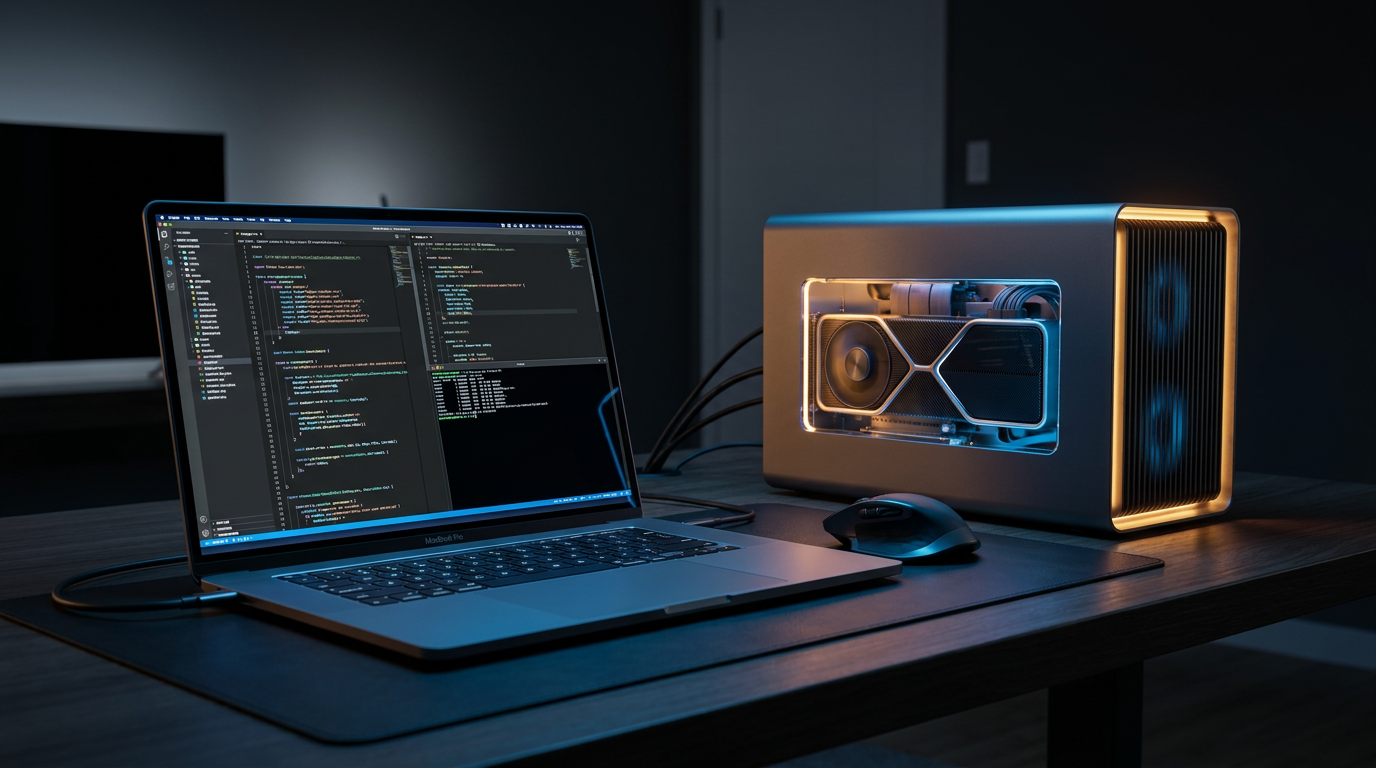
The hardware landscape has evolved to meet this software halfway. The primary bottleneck for local AI is not raw processing power, but memory bandwidth—how fast the computer can move the model's weights from storage into the processor. Apple's Silicon architecture (the M-series chips) has become a favorite for local AI because of its "unified memory," which allows the CPU and GPU to share a single, massive pool of RAM. Meanwhile, PC users rely on dedicated Nvidia or AMD graphics cards, utilizing their specialized Video RAM (VRAM) to achieve generation speeds of 20 to 100 tokens per second.[4][6]

The hardware landscape has evolved to meet this software halfway.
The benefits of this local architecture compound rapidly, beginning with absolute privacy. When an LLM runs locally, the user's prompts, documents, and generated responses never leave the machine. There are no API calls, no telemetry data sent to corporate servers, and no risk of sensitive information being used to train future models. For professionals handling confidential data, healthcare workers managing patient records, or developers writing proprietary code, this "air-gapped" capability is not just a preference—it is a strict requirement.[5][7]
Beyond privacy, local AI fundamentally alters the economics of artificial intelligence. Cloud-based APIs charge per token or require monthly subscriptions, creating a financial penalty for heavy usage. Local AI flips this model: after the initial hardware investment, the marginal cost of generating a million words is exactly zero. This zero-cost environment allows developers to build automated "agent swarms"—programs that continuously read, summarize, and generate text in the background—without worrying about racking up astronomical cloud bills.[5][6]
Offline functionality provides another layer of resilience. Because the entire pipeline runs on local silicon, the AI remains fully functional during internet outages, on airplanes, or in remote locations. Digital nomads, researchers in the field, and enterprise IT teams operating in secure, disconnected environments can rely on their AI assistants without needing a constant tether to a data center. The latency is also virtually non-existent, as there is no network round-trip time to wait for.[5][7]

Finally, local deployment offers complete control and censorship resistance. Cloud providers frequently update their models, sometimes degrading performance or altering safety guardrails in ways that break existing workflows. A local model is immutable; it will behave exactly the same way on day one thousand as it did on day one. Users have the freedom to customize the system prompt, adjust the "temperature" (creativity) of the responses, and fine-tune the model on their own specific data without asking for permission.[3][5]
As 2026 progresses, the ecosystem continues to mature. The open-source community is producing smaller, denser models that punch far above their weight class, while hardware manufacturers are explicitly designing consumer chips with local AI inference in mind. By democratizing access to the underlying weights and the tools to run them, the local LLM movement ensures that the most powerful technology of the decade is not exclusively controlled by a handful of centralized cloud providers, but distributed across millions of personal devices.[1][3][6]
How we got here
Early 2023
Meta's original LLaMA model weights are leaked, sparking the grassroots open-source AI movement.
Mid 2023
The llama.cpp project is launched, allowing large models to run efficiently on standard computer processors (CPUs).
Late 2023
Quantization formats like GGUF become standard, drastically reducing the memory required to run AI models.
2024
User-friendly inference engines like Ollama and LM Studio launch, making local AI accessible to non-developers.
2025–2026
Highly capable, smaller models (like Llama 3 and Phi) are released, allowing frontier-level reasoning on standard laptops.
Viewpoints in depth
Privacy & Security Advocates
Focuses on data sovereignty, confidentiality, and the elimination of third-party data harvesting.
For privacy advocates and enterprise security teams, local AI is the only viable path forward for integrating large language models into sensitive workflows. They argue that sending proprietary code, patient health records, or confidential legal documents to a cloud provider is an unacceptable risk, regardless of the provider's privacy policy. By air-gapping the AI on local hardware, organizations achieve absolute data sovereignty. This camp views local LLMs not just as a technical alternative, but as a necessary defense against corporate surveillance and data breaches.
Open-Source Developers
Values the freedom to tinker, customize, and build automated systems without API restrictions.
The developer community champions local AI for its flexibility and zero marginal cost. Without rate limits or per-token billing, developers can build complex 'agentic' workflows—where multiple AI models talk to each other to solve problems—that would be prohibitively expensive on the cloud. This camp is actively driving the ecosystem forward, creating the quantization formats, inference engines, and fine-tuned models that make local deployment possible. For them, local AI is about democratizing the technology and preventing vendor lock-in.
Hardware & Infrastructure Analysts
Focuses on the physical constraints, VRAM bottlenecks, and the economics of enterprise deployment.
Hardware analysts view the local AI movement through the lens of silicon economics. They point out that while the software is free, the hardware required to run large, frontier-class models (like a 70-billion parameter LLM) still requires significant upfront investment in GPUs or high-end Apple Silicon. This camp tracks the ongoing race between model compression techniques and hardware memory bandwidth. They emphasize that while local AI is cheaper at scale, organizations must carefully calculate the break-even point between buying on-premise servers versus renting cloud APIs.
What we don't know
- How quickly hardware manufacturers will increase base RAM in consumer laptops to accommodate larger local models.
- Whether future open-source models will be able to match the reasoning capabilities of the absolute largest, trillion-parameter closed cloud models.
- How regulatory frameworks might attempt to govern the distribution of highly capable, uncensored open-weight models.
Key terms
- Inference
- The process of an AI model generating a response or prediction based on a user's prompt.
- Quantization
- A compression technique that reduces the precision of an AI model's internal numbers, shrinking its file size so it can run on consumer hardware.
- VRAM (Video RAM)
- The specialized memory on a graphics card used to quickly load and process the massive amounts of data required by AI models.
- Open-Weight Model
- An AI model where the underlying mathematical parameters (weights) are made publicly available for anyone to download and run.
- GGUF
- A popular file format designed specifically for storing and running quantized language models efficiently on local hardware.
Frequently asked
Do I need an internet connection to use local AI?
No. Once you have downloaded the model weights and the inference software, the AI runs completely offline.
Is running local AI completely free?
The software and open-source models are free. Your only cost is the physical hardware (your computer or GPU) and the electricity to run it.
Can my laptop run a local LLM?
Most modern laptops with at least 8GB to 16GB of RAM can run smaller, quantized models. Apple Silicon Macs (M1/M2/M3) are particularly efficient at this.
Is local AI as smart as ChatGPT?
The largest open-source models are highly competitive with commercial cloud models. Smaller models designed for laptops are slightly less capable but excel at specific tasks like coding or summarization.
Sources
Source coverage
8 outlets
3 viewpoints surfaced








[1]Factlen Editorial Team
Synthesis by Factlen editorial team
Read on Factlen Editorial Team →[2]FreeCodeCampOpen-Source Developers
How to Run Open-Source LLMs Locally
Read on FreeCodeCamp →[3]IBMHardware & Infrastructure Analysts
Local LLMs and the future of enterprise AI
Read on IBM →[4]WillItRunAIHardware & Infrastructure Analysts
Step-by-step guide to running AI models locally
Read on WillItRunAI →[5]Local-LLM.netPrivacy & Security Advocates
Why Run AI Locally? The Compound Effect
Read on Local-LLM.net →[6]AgentNativeHardware & Infrastructure Analysts
The state of local LLMs in 2026
Read on AgentNative →[7]Enclave AIPrivacy & Security Advocates
Cloud AI vs Local LLMs: Understanding the Privacy Gap
Read on Enclave AI →[8]MindStudioOpen-Source Developers
How to Use Ollama to Run AI Models Locally: A Beginner's Setup Guide
Read on MindStudio →



Every angle. Every day.
Get ai stories with full source coverage and perspective breakdowns delivered to your inbox.