
How the Photography Industry is Securing the Truth with Content Credentials
As AI-generated deepfakes flood the internet, a coalition of camera makers and tech giants is deploying cryptographic 'nutrition labels' to mathematically prove when a photograph is real.
By Factlen Editorial Team
- Authenticity Advocates
- Photographers and technologists who view cryptographic provenance as the only viable solution to the deepfake crisis.
- Hardware & Software Ecosystem
- Camera manufacturers and software developers focused on the practical implementation of the standard.
- Security Analysts
- Cryptographers and security researchers who caution against over-relying on the standard to determine objective truth.
What's not represented
- · Social Media Platforms (who currently strip metadata)
- · Independent creators using older, unsupported hardware
Why this matters
With synthetic media projected to dominate the internet, the ability to distinguish a real photograph from an AI generation is becoming critical for democracy, journalism, and historical record. Content Credentials provide the first standardized, mathematical proof of a digital file's origin.
Key points
- Deepfake incidents increased by 900% between 2023 and 2025, prompting a shift from AI detection to cryptographic provenance.
- The C2PA standard embeds a tamper-evident 'manifest' into media files, acting as a digital nutrition label.
- Cameras from Leica, Sony, and Nikon can now sign photos with a cryptographic hash at the exact moment of capture.
- Editing in supported software adds transparent layers to the manifest, preserving the file's complete history.
- The standard proves the origin and edit history of a file, but cannot guarantee the objective truth of the scene depicted.
Deepfakes rose 900% between 2023 and 2025, fundamentally fracturing the public's relationship with visual media. The era of trusting a photograph by default is over. Generative AI models can now conjure photorealistic scenes in seconds, leaving audiences, editors, and algorithms questioning every pixel. Because detection software is perpetually losing the arms race against increasingly sophisticated generation models, the tech and media industries realized that hunting for fakes was a losing battle. Instead, they needed a way to mathematically prove what is real.[4]
This shift in strategy birthed the Coalition for Content Provenance and Authenticity (C2PA). Rather than scanning images for synthetic artifacts, C2PA flips the paradigm: it attaches a cryptographically signed record of origin directly to a media file at the exact moment of creation. Backed by a massive consortium that includes Adobe, Microsoft, Google, Sony, Nikon, Canon, and Leica, the open standard has moved from a theoretical whitepaper into shipping hardware, establishing a unified framework for digital trust.[1][5]
The consumer-facing implementation of this standard is known as Content Credentials, frequently described as a "digital nutrition label" for media. Just as a food label lists ingredients and sourcing, a Content Credential provides a tamper-evident history of a photograph. Viewers can click a small "CR" icon on a supported image to reveal who captured it, what specific camera and lens were used, what software edited it, and crucially, whether artificial intelligence was involved at any stage of its lifecycle.[2][5]

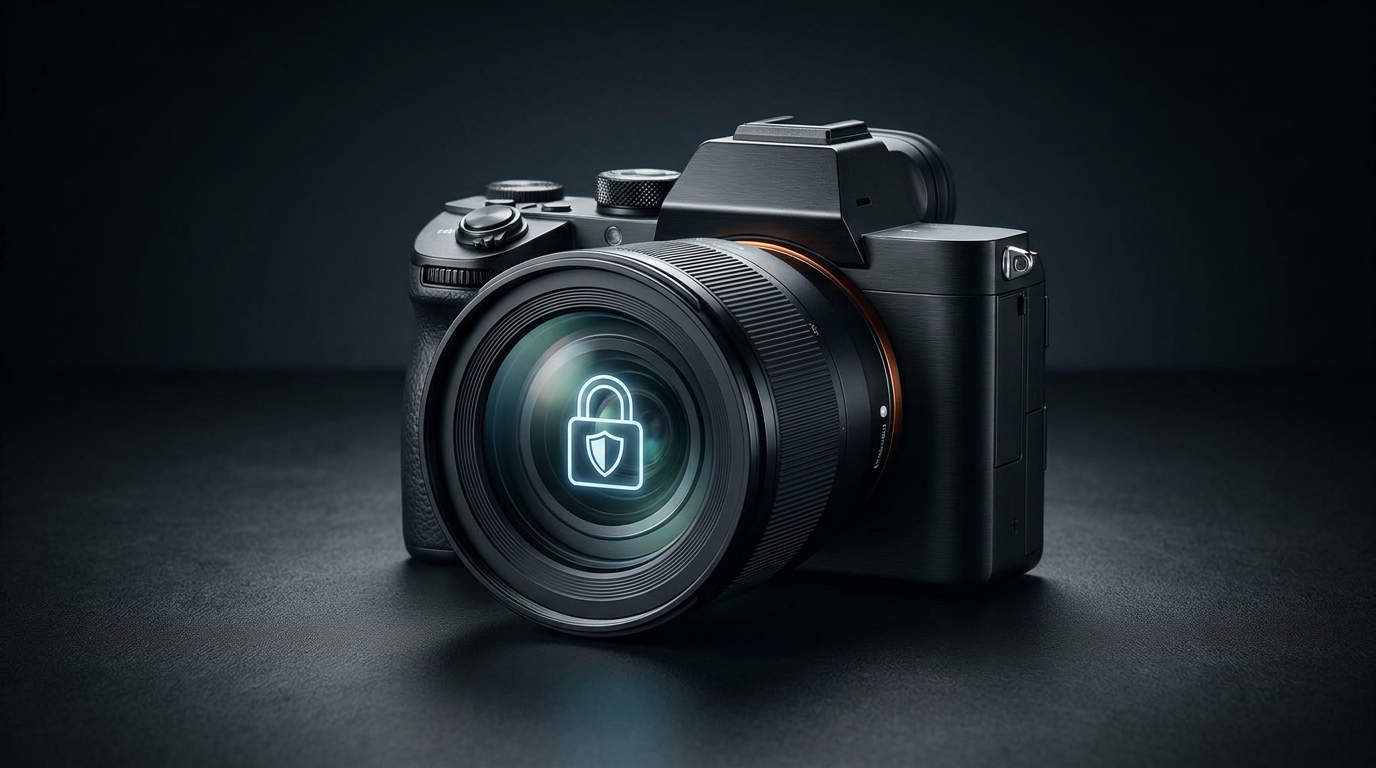
The provenance chain begins at the hardware level, right on the camera sensor. When a photographer presses the shutter on a C2PA-compliant device—such as the Leica M11-P, Sony a9 III, or Nikon Z9—a dedicated hardware encryption chip immediately signs the image file. This creates a secure manifest tied to the manufacturer's certificate authority, permanently recording the camera's serial number, the capture timestamp, and the raw sensor data before the file ever leaves the device.[3][4]
Crucially, this system is designed to accommodate the reality of professional photography, where raw files are always processed and edited. When a signed photograph is opened in C2PA-enabled software like Adobe Photoshop or Capture One, the original capture signature is verified and preserved. Any subsequent edits—whether adjusting exposure, cropping the frame, or using generative AI tools to expand a background—are logged as new, transparent layers in the manifest. The credential grows, documenting the entire journey from lens to final export.[1][2]
Crucially, this system is designed to accommodate the reality of professional photography, where raw files are always processed and edited.
The architecture relies on cryptographic hard binding, utilizing the same SHA-256 hashing protocols that secure global banking infrastructure. It is important to note that Content Credentials are "tamper-evident," not "tamper-proof." If a bad actor attempts to maliciously alter the image outside of a compliant program, the pixel data will no longer match the embedded cryptographic hash. The digital seal breaks, and the credential immediately flags the file as tampered with, alerting viewers that the history is incomplete.[4][5]
Beyond authenticating traditional photography, C2PA has become the primary mechanism for AI transparency. Major synthetic image generators, including OpenAI's DALL-E and Adobe Firefly, now automatically attach Content Credentials to their outputs, explicitly labeling the media as machine-generated. This standardized labeling is no longer just an ethical best practice; it is increasingly vital for tech companies seeking to satisfy the mandatory machine-readable disclosure requirements established by the European Union's AI Act.[2][7]

For the journalism industry, the adoption of cryptographic provenance is an existential necessity. Wire services like the Associated Press and Agence France-Presse, alongside broadcasters like the BBC, are actively integrating C2PA validation into their content management systems. Recent field tests have successfully demonstrated that these credentials can survive the chaotic, high-speed journey from a photojournalist's camera in a conflict zone, through a busy editorial desk, and out to a live global broadcast without losing their cryptographic integrity.[3][7]
Despite its robust technical architecture, security analysts emphasize a critical limitation: C2PA cannot guarantee objective truth. The standard proves the history of a file, not the honesty of the scene. A photographer could easily stage a physical event, or point a cryptographically verified Leica at a high-resolution monitor displaying a deepfake. In both cases, the manifest would perfectly validate the capture, proving only that a real camera took a real photo of a lie.[2][4]
The most significant friction point facing the standard today is adoption inertia and metadata stripping. The internet was not built for persistent provenance. Many legacy web platforms, messaging apps, and social media networks still automatically strip all metadata from uploaded images to save server space. When this happens, the C2PA manifest is destroyed. Until universal browser and platform support is achieved, the chain of trust can be inadvertently severed by a simple upload.[4][7]

As we move deeper into 2026, Content Credentials are transitioning from a niche technical specification to a baseline expectation for visual media. With hardware manufacturers baking encryption directly into their flagship cameras and regulators demanding transparency for synthetic media, the photography industry is successfully building a permanent infrastructure for trust. By giving creators the tools to prove their work, C2PA ensures that human-captured moments remain verifiable and valuable in an increasingly synthetic world.[6]
To prevent this trust layer from becoming a luxury feature exclusive to high-end professionals, the C2PA coalition has prioritized open-source accessibility. The underlying specifications are royalty-free, and developers have released free, open-source libraries that allow independent software makers to integrate credential signing into their apps. This ensures that independent creators, citizen journalists, and developers building alternative camera apps can participate in the authenticated web without paying exorbitant licensing fees.[1][6]
How we got here
Late 2023
Leica releases the M11-P, the world's first camera with built-in C2PA hardware signing.
2024
Major AI generators like DALL-E and Adobe Firefly begin attaching Content Credentials to synthetic outputs.
January 2025
Leica expands hardware support to its mirrorless line with the SL3-S.
February 2025
Nikon and AFP successfully test C2PA survival through live wire-service editorial workflows.
December 2025
C2PA releases version 2.3 of the technical specification, standardizing AI disclosure.
Viewpoints in depth
Authenticity Advocates
Photographers and technologists who view cryptographic provenance as the only viable solution to the deepfake crisis.
This camp argues that the arms race between AI generation and AI detection is fundamentally unwinnable, as synthetic models will always eventually outsmart detectors. They believe the only sustainable path forward is a 'zero-trust' visual ecosystem where media is assumed synthetic unless it carries a verifiable chain of custody back to a physical camera sensor.
Hardware & Software Ecosystem
Camera manufacturers and software developers focused on the practical implementation of the standard.
For this group, the challenge is entirely logistical. They are focused on building hardware encryption chips into camera bodies, ensuring manifests survive complex newsroom workflows, and convincing social media platforms to stop stripping metadata. They view C2PA not just as a security tool, but as a necessary infrastructure upgrade for the entire internet.
Security Analysts
Cryptographers and security researchers who caution against over-relying on the standard to determine truth.
While praising the cryptographic math behind C2PA, security analysts warn of the 'analog hole.' They point out that a perfectly verified, hardware-signed photograph can still depict a staged event, a physical forgery, or a screen showing a deepfake. They worry that audiences might mistake a valid Content Credential for a guarantee of objective truth, rather than just a guarantee of file history.
What we don't know
- When major social media platforms will stop automatically stripping C2PA metadata from user uploads.
- Whether consumers will actively check Content Credentials or ignore them like traditional metadata.
- How older, non-compliant cameras will be integrated into strict zero-trust editorial workflows.
Key terms
- C2PA
- The Coalition for Content Provenance and Authenticity, the open-standards body developing the technical architecture for media provenance.
- Content Credentials
- The consumer-facing name and user interface for C2PA data, often represented by a 'CR' icon on images.
- Manifest
- The secure data structure embedded in a file that contains the cryptographic hashes, edit history, and creator information.
- Cryptographic Hard Binding
- A security method that mathematically links the provenance data to the exact pixels of the image, breaking the seal if the pixels are altered.
- Provenance
- The factual, chronological history of a digital asset, detailing its origin and any subsequent modifications.
Frequently asked
What happens if I edit a C2PA-signed photo in an older program?
If you edit the photo in software that doesn't support C2PA, the cryptographic hash will break. The image will still open and look normal, but the Content Credentials will flag that the file has been altered outside the trusted chain.
Do I need to buy a new camera to use Content Credentials?
No. While new cameras like the Leica M11-P and Nikon Z9 can sign photos at the moment of capture, you can still add Content Credentials to any photo during the editing process using supported software like Adobe Photoshop.
Can C2PA automatically detect if an image is AI-generated?
No. C2PA relies on the AI generator voluntarily attaching a credential that declares the image is synthetic. It is a system of declared provenance, not a detection algorithm.
Is C2PA the same thing as a digital watermark?
No. Watermarks alter the actual pixels of an image and can often be cropped out. C2PA is cryptographically bound metadata that travels with the file, revealing if any pixel has been tampered with.
Sources
Source coverage
7 outlets
3 viewpoints surfaced





[1]C2PA OfficialAuthenticity Advocates
C2PA Technical Specifications and Explainer
Read on C2PA Official →[2]C2PA.ai ResearchAuthenticity Advocates
The digital nutrition label for media: A comprehensive guide
Read on C2PA.ai Research →[3]LumethicHardware & Software Ecosystem
Which cameras sign photos with C2PA content credentials at capture
Read on Lumethic →[4]SoftwareSeniSecurity Analysts
C2PA Architecture: How cryptographic provenance works
Read on SoftwareSeni →[5]Glyn DewisAuthenticity Advocates
Content Credentials: The Future of Photography Authenticity
Read on Glyn Dewis →[6]Factlen Editorial Team
Synthesis by Factlen editorial team
Read on Factlen Editorial Team →[7]EnvisioningHardware & Software Ecosystem
Content provenance watermarking for multimodal media
Read on Envisioning →
Every angle. Every day.
Get culture stories with full source coverage and perspective breakdowns delivered to your inbox.