
How the Architecture of Your Home Actively Shapes Your Brain
Emerging research in neuroaesthetics reveals that interior design choices—from curved archways to natural wood—trigger measurable biological responses that can lower stress and improve cognitive function.
By Factlen Editorial Team
- Cognitive Neuroscientists
- Focus on empirical data, utilizing fMRI and EEG scans to measure exactly how spatial geometries and materials alter brain activity and biological markers.
- Biophilic Design Advocates
- Emphasize our evolutionary connection to nature, arguing that integrating organic patterns, plants, and natural light is essential for human well-being.
- Evidence-Based Planners
- Focus on translating clinical neuroaesthetic findings into practical, actionable architectural standards for homes, hospitals, and workplaces.
What's not represented
- · Cost Estimators and Affordable Housing Developers
Why this matters
Understanding how interior spaces affect the nervous system transforms home decoration from a purely aesthetic pursuit into a vital tool for preventive mental healthcare, allowing you to design environments that actively lower stress and boost focus.
Key points
- Neuroaesthetics uses brain scans to prove that interior design directly impacts biological health and stress levels.
- The brain evaluates rooms based on three psychological dimensions: coherence, fascination, and hominess.
- Curved architecture and arched doorways activate emotion-processing centers in the brain, inducing relaxation.
- Natural wood interiors significantly boost cognitive performance compared to concrete or metal environments.
- Biophilic design principles are proven to lower blood pressure, reduce cortisol, and increase serotonin.
- Hospitals and workplaces are increasingly adopting these science-backed design principles to improve recovery and productivity.
For decades, interior designers and homeowners have relied on a shared intuition: certain rooms simply feel better to be in. You cross a threshold and your shoulders drop, your breathing slows, and a sense of calm washes over you. Historically, this phenomenon was chalked up to subjective taste or a vague sense of "good energy." Today, science has a much more precise explanation, and it is reshaping how we build the spaces we inhabit.[1]
The explanation lies in neuroaesthetics, a rapidly growing scientific discipline that studies how beauty, art, and spatial design affect the human brain. By utilizing advanced scanning technology like functional magnetic resonance imaging (fMRI) and electroencephalography (EEG), researchers are no longer guessing how a room makes people feel. They are documenting the exact physiological changes—from heart rate fluctuations to hormone release—triggered by our physical surroundings.[1][2]
The stakes for understanding these mechanisms are remarkably high. The average person now spends more than 90 percent of their life indoors, constantly bombarded by sensory information. In this context, architecture is not merely a passive backdrop to our lives; it is an active interface that continuously shapes our cognitive processes, emotional resilience, and baseline stress levels.[4]
At the heart of this architectural awakening is the concept of biophilia. Popularized in the 1980s by biologist E.O. Wilson, the biophilia hypothesis posits that humans possess an innate, evolutionary urge to connect with nature and other forms of life. When our built environments mimic the patterns, materials, and geometries of the natural world, our nervous systems recognize the cues as signals of safety and abundance.[5]
To understand exactly how the brain processes a room, researchers at the Penn Center for Neuroaesthetics conducted a massive study analyzing how people evaluate architectural interiors. They discovered that our aesthetic responses reduce to three primary psychological dimensions: coherence, fascination, and hominess. Coherence measures how easily the brain can organize and comprehend a scene, while fascination tracks the environment's informational richness.[2]

The third dimension, hominess, emerged as a uniquely architectural metric. It measures the extent to which a space feels personal, safe, and reflective of human habitation. Crucially, the researchers found that these three dimensions are not just abstract concepts—they evoke specific, measurable neural signatures in the visual cortices of the brain, proving that our minds are hardwired to seek out environments that balance order with intrigue.[2]
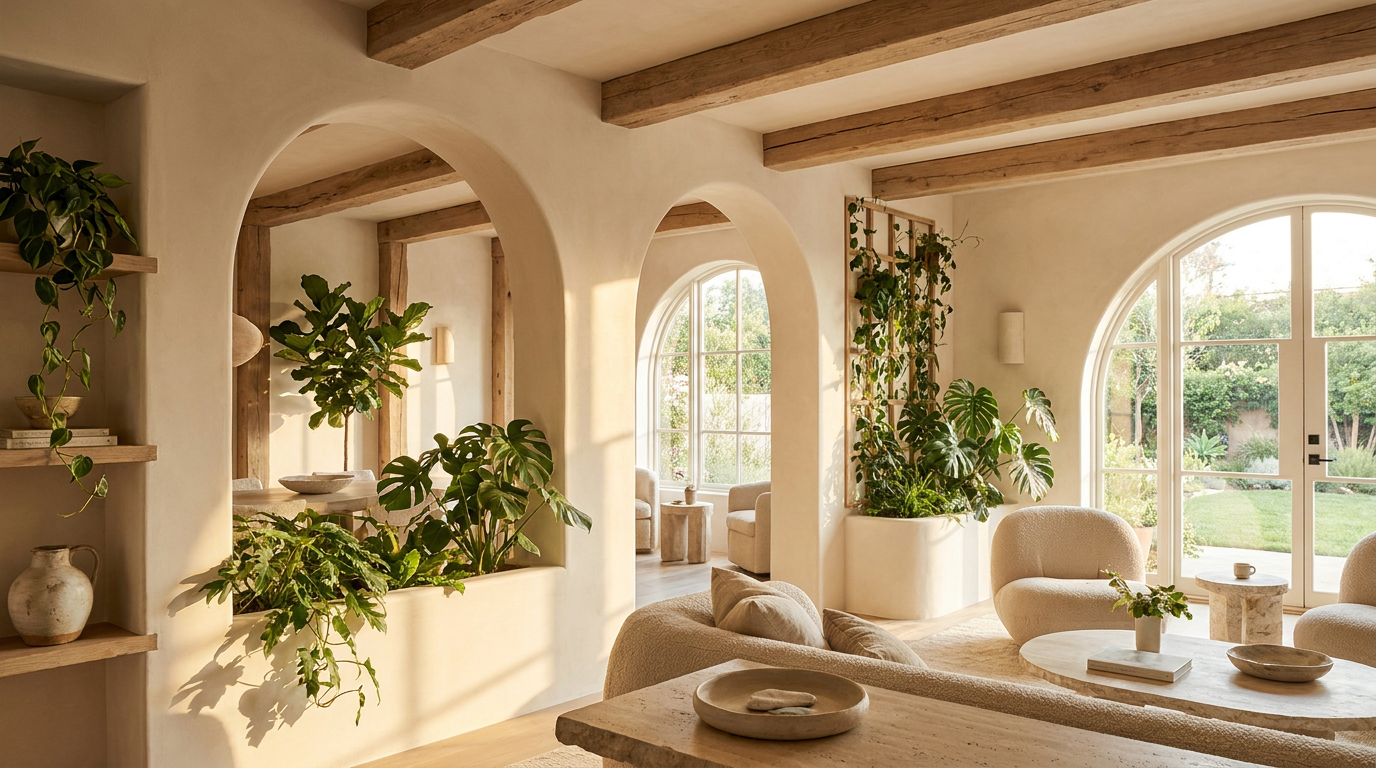
One of the most profound discoveries in neuroaesthetics revolves around geometry, specifically the brain's reaction to curves versus straight lines. Straight lines and sharp angles, which dominate modern industrial architecture, signal order and efficiency. However, when they overwhelm a space, they can subtly heighten alertness and avoidance responses, keeping the brain in a state of low-grade vigilance.[3]
One of the most profound discoveries in neuroaesthetics revolves around geometry, specifically the brain's reaction to curves versus straight lines.
Curves and arches, by contrast, are processed entirely differently. fMRI studies have shown that viewing curvilinear rooms activates the anterior cingulate cortex, a brain region deeply involved in processing emotion and reward. Because nature rarely works in perfect right angles, the human brain interprets softened openings, arched niches, and rounded furniture as inherently safer and more approachable, prompting us to relax and linger.[3][6]

Beyond geometry, the physical materials used in a space exert a massive influence on cognitive performance. A comprehensive 2025 study utilized EEG monitors to track the brain activity of participants working in rooms finished with different materials. The results were stark: environments featuring natural wood yielded the highest cognitive outcomes, with participants achieving 93 percent accuracy on complex tasks while exhibiting neural patterns associated with deep relaxation.[4]
Conversely, spaces dominated by concrete and metal correlated with reduced cognitive performance, elevated stress markers, and emotional disturbance. The data suggests that the textures and materials we surround ourselves with act as a continuous subliminal feed to the brain, either taxing our cognitive load or actively supporting our mental bandwidth.[4]

True neuroaesthetic design, however, extends far beyond what the eye can see. It requires a multisensory approach. Unpredictable acoustic noise, for example, elevates cortisol levels and maintains heightened stress states. Thoughtful spatial design incorporates sound-absorbing textiles, intentional furniture placement, and ambient natural sounds to create an acoustic environment that lowers the body's defensive barriers.[1][5]
The biological dividends of getting these details right are profound. Clinical research consistently demonstrates that thoughtfully designed, biophilic spaces can trigger a 15 to 20 percent reduction in stress hormones. Heart rates slow, blood pressure drops, and the brain increases its release of serotonin and dopamine—the exact neurochemical cocktail required for healing and deep focus.[1]

These findings are already revolutionizing commercial architecture. Healthcare facilities are investing heavily in biophilic design after studies proved that patients recover faster and require less pain medication when they have access to natural light and organic geometries. Similarly, forward-thinking workplaces are abandoning sterile, rectilinear cubicles in favor of environments that actively nurture the nervous system.[1][5]
For homeowners, the implications are equally empowering. By understanding the science of space, individuals can make intentional design choices—opting for a curved sofa, exposing natural wood grain, or prioritizing natural light—that transform their living rooms into genuine sanctuaries. It shifts the goal of interior design from impressing guests to actively supporting the mental health of the people who live there.[7]
Ultimately, the convergence of neuroscience and architecture validates what humans have instinctively known for millennia. We are not separate from our environments; we are in a constant, biological dialogue with them. By designing spaces that honor our evolutionary past, we can build homes that don't just look beautiful, but actually help us heal.[7]
Viewpoints in depth
Cognitive Neuroscientists
Researchers focused on mapping the exact biological mechanisms triggered by architectural stimuli.
For cognitive neuroscientists, the subjective feeling of a 'good room' is a measurable data problem. By utilizing fMRI and EEG technology, this camp has moved interior design out of the realm of intuition and into empirical science. They focus on identifying which specific neural pathways—such as the anterior cingulate cortex—are activated by different geometries, and how environmental variables like acoustic noise and material textures translate into quantifiable changes in cortisol, serotonin, and cognitive bandwidth.
Biophilic Design Advocates
Architects and designers who prioritize the integration of natural elements to support human well-being.
Biophilic designers operate on the evolutionary principle that humans are fundamentally outdoor animals currently trapped in indoor environments. They argue that the modern reliance on sterile, rectilinear, and highly industrial spaces is actively harming public health. Their solution is to layer sensory experiences—maximizing natural light, utilizing biomorphic shapes, and incorporating organic materials like wood and stone—to trick the nervous system into feeling the safety and restoration it naturally associates with the outdoors.
Evidence-Based Planners
Professionals focused on applying neuroaesthetic data to improve outcomes in institutional and residential settings.
Evidence-based planners bridge the gap between laboratory science and real-world construction. They look at the 15 to 20 percent reduction in stress hormones associated with biophilic design and translate that into ROI for hospitals, schools, and corporate offices. For this group, neuroaesthetics is a tool for preventive healthcare and operational efficiency, proving that investing in natural light and acoustic dampening pays dividends in faster patient recovery times and reduced employee burnout.
What we don't know
- How long the physiological benefits of a neuroaesthetic space last once a person leaves the environment.
- Whether the brain's preference for certain materials and curves is entirely universal or partially influenced by cultural upbringing.
- How to scale these high-end, science-backed design principles affordably for low-income housing developments.
Key terms
- Neuroaesthetics
- A scientific discipline that explores the neural basis for the contemplation and creation of a work of art, or the aesthetic evaluation of an environment.
- Biophilia
- The hypothesis that humans possess an innate, evolutionary tendency to seek connections with nature and other forms of life.
- Anterior Cingulate Cortex
- A region of the brain involved in processing emotion, reward, and decision-making, which is highly active when viewing curvilinear architecture.
- Coherence
- In environmental psychology, the ease with which the human brain can visually organize, comprehend, and make sense of a physical space.
- Hominess
- A psychological dimension of interior space that measures how personal, safe, and reflective of human habitation a room feels.
Frequently asked
What is neuroaesthetics?
Neuroaesthetics is the scientific study of how the brain processes and responds to beauty, art, and architectural design, often using tools like fMRI and EEG scans.
Why do curved lines feel more relaxing than straight lines?
Straight lines signal order but can induce subtle alertness. Curves activate the anterior cingulate cortex—an emotion-processing center—and mimic the organic shapes found in nature, signaling safety to the brain.
Can the materials in a room really affect my focus?
Yes. Recent EEG studies show that working in environments dominated by natural wood improves cognitive task accuracy to 93%, while concrete and metal environments correlate with higher stress and lower focus.
What is biophilic design?
Biophilic design is an architectural approach that incorporates natural elements—like sunlight, plants, water features, and organic materials—to satisfy the human instinct to connect with nature.
Sources
Source coverage
7 outlets
3 viewpoints surfaced







[1]Science in DesignBiophilic Design Advocates
Neuroaesthetics: The Future of Interior Design
Read on Science in Design →[2]National Institutes of HealthCognitive Neuroscientists
Psychological dimensions of architectural interiors evoke specific neural signatures
Read on National Institutes of Health →[3]Oria InteriorsBiophilic Design Advocates
How neuroaesthetics and biophilic design shape a sense of refuge in interior spaces
Read on Oria Interiors →[4]ResearchGateCognitive Neuroscientists
How interior materials influence brain activity, cognition, and emotional well-being
Read on ResearchGate →[5]University of the Built EnvironmentBiophilic Design Advocates
What is biophilic design and why is it important?
Read on University of the Built Environment →[6]Oxford University PressCognitive Neuroscientists
The Neuroaesthetics of Architecture
Read on Oxford University Press →[7]Factlen Editorial TeamEvidence-Based Planners
Synthesis by Factlen editorial team
Read on Factlen Editorial Team →

Every angle. Every day.
Get home stories with full source coverage and perspective breakdowns delivered to your inbox.