
How Small Language Models Are Bringing AI Directly to Your Phone
The tech industry is shifting away from massive cloud-based AI toward compact 'Small Language Models' that run entirely on-device. This localized approach offers unprecedented privacy, zero latency, and offline capabilities.
By Factlen Editorial Team

- Privacy Advocates
- Focus on keeping personal and corporate data entirely on-device to prevent cloud transmission risks.
- Open-Source Developers
- Value the ability to download, modify, and run AI models locally without paying corporate API gatekeepers.
- Enterprise Efficiency Optimizers
- View SLMs as a crucial tool to cut cloud computing costs and reduce latency for repetitive business tasks.
- Hardware Manufacturers
- Push for specialized on-device silicon (NPUs) to handle localized AI workloads efficiently.
What's not represented
- · Cloud Infrastructure Providers
- · AI Safety Researchers concerned about unregulated local models
Why this matters
By moving AI processing from distant cloud servers directly onto your laptop or smartphone, Small Language Models ensure your private data never leaves your device. This shift not only protects user privacy but also makes AI faster, cheaper, and available completely offline.
Key points
- Small Language Models (SLMs) typically contain between 1 billion and 10 billion parameters, allowing them to run on consumer hardware.
- Because they process data locally, SLMs offer superior privacy, ensuring sensitive information never leaves the user's device.
- Local execution eliminates network latency, enabling near-instantaneous responses and fully offline functionality.
- Techniques like 'knowledge distillation' and 'quantization' allow these compact models to achieve reasoning capabilities previously restricted to massive cloud servers.
- Future consumer AI will likely use a hybrid approach, handling simple tasks locally while routing complex queries to the cloud.
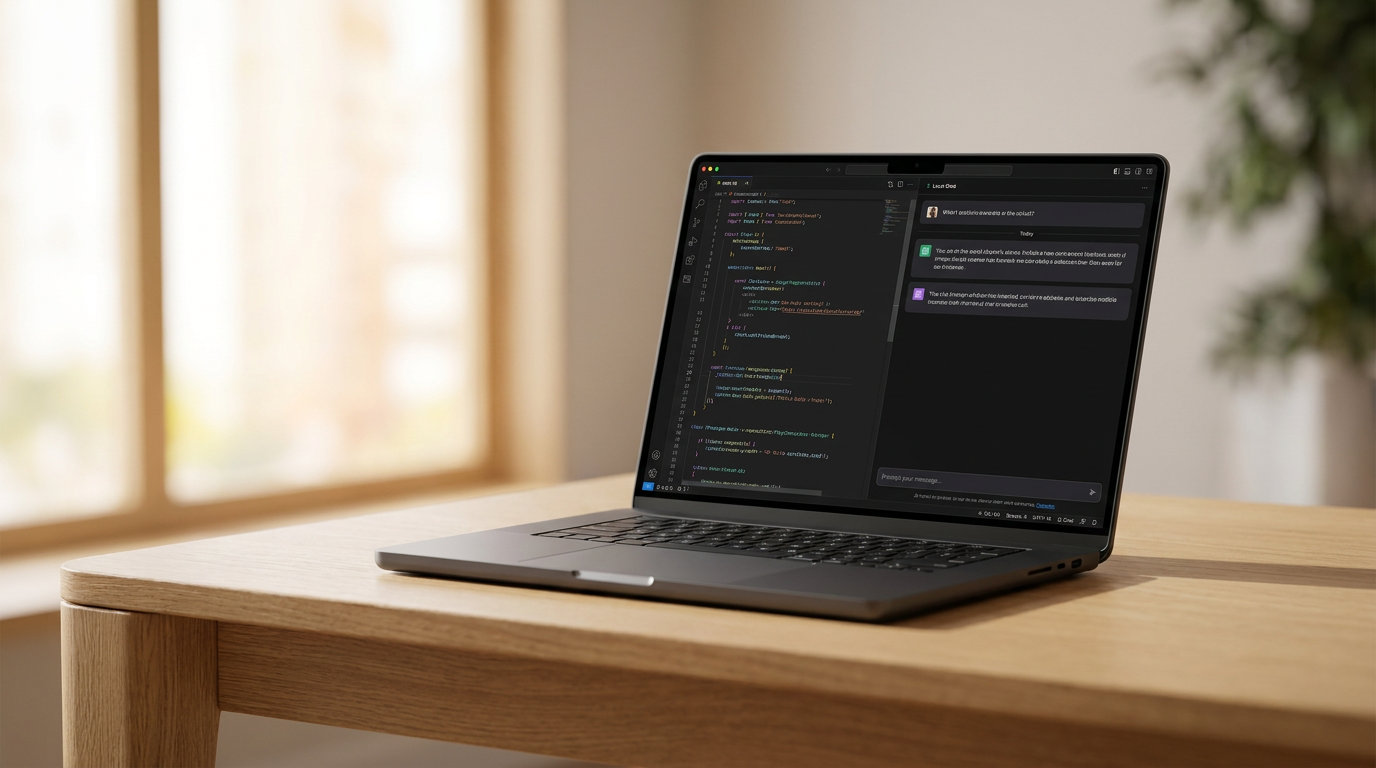
The generative AI boom of the past three years has been defined by massive scale. Models like OpenAI's GPT-4 and Google's Gemini 1.5 Pro rely on hundreds of billions of parameters, requiring vast, energy-hungry data centers to answer a single user prompt. But in 2026, the most significant shift in artificial intelligence isn't happening in the cloud. It is happening directly in your pocket.[8]
The tech industry is aggressively pivoting toward Small Language Models (SLMs). These are compact neural networks typically containing between 1 billion and 10 billion parameters—the internal numerical weights that dictate how an AI processes language. While they lack the encyclopedic trivia knowledge of their trillion-parameter counterparts, SLMs are designed to do something large models cannot: run entirely locally on consumer laptops, smartphones, and edge devices.[4][6]
This localized approach solves the three biggest bottlenecks facing consumer AI today: privacy, latency, and cost. When an AI model runs locally, the data never leaves the device. For users summarizing sensitive medical documents, drafting confidential emails, or analyzing personal finances, this architectural shift eliminates the risk of transmitting private information to third-party corporate servers.[3][4]
Apple has made this privacy-first architecture the cornerstone of its Apple Intelligence rollout. The company's third-generation Foundation Models include the AFM 3 Core, a roughly 3-billion-parameter model optimized specifically for Apple silicon. By processing requests directly on the iPhone or Mac, Apple ensures that personal context—like reading a user's text messages to find a flight time—remains strictly on the hardware.[3][7]

Beyond privacy, local execution drastically reduces latency. Cloud-based AI requires a network round-trip: the user's prompt is sent to a server, processed, and beamed back. This delay is noticeable and requires a persistent internet connection. SLMs bypass the network entirely. Google's recently updated Gemma 4 family, which includes models small enough to fit in a few gigabytes of memory, can process thousands of tokens per second directly on a mobile GPU.[1][4]
This speed unlocks new use cases that were previously impossible. A field technician in a remote area without cellular service can use an SLM to diagnose a mechanical issue via an offline manual. Apps like PocketPal allow users to download models from Hugging Face and run them in airplane mode, turning the smartphone into an always-available, offline reasoning engine.[1][6]
For enterprise developers, the primary driver of SLM adoption is sheer economics. Calling a cloud API for every single user interaction becomes prohibitively expensive at scale. Industry analysts note that for highly predictable, repetitive tasks—like parsing receipts, formatting text, or basic customer service routing—a local SLM can reduce operational costs by up to 95% compared to querying a massive frontier model.[4]

For enterprise developers, the primary driver of SLM adoption is sheer economics.
But how did these models get so capable while shrinking their footprint? The secret lies in a technique called 'knowledge distillation.' Instead of training a small model on the raw, unfiltered internet—which is full of noise and low-quality text—researchers use massive, highly capable 'teacher' models to generate pristine, textbook-quality synthetic data.[2][4]
Microsoft pioneered this approach with its Phi family of models. By training the AI exclusively on heavily filtered web data and synthetically generated 'textbook' examples, Microsoft's researchers proved that data quality matters far more than data quantity. The resulting Phi-3 and Phi-4 models, despite having fewer than 4 billion parameters, routinely match or beat the reasoning capabilities of models ten times their size.[2]
The second breakthrough enabling the SLM revolution is 'quantization.' In machine learning, parameters are typically stored as high-precision 16-bit or 32-bit floating-point numbers. Quantization compresses these weights down to 4-bit or 8-bit integers. This mathematical compression allows a highly capable 7-billion-parameter model to squeeze into just 4 to 8 gigabytes of RAM, making it accessible to standard consumer hardware.[4][5]

Hardware manufacturers are simultaneously altering their chip designs to accommodate this shift. Modern smartphones and laptops now feature dedicated Neural Processing Units (NPUs)—specialized silicon designed specifically to handle the matrix math required by neural networks. This allows devices to run SLMs continuously in the background without instantly draining the battery or overheating the processor.[1]
Despite their rapid advancement, Small Language Models come with inherent limitations. Because they have fewer parameters, they simply cannot memorize as much world knowledge. If asked to write a biography of an obscure 18th-century poet, an SLM is far more likely to hallucinate—inventing plausible-sounding but entirely fake facts—than a massive cloud model.[6][8]
To mitigate this, developers are increasingly using SLMs as reasoning engines rather than encyclopedias. Through a process called Retrieval-Augmented Generation (RAG), the local model is fed the exact document or data it needs to read, and instructed to only answer based on that provided text. This plays to the SLM's strengths: it doesn't need to know the answer beforehand, it just needs to be smart enough to extract it from the provided file.[4][5]

The future of consumer AI is likely a hybrid routing system. Both Apple and Google are implementing architectures where the operating system acts as a traffic cop. When a user asks a simple question—like 'summarize this email' or 'turn on the living room lights'—the on-device SLM handles it instantly and privately.[7]
However, if the user asks a complex, multi-step question requiring deep world knowledge—such as 'plan a five-day itinerary to Tokyo based on current exchange rates'—the system will transparently route the request to a massive cloud model. This hybrid approach ensures that users get the speed and privacy of local AI for daily tasks, without losing the raw power of the cloud when they truly need it.[7][8]
How we got here
2020-2023
The AI industry focuses almost exclusively on scaling up, building massive cloud-based Large Language Models (LLMs) like GPT-3 and GPT-4.
Mid 2023
Researchers begin experimenting with 'knowledge distillation,' proving that smaller models trained on highly curated data can punch above their weight.
Early 2024
Microsoft releases the Phi-3 family, demonstrating that a 3.8-billion-parameter model can run on a phone and rival the reasoning of much larger cloud models.
June 2026
Apple and Google deeply integrate Small Language Models directly into their mobile operating systems, making on-device AI a standard consumer feature.
Viewpoints in depth
Privacy and Security Advocates
This camp argues that local AI is the only way to safely integrate generative models into daily life.
Privacy advocates emphasize that sending personal data—like health records, private messages, or financial documents—to cloud servers is an inherent security risk, regardless of corporate promises. They view Small Language Models as a fundamental architectural fix. By processing data entirely on the user's hardware, SLMs ensure that sensitive context never traverses the internet, making AI safe for regulated industries like healthcare and law, as well as for everyday consumer privacy.
Open-Source and Indie Developers
This community values SLMs for democratizing access to artificial intelligence technology.
For independent developers and researchers, the massive cost of querying cloud APIs has historically been a barrier to building AI applications. Open-source SLMs like Llama 3 and Gemma allow developers to download the model weights for free, fine-tune them on their own specific datasets, and deploy them without paying per-token fees to tech giants. This camp argues that local AI prevents a future where a few massive corporations act as the gatekeepers to machine intelligence.
Enterprise Cost Optimizers
Corporate IT and financial leaders view SLMs primarily as a mechanism for drastic cost reduction.
While frontier models are necessary for complex reasoning, enterprise leaders note that 80% of daily business AI tasks—such as formatting text, extracting entities from receipts, or routing customer service tickets—are highly repetitive. Paying cloud API fees for these simple tasks is inefficient. By deploying SLMs on their own hardware or directly on employee laptops, companies can slash their AI operational costs by up to 95% while simultaneously reducing latency.
What we don't know
- It remains unclear how quickly hardware advancements will allow SLMs to fully match the encyclopedic knowledge of today's largest frontier models.
- The long-term impact of continuous on-device AI processing on smartphone battery degradation is still being studied in real-world conditions.
- Regulators have not yet determined how to govern open-weight SLMs that can be downloaded and run locally without corporate safety filters.
Key terms
- Small Language Model (SLM)
- An AI model with fewer than 10 billion parameters, optimized to run efficiently on consumer hardware like phones and laptops.
- Parameter
- The internal numerical weights a neural network uses to process information, recognize patterns, and make predictions.
- Quantization
- A compression technique that reduces the precision of a model's parameters, drastically shrinking its file size and memory usage so it can fit on a phone.
- Knowledge Distillation
- A training method where a massive, highly capable 'teacher' model generates high-quality examples to train a smaller 'student' model.
- Inference
- The actual process of an AI model generating a response or prediction after it has finished its initial training phase.
Frequently asked
Can a Small Language Model replace ChatGPT for me?
For writing emails, summarizing documents, and basic coding help, yes. However, for obscure trivia or complex multi-step research, large cloud models are still superior.
Do I need a brand new phone to run these models?
While newer devices with Neural Processing Units (NPUs) run them fastest, highly optimized models can run on devices that are a few years old, such as the Pixel 7 or iPhone 13.
Does running AI locally drain the battery?
It uses more power than a standard app, but because inference happens in seconds and avoids cellular radio usage, the overall battery impact is generally manageable.
Are these models free to use?
Yes, open-weights models like Llama 3, Gemma, and Phi-3 can be downloaded and run entirely for free using local applications like Ollama or PocketPal.
Sources
Source coverage
8 outlets
4 viewpoints surfaced







[1]Google BlogHardware Manufacturers
Introducing Gemma 4 12B: a unified, encoder-free multimodal model
Read on Google Blog →[2]Microsoft SourceEnterprise Efficiency Optimizers
Tiny but mighty: The Phi-3 small language models with big potential
Read on Microsoft Source →[3]Apple DeveloperPrivacy Advocates
Apple Intelligence: The Foundation Models framework
Read on Apple Developer →[4]Machine Learning MasteryEnterprise Efficiency Optimizers
Introduction to Small Language Models: The Complete Guide for 2026
Read on Machine Learning Mastery →[5]BentoMLOpen-Source Developers
The Best Open-Source Small Language Models (SLMs) in 2026
Read on BentoML →[6]Hugging FaceOpen-Source Developers
Small Language Models (SLM): A Comprehensive Overview
Read on Hugging Face →[7]9to5MacPrivacy Advocates
Apple's third-generation Foundation Models explained: on-device AI, cloud AI, and everything in between
Read on 9to5Mac →[8]Factlen Editorial TeamHardware Manufacturers
Synthesis by Factlen editorial team
Read on Factlen Editorial Team →
Every angle. Every day.
Get ai stories with full source coverage and perspective breakdowns delivered to your inbox.