
How Running AI Locally on Consumer Hardware Became the New Standard
Advancements in model compression and open-source tooling have decoupled frontier AI from the cloud, allowing users to run powerful language models entirely on their own devices.
By Factlen Editorial Team
- Enterprise & Privacy Advocates
- Prioritize data sovereignty and compliance by keeping all AI inference on-premises.
- Open-Source Developers
- Value the freedom, offline capabilities, and zero marginal cost of open-weight models.
- Hardware Enthusiasts
- Focus on pushing the limits of consumer hardware through software optimization.
What's not represented
- · Cloud AI Providers
- · Hardware Manufacturers
Why this matters
Running AI locally means your data never leaves your device, eliminating privacy risks and subscription fees while democratizing access to frontier-grade intelligence.
Key points
- Over half of enterprise AI inference now happens on-premises to protect data privacy.
- Quantization techniques compress massive models to fit on consumer graphics cards.
- Tools like Ollama and llama.cpp allow users to run models offline with a single click.
- Local inference eliminates the per-token subscription costs associated with cloud APIs.
- A hybrid approach uses local AI for 80% of tasks and cloud APIs only for complex reasoning.
For years, the assumption was that frontier artificial intelligence required massive, centralized data centers. If you wanted to run a highly capable language model, you rented access through an API and sent your data to a third-party server. In 2026, that paradigm has fundamentally shifted. The open-source AI community has successfully decoupled high-performance intelligence from cloud dependency, allowing developers and everyday users to run powerful models entirely on consumer hardware.[7]
The numbers reflect a rapid migration. Today, an estimated 55% of enterprise AI inference happens on-premises or on local machines, a staggering increase from just 12% in 2023. This transition is not driven merely by ideological commitments to open-source software; it is a pragmatic response to the costs, latencies, and privacy risks associated with cloud-based AI.[1][4]
The foundation of this local revolution is a technique called quantization. Uncompressed neural networks are massive, requiring hundreds of gigabytes of memory just to load. Quantization mathematically compresses the model's weights—often down to 4-bit precision (INT4)—sacrificing a negligible fraction of accuracy to shrink the file size by up to 80%.[2]

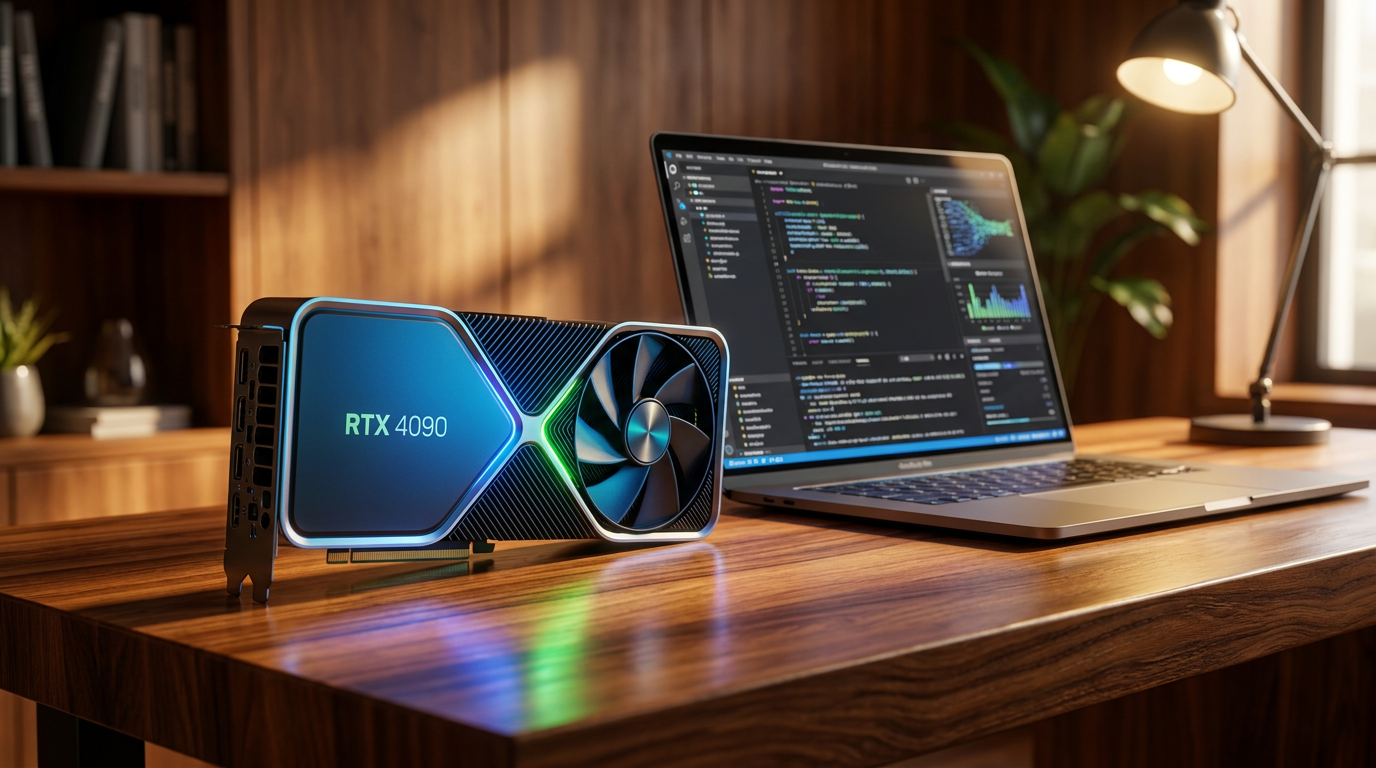
This compression allows models with tens of billions of parameters to fit comfortably within the Video RAM (VRAM) of consumer graphics cards. The NVIDIA RTX 4090, with its 24GB of VRAM, has emerged as the benchmark hardware for local AI enthusiasts, capable of running 32-billion parameter models smoothly. Meanwhile, Apple Silicon's unified memory architecture allows MacBooks to allocate system RAM directly to the GPU, turning standard laptops into highly capable inference machines.[5][6]
Alongside quantization, the widespread adoption of Mixture-of-Experts (MoE) architectures has changed the economics of local compute. Instead of activating the entire neural network for every word generated, an MoE model routes the query only to the specific "expert" sub-networks needed for that task. A model might have 119 billion total parameters, but only activate 24 billion during inference, delivering large-model intelligence with small-model resource requirements.[3][6]
The software ecosystem has matured to match the hardware. Just a few years ago, running a local model required navigating complex Python environments and compiling code from scratch. Today, tools like Ollama, LM Studio, and llama.cpp have reduced the process to a single click or terminal command. These platforms automatically download the optimized model files—often in the GGUF format—and expose a local, offline endpoint that mimics cloud APIs.[2][4]
For enterprises and privacy advocates, the primary draw of local inference is absolute data sovereignty. When a model runs locally, prompts, files, and outputs never leave the machine. There are no network calls to intercept and no terms-of-service granting a provider training rights over user data.[1][4]
For enterprises and privacy advocates, the primary draw of local inference is absolute data sovereignty.
This architectural guarantee is transforming regulated industries. Healthcare organizations handling HIPAA-compliant patient data, financial firms analyzing confidential client records, and government agencies processing classified information can now deploy AI without triggering massive compliance reviews. The data stays within the organization's jurisdiction and under its governance policies.[1][4]

Software engineering has also seen a massive shift toward local models. Developers using AI copilots to write or review code are increasingly wary of sending proprietary, unreleased codebases to external servers. Local coding models, such as Mistral's Devstral or Qwen 3.5, can run directly on a developer's workstation, providing real-time autocomplete and debugging without ever transmitting intellectual property over the internet.[3]
Beyond privacy, the unit economics of local AI are compelling. Every call to a cloud-based LLM carries a per-token price tag, which scales linearly with usage. For high-volume tasks like document processing, log analysis, or automated data extraction, cloud costs can quickly become prohibitive. Running a local model incurs only the upfront cost of the hardware and the electricity to power it, effectively reducing the marginal cost of inference to zero.[1]
Performance and latency have also tipped in favor of local setups for single users. Because local inference skips the network round-trip entirely, a well-configured machine can deliver a first-token latency of under 40 milliseconds. There are no rate limits, no peak-hour queues, and no unexpected service outages.[4][5]

The open-weight models powering this ecosystem are now sourced globally. Meta's Llama 4 family, Alibaba's Qwen 3.5, and Europe's Mistral Small 3.2 are consistently matching or beating older proprietary cloud models on standard reasoning and coding benchmarks. Many of these models are released under permissive licenses like Apache 2.0, removing commercial restrictions and legal friction for businesses building AI products.[3]
Despite these advances, local inference is not a panacea. The most complex reasoning tasks—such as advanced mathematical proofs or highly ambiguous strategic planning—still benefit from the massive scale of frontier cloud models. As a result, many organizations are adopting a hybrid pattern.[1][4]
In a hybrid architecture, a local model handles 80% of the daily workload: routine summarization, classification, code review, and drafting. Only when a query requires deep, multi-step reasoning is it routed to a premium cloud API. This approach balances the privacy and cost benefits of local hardware with the peak capabilities of centralized data centers.[4]

Ultimately, the rise of local AI represents a democratization of compute. By packaging frontier-grade intelligence into formats that run on the hardware people already own, the open-source community has ensured that the future of artificial intelligence will not be entirely locked behind corporate APIs.[7]
How we got here
2023
Cloud APIs dominate the landscape, with only 12% of enterprise inference happening on-premises.
Early 2024
The release of Llama 3 and the popularization of the GGUF format make local inference viable on standard laptops.
Late 2025
Mixture-of-Experts (MoE) architectures become mainstream in open-source models, drastically reducing VRAM requirements.
Mid 2026
Local inference reaches 55% enterprise adoption, driven by privacy needs and zero-cost API tooling.
Viewpoints in depth
Enterprise & Privacy Advocates
Prioritize data sovereignty and compliance by keeping all AI inference on-premises.
For heavily regulated industries like healthcare and finance, sending sensitive data to cloud APIs is a compliance nightmare. This camp views local AI not just as a cost-saving measure, but as a mandatory architectural requirement. By running models on hardware they own, enterprises can guarantee that proprietary data, patient records, and unreleased code never touch a third-party server, entirely bypassing the legal friction of cloud vendor agreements.
Open-Source Developers
Value the freedom, offline capabilities, and zero marginal cost of open-weight models.
The developer community champions local inference as a return to the open web's roots. For this group, the appeal lies in the lack of gatekeepers: there are no rate limits, no sudden API deprecations, and no monthly subscription fees. They rely on tools like Ollama and llama.cpp to build offline-first applications, ensuring that their AI workflows remain functional regardless of internet connectivity or cloud service outages.
Hardware Enthusiasts
Focus on pushing the limits of consumer hardware through software optimization.
This camp is deeply invested in the technical mechanics of making massive models fit into constrained environments. They track the latest advancements in quantization (like GGUF formats) and Mixture-of-Experts architectures, constantly benchmarking how many tokens per second they can squeeze out of consumer GPUs like the RTX 4090 or Apple Silicon Macs. For them, local AI is a performance project, proving that smart engineering can overcome raw compute deficits.
What we don't know
- Whether future frontier models will grow too large for consumer hardware to keep up, even with advanced quantization.
- How cloud providers will adjust their pricing models to compete with the zero marginal cost of local inference.
- If regulatory bodies will eventually impose restrictions on the distribution of highly capable open-weight models.
Key terms
- Quantization
- A mathematical technique that compresses a neural network's weights into a smaller format (like 4-bit), drastically reducing the memory required to run it.
- VRAM
- Video Random Access Memory; the dedicated memory on a graphics card where AI models are loaded for fast processing.
- Mixture-of-Experts (MoE)
- An AI architecture that divides a model into specialized sub-networks, activating only the relevant "experts" for a given prompt to save compute power.
- Inference
- The process of running live data through a trained AI model to generate an output or prediction.
- GGUF
- A popular file format optimized for loading and running quantized language models quickly on consumer hardware.
Frequently asked
Do I need an internet connection to run local AI?
No. Once the model weights are downloaded to your machine, the AI runs entirely offline, ensuring absolute privacy.
Can a local model match cloud APIs?
For routine tasks like drafting, summarizing, and coding, local models like Llama 4 and Qwen 3.5 perform on par with cloud APIs. Cloud models still hold an edge in highly complex, multi-step reasoning.
What is the minimum hardware required?
While an NVIDIA RTX 4090 with 24GB of VRAM is the benchmark for high performance, smaller models can run smoothly on laptops with 16GB of unified memory or even modern CPUs.
Is it legal to use open-source models for business?
Yes. Many top models are released under permissive licenses like Apache 2.0, which allow for unrestricted commercial use without licensing fees.
Sources
Source coverage
7 outlets
3 viewpoints surfaced







[1]IBMEnterprise & Privacy Advocates
The Economics of Local AI and Open Source Models
Read on IBM →[2]Red HatOpen-Source Developers
llama.cpp: Efficient AI inference on consumer hardware
Read on Red Hat →[3]Hugging FaceOpen-Source Developers
The Best Open Source LLM Models to Run Locally in 2026
Read on Hugging Face →[4]TechsyEnterprise & Privacy Advocates
Run LLMs Locally 2026: The 5-Minute Setup for Any GPU
Read on Techsy →[5]DataCampOpen-Source Developers
Serving Llama Locally: A Complete Guide
Read on DataCamp →[6]AIMagicXHardware Enthusiasts
Choosing Hardware for Local AI: The Complete Guide
Read on AIMagicX →[7]Factlen Editorial TeamHardware Enthusiasts
Synthesis by Factlen editorial team
Read on Factlen Editorial Team →

More in ai
See all 6 stories →Local AI
The Rise of Local AI: Running Frontier Models on Consumer Hardware
8 sources

Local Inference
The Era of the Local LLM: How Consumer Laptops Are Replacing Cloud AI
8 sources
Language Tech
AI Translation Models Reach Historic Milestone in Preserving Endangered Languages
6 sources
On-Device AI
The Era of Pocket AI: How Small Language Models Are Bringing Privacy and Speed to Local Devices
8 sources
Every angle. Every day.
Get ai stories with full source coverage and perspective breakdowns delivered to your inbox.