
How Online Dispute Resolution is Transforming Civil Courts for Everyday Citizens
Digital platforms are replacing traditional courtrooms for small claims and civil disputes, dramatically reducing costs and making justice accessible from a smartphone.
By Factlen Editorial Team
- Access-to-Justice Advocates
- Argue that ODR levels the playing field for everyday citizens who cannot afford lawyers or time off work.
- Judicial Administrators
- Focus on the efficiency gains, noting that ODR clears massive court backlogs and saves taxpayer money.
- Digital Equity Skeptics
- Warn that moving justice online could disenfranchise vulnerable populations without reliable internet or tech literacy.
What's not represented
- · Traditional trial lawyers
- · Court clerks and administrative staff
Why this matters
For decades, the high cost of lawyers and the inflexibility of court schedules meant that everyday people simply abandoned valid legal claims. Online Dispute Resolution allows citizens to resolve disputes on their own time, saving thousands of dollars and leveling the playing field against larger corporations.
Key points
- Online Dispute Resolution (ODR) allows citizens to settle civil disputes via digital portals rather than physical courtrooms.
- The process relies on asynchronous negotiation and online mediation, saving participants from taking time off work.
- ODR can reduce litigation costs by up to 80%, making justice accessible for those who cannot afford lawyers.
- Early adopters like Utah and Michigan report high success rates and drastically reduced court backlogs.
- Experts warn that courts must maintain physical alternatives to avoid disenfranchising those without internet access.
For most everyday citizens, the civil justice system is a maze of prohibitive costs, arcane rules, and scheduling nightmares. Taking time off work to fight a $1,500 contractor dispute, contest a traffic ticket, or recover a withheld security deposit often costs more in lost wages and legal fees than the claim itself is worth.[7]
But a quiet revolution is transforming how small claims and civil disputes are settled. Online Dispute Resolution (ODR)—a digital-first approach to justice—is rapidly moving from the private sector into public courthouses, offering a streamlined alternative to the traditional gavel and bench.[1][5]
Originally pioneered by e-commerce giants like eBay to handle millions of buyer-seller disagreements without human intervention, ODR is now being deployed by dozens of state and local courts to clear massive backlogs and democratize access to justice.[4][5]
The mechanism is straightforward but profoundly different from traditional litigation. Instead of filing paper motions and waiting months for a hearing date in a physical building, parties log into a secure, court-sponsored digital portal.[1]

The first phase is typically asynchronous negotiation. Much like a structured email thread or a secure messaging app, the plaintiff and defendant can upload evidence, make claims, and offer settlement terms on their own time, 24 hours a day.[3][5]
If the parties cannot reach an agreement directly, the platform seamlessly escalates the case to a court-appointed mediator who facilitates the conversation online. Only if this digital mediation fails does the case proceed to a traditional judge in a physical courtroom.[3][7]
The evidence supporting this model is compelling. In Utah, which launched an ambitious ODR platform for small claims in 2018, the system has successfully resolved over 12,000 disputes while drastically reducing the need for physical court appearances and processing times.[4]
Similarly, in Michigan, courts utilizing ODR for landlord-tenant disputes have reported a 75% success rate in reaching settlements, easing the burden on local dockets and preventing drawn-out eviction battles.[4]
The financial implications for everyday people are staggering. The American Bar Association estimates that utilizing ODR can reduce litigation costs by 60% to 80%, particularly for small businesses and individuals who cannot afford hefty attorney retainer fees.[4]
The financial implications for everyday people are staggering.
This cost reduction strikes at the heart of the modern "access to justice" crisis. According to the National Center for State Courts, an estimated 75% of civil cases in the United States currently involve at least one party who does not have legal representation.[1]

These self-represented, or pro se, litigants are historically at a massive disadvantage. Navigating courtroom procedures without a law degree often leads to procedural errors, deep frustration, and a high rate of default judgments simply because a defendant could not take a Tuesday morning off work to appear in court.[3][7]
By shifting the venue to a smartphone or laptop, ODR eliminates the geographical and temporal barriers of the physical courthouse. In Los Angeles County, the nation's largest trial court system saw hundreds of small claims cases resolved within months of launching its platform, saving residents from navigating notorious local traffic.[3]
Judicial administrators are equally enthusiastic about the shift. By siphoning off straightforward disputes that can be settled administratively, judges are freed up to dedicate their time and courtroom resources to complex cases that genuinely require a full trial.[3][6]
However, the transition is not without uncertainty and valid criticism. The primary concern among legal advocates is the "digital divide"—the reality that lower-income individuals, the elderly, or rural populations may lack reliable broadband access or digital literacy.[2][3]

If courts mandate ODR without providing physical alternatives or digital kiosks at local libraries, they risk automating the very inequalities they are trying to solve, effectively locking vulnerable populations out of the justice system.[6]
To mitigate these risks, the American Bar Association has issued comprehensive guidance urging courts to ensure their platforms remain voluntary, are fully accessible to non-native speakers, and are designed to prevent algorithmic bias if automated triage tools are utilized.[2]
Despite these hurdles, the trajectory of civil justice is clear. With over 80% of voters expressing a desire for more online access to court services, the public demand for digital, user-friendly justice is overwhelming.[1]
As technology improves, including the integration of AI-driven tools designed to de-escalate emotionally charged conflicts and translate legal jargon into plain language, ODR is poised to become the default pathway for civil litigation.[1][7]
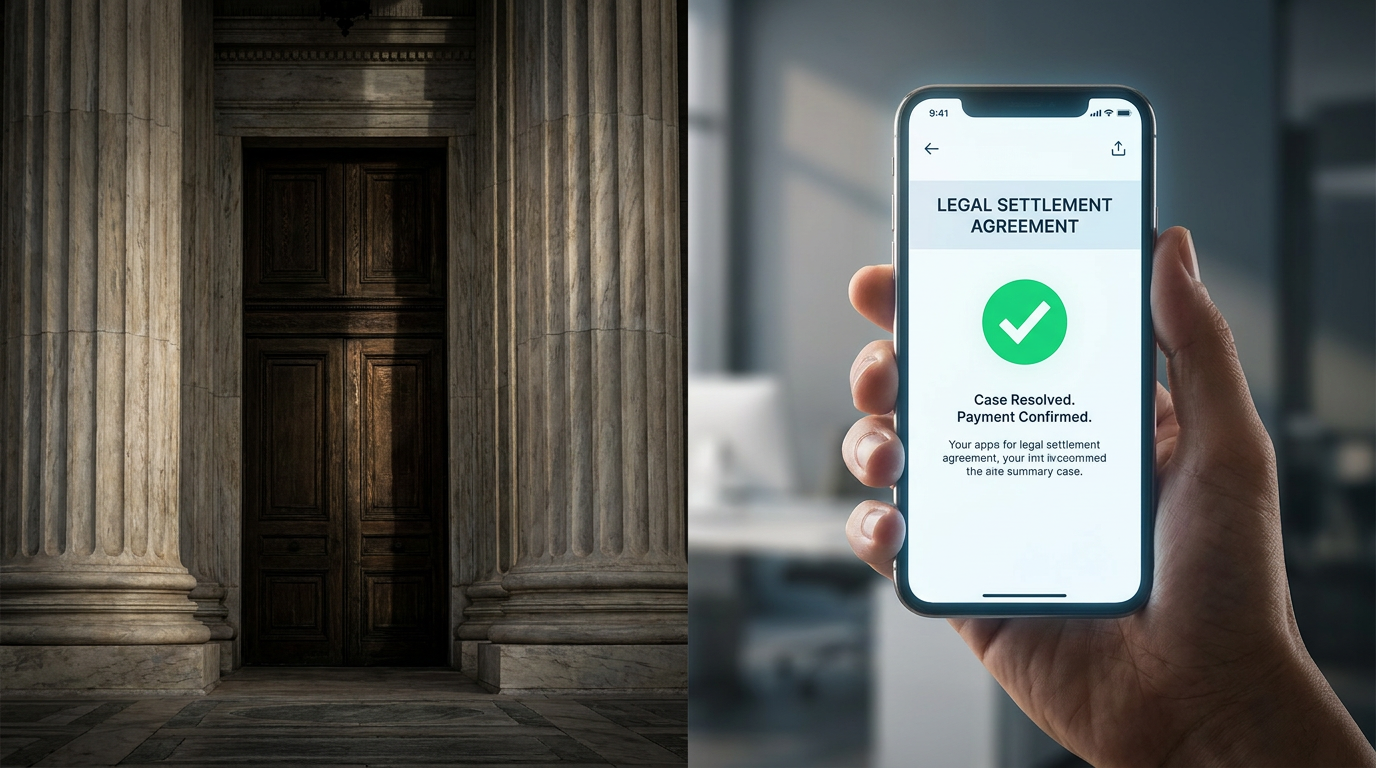
Ultimately, the courthouse of the future may not be an imposing marble building downtown, but an app in your pocket—transforming the legal system from a place you go, into a service you use.[7]
Viewpoints in depth
Access-to-Justice Advocates
Argue that ODR levels the playing field for everyday citizens who cannot afford lawyers or time off work.
For legal aid organizations and access-to-justice advocates, the traditional court system is structurally biased against the working class. They point out that 75% of civil cases involve a self-represented party, and these individuals routinely lose by default simply because they cannot afford to miss a shift at work to attend a hearing. Advocates view ODR as a profound equalizer. By allowing parties to upload evidence and negotiate asynchronously from a smartphone, the system removes the geographic and temporal barriers that have historically kept lower-income individuals from exercising their legal rights.
Judicial Administrators
Focus on the efficiency gains, noting that ODR clears massive court backlogs and saves taxpayer money.
Court administrators and judges view ODR primarily as a vital triage mechanism. State courts are drowning in high-volume, low-complexity cases like unpaid medical bills, minor property damage, and traffic citations. Administrators argue that forcing these cases through the traditional, paper-heavy litigation pipeline is a waste of taxpayer resources. By resolving these disputes online, courts can clear their dockets, reduce administrative overhead, and reserve highly trained judges and physical courtrooms for complex trials that genuinely require human adjudication.
Digital Equity Skeptics
Warn that moving justice online could disenfranchise vulnerable populations without reliable internet or tech literacy.
While acknowledging the efficiencies of ODR, digital equity advocates and some legal ethicists warn of unintended consequences. They argue that the "digital divide" is real; elderly populations, non-English speakers, and rural residents often lack the broadband access or technological literacy required to navigate a digital portal. Skeptics caution that if courts make ODR mandatory to save money, they risk automating injustice—effectively locking the most vulnerable citizens out of the legal system entirely. They insist that traditional, in-person pathways must remain fully funded and easily accessible.
What we don't know
- Whether the long-term settlement compliance rates for ODR match those of in-person court judgments.
- How the integration of AI tools into ODR platforms will affect the fairness of automated mediations.
Key terms
- Online Dispute Resolution (ODR)
- A public-facing digital platform where parties can convene to negotiate, mediate, and resolve their legal disputes without a physical court appearance.
- Pro Se Litigant
- A person who represents themselves in a legal proceeding without the assistance of an attorney.
- Asynchronous Negotiation
- Communication that does not happen in real-time, allowing parties to log in, review claims, and respond at their own convenience.
- Default Judgment
- A binding court ruling granted in favor of one party because the other party failed to appear in court or take action.
- Alternative Dispute Resolution (ADR)
- Processes like mediation and arbitration that help parties resolve disputes without a formal trial.
Frequently asked
Can I still go to court if ODR fails?
Yes. ODR is usually the first step in the process. If the parties cannot reach an agreement online, the case proceeds to a traditional judge.
Do I need a lawyer to use an ODR platform?
No. These platforms are specifically designed for self-represented individuals, featuring plain-language interfaces and step-by-step guidance.
Is ODR mandatory for all small claims?
It depends on the jurisdiction. Some courts require parties to attempt ODR first, while others offer it as a voluntary alternative to an in-person hearing.
What kinds of cases are eligible?
Most courts limit ODR to small claims, landlord-tenant disputes, traffic tickets, and simple family law matters like uncontested divorces.
Sources
Source coverage
7 outlets
3 viewpoints surfaced






[1]National Center for State CourtsAccess-to-Justice Advocates
Online Dispute Resolution for Courts
Read on National Center for State Courts →[2]American Bar AssociationDigital Equity Skeptics
Guidance for Online Dispute Resolution
Read on American Bar Association →[3]ABA JournalDigital Equity Skeptics
Courts are turning to online dispute resolution, but some worry about accessibility
Read on ABA Journal →[4]The GuardianJudicial Administrators
ODR success rates in civil litigation courts
Read on The Guardian →[5]William & Mary Law SchoolJudicial Administrators
An Evaluation and Performance Measure Framework for Online Dispute Resolution Programs
Read on William & Mary Law School →[6]UN Office on Drugs and CrimeAccess-to-Justice Advocates
Civil Legal System Modernization: Is Online Dispute Resolution Making a Difference?
Read on UN Office on Drugs and Crime →[7]Factlen Editorial Team
Synthesis by Factlen editorial team
Read on Factlen Editorial Team →
Every angle. Every day.
Get law justice stories with full source coverage and perspective breakdowns delivered to your inbox.