
How Neuroaesthetics is Turning Interior Design into Preventative Healthcare
Advancements in neuroscience reveal that interior design directly manipulates heart rates, stress hormones, and cognitive function, shifting architecture from a visual art to a biological science.
By Factlen Editorial Team
- Neuroaesthetics Researchers
- Argue that interior design should be evaluated through measurable biological markers like heart rate and brain activity, rather than subjective taste.
- Commercial Architects
- Focus on leveraging neuroaesthetic principles to boost employee productivity, reduce cognitive fatigue, and create spaces that yield a tangible return on investment.
- Healthcare Providers
- View biophilic and neuroaesthetic design as a crucial non-pharmacological intervention that accelerates patient recovery and reduces staff burnout.
- Neuro-Inclusive Advocates
- Emphasize that because human brains process sensory input differently, spaces must be adaptable rather than imposing a single aesthetic on everyone.
What's not represented
- · Residential Homeowners
- · Budget-Constrained Developers
Why this matters
Understanding how your environment affects your brain empowers you to design living and workspaces that actively reduce stress, improve focus, and support long-term mental health.
Key points
- Neuroaesthetics uses brain-scanning technology to prove that interior design directly impacts human biology.
- Curvilinear shapes activate emotion-processing centers in the brain, signaling safety and comfort.
- Cool colors activate the parasympathetic nervous system, lowering heart rates and reducing stress.
- Biophilic design, which integrates nature into architecture, has been shown to accelerate physical healing.
- Natural textures like wood and stone stimulate the brain's touch centers, fostering a sense of grounding.
- Neuro-inclusive design ensures spaces remain adaptable to prevent sensory overload in neurodivergent individuals.
For decades, interior designers have relied on intuition to explain why a certain room feels "right." Clients walk into a space and report feeling instantly calmer, more focused, or more energized, but the mechanisms behind those reactions were largely treated as an intangible art. Today, that intuition is being replaced by hard biological evidence.[6]
Welcome to the emerging field of neuroaesthetics—the scientific study of how our brains and bodies respond to aesthetic experiences. By utilizing advanced brain-scanning technology like functional magnetic resonance imaging (fMRI) and tracking physiological markers, researchers are proving that interior design is not merely a matter of visual preference. It is a direct manipulator of human biology.[1]
The convergence of neuroscience and architecture reveals that our environments trigger measurable biological responses. When we enter a thoughtfully designed space, heart rates can slow, blood pressure can drop, and the brain's production of stress hormones like cortisol can decrease by as much as 15 to 20 percent. Conversely, poorly designed spaces can induce cognitive fatigue and low-level chronic stress.[1]

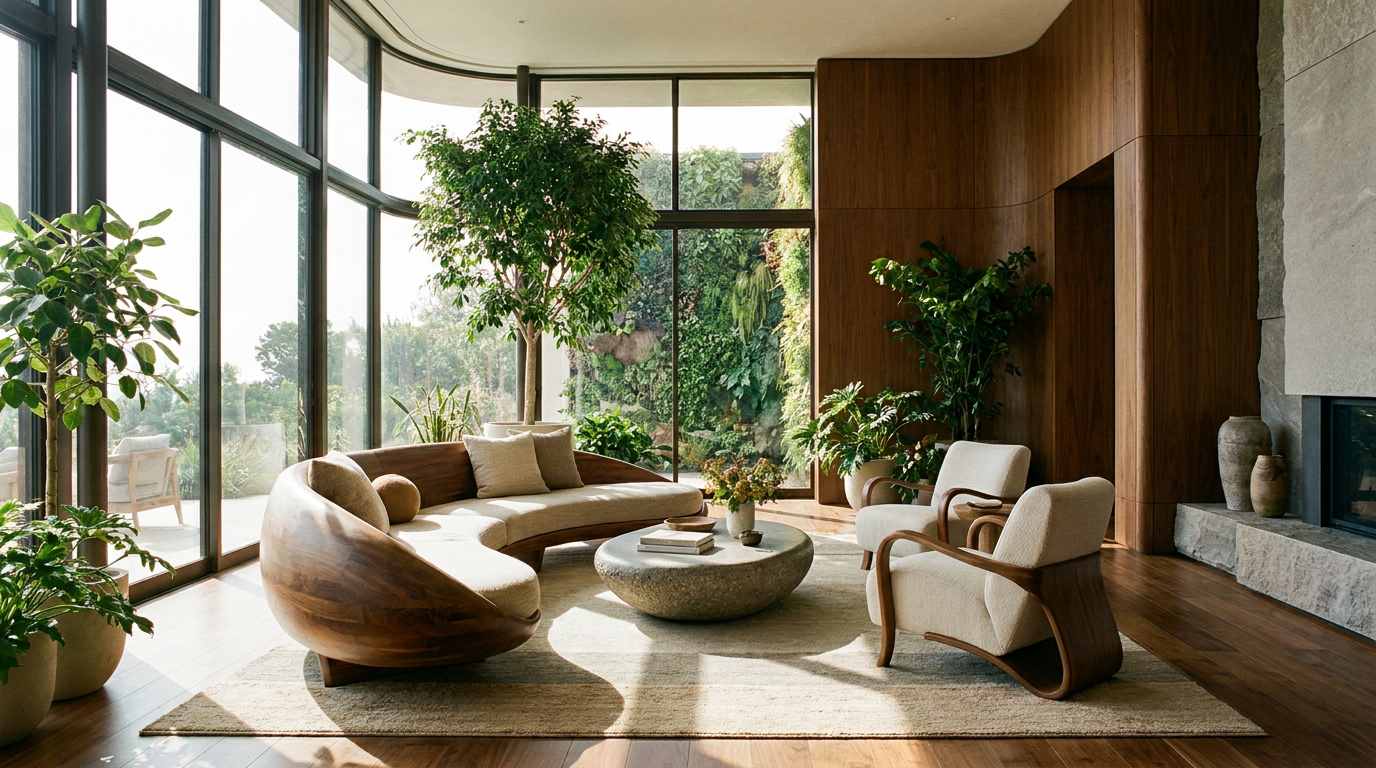
To understand how a room changes the brain, researchers first looked at geometry. Humans have a documented preference for curvilinear shapes—arches, rounded furniture, and sweeping architectural lines—over sharp, rectilinear environments.[2]
A landmark study published by Oxford University Press examined this phenomenon using fMRI scanners. Participants were shown images of various room interiors while their brain activity was monitored. The neural data revealed that viewing curvilinear rooms directly activated the anterior cingulate cortex, a region of the brain deeply involved in processing emotion.[2]
This suggests that our preference for curved design is not just a passing trend, but a deeply ingrained affective response. Sharp angles often register in the primitive brain as potential threats, whereas rounded forms signal safety and comfort, allowing the nervous system to relax.[2][5]
Color, too, operates on a profound neurological level. When light enters the eye, it does more than just facilitate vision; it stimulates direct neural pathways to the brain regions responsible for managing mood, energy, and stress responses.[1]
The science of color psychology maps directly onto the autonomic nervous system. Cooler hues, such as muted blues and greens, activate the parasympathetic nervous system—the "rest and digest" network. This activation physically slows the heart rate and promotes relaxation.[1]

In contrast, warmer hues like reds, oranges, and yellows stimulate the sympathetic nervous system, which governs the "fight or flight" response. While excessive exposure can cause anxiety, strategic use of warm tones increases alertness, vitality, and focus, making them highly effective in collaborative workspaces or dining areas.[1][5]
In contrast, warmer hues like reds, oranges, and yellows stimulate the sympathetic nervous system, which governs the "fight or flight" response.
Beyond shape and color, the most heavily researched pillar of neuroaesthetics is biophilic design. Rooted in the concept of biophilia—the innate human tendency to seek connections with nature—this approach integrates natural light, organic materials, and vegetation into the built environment.[3]
The biological impact of biophilia is staggering. A foundational study by researcher Roger Ulrich demonstrated that hospital patients with views of nature from their beds recovered faster, required fewer painkillers, and had shorter hospital stays than those whose windows faced a brick wall.[4]

Modern research builds on Ulrich's findings, indicating that interactions with natural elements in the built environment can positively influence brain plasticity. These environments support the areas of the brain critical for memory and emotional regulation, offering a non-pharmacological approach to enhancing cognitive health.[3]
In commercial settings, the integration of biophilic elements—such as dynamic daylighting, plant walls, and natural airflow—has been linked to a 15 percent increase in employee productivity and a significant reduction in cognitive fatigue. The brain simply does not have to work as hard to filter out unnatural stressors.[5]
But neuroaesthetics extends beyond what we can see. The somatosensory cortex, the part of the brain that processes touch, is highly responsive to the textures we surround ourselves with.[5]
Studies in environmental psychology show that people feel more secure and grounded around natural materials like wood, stone, and woven fabrics. These tactile elements produce feelings of belongingness and warmth that synthetic materials like plastic and harsh metals often fail to evoke.[5]

The auditory environment is equally critical. Psychoacoustics—the study of how humans perceive sound—reveals that the brain is constantly scanning the acoustic environment for threats. In open-plan offices or busy homes, chaotic noise pollution spikes cortisol levels.[4]
Interestingly, evolutionary biology dictates our acoustic preferences. Research indicates that the sound of flowing water is the most effective acoustic masking tool for human environments, likely because our ancestors associated the sound of clean, running water with survival and safety.[4]
Despite these universal biological baselines, the field of neuroaesthetics is increasingly grappling with the concept of neuro-inclusive design. Because human brains are diverse, a sensory environment that feels calming to a neurotypical individual might be overwhelmingly stimulating to someone who is neurodivergent.[5]
For example, while highly saturated colors and complex fractal patterns might boost creativity for some, they can trigger sensory overload in individuals with autism or ADHD. Neuro-inclusive architecture advocates for adaptable spaces—environments where lighting, acoustics, and visual stimuli can be controlled by the user.[5]
As the science matures, the implications for how we build our world are profound. Interior design is no longer just about creating a beautiful backdrop for life; it is emerging as a vital form of preventative mental healthcare. By aligning our built environments with our biology, we can engineer spaces that actively heal, restore, and elevate the human mind.[3][6]
How we got here
1984
Roger Ulrich publishes a landmark study showing hospital patients recover faster with views of nature.
1990s
Advancements in fMRI technology allow researchers to observe real-time brain responses to aesthetic stimuli.
2013
Researchers publish fMRI data proving curvilinear architectural spaces activate emotion-processing centers in the brain.
2020s
Post-pandemic commercial architecture heavily adopts neuroaesthetic principles to draw employees back to offices.
Viewpoints in depth
Neuroaesthetics Researchers
Argue that interior design should be evaluated through measurable biological markers like heart rate and brain activity, rather than subjective taste.
For researchers in this field, the era of treating interior design as a purely subjective art form is over. By utilizing fMRI scanners, EEG monitors, and cortisol tracking, they argue that the built environment is a medical intervention. Their focus is on establishing universal biological baselines—proving, for instance, that the human brain universally interprets sharp angles as potential threats and curved lines as safe harbors. They advocate for evidence-based design codes that prioritize human biology over fleeting aesthetic trends.
Commercial Architects
Focus on leveraging neuroaesthetic principles to boost employee productivity, reduce cognitive fatigue, and create spaces that yield a tangible return on investment.
Commercial design firms view neuroaesthetics as a powerful tool for ROI. In an era where drawing employees back to physical offices is a challenge, architects are using biophilic design and color psychology to engineer spaces that actively reduce cognitive fatigue. By installing circadian lighting systems and acoustic masking that mimics flowing water, they aim to create environments where people can focus longer and collaborate more effectively, directly tying architectural choices to a company's bottom line.
Healthcare Providers
View biophilic and neuroaesthetic design as a crucial non-pharmacological intervention that accelerates patient recovery and reduces staff burnout.
The medical community has embraced neuroaesthetics as a form of preventative and restorative care. Hospital administrators and clinicians point to decades of data showing that patients with access to natural light, views of greenery, and calming color palettes require less pain medication and discharge faster. Furthermore, they emphasize that these environments are critical for reducing the chronic stress and burnout experienced by healthcare workers operating in high-stakes, high-pressure settings.
Neuro-Inclusive Advocates
Emphasize that because human brains process sensory input differently, spaces must be adaptable rather than imposing a single aesthetic on everyone.
While acknowledging the biological benefits of neuroaesthetics, neuro-inclusive advocates caution against a one-size-fits-all approach. They point out that a visually complex biophilic wall or a highly saturated "energizing" color might trigger sensory overload for an individual with autism or ADHD. This camp argues that the future of neuroarchitecture lies in adaptability—creating modular spaces where lighting, acoustics, and visual stimuli can be customized by the user to match their specific neurological needs.
What we don't know
- How long the biological benefits of a neuroaesthetic space last once an individual leaves the environment.
- The exact threshold at which biophilic elements transition from being calming to becoming visually overstimulating.
- How virtual or augmented reality environments compare to physical spaces in triggering these specific neural responses.
Key terms
- Neuroaesthetics
- The study of how the brain perceives and responds to beauty, art, and design.
- Biophilic Design
- An architectural approach that connects occupants to nature through light, materials, and spatial layouts.
- Anterior Cingulate Cortex
- A region of the brain involved in processing emotion, which is activated by viewing curvilinear spaces.
- Parasympathetic Nervous System
- The 'rest and digest' network of the body that slows the heart rate and promotes relaxation.
- Psychoacoustics
- The scientific study of how humans perceive and react to sound in their environment.
- Somatosensory Cortex
- The part of the brain responsible for processing tactile sensations, such as the texture of wood or fabric.
Frequently asked
What exactly is neuroaesthetics?
Neuroaesthetics is the scientific study of how the brain and body respond to aesthetic experiences, using tools like fMRI to measure biological reactions to design.
How does biophilic design differ from just adding houseplants?
While plants are a component, true biophilic design integrates natural light patterns, organic textures, and spatial configurations that mimic natural ecosystems to reduce stress.
Can interior design actually lower blood pressure?
Yes. Studies show that environments utilizing cool colors, curvilinear shapes, and natural materials activate the parasympathetic nervous system, which physically slows the heart rate and lowers blood pressure.
What is neuro-inclusive design?
It is an approach that recognizes diverse neurological needs, ensuring spaces offer adaptable lighting, acoustics, and sensory inputs so they do not overstimulate neurodivergent individuals.
Sources
Source coverage
6 outlets
4 viewpoints surfaced






[1]Science in DesignNeuroaesthetics Researchers
What is Neuroaesthetics? The Convergence of Science and Design
Read on Science in Design →[2]Oxford University PressNeuroaesthetics Researchers
The Neuroaesthetics of Architecture
Read on Oxford University Press →[3]Global Wellness InstituteHealthcare Providers
Biophilic Design: Healthy Buildings, Healthy Brain
Read on Global Wellness Institute →[4]Academy of Neuroscience for ArchitectureHealthcare Providers
Exploring the Impact of Biophilic Design on Human Well-being
Read on Academy of Neuroscience for Architecture →[5]ArchDailyNeuro-Inclusive Advocates
Neuroaesthetics and Neuroarchitecture: Designing for the Mind
Read on ArchDaily →[6]Factlen Editorial Team
Synthesis by Factlen editorial team
Read on Factlen Editorial Team →
Every angle. Every day.
Get home stories with full source coverage and perspective breakdowns delivered to your inbox.