
How Mycelium Leather is Grown: The Science Behind Fashion's Fungal Revolution
Biotech startups are growing premium leather alternatives from the root structures of mushrooms in just two weeks. As luxury brands adopt the material, life-cycle analyses show massive environmental benefits, though scaling and plastic coatings remain hurdles.
By Factlen Editorial Team
- Biomaterial Innovators
- Startups focused on scaling the technology to replace animal and plastic leather.
- Sustainability Researchers
- Academics focused on life-cycle assessments and the environmental math of circular economies.
- Industry Watchdogs
- Analysts focused on market viability, greenwashing risks, and the reality of plastic coatings.
What's not represented
- · Traditional leather tanners and cattle farmers whose livelihoods are tied to the conventional leather supply chain.
- · Garment workers in developing nations who currently manufacture mass-market synthetic leathers.
Why this matters
Traditional leather drives deforestation and toxic pollution, while synthetic 'vegan' leather relies on fossil fuels and sheds microplastics. Mycelium offers a third path—a grown, biodegradable material that could dramatically reduce the fashion industry's carbon and water footprint.
Key points
- Mycelium leather is grown from the root structures of fungi using agricultural waste as a substrate.
- The cultivation process takes just two to three weeks in controlled vertical farming environments.
- Life-cycle assessments show mycelium uses significantly less water and emits less carbon than animal or synthetic leathers.
- Luxury brands like Hermès and Stella McCartney are actively incorporating the material into their collections.
- Some manufacturers still rely on thin polyurethane coatings for durability, which impacts the material's biodegradability.
For decades, the fashion industry has been trapped in a binary choice when it comes to leather. Traditional bovine leather carries a massive environmental toll, driving deforestation, immense water consumption, and toxic pollution from chromium tanning. The alternative—synthetic "vegan" leather—is typically made from polyurethane (PU) or polyvinyl chloride (PVC), meaning it relies on fossil fuels, sheds microplastics, and sits in landfills for centuries.[6]
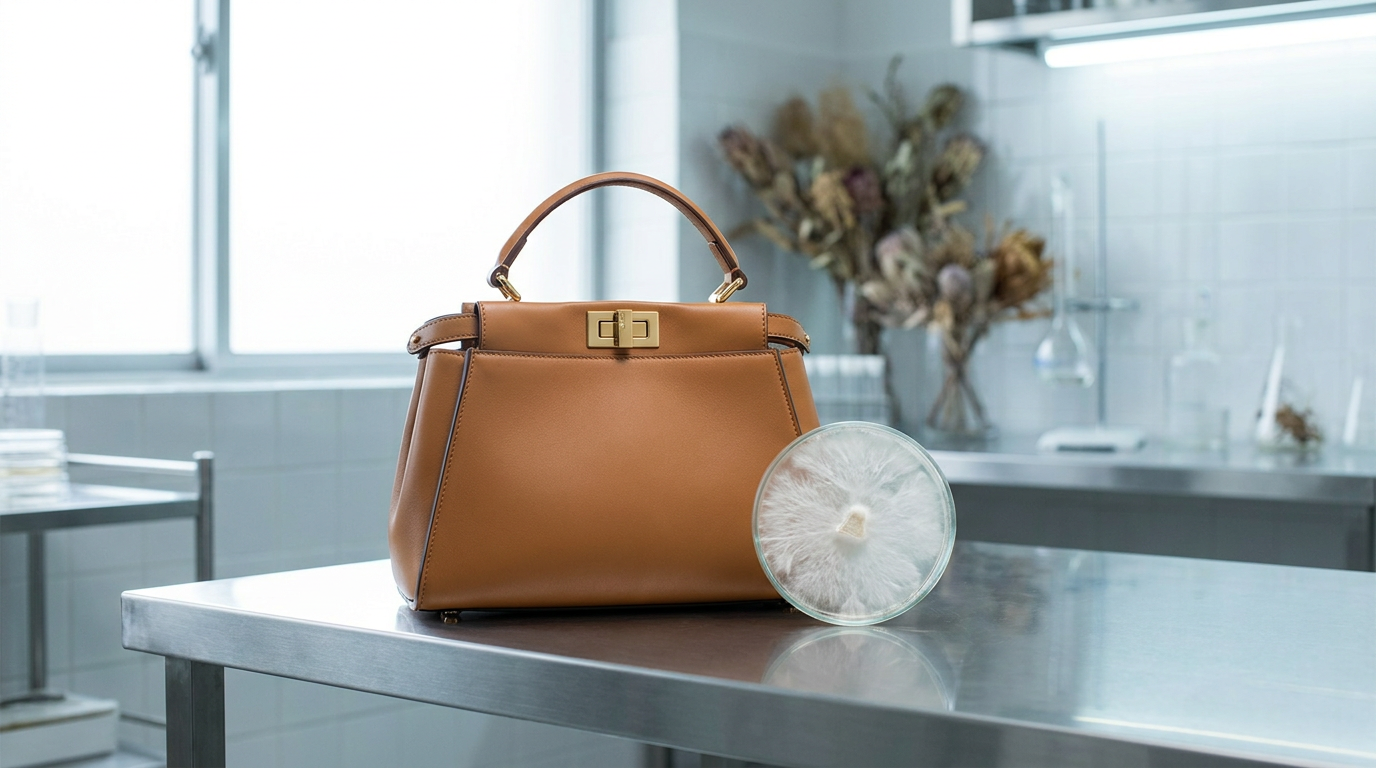
A third option is now moving from science-fiction to commercial reality: leather grown from fungi. Specifically, material innovators are cultivating mycelium, the underground root-like network that supports the visible mushroom. By harnessing the natural binding properties of fungi, biotech startups are producing a material that mimics the feel, warmth, and durability of animal hide without the grim costs to nature.[1][3]
The secret to mycelium's success lies in biomimicry. Mycelium consists of hyphae—microscopic, branching threads that naturally weave together as they grow. This dense, interlocking structure closely mirrors the collagen fibers found in animal skin. Because of this structural similarity, mycelium can replicate the spongy, supple properties of premium leather in a way that flat, extruded plastics simply cannot.[1]
Unlike animal leather, which requires years of resource-intensive livestock rearing, or synthetic leather, which is manufactured in petrochemical plants, mycelium leather is cultivated. The process begins with a nutrient-rich substrate made from agricultural waste, such as sawdust, hemp hurd, or corn stalks. Mushroom spores are introduced to this waste in controlled, vertical-farming trays.[1][3]

Over the course of just two to three weeks, the mycelium consumes the organic waste. As it feeds, it grows upward and binds together, eventually forming a thick, uniform, foam-like mat. The environment—specifically humidity, temperature, and light—is strictly controlled to ensure consistent growth and thickness.[1][3]
Once the mycelium mat reaches the desired density, it is harvested. The remaining substrate byproducts are composted, creating a closed-loop agricultural cycle. The raw mycelium sheet then undergoes a tanning and finishing process. Crucially, this stage utilizes chromium-free and low-impact treatments, avoiding the heavy metals and toxic runoff associated with conventional leather tanning.[1][3]
The environmental math heavily favors this grown approach. Because the fungi obtain the vast majority of their nutrients from a single waste substrate, the process requires very little energy and water. Estimates suggest that cultivating mycelium uses between 90 and 99 percent less water than raising cattle for bovine leather, while generating a fraction of the greenhouse gas emissions.[3][6]
Because the fungi obtain the vast majority of their nutrients from a single waste substrate, the process requires very little energy and water.
A recent comparative Life Cycle Assessment (LCA) conducted by researchers at the KTH Royal Institute of Technology quantified these benefits. The study evaluated bovine, polyurethane, and mycelium leathers across multiple impact categories. Bovine leather scored the worst due to its massive carbon footprint and toxicity potential, while PU leather carried the burden of fossil-fuel reliance. Mycelium leather emerged as the most sustainable alternative, logging the lowest impact scores across all measured categories.[5]

Armed with this data, the fashion industry is transitioning mycelium from a novelty prototype to a runway staple. The market is being driven by luxury houses that need to meet aggressive public climate commitments without compromising on material quality. The European Union's upcoming Digital Product Passport regulations, which will force brands to disclose exact material footprints, are further accelerating the shift toward traceable, low-impact biomaterials.[1][2]
High-profile partnerships are already bearing fruit. Hermès collaborated with biotech firm MycoWorks to develop Sylvania, a mycelium-based material used in its luxury travel bags. Stella McCartney, a long-time pioneer in sustainable fashion, has debuted garments and handbags made from mycelium, proving that the material can meet the exacting aesthetic standards of high fashion.[2]
However, the transition to a fungal fashion economy is not without significant hurdles and scientific uncertainties. The primary point of contention centers on how the material is finished. To achieve the exact grain, texture, and abrasion resistance required by commercial brands, some mycelium leathers are currently treated with thin polyurethane (PU) coatings.[4]
While the base mycelium mat is entirely natural and plastic-free, the addition of a conventional urethane finish compromises the material's biodegradability. Sustainability advocates warn that relying on plastic coatings undercuts the core environmental promise of biomaterials. Manufacturers acknowledge the issue, noting that while they offer bio-based finishing options like waxes or casein, the final choice of coating is often dictated by the brand's durability requirements.[4]

Scaling production to meet global demand presents another formidable challenge. Growing consistent, uniform mycelium sheets at a commercial volume requires massive infrastructure and precise environmental controls. The industry witnessed a high-profile setback when Bolt Threads, an early pioneer backed by major fashion conglomerates, was forced to pause its operations due to high overhead costs and the harsh realities of scaling new supply chains.[2]
Despite these growing pains, the sector remains heavily capitalized, with startups like MycoWorks and Ecovative raising hundreds of millions of dollars to build out commercial-scale vertical farms. As production volumes increase, the cost per square foot is expected to drop, eventually making mycelium competitive with mid-tier animal and synthetic leathers.[2]
Ultimately, mycelium leather represents a fundamental shift in how humans interact with materials. Instead of extracting fossil fuels or exploiting animals, the fashion industry is learning to collaborate with nature's oldest recyclers. By transforming agricultural waste into premium textiles in a matter of weeks, grown materials offer a viable blueprint for a truly circular economy.[1][6]
How we got here
2016
Early prototypes of mycelium materials begin appearing in concept fashion pieces.
2021
Hermès announces a partnership with MycoWorks to develop a mycelium-based travel bag.
2023
Bolt Threads pauses its Mylo operations, highlighting the immense financial challenges of scaling biomaterials.
2025–2026
Mycelium leather enters commercial viability as startups raise hundreds of millions to build dedicated vertical farming facilities.
Viewpoints in depth
Biomaterial Innovators
Startups argue that grown materials are the only scalable way to decouple fashion from animal agriculture and fossil fuels.
Companies like MycoWorks and Ecovative emphasize that mycelium is not just a substitute, but a superior material category. By engineering the growth environment, they can customize the thickness, strength, and flexibility of the material before it is even harvested, eliminating the massive scrap waste associated with cutting traditional animal hides. They view the current reliance on bio-based or PU finishes as a temporary stepping stone while fully biodegradable coatings are perfected.
Sustainability Researchers
Academics emphasize the verified life-cycle benefits but warn against hidden plastics.
Environmental scientists and life-cycle analysts celebrate mycelium's incredibly low water and carbon footprint, noting that it actively upcycles agricultural waste that would otherwise decompose and release methane. However, they caution that the material's circularity is broken if brands insist on applying synthetic polyurethane coatings to achieve a specific aesthetic. Researchers argue that consumers must be willing to accept new textures and aging processes rather than demanding biomaterials perfectly mimic plastic-coated leathers.
What we don't know
- Whether fully biodegradable, plastic-free coatings can be developed that meet the strict durability standards of luxury fashion brands.
- How quickly production costs will fall to make mycelium leather competitive with mass-market polyurethane synthetics.
- Whether mainstream consumers will embrace the natural aging and unique textures of grown materials over time.
Key terms
- Mycelium
- The underground, root-like network of fungi, consisting of microscopic branching threads.
- Hyphae
- The individual microscopic filaments that make up mycelium, which bind together to form dense structures.
- Substrate
- The nutrient-rich base material, often agricultural waste like sawdust or hemp hurd, that fungi feed on to grow.
- Polyurethane (PU)
- A synthetic plastic polymer commonly used in traditional 'vegan leather' and sometimes applied as a thin coating on biomaterials for durability.
- Life Cycle Assessment (LCA)
- A scientific method used to evaluate the environmental impact of a product through its entire lifespan, from raw material extraction to disposal.
Frequently asked
Is mushroom leather actually made from mushrooms?
No, it is made from mycelium, which is the underground root-like structure of fungi, rather than the visible fruiting body (the mushroom).
Does mycelium leather use plastic?
While the base material is entirely natural and plastic-free, some manufacturers currently apply a thin polyurethane (PU) coating to improve durability and texture, which can affect biodegradability.
How long does it take to produce?
Mycelium can be grown into a solid, leather-like mat in just two to three weeks inside controlled vertical farming facilities.
Is it as durable as animal leather?
Premium mycelium leathers have met or exceeded industry benchmarks for flexibility, abrasion resistance, and colorfastness, though achieving consistent quality at mass scale remains a challenge.
Sources
Source coverage
6 outlets
3 viewpoints surfaced






[1]BSL AssociationSustainability Researchers
Mycelium Leather: How Grown Materials Are Redefining the Future of Leather Alternatives
Read on BSL Association →[2]TrellisBiomaterial Innovators
Hèrmes and Stella McCartney embrace a leather alternative: fungus
Read on Trellis →[3]Sentient MediaBiomaterial Innovators
What Is Mushroom Leather Made Of?
Read on Sentient Media →[4]Retail DiveIndustry Watchdogs
Is mycelium leather as sustainable as some claim?
Read on Retail Dive →[5]KTH Royal Institute of TechnologySustainability Researchers
Comparative LCA of bovine, PU and mycelium leather
Read on KTH Royal Institute of Technology →[6]Factlen Editorial TeamIndustry Watchdogs
Synthesis by Factlen editorial team
Read on Factlen Editorial Team →

Every angle. Every day.
Get lifestyle stories with full source coverage and perspective breakdowns delivered to your inbox.