
How Agrivoltaics Work: The Dual-Use Future of Solar and Farming
By elevating solar panels above agricultural fields, engineers are creating microclimates that boost crop yields, save water, and generate clean energy simultaneously.
By Factlen Editorial Team
- Agricultural Researchers
- Focuses on optimizing crop yields, measuring water conservation, and identifying which plant species thrive best under partial shade microclimates.
- Farmers & Landowners
- Views agrivoltaics as a crucial tool for economic resilience, providing a diversified, weather-proof income stream while keeping family land in active agricultural production.
- Ecologists & Conservationists
- Emphasizes the potential to rehabilitate degraded soils, reduce agricultural water consumption, and create vast new habitats for threatened pollinator species.
- General Synthesis
- Provides a broad overview of the technology's mechanics, history, and global adoption trends.
What's not represented
- · Utility-Scale Solar Developers
- · Heavy Machinery Manufacturers
Why this matters
As the world transitions to renewable energy, the competition for land between solar developers and farmers has intensified. Agrivoltaics solves this conflict by stacking both industries on the same footprint, securing the global food supply while accelerating the clean energy transition.
Key points
- Agrivoltaics combines solar energy generation and agriculture on the exact same footprint of land.
- The partial shade from solar panels prevents plants from suffering heat stress by blocking excess sunlight.
- This microclimate significantly reduces soil evaporation, saving vast amounts of irrigation water.
- Moisture released by the crops cools the solar panels, allowing them to generate electricity more efficiently.
- Shade-tolerant crops like leafy greens and tomatoes thrive, while staple crops like wheat require full sun.
- Global adoption could theoretically add 1.8 billion tonnes to annual crop yields and $1 trillion in farm income.
As the world races to decarbonize its power grids, solar energy demands vast tracts of land to meet aggressive climate targets. Traditionally, this rapid expansion has forced a zero-sum conflict in rural communities: a hectare of sun-drenched land can either be used to grow food or to generate electricity, but not both. This tension has frequently led to prime agricultural soil being stripped, compacted, and covered in gravel to make way for utility-scale solar farms, sparking pushback from farming advocates.[4][6]
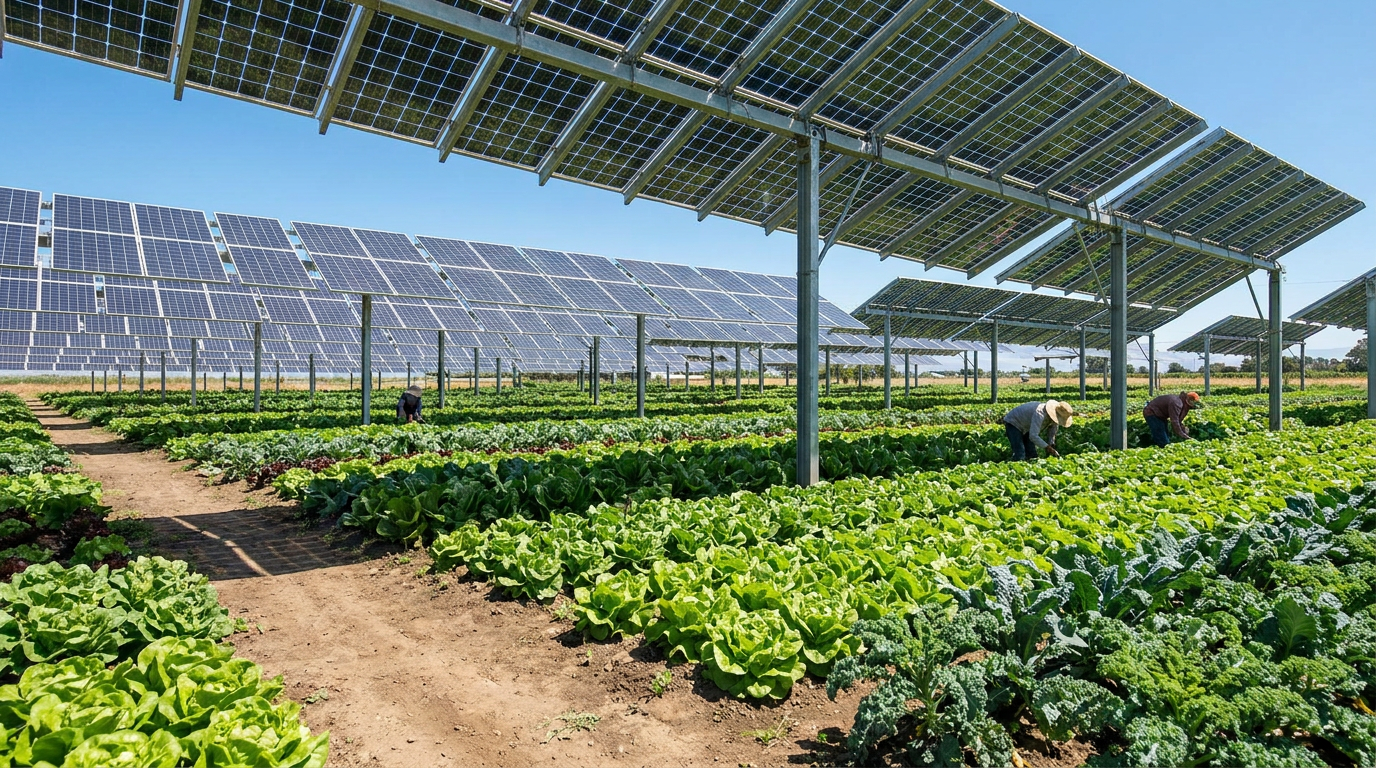
Enter agrivoltaics. Also known as dual-use solar or agro-photovoltaics, this emerging engineering practice integrates renewable energy infrastructure directly into active agricultural land. Instead of clearing the earth and halting food production, developers elevate solar arrays on specialized steel racking systems high above the crops. This three-dimensional approach allows both food and electricity to be harvested from the exact same footprint simultaneously. By stacking these two vital industries, agrivoltaics represents a fundamental shift from land competition to land synergy, offering a compelling solution to the food-energy-water nexus.[5][6]
The concept is rapidly moving from experimental university plots to commercial reality across the globe. In the United States alone, the total footprint of agrivoltaic installations more than doubled from roughly 27,000 acres in 2020 to over 62,000 acres by late 2024. As the underlying technology matures and the economic models prove viable, utility-scale energy developers and local agricultural cooperatives are increasingly partnering to deploy these hybrid systems at scale. This rapid adoption is being driven by a growing recognition that dual-use solar can solve multiple logistical and environmental hurdles simultaneously.[1]
To understand why agrivoltaics is biologically effective, one must look at the botanical concept of the "light saturation point." Every plant species has a strict, evolutionary limit to the amount of direct sunlight it can actually process and use for photosynthesis at any given moment. While sunlight is obviously essential for crop growth, more is not always better. Once a plant reaches its specific saturation threshold, its photosynthetic machinery is essentially maxed out, and any additional solar radiation provides zero benefit to the plant's development.[3][6]

Once a plant crosses this saturation threshold, the excess sunlight becomes an active liability rather than a fuel source. The intense radiation causes severe heat stress, forcing the plant to expend its limited energy drawing up massive amounts of water from the soil simply to replace what is rapidly evaporating from its leaves. During the hottest parts of the afternoon, the plant essentially stops focusing on growing fruit or foliage and shifts entirely into survival and hydration management, wasting both energy and precious groundwater in the process.[3][6]
Agrivoltaic systems are precisely engineered to exploit this biological limit to the benefit of both the farmer and the grid. By carefully calculating the spacing, height, and tilt angle of the solar panels, engineers ensure that the crops below receive exactly enough direct sunlight during the day to reach their maximum saturation point. The solar panels then act as a protective shield, absorbing the excess afternoon solar energy—and converting it into usable electricity—that would otherwise dehydrate and stress the plants below.[3][6]
The resulting microclimate creates a powerful symbiotic relationship between the steel infrastructure and the biological crops. The partial shade cast by the overhead panels significantly reduces evapotranspiration, keeping the soil moist for much longer periods between watering cycles. In arid agricultural environments, such as the sun-baked deserts of California, researchers have documented remarkable evaporation savings ranging from 14 to 29 percent. This drastically reduces the total volume of irrigation water required to keep crops alive, a crucial advantage as global freshwater resources become increasingly scarce.[3][5]
The resulting microclimate creates a powerful symbiotic relationship between the steel infrastructure and the biological crops.
The benefits of this engineered microclimate flow in both directions, improving the performance of the hardware as well. Counterintuitively, photovoltaic solar panels actually lose conversion efficiency when their surface temperatures get too hot. The crops growing beneath the arrays continuously release moisture into the air through a biological process called transpiration, which creates a localized evaporative cooling effect. This gentle, cool updraft lowers the operating temperature of the solar panels above, allowing them to generate electricity more efficiently than they would if they were installed over bare, heat-reflecting dirt or gravel.[1][5]

The National Renewable Energy Laboratory (NREL) has been at the forefront of quantifying these complex interactions through its long-running InSPIRE project. NREL researchers have established rigorous, data-driven test sites across the United States, including high-profile partnerships with the Denver Botanic Gardens and various commercial farming operations. Their primary goal is to meticulously monitor how different types of vegetation perform under the partial shade of commercial solar arrays, gathering actionable data on crop yields, soil moisture retention, and overall system economics to share with the broader agricultural community.[1]
The accumulated data reveals that not all crops are perfectly suited for dual-use systems. Staple commodity crops like wheat, corn, and soybeans require massive amounts of uninterrupted sunlight to reach maturity and generally struggle to thrive under the partial shade of solar arrays. However, shade-tolerant specialty crops—including leafy greens, root vegetables, tomatoes, and peppers—often see noticeably increased yields when protected from the harsh midday sun. By shielding these sensitive plants from extreme heat, agrivoltaics extends their growing season and improves the overall quality of the harvest.[1][6]
Beyond traditional crop cultivation, the agrivoltaic umbrella encompasses other highly effective forms of agriculture. One of the most popular and easily scaled applications across the industry is solar grazing, where flocks of sheep are deployed to forage directly beneath the low-mounted panels. The sheep naturally manage the vegetation and keep weeds from shading the lower edges of the solar modules, saving energy developers the significant recurring cost of mechanical mowing. In return, the solar panels provide the animals with vital, cooling shade during the hottest days of summer, improving livestock welfare.[4]

Another rapidly growing variation of the concept, often termed "ecovoltaics," focuses entirely on ecological restoration rather than direct food production. Instead of planting commercial crops, the land beneath the solar arrays is intentionally seeded with deep-rooted native grasses and pollinator-friendly wildflowers. This restorative approach rehabilitates degraded topsoil, prevents dangerous agricultural runoff, and supports threatened local bee and butterfly populations. By creating massive new sanctuaries for these crucial insects, ecovoltaic installations ultimately improve the yield of adjacent agricultural fields that rely heavily on natural pollination to produce fruit.[5]
The economic implications for rural farming communities are profound and potentially transformative. For independent farmers facing increasingly unpredictable weather patterns, prolonged droughts, and wildly fluctuating global commodity prices, leasing a portion of their vertical airspace for solar generation provides a highly stable, weather-proof income stream. This guaranteed annual revenue acts as a financial shock absorber, allowing farmers to reinvest in their equipment and operations without being forced to sell off their family land to developers or take it out of active agricultural production entirely.[4][6]
On a macro scale, the global potential of widespread agrivoltaic adoption is staggering. A comprehensive analysis published in the peer-reviewed journal Nature Sustainability estimated that deploying agrivoltaics globally on all suitable agricultural land could theoretically add over 1,800 million tonnes to annual crop yields. By optimizing the light and water efficiency of the world's existing farmland, this dual-use infrastructure could dramatically increase the total volume of food produced without requiring the deforestation of a single additional acre of wild habitat.[2]
The same Nature Sustainability study projected the financial windfall of such a transition, estimating that this dual-use approach could generate over $1 trillion in added global agricultural income for rural economies. Simultaneously, the vast network of overhead solar panels would produce enough clean, renewable energy to meet a massive portion of the world's aggressive climate targets. This dual-output model provides a rare, tangible proof of concept that aggressive ecological preservation and robust economic growth do not have to be mutually exclusive endeavors.[2]

Challenges certainly remain for the industry, particularly regarding the high initial capital costs of building elevated steel racking systems and the need for specialized farming equipment to safely navigate around the structural pylons. However, rapid engineering innovations in the sector are quickly mitigating these hurdles. The development of semi-transparent solar glass that lets specific photosynthetic light wavelengths pass through to the plants, alongside vertically mounted bifacial panels that leave wide, unobstructed tractor lanes open, are rapidly expanding the design possibilities and lowering the barrier to entry for farmers.[6]
As climate change continues to intensify both summer heat waves and prolonged regional droughts, the global agricultural sector is being forced to rapidly adapt its traditional practices simply to survive. Agrivoltaics offers a rare, highly engineered paradigm where renewable energy production and global food security are no longer locked in a bitter, zero-sum competition for finite land. Instead, by stacking these two critical infrastructures vertically, they actively enhance, cool, and protect one another, charting a sustainable path forward for both the grid and the farm.[6]
Viewpoints in depth
Agricultural Researchers
Focuses on optimizing crop yields, measuring water conservation, and identifying which plant species thrive best under partial shade microclimates.
For agricultural scientists, the primary appeal of agrivoltaics lies in its ability to manipulate microclimates to protect vulnerable crops from the escalating extremes of climate change. Researchers at institutions like the National Renewable Energy Laboratory meticulously track metrics such as soil moisture retention, ambient temperature drops, and photosynthetic efficiency under various panel configurations. Their data proves that by shielding plants from the harshest afternoon sun, farmers can significantly reduce their reliance on irrigation while simultaneously extending the growing season for heat-sensitive specialty crops.
Farmers & Landowners
Views agrivoltaics as a crucial tool for economic resilience, providing a diversified, weather-proof income stream while keeping family land in active agricultural production.
From the perspective of independent farmers, agrivoltaics is fundamentally an economic lifeline. Facing unpredictable weather patterns, prolonged droughts, and volatile commodity markets, farmers are constantly seeking ways to stabilize their revenue. Leasing vertical airspace to solar developers provides a guaranteed, long-term income stream that is entirely immune to crop failures or market crashes. Crucially, unlike traditional solar leases that require paving over the soil, dual-use systems allow farmers to keep their ancestral land in active production, preserving their rural heritage while modernizing their operations.
Ecologists & Conservationists
Emphasizes the potential to rehabilitate degraded soils, reduce agricultural water consumption, and create vast new habitats for threatened pollinator species.
Ecologists view the rapid expansion of solar infrastructure as a unique opportunity to reverse decades of environmental degradation caused by industrial monoculture farming. By advocating for 'ecovoltaics'—the practice of planting native grasses and wildflowers beneath solar arrays instead of commercial crops—conservationists aim to rebuild depleted topsoil and eliminate toxic agricultural runoff. Furthermore, these massive, protected tracts of land serve as vital sanctuaries for threatened bee and butterfly populations, which in turn supports the broader ecological health of the surrounding region.
What we don't know
- How the long-term presence of heavy steel infrastructure will affect deep soil compaction over decades of use.
- Whether the high initial capital costs of elevated racking systems can be driven down enough to make the technology accessible to small-scale farmers without heavy government subsidies.
Key terms
- Agrivoltaics
- The simultaneous use of land for both solar energy generation and agricultural production.
- Evapotranspiration
- The combined process of water evaporating from the soil and transpiring from plant leaves into the atmosphere.
- Light Saturation Point
- The maximum amount of direct sunlight a plant can absorb and use for photosynthesis before excess light causes heat stress.
- Bifacial Solar Panels
- Solar modules designed to capture sunlight on both their front and back sides, utilizing light reflected off the ground.
- Ecovoltaics
- A variation of agrivoltaics focused on ecological restoration, such as planting native grasses and pollinator habitats beneath solar arrays.
Frequently asked
Can you grow any crop under solar panels?
No. Staple crops like corn and wheat require full, uninterrupted sunlight. Agrivoltaics works best with shade-tolerant crops like leafy greens, root vegetables, and certain fruits.
Do the solar panels get in the way of farm tractors?
Commercial systems are specifically engineered with elevated mounts and wide spacing to allow standard agricultural machinery to pass underneath and between the rows.
How do solar panels save water?
By providing partial shade, the panels lower the soil temperature and reduce the rate of evaporation, allowing the ground to retain moisture for much longer.
Does the heat from the crops affect the solar panels?
Yes, but in a positive way. Plants release moisture through transpiration, which creates a localized cooling effect that actually helps solar panels operate more efficiently.
Sources
Source coverage
6 outlets
4 viewpoints surfaced






[1]National Renewable Energy LaboratoryAgricultural Researchers
Agrivoltaics: Solar and Agriculture Co-Location
Read on National Renewable Energy Laboratory →[2]Nature SustainabilityAgricultural Researchers
Agrivoltaics: dual usage of agricultural land for sustainable development
Read on Nature Sustainability →[3]WikipediaGeneral Synthesis
Agrivoltaics
Read on Wikipedia →[4]American Farmland TrustFarmers & Landowners
Smart Solar and Dual-Use Farming
Read on American Farmland Trust →[5]Union of Concerned ScientistsEcologists & Conservationists
Agrivoltaics and Ecovoltaics: Sustainable Agriculture
Read on Union of Concerned Scientists →[6]Factlen Editorial TeamGeneral Synthesis
Synthesis by Factlen editorial team
Read on Factlen Editorial Team →



Every angle. Every day.
Get guides stories with full source coverage and perspective breakdowns delivered to your inbox.