
China's Massive JUNO Underground Detector Publishes First Neutrino Results in Nature
The Jiangmen Underground Neutrino Observatory has released its first physics results, measuring the elusive 'ghost particles' with unprecedented precision and marking a major milestone in particle physics.
By Factlen Editorial Team
- Standard Model Physicists
- Focused on measuring precise oscillation parameters to complete the current framework of particle physics.
- Cosmologists & Astrophysicists
- Focused on how neutrino mass ordering explains the Big Bang and matter-antimatter asymmetry.
- International Collaborators
- Focused on the engineering success of the massive underground facility and cross-border scientific cooperation.
What's not represented
- · Theoretical physicists proposing alternative models to the Standard Model
- · Engineers who designed the ultra-pure liquid scintillator systems
Why this matters
Understanding the exact properties of neutrinos is one of the final missing pieces of the Standard Model of physics. Solving this puzzle could ultimately explain why the universe is made of matter rather than antimatter, shedding light on the very origins of our existence.
Key points
- The Jiangmen Underground Neutrino Observatory (JUNO) published its first physics results in the journal Nature based on 59 days of data.
- The facility measured two key neutrino oscillation parameters with a 1.6-fold improvement in precision over the combined results of past decades.
- JUNO's data confirmed the 'solar neutrino tension,' a lingering discrepancy between solar and reactor neutrino measurements.
- The ultimate goal of the $376 million underground detector is to determine the 'mass ordering' of the three neutrino flavors.
Deep beneath the bedrock of southern China, the world's largest transparent spherical detector has captured its first major glimpse of the universe's most elusive particles. The Jiangmen Underground Neutrino Observatory (JUNO) has officially published its first physics results in the journal Nature, marking a new era of precision in particle physics. Based on just 59 days of valid data collected between August and November 2025, the international research team has measured two key parameters of "neutrino oscillation" with unprecedented accuracy. The findings reduce the associated uncertainties by a factor of 1.6 compared to the combined results of all previous global experiments conducted over the past several decades. For a facility that took over a decade to design and build, the rapid turnaround from first light to a cover-story publication in Nature signals that the detector is performing exactly as theorists had hoped.[1][2][3]
Often dubbed "ghost particles," neutrinos are among the most abundant fundamental particles in the universe, dating back to the immediate aftermath of the Big Bang. They are continuously produced by nuclear reactions in the core of the Sun, the violent explosions of dying stars, and the radioactive decay of elements deep within the Earth. Yet they carry no electrical charge and possess a mass so minuscule it has never been precisely measured. Trillions of them pass harmlessly through the human body every second, interacting with ordinary matter so rarely that a neutrino could travel through a light-year of solid lead with only a 50 percent chance of hitting an atom. Detecting them requires colossal, highly sensitive instruments buried deep underground to filter out the noisy background radiation of cosmic rays.[3][5][6]
As neutrinos travel through space at near light-speed, they exhibit a bizarre quantum behavior known as "oscillation." They continuously morph between three distinct varieties, or "flavors"—electron, muon, and tau. The discovery of this shape-shifting ability, which won the Nobel Prize in Physics in 2015, was revolutionary because it proved that neutrinos must have mass, contradicting the original assumptions of the Standard Model of particle physics. However, the exact mechanics of how and why they shift identities remain partially obscured. Physicists use a mathematical framework called the PMNS matrix to describe these transformations, which relies on six specific parameters. Pinning down the exact values of these parameters is considered paramount to completing our understanding of the subatomic world.[3][5][6]

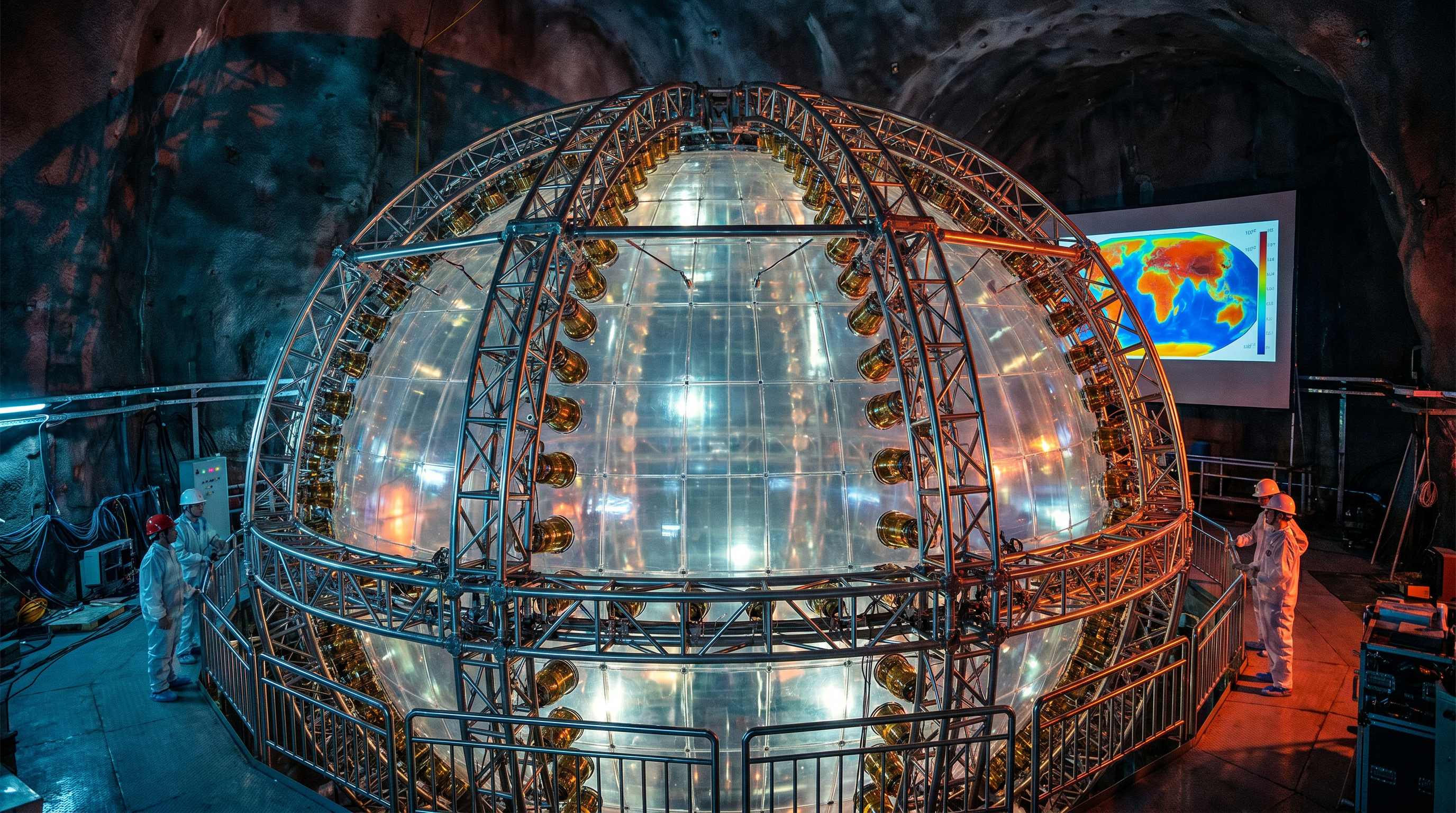
To catch these shape-shifting particles and measure their properties, JUNO was constructed 700 meters (2,297 feet) underground in Guangdong Province. The heart of the $376 million observatory is an engineering marvel: a 35.4-meter-diameter transparent acrylic sphere containing 20,000 tonnes of ultra-pure liquid scintillator. This massive volume of liquid acts as the target for the incoming particles. JUNO is strategically positioned exactly 52.5 kilometers away from the Taishan and Yangjiang nuclear power plants, which serve as massive, steady, and controllable sources of electron antineutrinos. This specific baseline distance was chosen because it corresponds to the precise distance where the oscillation effect they are trying to measure reaches its maximum mathematical amplitude.[4][5][6]
When a rare electron antineutrino from one of the reactors manages to collide with a proton inside the liquid scintillator, it triggers a reaction known as inverse beta decay. This collision produces a positron and a neutron, which in turn generate a faint, microscopic flash of light. Surrounding the central acrylic sphere is a stainless steel truss holding more than 45,000 photomultiplier tubes—highly sensitive light detectors that capture these microscopic flashes and convert them into electrical signals. By analyzing the exact intensity and timing of these flashes, physicists can reconstruct the original energy of the neutrino with unprecedented resolution, allowing them to track exactly how many electron antineutrinos survived the 53-kilometer journey without changing flavor.[3][4][6]
This collision produces a positron and a neutron, which in turn generate a faint, microscopic flash of light.
One of the immediate and most intriguing outcomes of JUNO's first data release is the confirmation of a lingering discrepancy in particle physics known as the "solar neutrino tension." For years, measurements of oscillation parameters using neutrinos emitted by the Sun have differed slightly from the measurements obtained using reactor neutrinos. The gap is small—about 1.5 standard deviations—but persistent enough to bother theorists. JUNO's highly precise reactor data confirms that this discrepancy is real and not merely an artifact of older, less sensitive equipment. Researchers note that this tension might hint at entirely new physics beyond the Standard Model, forcing theorists to re-evaluate how neutrinos interact with the dense matter inside the Sun compared to the vacuum of space.[4][6]

While the initial precision measurements are a triumph, JUNO's primary scientific objective is to solve the "neutrino mass ordering" problem. Physicists know the three neutrino flavors have different masses, but they do not know which is the heaviest and which is the lightest. They know that two of the mass states are relatively close together, while the third is an oddball. Determining whether the mass hierarchy is "normal" (where the oddball is the heaviest) or "inverted" (where the oddball is the lightest) is the holy grail of modern neutrino physics. JUNO is the first experiment designed to tackle this question by looking at the fine ripples in the energy spectrum of reactor antineutrinos.[2][3][5]
Solving the mass ordering puzzle is not just a bookkeeping exercise for particle physicists; it has profound cosmological implications. The mass hierarchy is a crucial input for understanding the formation of large-scale structures in the early universe. Furthermore, knowing the mass ordering is essential for the success of future experiments searching for "neutrinoless double-beta decay"—a hypothesized process that could prove neutrinos are their own antiparticles. If true, this would provide a mathematical mechanism to explain why the universe is made almost entirely of matter, rather than an equal mix of matter and antimatter that should have annihilated itself immediately after the Big Bang.[3][5][6]

The Nature publication serves as a resounding proof-of-concept for the colossal engineering effort behind JUNO. Reviewers noted that the results validate the detector's performance and establish the facility as a key player in the emerging precision era of neutrino physics. Arthur McDonald, who shared the 2015 Nobel Prize for the discovery of solar neutrino oscillation, praised the milestone. He noted that JUNO has successfully met its ambitious design objectives, achieving exceptional radiopurity and energy resolution, and is now fully ready to pursue its long-term physics goals.[1][3][6]
JUNO is designed for a scientific lifespan of up to 30 years, and its mission extends far beyond the reactor neutrinos it has measured so far. The observatory will act as a global watchtower for the intense bursts of neutrinos released by distant supernovae, potentially giving astronomers advance warning of exploding stars. It will also study geoneutrinos to map the heat-producing radioactive decay deep within the Earth's mantle. As data collection continues, the international collaboration of over 700 researchers from 17 countries expects to steadily unlock new insights. The ghost particles that have silently permeated the universe since its birth are finally being forced to reveal their secrets.[2][4][6]
How we got here
2008
The JUNO experiment is first proposed by physicists.
2015
Underground excavation and construction begins in Guangdong Province.
Dec 2024
Installation of the massive 35.4-meter acrylic detector sphere is completed.
Aug 2025
JUNO successfully completes filling 20,000 tonnes of liquid scintillator and begins taking data.
Jun 2026
The first physics results are published in Nature, achieving unprecedented precision.
Viewpoints in depth
Particle Physicists
Focus on the precision of the Standard Model parameters and the resolution of the mass ordering problem.
For the particle physics community, JUNO's initial results are a massive relief. The 1.6-fold improvement in precision over decades of combined previous experiments proves that the detector's unprecedented energy resolution is working as designed. Physicists are particularly focused on the confirmation of the "solar neutrino tension," viewing it not as an error, but as a potential crack in the Standard Model that could point toward new, undiscovered interactions between neutrinos and dense matter.
Cosmologists and Astrophysicists
Focus on the implications for the early universe, matter-antimatter asymmetry, and supernova detection.
Cosmologists view JUNO's ultimate goal—determining the neutrino mass ordering—as a critical missing variable in their equations of the early universe. Knowing the exact mass hierarchy will constrain models of how galaxies formed and will guide the search for neutrinoless double-beta decay. Furthermore, astrophysicists are eager to use JUNO as a deep-space early warning system; its massive volume makes it highly sensitive to the sudden flood of neutrinos that precede the visible light of a supernova explosion.
What we don't know
- Which neutrino mass state is the heaviest (the 'mass ordering' problem), though JUNO expects to solve this within a few years.
- Whether the confirmed 'solar neutrino tension' is a simple measurement artifact or evidence of entirely new physics beyond the Standard Model.
- Whether neutrinos are their own antiparticles, a question that future upgrades to JUNO may help answer.
Key terms
- Neutrino Oscillation
- The quantum process by which a neutrino changes from one flavor (electron, muon, or tau) to another as it travels.
- Liquid Scintillator
- A specialized ultra-pure fluid that emits a faint flash of light when struck by certain subatomic particles.
- Photomultiplier Tube
- A highly sensitive vacuum tube device that detects extremely faint flashes of light and converts them into measurable electrical signals.
- Standard Model
- The prevailing theoretical framework in physics that describes all known fundamental particles and the forces that govern their interactions.
- Inverse Beta Decay
- The specific nuclear reaction JUNO uses to detect antineutrinos, where an antineutrino collides with a proton to produce a positron and a neutron.
Frequently asked
What is a neutrino?
A neutrino is a fundamental subatomic particle with no electrical charge and an incredibly tiny mass. They are among the most abundant particles in the universe but rarely interact with ordinary matter.
Why is the JUNO detector built so deep underground?
JUNO is located 700 meters underground to shield its highly sensitive detectors from cosmic rays and background radiation on the Earth's surface, which would otherwise drown out the faint neutrino signals.
What is "neutrino oscillation"?
Neutrino oscillation is a quantum phenomenon where a neutrino changes its "flavor" (electron, muon, or tau) as it travels through space. This behavior proves that neutrinos have mass.
What does "mass ordering" mean?
Physicists know the three types of neutrinos have different masses, but they don't know which is the heaviest. Determining this order is crucial for understanding the early universe and the nature of matter.
Sources
Source coverage
6 outlets
3 viewpoints surfaced






[1]NatureStandard Model Physicists
Measurement of reactor neutrino oscillation with the first JUNO data
Read on Nature →[2]XinhuaInternational Collaborators
China's JUNO team releases first physics result about neutrino in Nature
Read on Xinhua →[3]China DailyInternational Collaborators
Chinese scientists report first physics results from Jiangmen Underground Neutrino Observatory
Read on China Daily →[4]CGTNInternational Collaborators
China's JUNO publishes first physics result in Nature
Read on CGTN →[5]Associated PressCosmologists & Astrophysicists
An underground detector in China unveils its first major findings about mysterious ghost particles
Read on Associated Press →[6]Institute of High Energy PhysicsStandard Model Physicists
First Physics Result of the Jiangmen Underground Neutrino Observatory Published in Nature
Read on Institute of High Energy Physics →

More in science
See all 35 stories →Longevity Science
How Sleep and Exercise Disarm the Genetic Mutations That Cause Heart Disease
8 sources

AI Hardware
A New Analog Chip Architecture Cuts AI Energy Use by 47x for 3D Vision
6 sources
Climate Data
Earth's Warming Rate Hits Record 0.27°C Per Decade as 1.5°C Carbon Budget Narrows
7 sources

Precision Medicine
Precision Lifestyle: How Sleep and Exercise Target Specific Genetic Drivers of Heart Disease
7 sources

Every angle. Every day.
Get science stories with full source coverage and perspective breakdowns delivered to your inbox.