
A Hybrid Chemical-Biological Process Turns Plant Waste Into the Precursor for Nylon
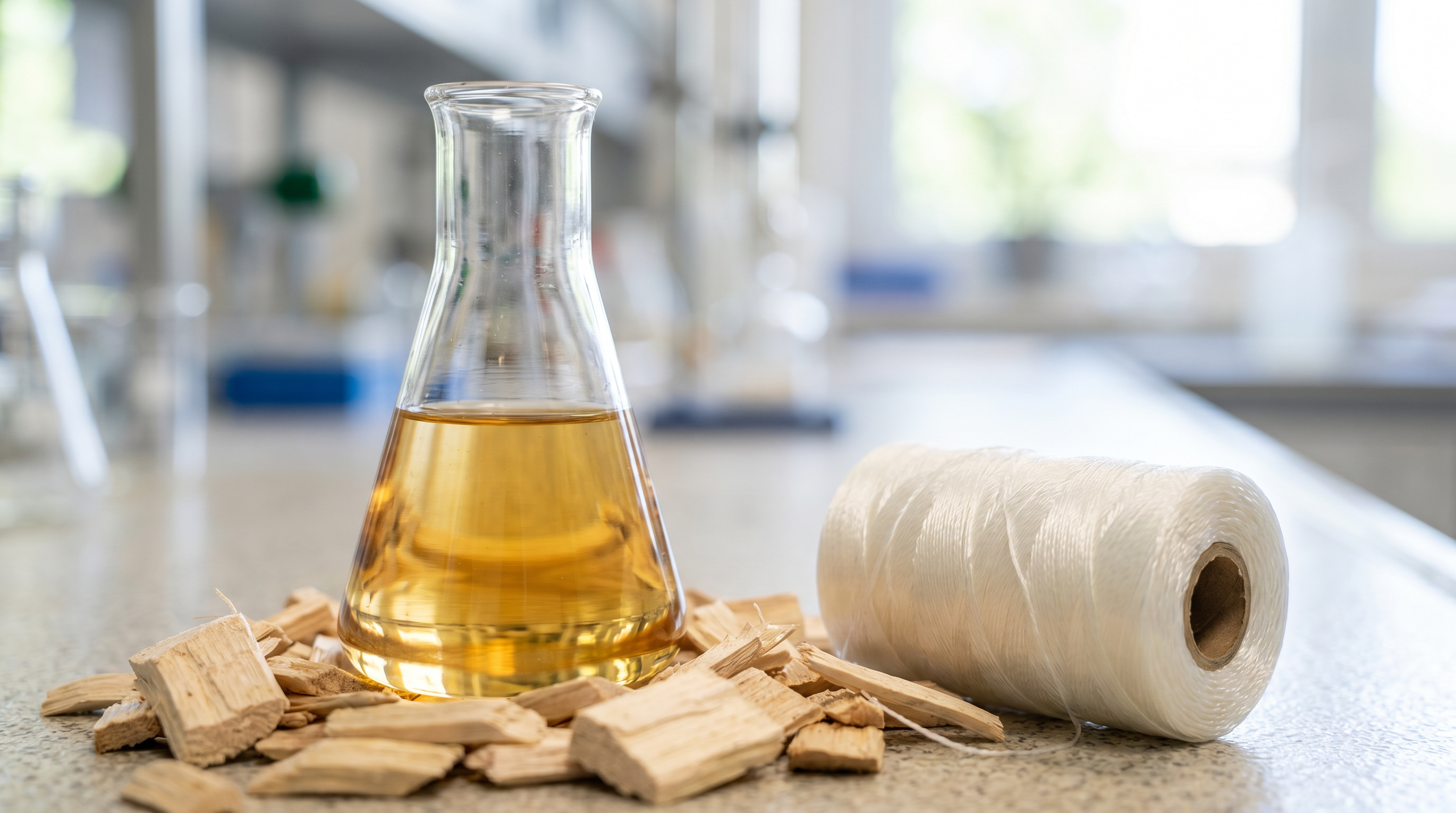
Researchers have developed a high-yield method to convert lignin, a massive industrial waste product, into adipic acid. The breakthrough could decarbonize the production of nylon and eliminate a major source of nitrous oxide emissions.
By Factlen Editorial Team
- Green Chemistry Researchers
- Focuses on the elegant integration of chemical catalysis and biological funneling to solve the lignin recalcitrance problem.
- Industrial Manufacturers
- Prioritizes the economic viability, catalyst lifespan, and scalability required to replace a 3.2-million-ton petrochemical supply chain.
- Climate Policy Advocates
- Emphasizes the urgent need to eliminate industrial nitrous oxide emissions, a massive but often overlooked driver of global warming.
What's not represented
- · Paper and pulp mill operators who would need to integrate these new chemical processes into their existing waste management streams.
- · Consumer apparel brands that rely heavily on nylon and are seeking to decarbonize their supply chains.
Why this matters
Adipic acid is essential for making nylon and polyurethanes, but its current petroleum-based production releases massive amounts of nitrous oxide—a greenhouse gas 298 times more potent than CO2. This new process solves two environmental crises at once by eliminating those emissions and finding a highly valuable use for the 50 million tons of lignin waste generated annually by the paper and biofuel industries.
Key points
- Adipic acid, the key precursor to nylon, is currently produced from petroleum in a process that emits massive amounts of nitrous oxide.
- Lignin is a tough plant polymer that generates 50 to 70 million tons of industrial waste annually.
- A new study in Nature details a hybrid process that successfully converts lignin into high-purity adipic acid.
- The method uses chemical catalysts to break down the lignin, followed by engineered bacteria that funnel the fragments into a single product.
- The breakthrough achieves unprecedented yields, overcoming a major historical hurdle in plant-waste valorization.
- Commercialization will require scaling up the bioreactors and proving the economics against entrenched petrochemical supply chains.
Nylon is woven into the fabric of modern life, found in everything from clothing and carpets to automotive parts and electrical connectors. But the chemical foundation of this versatile material relies on an environmental disaster. The primary precursor to nylon 6,6 is a white crystalline powder called adipic acid, a commodity chemical produced on a massive scale.[3]
The global economy consumes over 3.2 million metric tons of adipic acid every year. The vast majority of this supply is manufactured through the oxidation of petroleum-derived cyclohexane using nitric acid. While cost-effective, this traditional petrochemical route has a severe ecological flaw: it releases nitrous oxide (N2O) as an unavoidable byproduct.[3][4]
Nitrous oxide is a potent greenhouse gas with a global warming potential 298 times greater than that of carbon dioxide. Furthermore, it is currently the leading ongoing source of ozone layer depletion. Although many modern chemical plants have installed abatement technologies to capture N2O, the sheer scale of global adipic acid production means that fugitive emissions remain a significant climate liability.[4]
For decades, green chemistry researchers have searched for a biological, renewable pathway to synthesize adipic acid. The ideal feedstock would be cheap, abundant, and rich in carbon. Enter lignin. Lignin is the second most abundant organic polymer on Earth, acting as the natural "glue" that gives plant cell walls their structural rigidity.[1][5]

Because it is so tough, lignin is a massive nuisance for the paper and biofuel industries. When wood is pulped to extract cellulose, the lignin is left behind. Globally, industrial facilities generate between 50 and 70 million tons of lignin waste every year. Most of it is simply burned for low-grade heat because its complex, irregular molecular structure makes it notoriously difficult to break down into useful chemicals.[5]
Now, a multi-institutional team of researchers has published a breakthrough in the journal Nature, detailing a hybrid process that successfully transforms stubborn lignin into high-purity adipic acid. The method achieves yields that fundamentally surpass previous attempts, offering a viable path to decarbonize the nylon supply chain.[1][6]
The research, led by scientists at the National Renewable Energy Laboratory (NREL) alongside collaborators from the University of Wisconsin-Madison and MIT, solves the lignin problem by splitting the conversion into two distinct stages: a chemical depolymerization followed by a biological refinement.[1][2]
The first stage of the process relies on chemical catalysis. The researchers utilized an oxidative depolymerization technique to break the chaotic, tightly bound lignin polymer into a "privileged" mixture of smaller, simpler aromatic molecules. This step essentially untangles the biological knot of the plant matter.[1][5]

The first stage of the process relies on chemical catalysis.
However, chemical depolymerization alone typically yields a messy soup of different compounds, which is economically disastrous because separating them costs more than the chemicals are worth. This is where the second stage—biological funneling—comes into play.[1]
The team engineered specialized bacteria capable of "eating" the diverse mixture of aromatic molecules produced in the first step. Through a biological redox process, these microbes metabolize the varied compounds and funnel them into a single, highly valuable output: adipic acid.[1][6]
The evidence for the process's efficacy lies in its unprecedented yield. Previous attempts to valorize lignin rarely achieved conversion rates above 20 percent by weight. The new hybrid approach dramatically exceeds that threshold, producing a single, pure product that does not require expensive downstream separation.[1][5]
By mimicking the efficiency of petrochemical refining—where crude oil is systematically broken down and reformed into specific molecules—the researchers have demonstrated that bio-refining can achieve similar precision using renewable plant waste.[1]

Despite the elegant chemistry, transparent uncertainties remain regarding the timeline for commercialization. The laboratory-scale success must now be translated into industrial bioreactors capable of processing thousands of tons of lignin continuously.[1][3]
Economic viability is the primary hurdle. The chemical catalysts used in the first depolymerization stage must be robust enough to handle the impurities found in raw industrial lignin without degrading. Furthermore, the engineered bacteria must maintain high productivity in large-scale fermentation tanks, where conditions are far less controlled than in a laboratory flask.[2][3]
Market analysts note that the transition to bio-based adipic acid is already gaining momentum. In 2023, over 100 kilotons of bio-based adipic acid were produced globally using simpler feedstocks like glucose. Moving to a waste feedstock like lignin would drastically improve the life-cycle emissions and land-use footprint of the process.[3]
If successfully scaled, this hybrid redox process could fundamentally alter the economics of biorefineries. Currently, biofuel plants struggle with profitability because they only monetize the cellulose in plants. Turning their largest waste stream into a premium chemical precursor could make renewable fuels significantly more competitive.[1][5]

How we got here
1990s
Adipic acid production is identified as the largest industrial source of nitrous oxide emissions, prompting the installation of abatement technologies.
2010s
Researchers heavily invest in 'biological funneling' to try and convert complex plant waste into useful chemicals, but yields remain low.
2023
Bio-based adipic acid production reaches 100 kilotons globally, though mostly relying on simple sugars rather than complex waste.
June 2026
Researchers publish a breakthrough in Nature demonstrating a high-yield hybrid process to convert lignin directly into adipic acid.
Viewpoints in depth
Green Chemistry Researchers
Focuses on the elegant integration of chemical catalysis and biological funneling.
For researchers in sustainable chemistry, the true triumph of this study is the successful marriage of two disciplines that are often siloed. Chemical depolymerization is fast and powerful but notoriously unselective, creating a messy soup of molecules. Biology, conversely, is highly selective but struggles to break down tough polymers quickly. By using chemistry to shatter the lignin and engineered bacteria to sort and funnel the pieces, researchers have proven that hybrid redox processes can achieve the precision of petrochemical refining using renewable waste.
Industrial Manufacturers
Prioritizes the economic viability and scalability required to replace a massive petrochemical supply chain.
From an industry perspective, the science is promising but the economics remain unproven. The global market consumes over 3.2 million metric tons of adipic acid annually, supported by highly optimized, deeply entrenched petrochemical infrastructure. Manufacturers point out that the chemical catalysts used in the first stage must be cheap and resilient enough to handle raw, impure industrial lignin without degrading. Furthermore, scaling up biological fermentation to produce millions of tons of commodity chemicals requires massive capital investment in new biorefinery infrastructure.
Climate Policy Advocates
Emphasizes the urgent need to eliminate industrial nitrous oxide emissions.
Climate advocates view this breakthrough as a critical tool for addressing a hidden driver of global warming. While carbon dioxide dominates the climate conversation, nitrous oxide is nearly 300 times more potent and actively depletes the ozone layer. Because adipic acid production is a major point-source of N2O, transitioning the nylon supply chain to a bio-based, zero-emission process is seen as a high-leverage climate victory. Advocates argue that government incentives and carbon pricing will be necessary to help this nascent technology compete with cheap, polluting fossil fuels.
What we don't know
- Whether the chemical catalysts can maintain their efficiency when exposed to the highly impure, raw lignin streams produced by commercial paper mills.
- The exact capital cost required to retrofit existing biorefineries with the necessary chemical and biological reactor infrastructure.
- How quickly the nylon industry will adopt bio-based adipic acid given the deeply entrenched, highly optimized petrochemical supply chains.
Key terms
- Adipic acid
- A commodity chemical primarily used as a building block for producing nylon and polyurethanes.
- Lignin
- A complex organic polymer that forms key structural materials in the support tissues of most plants, making wood stiff and resistant to rot.
- Nitrous oxide (N2O)
- A potent greenhouse gas and ozone-depleting substance emitted as a byproduct of traditional adipic acid and fertilizer production.
- Redox process
- A type of chemical reaction that involves a transfer of electrons between two species, combining reduction and oxidation.
- Biological funneling
- A bioengineering technique where microbes are designed to consume a messy mixture of different chemical compounds and convert them all into a single, pure product.
- Depolymerization
- The process of breaking down a large, complex polymer molecule into its simpler, smaller building blocks.
Frequently asked
What is adipic acid used for?
It is primarily used as a precursor to manufacture nylon 6,6, which is found in clothing, carpets, automotive parts, and polyurethanes.
Why is the current production method harmful?
Traditional adipic acid production relies on petroleum and emits nitrous oxide (N2O), a greenhouse gas 298 times more potent than carbon dioxide.
What is lignin?
Lignin is a tough, natural polymer that gives plant cell walls their rigidity. It is a massive waste product of the paper and biofuel industries.
How does the new process work?
It uses a two-step hybrid approach: chemical catalysts first break the tough lignin into smaller molecules, and then engineered bacteria consume those molecules to produce pure adipic acid.
Sources
Source coverage
6 outlets
3 viewpoints surfaced






[1]NatureGreen Chemistry Researchers
Lignin to adipic acid in a high-yield chemical and biological redox process
Read on Nature →[2]University of Wisconsin-MadisonGreen Chemistry Researchers
Stahl Research Group: Lignin Valorization and Aerobic Oxidation
Read on University of Wisconsin-Madison →[3]Market Reports WorldIndustrial Manufacturers
Global Adipic Acid Market Trends and Sustainability Shifts 2026
Read on Market Reports World →[4]Climate Action ReserveClimate Policy Advocates
Adipic Acid Production Protocol and N2O Abatement
Read on Climate Action Reserve →[5]PronedraIndustrial Manufacturers
American scientists develop a two-stage process to turn lignin into adipic acid
Read on Pronedra →[6]Upbeat BytesGreen Chemistry Researchers
Lignin to adipic acid in a high-yield chemical and biological redox process
Read on Upbeat Bytes →
More in science
See all 38 stories →AI Hardware
A New 'Computing-in-Memory' Chip Breaks the AI Bottleneck for 3D Vision
7 sources

Cellular Aging
Sleep and Exercise Can 'Turn Off' Heart Disease Risks from Mutant Blood Cells
6 sources

Particle Physics
China's Massive JUNO Underground Detector Publishes First Neutrino Results in Nature
6 sources

Longevity Science
How Sleep and Exercise Disarm the Genetic Mutations That Cause Heart Disease
8 sources

Every angle. Every day.
Get science stories with full source coverage and perspective breakdowns delivered to your inbox.