
Bioluminescent Beaches: The Science Behind the Ocean's Glowing Waves
Microscopic plankton use a complex biochemical reaction to emit bright blue light, creating one of nature's most spectacular and fragile coastal phenomena.
By Factlen Editorial Team
- Marine Biologists
- View bioluminescence as a complex evolutionary defense mechanism and a subject for advanced biochemical research.
- Eco-Tourism Advocates
- Highlight the experiential wonder of the bays and their value in driving sustainable, community-supporting travel.
- Conservationists
- Emphasize the extreme fragility of these ecosystems and advocate for strict bans on swimming and chemical pollutants.
What's not represented
- · Local fishermen navigating restricted waters
- · Indigenous communities with historical ties to the bays
Why this matters
Understanding the delicate biology behind bioluminescent bays helps travelers make responsible choices that protect these rare ecosystems from chemical pollution and over-tourism.
Key points
- Bioluminescent beaches glow due to dinoflagellates, microscopic plankton that emit light when mechanically disturbed.
- The glow is produced by a chemical reaction between the molecule luciferin and the enzyme luciferase inside the organism.
- Puerto Rico's Mosquito Bay holds the record for the brightest bioluminescence, aided by its unique geography and mangrove ecosystem.
- The light acts as a defense mechanism, startling predators or attracting larger predators to eat the dinoflagellate's attackers.
- Conservation rules, such as banning swimming and chemical sunscreens, are critical to protecting these fragile bays from human impact.
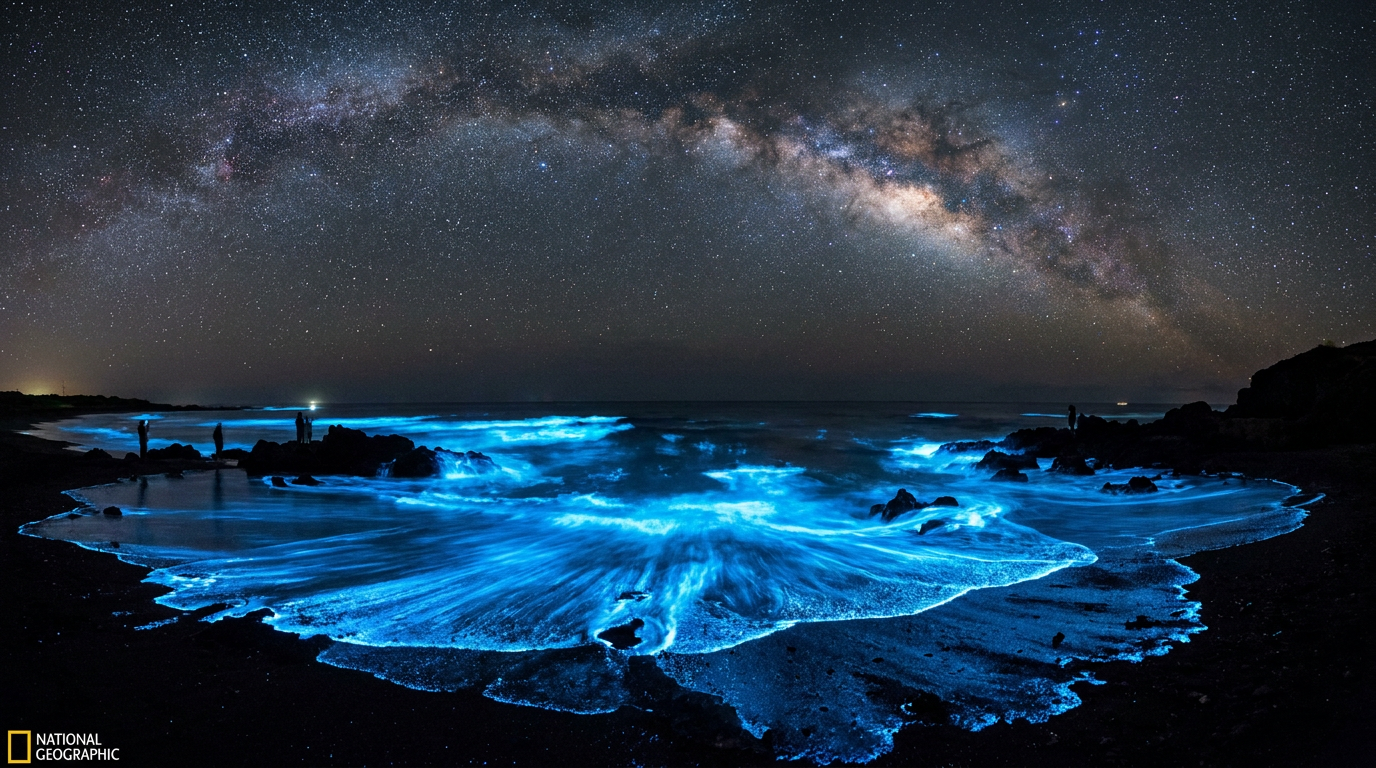
Walking along the shoreline on a pitch-black night, every footstep ignites a burst of neon blue in the wet sand. In the water, the crest of a breaking wave glows like liquid electricity, and the wake of a kayak leaves a trail of cold fire. This is the phenomenon of the bioluminescent beach, a spectacle that looks lifted from a science fiction film but is rooted entirely in complex marine biology.[6][8]
While these glowing waters can occasionally appear on coastlines from California to Chennai due to transient ocean currents, the most reliable and spectacular displays occur in a handful of permanent bioluminescent bays and specialized island ecosystems. Places like Mosquito Bay in Puerto Rico and Vaadhoo Island in the Maldives have become global pilgrimage sites for travelers seeking to witness the famous "Sea of Stars" firsthand.[3][4][5][6]
The architects of this light show are invisible to the naked eye. The glow is produced by dinoflagellates, a type of single-celled marine plankton that thrives in warm, nutrient-rich coastal waters. When millions of these microscopic organisms pulse together in response to movement, they create a radiant, wave-like shimmer across the surface of the ocean.[2][4][6]
The ability to generate light—bioluminescence—is a highly evolved biochemical trick. Inside the dinoflagellate, the reaction relies on two primary components: a substrate molecule called luciferin and an enzyme known as luciferase. When these two interact in the presence of oxygen, the luciferin is oxidized, releasing energy in the form of a brilliant blue photon.[1][2][7]

Unlike the heat-heavy light generated by an incandescent bulb, this reaction produces "cold light," meaning almost 100 percent of the energy is emitted as light rather than heat. This extreme efficiency allows the microscopic plankton to flash repeatedly without boiling themselves alive in the process.[2][8]
But the dinoflagellates do not glow constantly; they actuate their light only when physically disturbed. The trigger is mechanical stimulation—the crash of a wave, the paddle of a canoe, or the thrash of a swimming fish. This physical movement sets off a rapid cellular chain reaction within the plankton.[2][5][7]
When the organism is jostled, voltage-gated ion channels in its cellular membrane snap open. This allows a sudden influx of protons to rush into specialized organelles called scintillons, rapidly dropping the internal pH and creating an acidic environment. It is this sudden spike in acidity that activates the luciferase enzyme, initiating the flash in a fraction of a second.[1][7][8]
Biologists believe this elaborate mechanism serves as a microscopic "burglar alarm." When a small predator, like a shrimp, attempts to eat the dinoflagellate, the resulting flash of light startles the attacker. More importantly, the bright blue beacon illuminates the shrimp in the dark water, attracting the attention of larger fish that will swoop in and eat the dinoflagellate's predator.[2][4][5][8]
While dinoflagellates drift throughout the world's oceans, they only create a visible spectacle when concentrated in massive numbers. This requires a specific set of geographic and environmental conditions. The undisputed champion of this phenomenon is Mosquito Bay on the Puerto Rican island of Vieques, which holds the Guinness World Record for the brightest bioluminescence on Earth.[3][6]

While dinoflagellates drift throughout the world's oceans, they only create a visible spectacle when concentrated in massive numbers.
Mosquito Bay's brilliance is a product of perfect natural engineering. The bay features a very narrow opening to the Caribbean Sea, which traps the specific dinoflagellate species, Pyrodinium bahamense, inside the shallow lagoon. Furthermore, the bay is ringed by dense red mangrove forests. As the mangrove leaves fall into the water and decay, they release a steady stream of vitamin B12 and other essential nutrients that fuel explosive plankton growth.[3][8]
Halfway across the world, the Maldives offers a different but equally mesmerizing experience. On Vaadhoo Island, located in the Raa Atoll, a species known as Noctiluca scintillans washes directly onto the open beaches. Here, the glowing plankton stick to the sand, allowing visitors to walk among the "stars" as the tide recedes, creating a surreal, glittering shoreline.[5][6]
While Puerto Rico and Jamaica boast permanent, year-round bioluminescent bays, other regions experience the phenomenon as transient blooms. In places like Southern California or the coast of India, the glow is tied to seasonal "red tides." These blooms are driven by shifting ocean temperatures, heavy rainfall, and nutrient runoff, making their appearance thrilling but highly unpredictable.[4][8]

The magic of these bays, however, is exceptionally fragile. The exact environmental balance that allows dinoflagellates to thrive can be easily disrupted by human interference. Chemical pollutants are a primary threat; common tourist items like DEET-based insect repellents, chemical sunscreens, and boat engine exhaust can decimate plankton populations overnight.[6][8]
Light pollution poses another existential threat to the viewing experience. Bioluminescence is relatively faint compared to artificial lighting. As coastal areas develop, the ambient glow from streetlights, hotels, and passing cars can easily drown out the natural blue light of the dinoflagellates.[6][8]
To combat these threats, strict conservation measures have been implemented in the world's most famous bays. In Mosquito Bay, swimming is entirely prohibited to prevent chemical contamination from human skin. Access is heavily restricted to licensed tour operators who use non-motorized clear-bottom kayaks or specialized electric pontoon boats to navigate the waters without leaving a toxic wake.[3][8]
For travelers hoping to witness the phenomenon, timing is everything. The brightness of the dinoflagellates is in constant competition with the moon. Planning a trip during a new moon, when the night sky is at its absolute darkest, is the single most important factor in guaranteeing a spectacular, high-contrast light show.[6][8]

Visitors are also urged to manage their expectations regarding photography. While the human eye easily adjusts to the dark to see the shimmering blue trails, capturing the glow on a standard smartphone camera is notoriously difficult, often requiring long-exposure equipment and tripods to replicate what the eye sees naturally.[5][8]
Viewpoints in depth
Marine Biologists
Focusing on the evolutionary arms race and biochemical mechanics.
For marine biologists, the glowing beach is less of a tourist attraction and more of a microscopic battlefield. They study bioluminescence as a highly evolved 'burglar alarm' system designed to expose predators to larger threats. Researchers are particularly interested in the luciferase enzyme; fully understanding its structure and catalytic mechanism could unlock new applications in medical imaging, synthetic biology, and biosensor technology, though the dinoflagellate's specific chemical pathways remain notoriously difficult to map in a lab setting.
Eco-Tourism Advocates
Balancing natural wonder with sustainable economic growth.
Tourism boards and travel advocates view bioluminescent bays as crown jewels of local eco-tourism. They argue that when managed correctly, the influx of visitors provides vital funding for local communities and conservation efforts. By promoting guided, low-impact experiences—such as electric pontoon boats or clear-bottom kayaking—they believe it is possible to share this natural wonder with the public while fostering a broader appreciation for marine conservation.
Conservationists
Warning of the existential threats posed by human interference.
Conservation groups emphasize that permanent bioluminescent bays are among the most fragile ecosystems on the planet. They point to the devastating impact of chemical sunscreens, DEET-based bug sprays, and boat fuel, which can wipe out millions of dinoflagellates in a single evening. Consequently, they advocate for uncompromising protections, including total bans on swimming in sensitive bays, strict limits on daily visitor numbers, and aggressive campaigns to reduce coastal light pollution that drowns out the natural glow.
What we don't know
- The complete molecular structure of dinoflagellate luciferin, which remains poorly understood compared to the compounds found in fireflies and deep-sea fish.
- How long-term ocean acidification and rising sea temperatures will ultimately impact the global distribution of bioluminescent plankton.
- The exact evolutionary timeline of when and why dinoflagellates first developed this complex biochemical 'burglar alarm' system.
Key terms
- Dinoflagellate
- A type of microscopic, single-celled marine plankton responsible for the vast majority of coastal bioluminescence.
- Luciferin
- The organic substrate molecule that produces light when it undergoes an oxidation reaction.
- Luciferase
- The specialized enzyme that acts as a catalyst, triggering the oxidation of luciferin to create light.
- Scintillon
- A specialized organelle within a dinoflagellate's cell where the bioluminescent chemical reaction takes place.
- Cold Light
- Light produced by a chemical reaction that is incredibly efficient, generating almost zero heat in the process.
Frequently asked
Can you swim in bioluminescent bays?
In highly protected areas like Mosquito Bay, swimming is strictly banned to prevent chemicals from sunscreen and bug spray from killing the plankton. However, some open-ocean beaches with transient blooms do allow swimming.
Why is the bioluminescent light always blue?
Blue light has a shorter wavelength, allowing it to travel further and penetrate deeper through seawater than other colors, making it the most effective color for marine signaling.
When is the best time to see a glowing beach?
The most critical factor is the lunar cycle; visiting during a new moon ensures the sky is pitch-black, providing the high contrast needed to see the faint blue glow.
Are glowing beaches dangerous to humans?
Most permanent tourist bays are perfectly safe. However, some transient bioluminescent blooms are caused by toxic 'red tides' that can cause respiratory irritation, so it is always best to check local advisories.
Sources
Source coverage
8 outlets
3 viewpoints surfaced







[1]American Chemical SocietyMarine Biologists
Computational Investigation of the Dinoflagellate Bioluminescence Mechanism
Read on American Chemical Society →[2]UC Santa Barbara Science LineMarine Biologists
How do glowing algae chemically create their light?
Read on UC Santa Barbara Science Line →[3]Discover Puerto RicoEco-Tourism Advocates
Puerto Rico's 3 Must-See Bioluminescent Bays
Read on Discover Puerto Rico →[4]Travel + LeisureEco-Tourism Advocates
Decoding Chennai's bioluminescent waves: What makes them glow?
Read on Travel + Leisure →[5]EarthSkyEco-Tourism Advocates
Bioluminescent waves in the Maldives
Read on EarthSky →[6]Global RescueEco-Tourism Advocates
Where Are the Bioluminescent Beaches Around the World?
Read on Global Rescue →[7]Virginia Tech ChemistryMarine Biologists
Proposed mechanisms of dinoflagellate luciferase catalysis
Read on Virginia Tech Chemistry →[8]Factlen Editorial TeamConservationists
Synthesis by Factlen editorial team
Read on Factlen Editorial Team →
Every angle. Every day.
Get travel stories with full source coverage and perspective breakdowns delivered to your inbox.