
Beyond the Green Screen: How LED Volumes Became the New Standard for TV Production
Once an experimental tool for big-budget sci-fi, virtual production and LED volumes have been completely normalized by 2026, reshaping how everyday television is made. The technology is empowering actors, slashing carbon footprints, and giving directors unprecedented real-time control.
By Factlen Editorial Team
- Production & Technology Providers
- Focus on the efficiency, scalability, and real-time rendering pipelines that make virtual production a cost-effective industry standard.
- Creative Filmmakers
- Value the return to honest lighting, the ability to capture visual effects in-camera, and the improved environment for actor performances.
- Industry Historians
- Track the chronological evolution of the technology from its high-risk origins to its current democratized state.
What's not represented
- · Traditional set builders and carpenters
- · Location scouts facing reduced demand
Why this matters
By replacing green screens with real-time digital environments, LED volumes have fundamentally changed how television is made. This shift not only empowers actors to deliver better performances but also drastically reduces the carbon footprint of global productions by eliminating the need to fly crews around the world.
Key points
- LED volumes have largely replaced green screens in high-end television production by 2026.
- The technology uses video game engines to render 3D backgrounds that shift in real-time with the camera.
- Actors benefit from seeing their environments and being lit naturally by the screens.
- Virtual production drastically reduces the carbon footprint of filming by eliminating international travel.
- Smaller, accessible LED stages have democratized the technology for mid-budget shows and commercials.
The era of the green screen is quietly coming to an end. For decades, actors in visual-effects-heavy television shows were forced to deliver emotional performances while staring at tennis balls on sticks, surrounded by a sea of neon green fabric. They had to imagine the sweeping landscapes or alien worlds that would eventually be painted in behind them months later.[5]
Today, in 2026, a television actor is far more likely to step onto a soundstage and see the actual environment they are supposed to be inhabiting. Whether that is a bustling 1920s street, a dense jungle, or simply the passing scenery outside a car window, the digital world is rendered live, right in front of their eyes.[6]
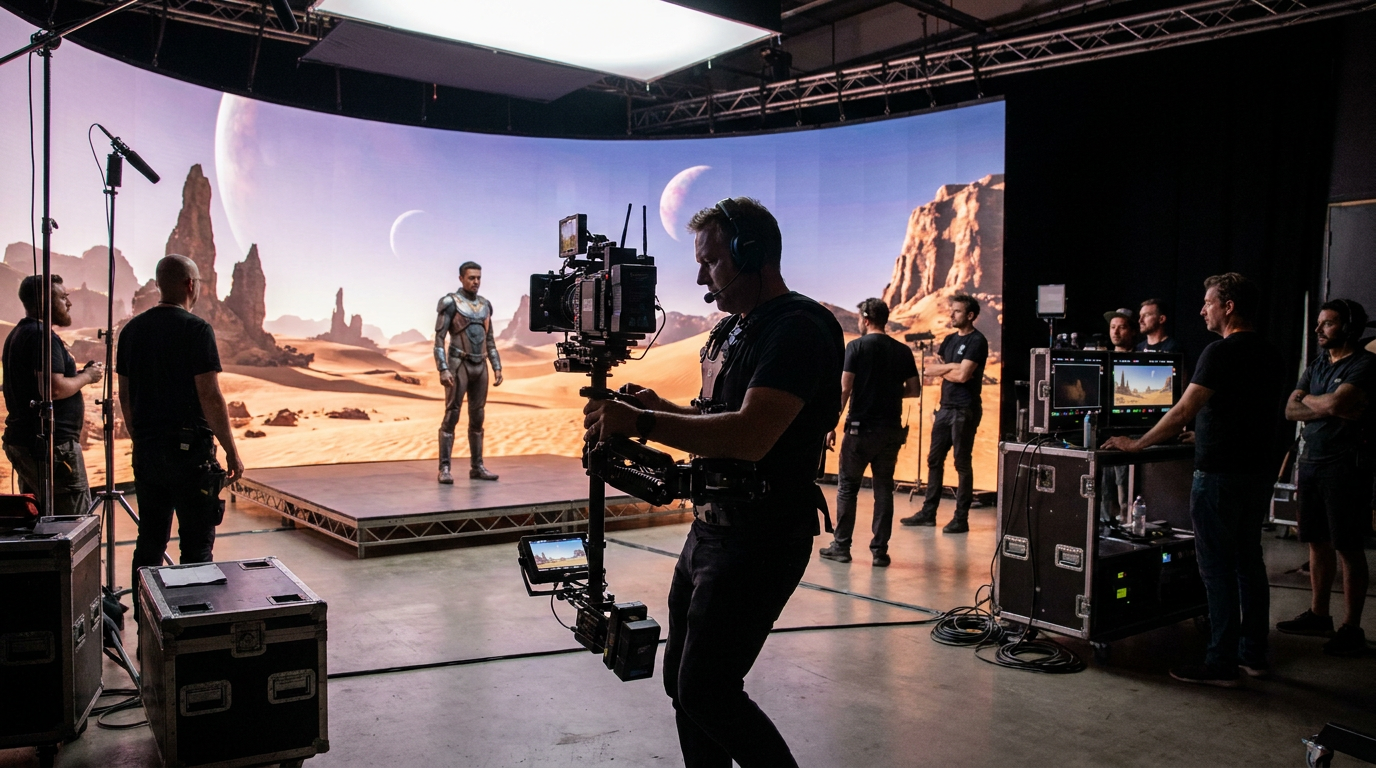
This paradigm shift is driven by virtual production, specifically the use of massive LED video walls known as volumes. By combining high-definition screens with real-time video game engines, the television industry has fundamentally rewired its production pipeline, moving visual effects from post-production to the actual shoot day.[1][6]
The mechanism behind an LED volume is a marvel of synchronized technology. A curved wall of high-resolution LED panels surrounds a physical set, creating a seamless digital horizon. The ceiling is often capped with more LED panels to provide ambient overhead lighting.[4]

Instead of playing a static, pre-recorded video, these screens display a fully rendered 3D environment. This imagery is powered by software originally designed for video games, such as Epic Games' Unreal Engine, which can calculate lighting, shadows, and textures in milliseconds.[1][2]
The true magic of the volume, however, lies in the camera tracking. As the physical camera moves on the stage, specialized sensors feed its exact position, angle, and lens focal length back to the rendering engine.[4]
The engine instantly recalculates the perspective of the digital background, shifting the imagery in real-time to match the camera's movement. This creates a perfect optical illusion of depth, known as parallax, making a flat screen look like a vast, three-dimensional world.[4]
The origins of this television revolution trace back to 2019, when Jon Favreau and Industrial Light & Magic debuted their proprietary StageCraft technology for the Disney+ series The Mandalorian. They built a groundbreaking 75-foot-diameter volume to bring the Star Wars universe to television.[1][2]
At the time, building such a massive LED stage was a significant financial risk, reserved for tentpole intellectual property. But the gamble paid off spectacularly, proving that television could achieve blockbuster-level visual effects on a serialized, fast-paced schedule.[5]
At the time, building such a massive LED stage was a significant financial risk, reserved for tentpole intellectual property.
Fast forward to 2026, and the technology has been thoroughly democratized. A 2021 industry report predicted that virtual production would be completely normalized within five years, and that forecast has proven remarkably accurate across the entertainment landscape.[3]

Today, productions do not need a Disney-sized budget to access a volume. Smaller, nimble LED stages have proliferated globally, catering to mid-budget dramas, commercial spots, and independent projects. Facilities like Garden Studios in the UK have delivered hundreds of projects using these accessible setups.[3]
For actors and directors, the benefits extend far beyond scheduling efficiencies. The most immediate advantage on set is the concept of honest lighting, which fundamentally changes how a scene is captured.[2][5]
In a traditional green screen shoot, the green fabric reflects a sickly hue onto the actors, which visual effects artists must painstakingly remove later. In a volume, the LED screens themselves act as the primary light source, wrapping the actors in the exact colors of the digital environment.[5]
If a scene is set during a fiery sunset, the screens emit the exact amber and crimson light needed, perfectly illuminating the actors' faces and reflecting accurately off shiny props, armor, or car windows. The light behaves naturally because it is actually there.[2][4]
Directors also gain unprecedented control over the elements. If a crucial emotional scene requires the golden hour of twilight, the production is no longer racing against the actual sun. The digital sun can be paused in the sky for a ten-hour shooting day, ensuring perfect continuity.[5]
Beyond the creative advantages, the normalization of virtual production has triggered a massive shift in the industry's environmental and economic footprint, aligning with broader sustainability goals.[3]

Historically, a globe-trotting television series required flying hundreds of cast and crew members, along with tons of heavy equipment, to multiple international locations. This generated a massive carbon footprint and logistical nightmares.[4]
Now, a production can shoot a scene set in the snowy Alps in the morning and a scene in a Tokyo alleyway in the afternoon, all without leaving a soundstage in London or Los Angeles. The locations are built digitally and loaded onto the screens with the click of a button.[4][6]
Despite its widespread adoption, the technology is not without its growing pains. The industry is currently navigating a skills shortage, as the demand for technicians who understand both traditional cinematography and real-time video game engines far outpaces the available workforce.[3]

Furthermore, filmmakers are learning that the volume is not a silver bullet. Over-reliance on the screens can lead to a claustrophobic feel if physical set pieces are not seamlessly blended with the digital backgrounds. Yet, as calibration standards improve and the technology becomes invisible, the LED volume has cemented itself as the most significant leap in television production since the transition to digital cameras.[4][6]
How we got here
2019
Industrial Light & Magic debuts StageCraft for the first season of The Mandalorian.
2020
ILM wins an Emmy for its virtual production technology, proving its viability for television.
2021
Garden Studios opens one of the UK's first permanent LED volume stages, signaling a shift toward accessibility.
2025
Industry reports confirm that LED volumes have transitioned from experimental tools to a cornerstone of modern production.
2026
Virtual production methods and pipelines are completely normalized across high-end television and commercial shoots.
Viewpoints in depth
Production & Technology Providers
Focus on the efficiency, scalability, and real-time rendering pipelines that make virtual production a cost-effective industry standard.
For the studios and technologists building these stages, the LED volume is primarily an engine of efficiency. By shifting the workload from post-production to pre-production, studios can lock in their visual effects before a single frame is shot. This eliminates the costly, months-long rendering processes that used to bottleneck television schedules. Furthermore, the democratization of the technology means that smaller studios can now offer high-fidelity virtual production services, breaking the monopoly once held by massive visual effects houses.
Creative Filmmakers
Value the return to honest lighting, the ability to capture visual effects in-camera, and the improved environment for actor performances.
Directors and cinematographers champion the volume because it restores the tactile nature of filmmaking. Instead of guessing how a digital creature or landscape will look against a green screen, they can compose their shots through the lens, seeing the final pixel output immediately. For actors, the volume removes the exhausting cognitive load of pretending to be somewhere they are not. The screens provide immediate spatial context and emotional grounding, resulting in more natural, spontaneous performances.
Industry Historians
Track the chronological evolution of the technology from its high-risk origins to its current democratized state.
Looking back at the trajectory of virtual production, historians note how rapidly the industry abandoned its century-old reliance on physical locations. The transition from the massive, bespoke StageCraft volume built in 2019 to the ubiquitous, modular LED stages of 2026 mirrors the rapid adoption of digital cameras in the early 2000s. What was once viewed as a highly specialized tool for science fiction has seamlessly integrated into the standard grammar of television production.
What we don't know
- How quickly the industry can train enough technicians to overcome the current skills shortage in real-time rendering.
- Whether the cost of high-end LED panels will drop enough to make the technology viable for ultra-low-budget independent television.
Key terms
- Virtual Production
- A filmmaking method that combines physical production with digital environments rendered in real-time.
- Real-time Rendering
- The process of generating 3D images at a speed fast enough to appear instantaneous, typically powered by video game engines.
- Camera Tracking
- Hardware and software that records the exact position, angle, and lens focus of a physical camera to sync it with a digital environment.
- In-camera Visual Effects (ICVFX)
- Capturing the final visual effect directly through the camera lens on set, rather than adding it later in post-production.
Frequently asked
What exactly is an LED volume?
An LED volume is a physical soundstage enclosed by massive, high-resolution LED video screens. Instead of a green screen, these screens display the digital background of a scene in real-time while the actors perform.
How is it different from a green screen?
Green screens require the background to be digitally added months later in post-production. LED volumes display the final background live on set, providing natural lighting and allowing actors to see their surroundings.
What is parallax in virtual production?
Parallax is the optical effect where background objects appear to move slower than foreground objects. The volume's software tracks the physical camera and shifts the digital background to recreate this effect, making the flat screen look three-dimensional.
Do television shows still shoot on location?
Yes. While volumes drastically reduce the need for travel, physical locations are still used for complex action sequences, natural sunlight, and expansive scenes that cannot physically fit inside a studio.
Sources
Source coverage
6 outlets
3 viewpoints surfaced






[1]WikipediaIndustry Historians
StageCraft and Virtual Production History
Read on Wikipedia →[2]Industrial Light & MagicCreative Filmmakers
ILM StageCraft and Virtual Production
Read on Industrial Light & Magic →[3]Garden StudiosProduction & Technology Providers
The landscape of virtual production in 2026
Read on Garden Studios →[4]DisguiseProduction & Technology Providers
Planning for an LED volume in 2025
Read on Disguise →[5]PostPerspectiveCreative Filmmakers
ILM StageCraft Leads the Way in Virtual Production
Read on PostPerspective →[6]Factlen Editorial TeamProduction & Technology Providers
Synthesis by Factlen editorial team
Read on Factlen Editorial Team →
Every angle. Every day.
Get entertainment stories with full source coverage and perspective breakdowns delivered to your inbox.