
AI Breakthrough Accelerates Molecular Simulations by 10,000 Times, Fast-Tracking Drug Discovery
A new generative AI model developed by Swedish researchers can predict molecular behavior 10,000 times faster than traditional methods, clearing a major computational bottleneck in pharmaceutical development.
By Factlen Editorial Team

- Pharmaceutical Industry
- Emphasize the commercial impact of compressing the early-stage drug discovery pipeline and reducing R&D costs.
- Computational Researchers
- Focus on the technical achievement of bypassing femtosecond numerical integration with generative AI.
- Biotech Analysts
- Highlight the broader implications for precision medicine, academic research, and faster patient access to treatments.
What's not represented
- · Regulatory Agencies (FDA/EMA)
- · Supercomputing Hardware Providers
Why this matters
Bringing a new drug to market typically takes over a decade and billions of dollars, largely due to the time-consuming process of simulating how molecules interact. By fast-forwarding these simulations, this AI breakthrough promises to dramatically shorten the time it takes to discover and develop life-saving treatments.
Key points
- A new AI model named TITO predicts molecular motion 10,000 times faster than traditional methods.
- The breakthrough bypasses the need to calculate atomic forces step-by-step at the femtosecond level.
- The AI was successfully tested on over 12,500 organic molecules and 1,000 short peptides.
- The technology promises to compress the early stages of drug discovery from years into days.
- Researchers from Chalmers University of Technology and the University of Gothenburg published the findings in Science Advances.
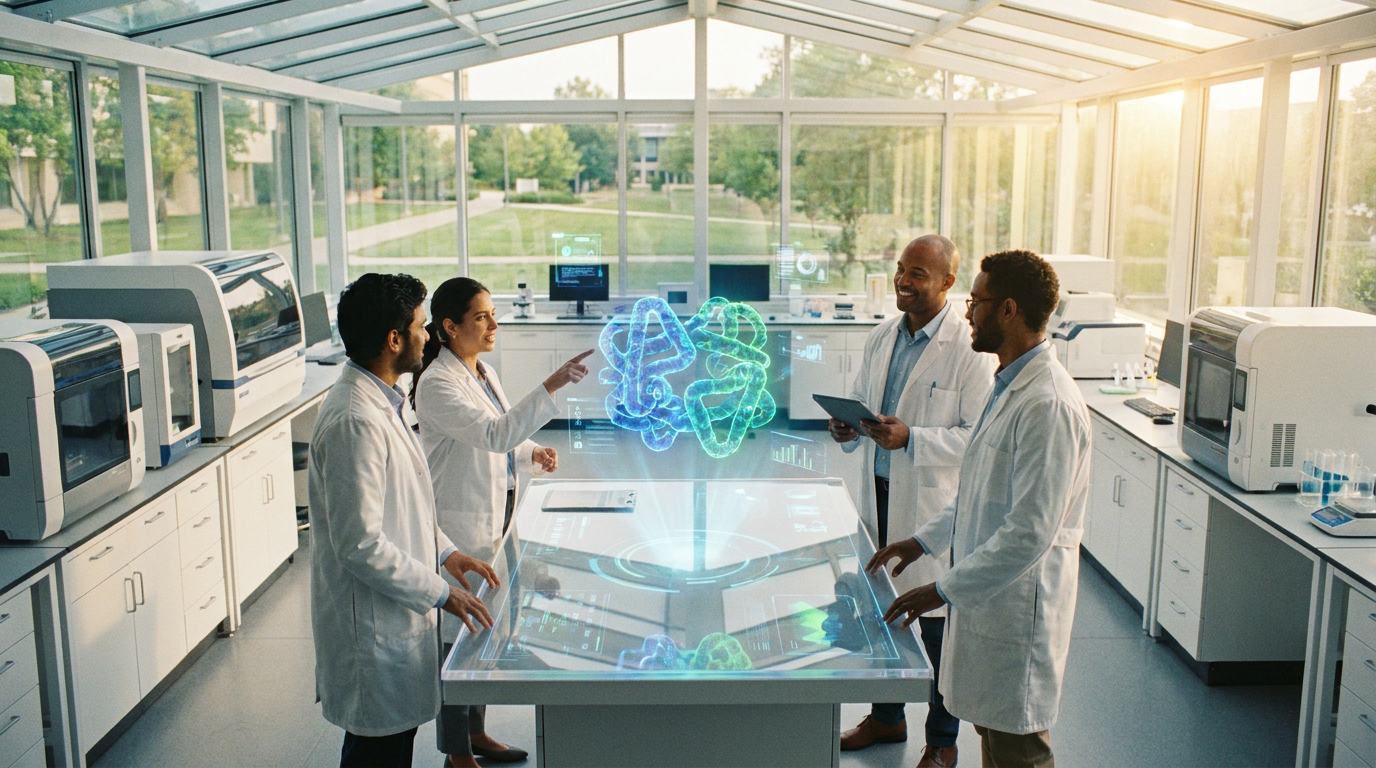
In a milestone that could fundamentally reshape the timeline of modern medicine, researchers have developed an artificial intelligence system capable of predicting molecular motion more than 10,000 times faster than conventional computer simulations. The breakthrough, detailed in a June 2026 study published in the journal Science Advances, effectively fast-forwards the computationally exhausting process of observing how potential drug compounds interact at the atomic level. By clearing one of the most significant bottlenecks in pharmaceutical research, the technology promises to compress the early stages of drug discovery from years into mere days.[2][3][1][5]
Developing a new medication is notoriously slow and expensive, typically requiring more than a decade and billions of dollars before a treatment reaches patients. A vast majority of that time is spent in the preclinical phase, where scientists must screen thousands of candidate molecules to see how they bind to target proteins or dissolve in cellular environments. To do this, researchers have traditionally relied on molecular dynamics—a simulation method that calculates the physical forces between every single atom, step by agonizing step.[1][3][4][5][6]
The sheer scale of traditional molecular dynamics is what makes it so computationally demanding. To keep the calculations physically stable, the simulation must advance in increments of roughly one femtosecond—a millionth of a billionth of a second. Because the biological processes relevant to drug discovery, such as a protein folding or a drug binding to a receptor, unfold over much longer timescales, simulating them requires billions of sequential calculations. This forces pharmaceutical companies to invest heavily in supercomputers and wait months for results.[3][4][1][6][5]

The new AI model, developed by a joint team from Chalmers University of Technology and the University of Gothenburg in Sweden, bypasses this numerical grind entirely. Dubbed TITO (Transferable Implicit Transfer Operators), the system utilizes a deep generative modeling framework that learns the underlying statistical rules governing how molecules move and change shape over time. Instead of calculating every microscopic interaction, the AI predicts the molecule's future configuration directly from its starting state.[1][3][2][6][4]
Scientists describe the advancement as the computational equivalent of skipping ahead to the most important scenes in a molecular movie, rather than being forced to watch every single frame in sequence. By learning the broad patterns of atomic behavior from short simulation sequences, TITO can accurately predict how a molecule will behave over timescales a thousand times longer than those it observed during its training phase.[4][6][2]
Crucially, the model does not just memorize the behavior of specific compounds. During testing, the research team evaluated TITO on more than 12,500 organic molecules—containing carbon, nitrogen, hydrogen, and oxygen—as well as over 1,000 short peptides. The AI successfully generalized its physical rules to accurately predict the dynamics of molecules it had never encountered before, producing results that matched the rigorous outputs of standard numerical algorithms.[4][6][2]

Crucially, the model does not just memorize the behavior of specific compounds.
The pharmaceutical industry is already taking notice of the technology's potential to streamline candidate screening. Juan Viguera Diez, the study's lead author and an industrial doctoral student affiliated with both the university research team and AstraZeneca, noted that there is considerable commercial interest in simulations that can rapidly and accurately reflect physical reality. By reducing the number of physical tests required in the laboratory, companies can identify the most promising therapeutic leads with unprecedented speed.[2][3][4][1][5]
Beyond commercial drug development, the 10,000-fold acceleration opens new doors for fundamental academic research. Biologists and chemists can now explore complex systems, such as enzymatic reactions and the behavior of biomaterials, with a fidelity and speed that was previously impossible. This broader understanding of molecular behavior could yield new insights into the underlying mechanisms of complex diseases.[5][2][1]

While the current iteration of TITO represents a massive leap forward, the research team acknowledges that the model is still evolving. The system has currently been validated on small molecular systems operating in simplified solvent models at specific temperatures. The next phase of development will focus on scaling the AI to handle more complex, realistic biological environments, such as the chaotic interior of a human cell.[3][4][1][5]
As artificial intelligence continues to transition from a theoretical tool to a practical engine for scientific discovery, its integration into the laboratory is becoming seamless. By dramatically lowering the computational barrier to entry, generative models like TITO are setting the stage for a new era of precision medicine—one where the agonizing decade-long wait for new treatments may finally begin to shrink.[1][5]
How we got here
Pre-2026
Drug discovery relies on computationally demanding numerical simulations that calculate atomic forces step-by-step.
October 2025
Researchers from Chalmers University and AstraZeneca release the initial preprint detailing the TITO framework.
June 2026
The peer-reviewed study is published in Science Advances, demonstrating a 10,000-fold speedup.
Viewpoints in depth
The Computational Leap
How generative AI bypasses traditional physics engines.
For decades, molecular dynamics relied on brute-force physics engines calculating atomic forces at the femtosecond scale. Computational researchers view the TITO model as a paradigm shift because it treats molecular motion as a statistical learning problem rather than a strict numerical integration task. By learning the 'rules' of how molecules transition between states, the AI can hallucinate accurate future configurations without calculating the billions of intermediate steps, freeing up massive amounts of supercomputing resources.
The Pharmaceutical Pipeline
Compressing the decade-long wait for new drugs.
From an industry perspective, the early stages of drug discovery are a costly numbers game. Pharmaceutical companies must screen thousands of compounds to find a single viable candidate, a process that can take years. Industry experts note that accelerating molecular simulations by 10,000 times allows labs to test exponentially more compounds in a fraction of the time. This rapid screening reduces the financial risk of early-stage R&D and allows companies to pivot quickly when a candidate fails, ultimately lowering the barrier to entry for developing novel therapeutics.
What we don't know
- How effectively the AI model will scale to simulate highly complex, chaotic biological environments like the interior of a human cell.
- The exact timeline for when drugs discovered using this specific AI framework will enter human clinical trials.
Key terms
- Molecular Dynamics
- A computer simulation method used to study the physical movements of atoms and molecules over time.
- Femtosecond
- One quadrillionth of a second (10⁻¹⁵ seconds), the tiny time step required by traditional simulations to maintain physical stability.
- Generative AI
- Artificial intelligence capable of generating new data—in this case, predicting plausible future arrangements of atoms based on learned patterns.
- TITO
- Transferable Implicit Transfer Operators, the specific deep learning model developed by the researchers to fast-forward molecular simulations.
Frequently asked
Why are traditional molecular simulations so slow?
They must calculate the physical forces between every atom step-by-step using extremely short time intervals (femtoseconds) to remain stable, requiring billions of calculations to simulate a single biological event.
How does the new AI model work?
Instead of calculating every tiny step, the AI learns the statistical rules of molecular motion and generates likely future arrangements directly, effectively skipping ahead in time.
Will this replace laboratory testing?
No. The AI accelerates the early screening phase to identify the most promising drug candidates faster, but those candidates still require rigorous experimental validation and clinical trials.
Sources
Source coverage
6 outlets
3 viewpoints surfaced






[1]News-MedicalBiotech Analysts
AI breakthrough accelerates molecular simulations for drug discovery
Read on News-Medical →[2]Science AdvancesComputational Researchers
Transferable generative models bridge femtosecond to nanosecond time-step molecular dynamics
Read on Science Advances →[3]Chalmers University of TechnologyComputational Researchers
AI fast-forwards molecular simulations by 10,000-fold
Read on Chalmers University of Technology →[4]Manufacturing ChemistPharmaceutical Industry
AI model accelerates molecular simulations by 10,000-fold
Read on Manufacturing Chemist →[5]Biology DigitalBiotech Analysts
AI Breakthrough Accelerates Molecular Simulations for Drug Discovery
Read on Biology Digital →[6]RockingrobotsPharmaceutical Industry
AI Accelerates Molecular Simulation Predictions by More Than 10,000 Times
Read on Rockingrobots →

Every angle. Every day.
Get ai stories with full source coverage and perspective breakdowns delivered to your inbox.