
Why communities are borrowing drills and tents instead of buying them
The "Library of Things" movement is rapidly expanding, allowing residents to borrow tools, appliances, and camping gear to save money and reduce waste.
By Factlen Editorial Team
- Community Organizers
- Focus on social cohesion, skill-sharing, and building local resilience through mutual aid.
- Environmental Advocates
- Focus on the circular economy, reducing manufacturing emissions, and diverting waste from landfills.
- Economic Access Advocates
- Focus on lowering barriers to entry for tradespeople and reducing household debt for low-income families.
What's not represented
- · Traditional Hardware Retailers
- · Tool Manufacturers
Why this matters
By shifting from individual ownership to community borrowing, neighborhoods are saving residents thousands of dollars, reducing landfill waste, and rebuilding local social safety nets. This model offers a practical blueprint for combating both household financial fragility and global overconsumption.
Key points
- Libraries of Things allow residents to borrow tools, appliances, and gear instead of buying them.
- The movement has grown to over 2,000 formal locations globally.
- Sharing resources reduces household debt and lowers the barrier to entry for home repairs.
- The circular economy model significantly reduces manufacturing emissions and landfill waste.
- Many libraries operate alongside repair cafes to teach residents valuable maintenance skills.
- Funding, space, and volunteer burnout remain the primary challenges for organizers.
The classic public library is evolving. For generations, these institutions have served as quiet repositories for books, offering communities free access to literature and reference materials. But today, instead of just checking out the latest bestselling novel, residents in cities from Detroit to London are checking out power drills, pasta makers, and pressure washers. This shift represents a fundamental rethinking of community resources, moving beyond the written word to address the practical, physical needs of everyday life.[8]
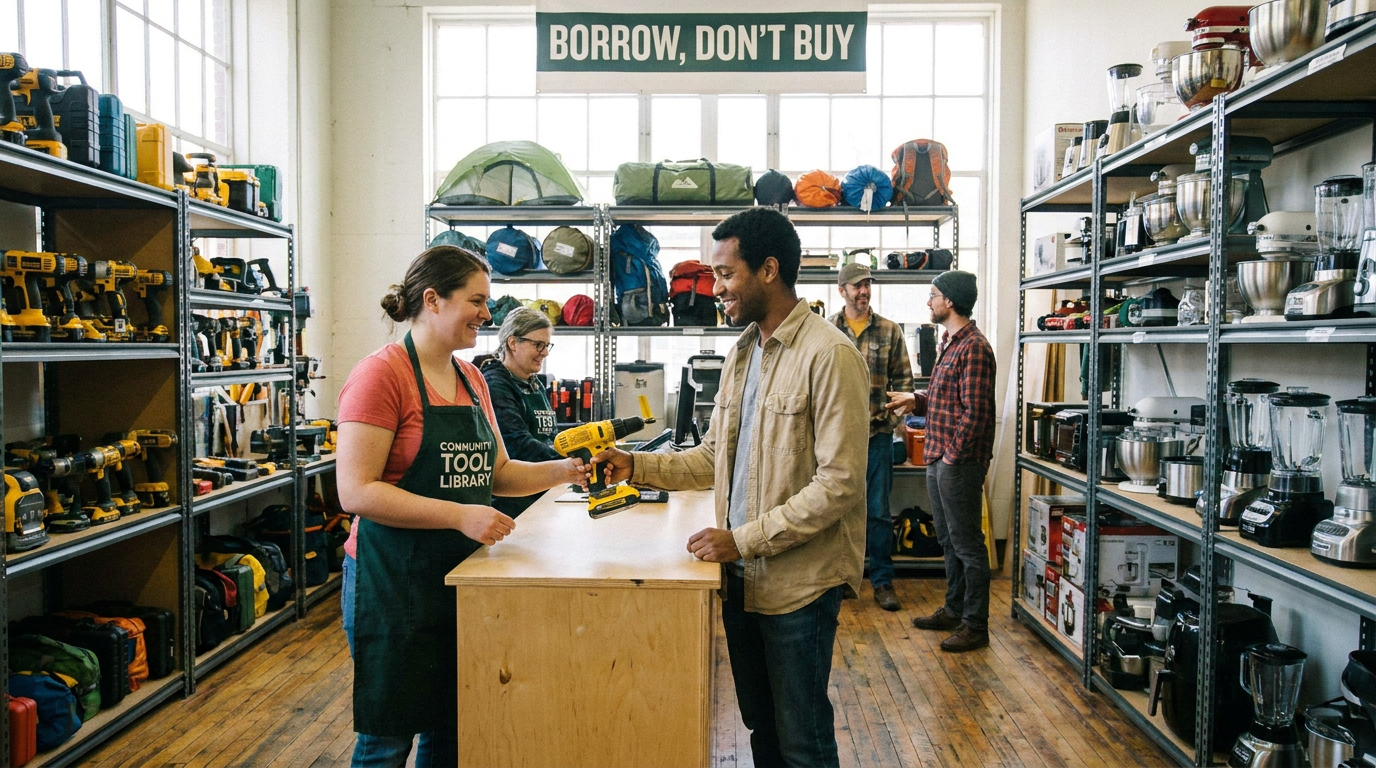
This is the "Library of Things" (LoT) movement. It takes the traditional mechanics of a public library—membership, cataloging, and borrowing—and applies them to physical resources that households use infrequently but cost a lot to buy and store. From camping gear and sewing machines to specialized gardening equipment and power tools, these libraries are pushing the boundaries of what can be collectively owned and shared.[3][7]
The concept is rapidly moving from a niche sustainability experiment to mainstream community infrastructure. While informal resource sharing has always been a part of the human experience, the formalized model is experiencing unprecedented growth. Today, there are roughly 2,000 formal Libraries of Things operating worldwide, alongside countless informal neighborhood sharing networks, all dedicated to turning underused goods into active community assets.[3]
Recent local launches highlight the momentum of this trend. In Detroit, the Bailey Park Neighborhood Development Corporation recently expanded its tool library, offering free access to lawnmowers, weed whackers, and heavy-duty equipment. The initiative is designed to help residents maintain and beautify their homes and neighborhoods without the steep financial burden of purchasing their own landscaping tools.[1]

Similarly, in Oregon, the Astoria Tool Library recently opened its doors in a historic building that once housed a daycare. For a small annual membership fee of $40, locals can borrow up to seven quality hand tools and small electric power tools for a week at a time. Organizers emphasize that the goal is not to make a profit, but to keep essential repair equipment accessible to the entire community.[2]
The operational mechanism behind these libraries varies widely depending on community needs and available resources. Some operate as standalone volunteer-run spaces, like a neighborhood share shop or a retrofitted shipping container, opening their doors a few days a week to process checkouts and accept donations.[4]
Others are integrating directly into existing public spaces using modern technology. In the United Kingdom, the Library of Things platform has pioneered a highly scalable model, placing self-service lockers in public libraries, reuse hubs, and shopping centers. This approach allows for longer opening hours and makes borrowing as convenient as buying from a major online retailer, all while reducing the reliance on volunteer labor.[4][5]
Others are integrating directly into existing public spaces using modern technology.
The economic argument for these libraries is compelling and immediate. Advocates point out that the average power drill is used for only a few minutes in its entire lifetime, spending the rest of its existence gathering dust in a garage. By sharing tools instead of purchasing them for one-time use, residents can repair porches, restore woodwork, and maintain homes far more affordably.[2][8]

This shared resource infrastructure directly addresses household financial fragility. For the cost of buying or even renting a single tool at a big-box hardware store, a member can access hundreds of items for an entire year. In affordable housing communities, integrated sharing libraries expand access to essential equipment without increasing household debt, providing a crucial safety net for low-income families facing emergency repairs.[3]
Beyond individual savings, the environmental impact is a major driver of the movement's expansion. The circular economy model inherently reduces resource extraction, manufacturing emissions, and the eventual disposal of cheap, plastic-heavy consumer goods. By maximizing the lifespan and utility of every manufactured item, communities can significantly shrink their collective carbon footprint and divert tons of usable material from local landfills.[5][8]
But organizers consistently stress that the most profound impact of a Library of Things is social, not just economic or environmental. These spaces serve as vibrant community hubs, bringing people together across demographic lines who might otherwise never interact. They foster a culture of trust, generosity, and mutual aid that strengthens the social fabric of a neighborhood.[3][4]

Many of these libraries operate alongside "repair cafes" or community makerspaces. In these collaborative environments, volunteers teach their neighbors how to fix broken electronics, hem clothing, or safely operate a table saw. This skill-sharing empowers residents, lowers barriers to entry for aspiring tradespeople, and preserves valuable repair knowledge that is often lost in a disposable consumer culture.[3][4]
Despite the enthusiasm, sustaining a Library of Things comes with distinct operational challenges. Unlike a hardcover book, a chainsaw or a carpet cleaner requires regular maintenance, safety checks, and eventual replacement. Managing liability, ensuring items are returned clean, and tracking consumables like sandpaper or drill bits require robust systems and dedicated personnel.[3][4]
Funding and physical space remain the biggest hurdles for new initiatives. While some libraries successfully secure municipal grants or partner with local councils, many rely heavily on volunteer labor and crowdfunding, which can lead to burnout over time. Finding rent-free or affordable space in dense urban centers is a constant struggle for organizers trying to keep membership costs low.[4][6]

To overcome these hurdles, global networks are forming to share best practices, software, and governance models. As the movement matures, advocates envision a future where shared resource infrastructure is as ubiquitous and well-funded as the local post office or public school. By proving that access is often more valuable than ownership, the Library of Things movement is quietly redefining what it means to be a well-resourced and resilient community.[3][8]
How we got here
1979
Berkeley Public Library launches one of the first modern tool lending programs.
2014
The Library of Things platform begins testing in London, popularizing the term.
2019
Library of Things incorporates as a mission-locked company to scale self-serve sharing.
2024
The global Library of Things Co-Lab trains hundreds of organizers to launch new spaces.
2026
Local tool libraries continue expanding into historic buildings and affordable housing networks.
Viewpoints in depth
Community Organizers
Focus on social cohesion, skill-sharing, and building local resilience.
For community organizers, the physical items in a Library of Things are secondary to the social connections they create. These advocates argue that modern society suffers from an epidemic of isolation, exacerbated by individualized consumption. By creating a central hub where neighbors must interact, share, and trust one another, organizers believe they are rebuilding the local social safety net. The integration of repair cafes and skill-sharing workshops further transforms these spaces from mere rental counters into active engines of community empowerment.
Environmental Advocates
Focus on the circular economy, reducing manufacturing emissions, and diverting waste.
Environmental advocates view the Library of Things as a critical intervention against the climate crisis and global overconsumption. They point out that the carbon footprint of a power drill isn't just in its electricity use, but in the mining of its metals, the manufacturing of its plastics, and its global shipping—all for a tool that is rarely used. By maximizing the utility of a single item across dozens of households, this camp argues that sharing libraries are one of the most effective, immediate ways a community can transition to a sustainable circular economy.
Economic Access Advocates
Focus on lowering barriers to entry for tradespeople and reducing household debt.
From an economic perspective, advocates highlight how sharing infrastructure directly combats financial fragility. Low-income households often face a 'poverty penalty' where the inability to afford basic maintenance tools leads to compounding home repair costs or reliance on high-interest credit cards. Economic access advocates argue that by providing affordable access to essential equipment, sharing libraries function as a form of economic relief, allowing families to maintain their living standards without taking on debilitating debt.
What we don't know
- Whether municipal governments will begin funding sharing libraries as essential public infrastructure on par with traditional book libraries.
- How traditional hardware retailers and tool manufacturers will adapt their business models if the borrowing movement reaches mass scale.
- The long-term viability of self-service locker models in rural or less digitally connected communities.
Key terms
- Library of Things (LoT)
- A community hub that allows people to borrow infrequently used items—like tools, camping gear, and appliances—instead of buying them.
- Circular Economy
- An economic system aimed at eliminating waste and the continual use of resources by sharing, repairing, and recycling existing materials.
- Makerspace
- A collaborative workspace equipped with tools and technology where community members can gather to create, invent, and learn.
- Mutual Aid
- A voluntary, reciprocal exchange of resources and services among community members to provide mutual benefit.
Frequently asked
How much does it cost to borrow items?
Most libraries charge a small annual membership fee (often $20 to $50), while some operate entirely for free or on a sliding scale based on income.
What happens if an item breaks?
Normal wear and tear is expected. Most libraries have volunteer repair teams to fix items, though borrowers may be asked to replace items lost or damaged through negligence.
Who donates the tools and equipment?
Inventory typically comes from community donations, local businesses, and occasionally municipal grants used to purchase high-demand items.
Can a Library of Things operate without a building?
Yes. Some operate using self-service lockers in existing public spaces, while others use mobile vans or pop-up sheds to reach different neighborhoods.
Sources
Source coverage
8 outlets
3 viewpoints surfaced








[1]ClickOnDetroitEconomic Access Advocates
'It makes a lot of difference': Detroit's free tool libraries are growing
Read on ClickOnDetroit →[2]The AstorianEconomic Access Advocates
Astoria Tool Library opens to the public
Read on The Astorian →[3]ShareableEconomic Access Advocates
The Library of Things Toolkit: How to start a sharing library
Read on Shareable →[4]Library of Things UKCommunity Organizers
How to start a Library of Things in your community
Read on Library of Things UK →[5]Doughnut Economics Action LabEnvironmental Advocates
Library of Things: A circular platform enabling communities
Read on Doughnut Economics Action Lab →[6]NatWestEconomic Access Advocates
How to launch a Library of Things
Read on NatWest →[7]WikipediaEnvironmental Advocates
Library of Things
Read on Wikipedia →[8]Factlen Editorial TeamCommunity Organizers
Synthesis by Factlen editorial team
Read on Factlen Editorial Team →
Every angle. Every day.
Get community stories with full source coverage and perspective breakdowns delivered to your inbox.