
The Chemistry of Flavor: How the Maillard Reaction Transforms Everyday Recipes
The complex chemical process known as the Maillard reaction is responsible for the browned crust on bread, the sear on a steak, and the rich aroma of roasted coffee. Understanding how heat, moisture, and pH influence this reaction allows home cooks to unlock deeper flavors and better textures in their kitchens.
By Factlen Editorial Team
- Culinary Scientists
- Focus on the precise molecular mechanisms and how specific variables alter the chemical cascade.
- Home Cooks & Recipe Developers
- Focus on practical kitchen techniques to maximize flavor without needing laboratory equipment.
- Nutritional Researchers
- Focus on the health implications of the compounds generated during high-heat cooking.
What's not represented
- · Industrial Food Manufacturers
- · Flavor Chemists (Flavorists)
Why this matters
Mastering the Maillard reaction elevates home cooking from merely heating food to actively building complex flavor profiles. By controlling temperature, moisture, and pH, cooks can intentionally trigger the chemical transformations that make restaurant-quality meals taste so rich and savory.
Key points
- The Maillard reaction is a chemical process between amino acids and reducing sugars that creates complex flavors and brown colors.
- The reaction proceeds most rapidly at temperatures between 140°C and 165°C (280°F to 330°F).
- Surface moisture prevents browning because water boils at 100°C (212°F), acting as a thermal ceiling.
- Unlike caramelization, which only involves the breakdown of sugars, the Maillard reaction requires proteins.
- Alkaline environments speed up the reaction, which is why baking soda is sometimes used to accelerate browning.
- Temperatures above 180°C (355°F) halt the Maillard reaction and trigger pyrolysis, leading to bitter, burnt flavors.
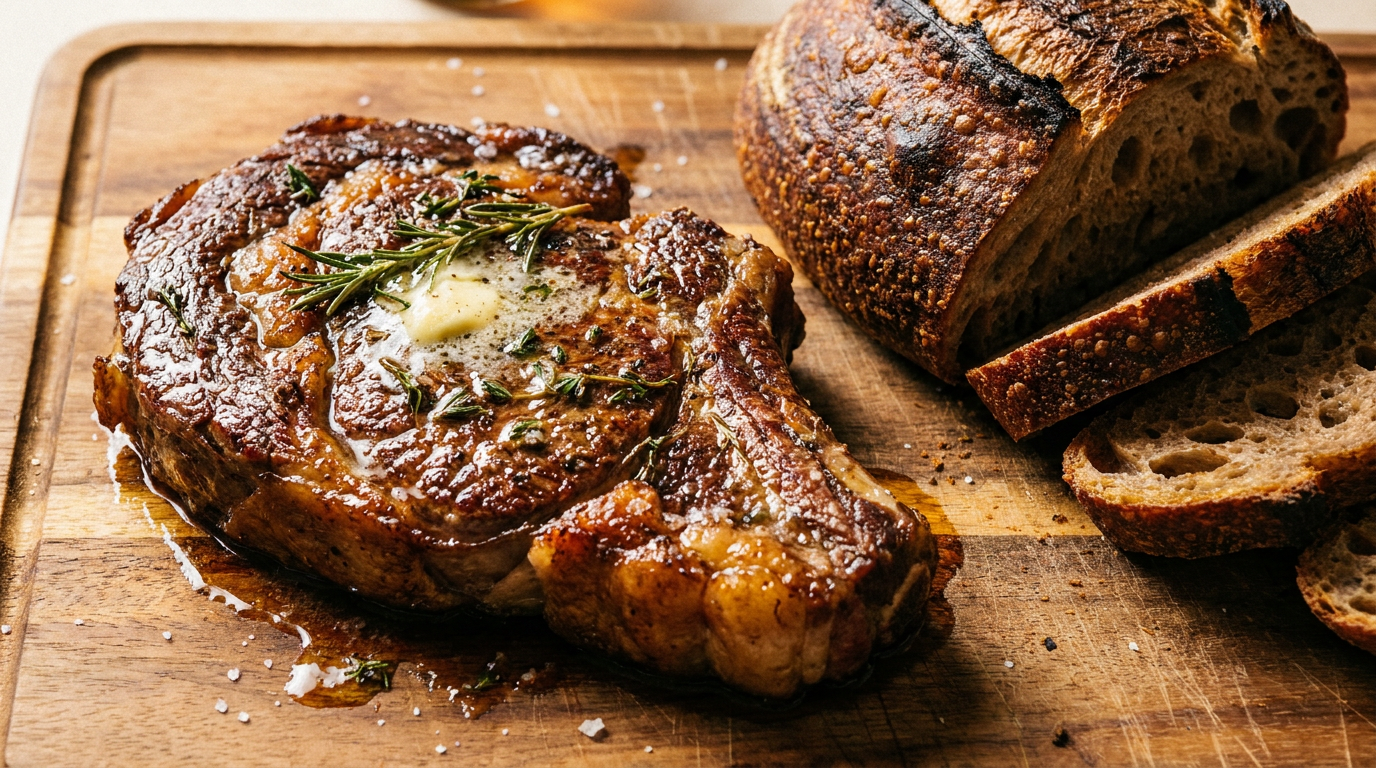
There is a distinct moment in cooking when raw ingredients transform into something entirely new. It happens when a pale piece of dough emerges from the oven with a golden, fragrant crust, or when a steak hits a hot cast-iron skillet and develops a savory, sizzling exterior. This transformation is not merely the result of food getting hot; it is the product of one of the most important chemical processes in the culinary world: the Maillard reaction.[3][4]
First described in 1912 by French chemist Louis Camille Maillard, the reaction is a form of non-enzymatic browning. Maillard originally observed the phenomenon while attempting to reproduce biological protein synthesis in a laboratory, noting that heating a solution of sugars and amino acids produced a distinct brown color. Today, food scientists and chefs recognize this reaction as the foundational engine of flavor in roasted, baked, and fried foods.[1][2]
At its core, the Maillard reaction is a chemical cascade triggered when amino acids—the building blocks of proteins—collide with reducing sugars under the stress of heat. The process begins with a nucleophilic attack, where the amino group bonds with the sugar's carbonyl group to form a Schiff base. This unstable structure quickly rearranges into what chemists call Amadori compounds.[1][7]
From there, the chemistry rapidly multiplies in complexity. The Amadori compounds break down and recombine into hundreds of highly volatile flavor molecules, including pyrazines, furans, and aldehydes. These microscopic compounds are responsible for the nutty, roasted, and savory aromas that human taste receptors find irresistible. Simultaneously, the reaction produces melanoidins—large, brown, nitrogen-rich polymers that give cooked food its characteristic dark color.[1][2][4]

A common misconception in the kitchen is conflating the Maillard reaction with caramelization. While both processes produce browning and complex flavors under heat, they are chemically distinct. Caramelization is the thermal degradation of sugar alone, requiring no proteins. The Maillard reaction, by contrast, strictly requires the presence of amino acids. This is why a plain sugar syrup melting in a pan behaves very differently than a roasting carrot, which contains both natural sugars and proteins.[2][3]
Temperature is the master switch for this chemical cascade. While the Maillard reaction can technically occur at room temperature over very long periods—such as the slow browning of aging champagne or the preservation of ancient bodies in peat bogs—it requires high heat to happen at a culinary pace. The reaction proceeds most rapidly between 140°C and 165°C (280°F to 330°F).[2][6]
The reaction proceeds most rapidly between 140°C and 165°C (280°F to 330°F).
This temperature requirement introduces the greatest enemy of the Maillard reaction: moisture. Water boils at 100°C (212°F), and as long as liquid water is present on the surface of a food, evaporating steam acts as a thermal ceiling. The surface temperature simply cannot rise high enough to trigger rapid browning until all the moisture has boiled away.[3][4]

Understanding this thermal barrier is the key to better home cooking. It explains why boiling or steaming food never produces a crust, and why recipes constantly instruct cooks to pat meat dry with a paper towel before searing. It is also the reason why overcrowding a frying pan leads to pale, unappetizing results; the trapped moisture from the food creates a localized steam bath, dropping the pan's temperature below the Maillard threshold.[3][5]
Beyond temperature and moisture, the pH level of the cooking environment heavily influences the speed of the reaction. The Maillard process accelerates significantly in alkaline conditions because the amino groups become deprotonated, increasing their reactivity. Food scientists and commercial bakers frequently manipulate this variable to achieve specific results.[1][2][6]
Home cooks can harness this alkaline advantage with simple pantry ingredients. Adding a small pinch of baking soda to a pan of onions will drastically reduce the time it takes to brown them. Similarly, the deep, glossy mahogany crust of a traditional soft pretzel is achieved by briefly dipping the raw dough in a highly alkaline lye or baked baking soda solution before it enters the oven.[2][4]

However, pushing the reaction too far introduces culinary and nutritional risks. When surface temperatures climb above 180°C (355°F), the Maillard reaction largely ceases, and a new chemical process takes over: pyrolysis. Pyrolysis is the thermal decomposition of the food—more commonly known as burning. This stage destroys the delicate flavor compounds, replacing them with bitter, acrid tastes and black char.[2][4][6]
Nutritional researchers also monitor the extremes of high-heat cooking. While the melanoidins produced by the Maillard reaction exhibit beneficial antioxidant properties, pushing the temperature too high can generate potentially harmful byproducts. In carbohydrate-rich foods like potatoes, excessive heat can lead to the formation of acrylamide, a compound linked to health risks in animal studies. Moderating heat and avoiding deep charring helps balance flavor development with nutritional safety.[1][2][7]
The scope of the Maillard reaction extends far beyond the frying pan. It is the invisible architect behind the flavor profiles of the world's most beloved foods and beverages. The roasting of green coffee beans into dark, aromatic espresso relies entirely on this process. The malting of barley for beer and whiskey, the roasting of cacao beans for chocolate, and the creation of black garlic all depend on the precise orchestration of amino acids and sugars.[2][5]
Ultimately, cooking is an act of applied chemistry. By understanding the mechanics of the Maillard reaction, home cooks are no longer just following instructions blindly. Recognizing the interplay of heat, moisture, and pH empowers anyone to intentionally build layers of complex flavor, transforming simple raw ingredients into extraordinary meals.[4][5][7]
How we got here
1912
French chemist Louis Camille Maillard first describes the browning phenomenon while attempting to reproduce biological protein synthesis.
1953
Chemist John E. Hodge publishes a comprehensive mechanism detailing the complex steps of the reaction, establishing the foundational model used today.
Early 2000s
The modernist cuisine movement brings the precise chemical manipulation of the Maillard reaction into high-end restaurant kitchens.
Present Day
Food scientists continue to map the hundreds of distinct volatile flavor compounds produced by the reaction in different ingredients.
Viewpoints in depth
Culinary Scientists
Focus on the precise molecular mechanisms and how specific variables alter the chemical cascade.
For food chemists and modernist chefs, the Maillard reaction is a highly tunable equation. They view cooking as the deliberate manipulation of variables—temperature, time, water activity, and pH—to favor the production of specific volatile compounds. By understanding that the reaction requires the nucleophilic attack of an amino group on a sugar's carbonyl carbon, scientists can predict flavor outcomes. In high-end kitchens, this knowledge is applied through techniques like pressure-cooking vegetables with baking soda to force rapid, deep browning without moisture loss, or using precise sous-vide temperatures to control enzymatic activity before a final, high-heat sear.
Home Cooks & Recipe Developers
Focus on practical kitchen techniques to maximize flavor without needing laboratory equipment.
Culinary educators and recipe developers translate complex chemistry into actionable kitchen rules. For this camp, the science is less about naming specific pyrazines and more about understanding the 'moisture barrier.' They emphasize foundational techniques: thoroughly patting proteins dry with paper towels, pre-heating heavy cast-iron pans to maintain thermal mass, and cooking in batches to avoid trapping steam. Their goal is to help everyday cooks achieve restaurant-quality crusts and deep, savory pan sauces by respecting the physical limits of heat and water.
Nutritional Researchers
Focus on the health implications of the compounds generated during high-heat cooking.
Public health experts and nutritional scientists study the dual nature of Maillard reaction products. On the positive side, the reaction generates melanoidins, which have been shown to possess antioxidant and antimicrobial properties. However, researchers caution against the extremes of high-heat cooking. When carbohydrate-rich foods are pushed to high temperatures, the reaction can produce acrylamide, a compound linked to cancer risks in animal models. Furthermore, the reaction can reduce the bioavailability of certain essential amino acids. This camp advocates for a balanced approach: enjoying the flavor benefits of moderate browning while avoiding excessive charring and pyrolysis.
What we don't know
- The exact chemical structures of many complex melanoidins produced in the late stages of the reaction remain poorly characterized.
- How the hundreds of distinct volatile compounds interact synergistically to create specific flavor profiles is still an active area of sensory research.
- The long-term health impacts of consuming various advanced glycation end products (AGEs) formed during the reaction are still being debated by nutritionists.
Key terms
- Maillard reaction
- A chemical reaction between amino acids and reducing sugars under heat that gives browned food its distinctive flavor and color.
- Melanoidins
- Brown, high-molecular-weight polymers formed in the late stages of the Maillard reaction, responsible for the dark color of cooked foods.
- Pyrolysis
- The thermal decomposition of materials at elevated temperatures, commonly perceived in cooking as burning or charring.
- Reducing sugar
- A type of sugar, such as glucose or fructose, that can donate electrons to another molecule, acting as a key reactant in the browning process.
- Amadori compounds
- Intermediate chemical structures formed early in the Maillard reaction before they break down into complex, highly volatile flavor molecules.
- Caramelization
- The browning of sugar through heat, a distinct process from the Maillard reaction as it does not involve amino acids or proteins.
Frequently asked
Why doesn't boiled or steamed food turn brown?
Water boils at 100°C (212°F), which acts as a thermal ceiling. The Maillard reaction requires temperatures around 140°C (280°F) to proceed rapidly, which cannot be reached while surface moisture is present.
Is the Maillard reaction the same as caramelization?
No. Caramelization involves only the breakdown of sugars under heat, while the Maillard reaction requires both sugars and amino acids (proteins) to create its distinct savory flavors.
Can I speed up browning in the kitchen?
Yes. Removing surface moisture with a paper towel, ensuring the pan is hot, or slightly raising the pH (such as adding a pinch of baking soda to onions) will accelerate the reaction.
Does the Maillard reaction only happen to meat?
Not at all. It is responsible for the crust on bread, the flavor of roasted coffee and chocolate, the browning of roasted vegetables, and the golden color of french fries.
Sources
Source coverage
7 outlets
3 viewpoints surfaced







[1]PMCCulinary Scientists
Maillard Reaction: Mechanism, Influencing Parameters, Advantages, Disadvantages, and Food Industrial Applications: A Review
Read on PMC →[2]WikipediaNutritional Researchers
Maillard reaction
Read on Wikipedia →[3]BBC Good FoodHome Cooks & Recipe Developers
The science of browning
Read on BBC Good Food →[4]Modernist CuisineCulinary Scientists
The Maillard Reaction
Read on Modernist Cuisine →[5]Escoffier School of Culinary ArtsHome Cooks & Recipe Developers
What Is a Maillard Reaction?
Read on Escoffier School of Culinary Arts →[6]AlimentariumCulinary Scientists
The Maillard reaction
Read on Alimentarium →[7]Factlen Editorial TeamNutritional Researchers
Synthesis by Factlen editorial team
Read on Factlen Editorial Team →
Every angle. Every day.
Get food drink stories with full source coverage and perspective breakdowns delivered to your inbox.