
How Next-Generation Geothermal Energy is Unlocking 24/7 Clean Power
By borrowing drilling techniques from the oil and gas industry, enhanced geothermal systems are tapping into the Earth's deep heat to provide reliable, carbon-free electricity.
By Factlen Editorial Team
- Geothermal Developers
- Argue that borrowing horizontal drilling and fracking techniques from the oil and gas industry is the key to scaling firm, carbon-free power globally.
- Grid Operators & Tech Companies
- View next-generation geothermal as an essential solution to power the massive, 24/7 electricity demands of AI data centers without increasing carbon emissions.
- Federal Policymakers
- See advanced geothermal as a critical pillar for national energy security and grid decarbonization, requiring significant upfront investment to reach commercial liftoff.
What's not represented
- · Local communities near drilling sites concerned about water usage and induced seismicity
- · Oil and gas workers transitioning their skills to the geothermal sector
Why this matters
As artificial intelligence and electrification drive up global power demand, the grid desperately needs clean energy that runs 24/7. Next-generation geothermal provides a viable alternative to fossil fuels and nuclear power, potentially unlocking enough firm electricity to power the world hundreds of times over.
Key points
- Next-generation geothermal uses oil and gas drilling techniques to tap heat from dry rock, bypassing the need for natural hot springs.
- The technology provides 24/7 'firm' clean power, making it an ideal complement to intermittent solar and wind energy.
- Fervo Energy is leading the sector, preparing for a $1.33 billion IPO in 2026 as AI data centers drive massive electricity demand.
- The U.S. Department of Energy projects advanced geothermal could grow from 4 gigawatts today to 90 gigawatts by 2050.
- Scientists are using advanced fiber-optic sensors to monitor subsurface micro-earthquakes and ensure the fracturing process remains safe.
The global energy transition has a math problem. While solar and wind power are deploying at record speeds, they are inherently intermittent—dependent on the sun shining and the wind blowing. To build a reliable, decarbonized grid, utilities need "firm" clean power that runs 24 hours a day, seven days a week. For decades, the options for this baseload power have been limited to nuclear energy, which faces steep regulatory and cost hurdles, or natural gas paired with nascent carbon capture technology. But a third option is rapidly moving from theoretical promise to commercial reality: next-generation geothermal energy. By tapping into the near-limitless heat trapped within the Earth's crust, engineers are unlocking a power source that could theoretically meet global electricity demand hundreds of times over.[1][2]
Traditional geothermal energy is not new; it has been used for over a century to generate electricity in places like Iceland, Kenya, and parts of California. However, conventional geothermal plants require a rare geological trifecta: subterranean heat, naturally occurring water, and highly permeable rock to allow that fluid to flow and carry heat to the surface. Because these conditions only occur naturally near tectonic plate boundaries or volcanic regions, geothermal energy has historically been geographically constrained, accounting for less than 1 percent of global electricity generation. Next-generation geothermal technologies aim to remove these geographic handcuffs entirely.[5]
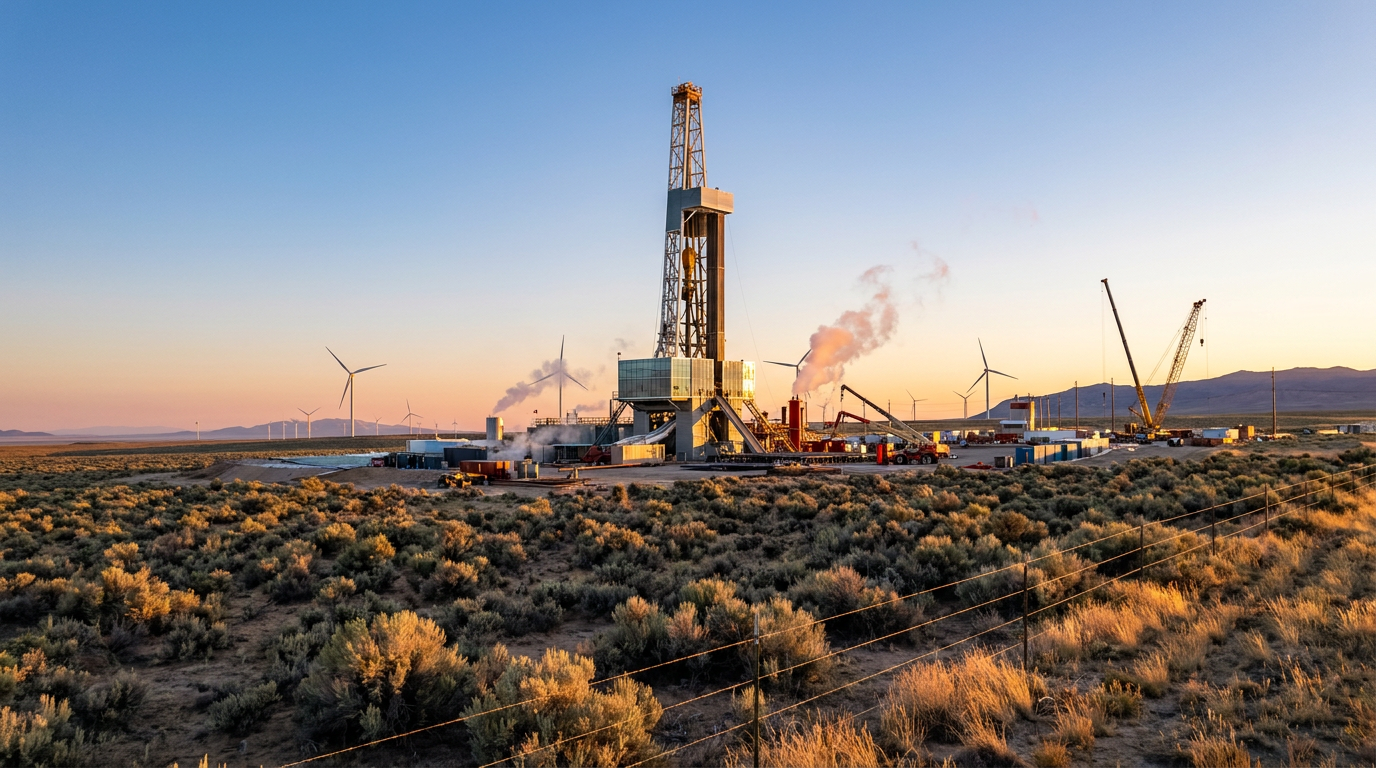
The most mature of these new approaches is known as Enhanced Geothermal Systems (EGS). Instead of hunting for natural underground aquifers, EGS creates engineered reservoirs in hot, dry rock. Developers drill thousands of feet into the earth where temperatures exceed 300 degrees Fahrenheit. They then inject fluid under high pressure to create or reopen millimeter-thick fractures in the impermeable rock—a process known as hydraulic stimulation. A second well is drilled to intersect this newly created fracture network. Water is pumped down the injection well, heated as it flows through the hot rock, and drawn up the production well to drive steam turbines on the surface.[5][8]

Ironically, the clean energy breakthrough of EGS owes its existence to the fossil fuel industry. Geothermal developers are directly repurposing the horizontal directional drilling and hydraulic fracturing (fracking) techniques pioneered during the shale gas revolution. By drilling horizontally for thousands of feet through hot rock, modern geothermal companies can expose vastly more surface area to the circulating water than older vertical wells ever could. This technology transfer is not just about hardware; it is also absorbing the specialized workforce of the oil and gas sector, offering a seamless transition for drillers and petroleum engineers into the green energy economy.[8]
The undisputed leader in the EGS space is Fervo Energy, a Houston-based startup backed by tech giants like Google. Fervo's "Project Red" in Nevada recently became the world's longest-running commercial EGS facility, proving that the physics of engineered reservoirs work at scale with zero thermal decline over its first year of operation. Now, the company is scaling up massively with "Cape Station," a sprawling development in Beaver County, Utah. Expected to begin delivering its first 100 megawatts of power to the grid in 2026, Cape Station is slated to eventually reach 400 to 500 megawatts—enough to power hundreds of thousands of homes.[3][4]
The financial markets are taking notice of this technical validation. Driven by the voracious electricity demands of artificial intelligence data centers and widespread industrial electrification, Fervo Energy is reportedly preparing for a massive initial public offering in 2026. Industry analysts suggest the IPO could raise up to $1.33 billion, targeting a company valuation of $6.5 billion. This influx of capital highlights a broader shift: tech companies and grid operators are no longer just buying renewable energy credits; they are actively investing in the physical infrastructure required to guarantee 24/7 clean power for their operations.[4]

The U.S. Department of Energy (DOE) views next-generation geothermal as a linchpin of future grid stability. In its recent "Pathways to Commercial Liftoff" report, the DOE projected that advanced geothermal capacity in the United States could grow from just 4 gigawatts today to 90 gigawatts by 2050. Under aggressive deployment scenarios, that figure could reach 300 gigawatts, representing roughly a quarter of the nation's current total electricity capacity. Achieving this scale will require an estimated $225 billion to $250 billion in capital investment, but the DOE notes that costs are already falling rapidly as drilling speeds improve.[2]
Department of Energy (DOE) views next-generation geothermal as a linchpin of future grid stability.
While EGS is currently the most commercially advanced technology, other next-generation approaches are also gaining traction. Advanced Geothermal Systems (AGS), often referred to as closed-loop geothermal, function like massive underground radiators. Instead of injecting fluid directly into the rock fractures, AGS circulates a working fluid through a sealed network of subterranean pipes. Because the fluid never touches the surrounding rock, closed-loop systems eliminate the need for hydraulic fracturing and can theoretically be deployed in highly porous or fragile geologies where EGS might struggle. Companies like Eavor are already deploying commercial closed-loop projects in Europe.[1][5]
Further out on the technological horizon is Superhot Rock (SHR) geothermal. While current EGS projects target rock temperatures around 350 to 400 degrees Fahrenheit, SHR aims to drill even deeper to reach rock exceeding 750 degrees Fahrenheit (400 degrees Celsius). At these extreme temperatures, water enters a "supercritical" state, behaving as both a liquid and a gas. Supercritical fluid can carry exponentially more energy than standard steam, meaning a single SHR well could potentially generate ten times the electricity of a conventional geothermal well.[6]
Reaching superhot rock, however, requires entirely new drilling paradigms. Conventional mechanical drill bits melt or degrade rapidly at such extreme depths and temperatures. To solve this, researchers at the Massachusetts Institute of Technology and spin-off companies like Quaise Energy are developing millimeter-wave drilling technology. This approach uses high-power microwaves to literally vaporize the rock, allowing the drill to penetrate deep into the Earth's crust without physical contact. If successful, millimeter-wave drilling could make superhot geothermal energy accessible virtually anywhere on the planet.[6]

Despite the immense promise, the widespread deployment of next-generation geothermal faces several significant hurdles. The most prominent environmental concern is induced seismicity. The hydraulic stimulation used in EGS inherently involves breaking rock, which creates micro-earthquakes. While the vast majority of these seismic events are too small to be felt on the surface, the industry must carefully manage injection pressures to avoid triggering larger, damaging tremors.[7][8]
To mitigate seismic risks, the industry is investing heavily in advanced subsurface monitoring. At Fervo's Cape Station, geophysicists from the Lawrence Berkeley National Laboratory recently achieved a major breakthrough by deploying custom fiber-optic seismometers nearly 7,000 feet underground. Operating continuously for months in 338-degree heat, these sensors provide real-time, high-resolution data on how fractures are forming. This continuous monitoring allows operators to adjust fluid pressures dynamically, optimizing heat extraction while keeping seismic activity safely below noticeable thresholds.[7]

Water usage is another critical consideration, particularly in the arid American West where many early EGS projects are located. While geothermal plants use significantly less water than coal or nuclear facilities, the initial hydraulic stimulation process requires millions of gallons of water to create the fracture network. Developers are exploring ways to use non-potable brackish water or even supercritical carbon dioxide as the working fluid, which could simultaneously sequester greenhouse gases while extracting heat.[1][5]
Finally, there is the challenge of upfront capital costs. Drilling deep into hard crystalline rock is inherently expensive, and a geothermal project can require tens of millions of dollars in capital expenditure before a single electron is generated. Unlike solar and wind projects, which have highly predictable costs and rapid deployment timelines, geothermal exploration carries "dry hole" risk—the possibility that a completed well fails to produce the expected thermal output.[2][8]
Overcoming these financial barriers will require sustained policy support and innovative financing models. The DOE's Frontier Observatory for Research in Geothermal Energy (FORGE) in Utah has been instrumental in de-risking the technology by providing a dedicated field laboratory for companies to test new drill bits and stimulation techniques. As drilling times decrease and the technology moves down the learning curve, the levelized cost of energy for next-generation geothermal is projected to fall below that of natural gas with carbon capture by the mid-2030s.[2][8]
The transition of next-generation geothermal from a speculative science experiment to a bankable infrastructure asset marks a pivotal moment in the fight against climate change. By harnessing the heat beneath our feet, the energy sector is unlocking a dispatchable, zero-carbon power source that can backstop the intermittent nature of renewables. As the first commercial-scale EGS plants come online in 2026, they will not just be powering data centers and homes; they will be proving that the Earth itself holds the key to a fully decarbonized grid.[1][4]
How we got here
2023
Fervo Energy's Project Red in Nevada becomes the first commercial EGS facility to send electricity to the grid.
March 2024
The U.S. Department of Energy releases its Liftoff report, projecting geothermal could reach 90 GW by 2050.
July 2025
Berkeley Lab scientists deploy continuous fiber-optic monitoring sensors nearly 7,000 feet underground at Fervo's Utah site.
Early 2026
Fervo Energy prepares for a major initial public offering to fund rapid expansion driven by AI power demand.
Late 2026
Fervo's Cape Station in Utah is scheduled to begin delivering its first 100 megawatts of power to the grid.
Viewpoints in depth
Geothermal Developers
Argue that the technology is ready to scale today by repurposing oil and gas expertise.
Companies like Fervo Energy and Eavor argue that the geothermal industry no longer needs to wait for fundamental scientific breakthroughs. By adopting the horizontal directional drilling and hydraulic fracturing techniques perfected by the shale gas industry over the last two decades, developers can now engineer geothermal reservoirs almost anywhere. They point to the rapid decline in drilling costs and the successful, sustained output of pilot projects as proof that Enhanced Geothermal Systems (EGS) are ready for commercial deployment. For these developers, the primary remaining hurdles are regulatory permitting and securing the massive upfront capital required to drill.
Grid Operators & Tech Companies
View geothermal as the missing puzzle piece for a reliable, zero-carbon electricity grid.
For utility companies and major tech firms like Google and Microsoft, the appeal of next-generation geothermal lies in its 'firm' capacity. As artificial intelligence data centers and widespread electrification push grid demand to unprecedented levels, operators are struggling to balance the intermittent nature of solar and wind power. Batteries can bridge short gaps, but they cannot provide days or weeks of backup power. These stakeholders view geothermal as a direct, zero-carbon replacement for baseload coal and natural gas plants, providing the 24/7 reliability required to keep the modern digital economy running without compromising corporate climate pledges.
Environmental & Community Watchdogs
Express cautious optimism but warn about the risks of induced seismicity and water consumption.
While broadly supportive of decarbonization efforts, environmental groups and local communities raise concerns about the physical footprint of EGS technologies. The hydraulic stimulation process inherently involves fracturing deep rock, which creates micro-seismic events. Watchdogs point to past geothermal projects in Europe and Asia that were shut down after triggering noticeable earthquakes. Additionally, in the arid regions of the American West where many early projects are located, the millions of gallons of water required to stimulate the wells present a potential conflict with local agricultural and municipal water needs. These groups advocate for strict regulatory oversight, mandatory continuous seismic monitoring, and the use of non-potable water sources.
What we don't know
- Whether the rapid cost reductions seen in early pilot projects will hold true as developers drill in more complex and varied geological formations.
- How effectively the industry can manage the risk of induced seismicity as projects scale up to hundreds of megawatts near populated areas.
- If experimental 'Superhot Rock' drilling technologies, like millimeter-wave vaporizing, can successfully transition from the lab to commercial field operations.
Key terms
- Enhanced Geothermal Systems (EGS)
- A technology that creates artificial underground reservoirs by injecting fluid into hot, dry rock to fracture it, allowing water to circulate and extract heat.
- Firm Power
- Electricity generation that can be relied upon to produce power consistently 24 hours a day, unlike intermittent sources like solar or wind.
- Hydraulic Stimulation
- The process of injecting high-pressure fluid deep underground to create or widen fractures in rock, commonly known as fracking.
- Superhot Rock Geothermal
- An experimental frontier of geothermal energy that drills deep enough to reach rock exceeding 400 degrees Celsius, where water becomes a highly energetic supercritical fluid.
- Closed-Loop Geothermal
- A system that circulates a working fluid through sealed underground pipes to absorb heat, acting like a massive subterranean radiator without fracturing the rock.
Frequently asked
What is the difference between traditional and next-generation geothermal?
Traditional geothermal requires natural underground hot springs, which are geographically rare. Next-generation geothermal uses advanced drilling to create artificial reservoirs in hot, dry rock, allowing it to be deployed almost anywhere.
Does next-generation geothermal use fracking?
Yes, Enhanced Geothermal Systems (EGS) use hydraulic fracturing techniques borrowed from the oil and gas industry to create millimeter-thick cracks in deep rock so water can circulate and absorb heat.
Why are tech companies investing in geothermal energy?
Tech companies need massive amounts of electricity to run AI data centers 24/7. Because solar and wind are intermittent, geothermal provides the constant, carbon-free 'firm' power they require.
Can geothermal drilling cause earthquakes?
The fracturing process creates micro-seismic events, which are usually too small to be felt. However, operators use advanced fiber-optic monitoring to carefully manage fluid pressures and prevent larger, damaging tremors.
Sources
Source coverage
8 outlets
3 viewpoints surfaced








[1]Factlen Editorial Team
Synthesis by Factlen editorial team
Read on Factlen Editorial Team →[2]U.S. Department of EnergyFederal Policymakers
Pathways to Commercial Liftoff: Next-Generation Geothermal Power
Read on U.S. Department of Energy →[3]Fervo EnergyGeothermal Developers
Project Red: Validating the Physics of Enhanced Geothermal Systems
Read on Fervo Energy →[4]CarbonCredits.comGrid Operators & Tech Companies
Fervo Energy Eyes $1.33B IPO As AI Drives Geothermal Demand
Read on CarbonCredits.com →[5]World Resources Institute
Next-Generation Geothermal Energy, Explained
Read on World Resources Institute →[6]Massachusetts Institute of Technology
Tapping into superhot rock for limitless geothermal energy
Read on Massachusetts Institute of Technology →[7]Lawrence Berkeley National LaboratoryFederal Policymakers
Scientists Develop New Technology to Continuously Monitor Geothermal Energy Operations
Read on Lawrence Berkeley National Laboratory →[8]Information Technology and Innovation FoundationGeothermal Developers
Enhanced Geothermal Systems: A Case Study in Clean Energy Innovation
Read on Information Technology and Innovation Foundation →

Every angle. Every day.
Get guides stories with full source coverage and perspective breakdowns delivered to your inbox.