
How Local AI Works: Running Large Language Models Offline in 2026
Advances in open-weight models and user-friendly software have made it possible to run powerful AI directly on consumer laptops, offering complete privacy and zero subscription costs.
By Factlen Editorial Team
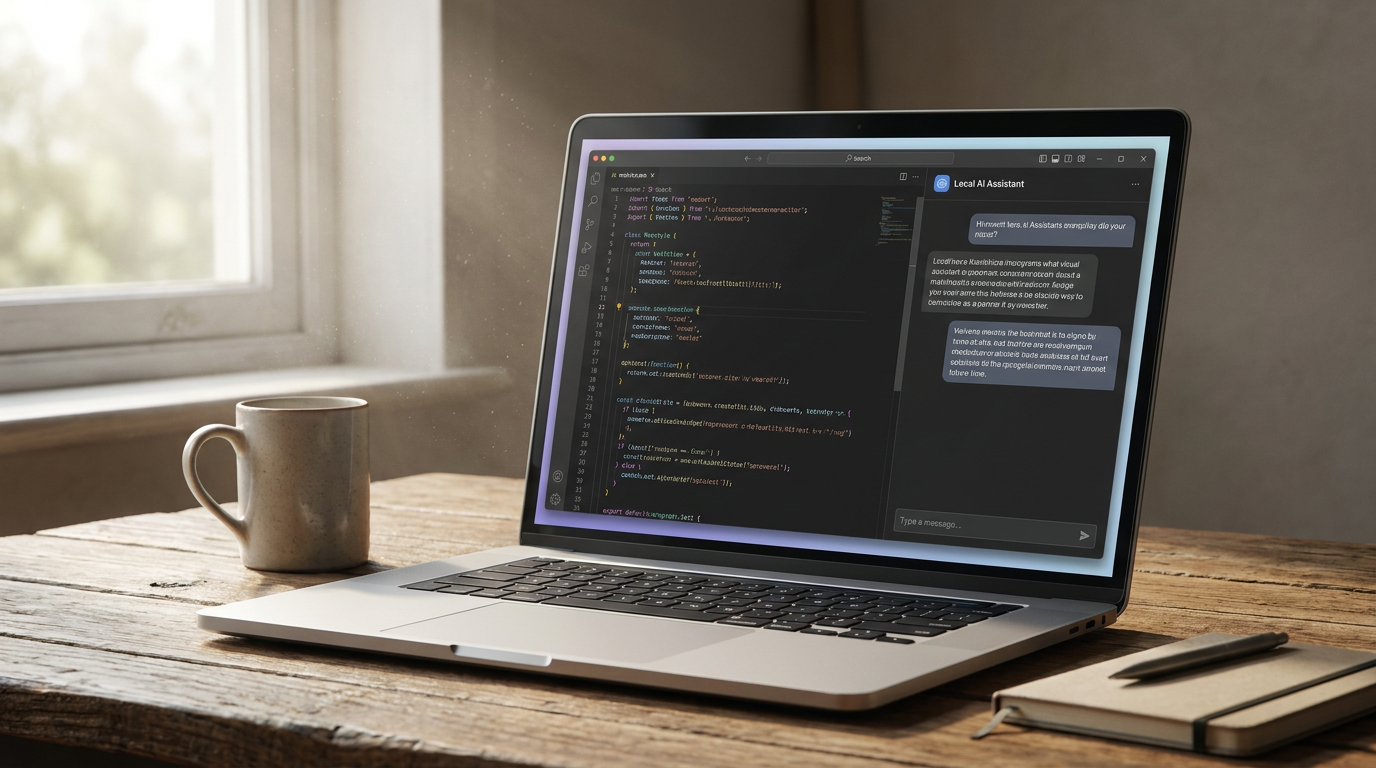
- Privacy & Enterprise IT
- Focuses on data sovereignty, security, and eliminating third-party exposure.
- Open-Source Advocates
- Values the freedom, cost-efficiency, and offline capabilities of local models.
- Frontier AI Realists
- Maintains that cloud infrastructure is necessary for the most advanced reasoning tasks.
What's not represented
- · Cloud Infrastructure Providers
- · Hardware Manufacturers
Why this matters
As AI becomes deeply integrated into daily workflows, sending sensitive personal, legal, or corporate data to cloud providers poses significant privacy risks. Local AI flips the architecture, bringing the intelligence directly to your device so your data never leaves your machine.
Key points
- Local AI allows users to run Large Language Models entirely offline.
- Data privacy is guaranteed because prompts never leave the user's device.
- Open-weight models from Meta, Alibaba, and OpenAI rival cloud performance.
- Tools like LM Studio and Ollama make installation accessible to non-programmers.
- Quantization enables these models to run on standard 16 GB laptops.
- Cloud APIs still hold an advantage for complex, multi-step reasoning tasks.
The era of cloud-only artificial intelligence is ending. For years, accessing a highly capable Large Language Model (LLM) meant sending prompts to a remote server owned by a tech giant. In 2026, the gap between "capable AI" and "AI you can run offline" has effectively vanished.[1][7]
The primary driver behind this shift is data privacy. When using cloud-based services, every query, document, and line of code is transmitted over the internet to third-party servers. For developers, healthcare professionals, and enterprise IT departments, this creates unacceptable data exposure risks.[5][8]
Local AI flips this architecture entirely. By running the model directly on the user's hardware, the data never leaves the machine. There are no cloud round-trips, no telemetry, and no risk of a vendor's database misconfiguration exposing sensitive chat histories.[1][10]

Beyond privacy, the financial mathematics of AI usage are pushing users toward local deployment. Standard cloud AI subscriptions—such as ChatGPT Plus or Claude Pro—typically cost around $20 per month, totaling $240 annually per service.[8]
For heavy users or teams, these recurring costs and API token fees accumulate rapidly. In contrast, local AI operates on a one-time hardware investment. Once the equipment is purchased, generating responses costs nothing beyond the electricity required to run the device.[7][8]

This offline revolution is powered by a new generation of "open-weight" models. Unlike proprietary systems hidden behind APIs, open-weight models allow anyone to download the underlying neural network architecture for free.[3][10]
The ecosystem has matured rapidly. Tech heavyweights like Meta, Alibaba, and Mistral have released highly capable models that offer multilingual support and advanced coding capabilities directly to the public.[3][4]
The movement gained unprecedented momentum when OpenAI, traditionally known for its closed-cloud approach, released its GPT-OSS models. These open-weight releases match the performance of their smaller frontier models, bringing cutting-edge reasoning to consumer hardware.[9]
The movement gained unprecedented momentum when OpenAI, traditionally known for its closed-cloud approach, released its GPT-OSS models.
But downloading a massive AI model is only half the battle; running it used to require complex command-line knowledge and specialized environments. Today, user-friendly software has bridged that gap, making local AI accessible to non-programmers.[2][10]
LM Studio has emerged as the premier graphical interface for everyday users. It operates much like a standard desktop application, allowing users to search a directory of models, download them with a click, and start chatting immediately in a familiar interface.[5][6]
For developers and engineers, Ollama serves as the engine of choice. It provides a seamless, single-command setup that acts as a local API, allowing developers to build offline applications and route their existing software to a local model instead of a cloud provider.[6]
The hardware barrier has also lowered significantly thanks to a software technique called "quantization." This process compresses massive neural networks by reducing the precision of their weights, allowing them to run efficiently without losing substantial accuracy.[9][10]

While massive 70-billion-parameter models still require dedicated high-end GPUs with ample VRAM, smaller 7B and 8B models run comfortably on modern Apple Silicon laptops or mid-range PCs equipped with 16 GB of RAM.[2][4]
Despite these advances, local AI is not a complete replacement for the cloud. Frontier models hosted in massive data centers still maintain a noticeable edge in complex, multi-step reasoning and long-horizon coding tasks.[4][7]
Furthermore, local models lack native web access. Because they operate entirely offline, they rely solely on their training data and cannot retrieve real-time information or current events without the addition of specialized agentic frameworks.[4]
How we got here
Early 2023
The release of LLaMA by Meta sparks the open-source AI movement, though running it requires complex technical setups.
Late 2023
Tools like Ollama and LM Studio launch, providing user-friendly interfaces for running models locally.
2024
Quantization techniques improve dramatically, allowing capable models to run on standard laptops.
2025
OpenAI releases GPT-OSS, bringing frontier-level reasoning to the open-weight ecosystem.
Mid 2026
Local AI becomes a mainstream alternative to cloud subscriptions, driven by privacy concerns and highly capable small models.
Viewpoints in depth
Privacy Advocates & Enterprise IT
Focuses on data sovereignty, security, and eliminating third-party exposure.
For corporate IT departments and privacy advocates, local AI is a non-negotiable requirement for handling sensitive data. They argue that sending proprietary code, legal documents, or patient information to cloud providers—even those with enterprise agreements—creates unnecessary attack vectors and compliance headaches. By air-gapping the AI, organizations maintain absolute data sovereignty and protect themselves against vendor data breaches or sudden changes in terms of service.
Everyday Users & Open-Source Developers
Values the freedom, cost-efficiency, and offline capabilities of local models.
This camp views local AI as a democratizing force. They emphasize the financial benefits of escaping the $20-a-month subscription treadmill and the practical utility of having an AI assistant that works on an airplane or during an internet outage. For developers, tools like Ollama and open-weight models represent a sandbox for unrestricted innovation, allowing them to tinker, fine-tune, and build applications without worrying about API rate limits or censorship.
Frontier AI Researchers
Maintains that cloud infrastructure is necessary for the most advanced reasoning tasks.
Researchers focused on the absolute cutting edge acknowledge the utility of local models but stress their limitations. They point out that while a 7-billion-parameter model on a laptop is impressive, it cannot compete with a trillion-parameter frontier model running on a massive GPU cluster when it comes to complex, multi-step logic or advanced mathematics. This camp advocates for a hybrid approach: local for routine tasks, cloud for the heavy lifting.
What we don't know
- Whether hardware manufacturers will begin shipping consumer laptops with dedicated AI accelerators specifically optimized for massive local models.
- How future regulatory frameworks might attempt to govern or restrict the distribution of powerful open-weight models.
- The exact timeline for when local models will fully close the reasoning gap with trillion-parameter cloud clusters.
Key terms
- Local LLM
- A Large Language Model that runs directly on a user's personal computer or local server rather than in the cloud.
- Open Weights
- AI models where the underlying neural network parameters are made publicly available for anyone to download and use.
- Quantization
- A compression technique that reduces the memory footprint of an AI model, allowing it to run on consumer hardware with minimal loss in quality.
- Inference
- The process of an AI model generating a response or prediction based on a user's prompt.
- VRAM
- Video RAM; the specialized memory on a graphics card that is crucial for loading and running large AI models quickly.
Frequently asked
Do I need an internet connection to use local AI?
No. Once you download the model and the software (like LM Studio or Ollama), the AI runs entirely offline on your device's hardware.
Do I need an expensive graphics card?
Not necessarily. While high-end GPUs are required for massive models, smaller models run comfortably on modern CPUs, especially Apple Silicon Macs with unified memory.
Is local AI actually private?
Yes. Because the computation happens on your machine, your prompts and data are never sent to a remote server, making it inherently private.
Can local AI search the web?
By default, no. Local models rely entirely on their training data. However, developers can connect them to local search tools or agentic frameworks to grant them web access.
Sources
Source coverage
10 outlets
3 viewpoints surfaced










[1]IPRoyalOpen-Source Advocates
Explore the top local LLM options for 2026
Read on IPRoyal →[2]AyautomateOpen-Source Advocates
8 Best Local LLM Tools to Run LLMs Locally in 2026
Read on Ayautomate →[3]OverchatOpen-Source Advocates
Best Local LLMs in 2026: Complete Guide
Read on Overchat →[4]Prompt QuorumFrontier AI Realists
Local LLM vs Cloud API: When to Use Each (2026 Trade-offs)
Read on Prompt Quorum →[5]Yuv AIPrivacy & Enterprise IT
Run AI Locally
Read on Yuv AI →[6]Zen Van RielOpen-Source Advocates
Ollama vs LM Studio
Read on Zen Van Riel →[7]D-Central TechFrontier AI Realists
Local AI vs cloud AI at a glance
Read on D-Central Tech →[8]GitHub CommunityPrivacy & Enterprise IT
Local AI vs Cloud AI — A 2026 Cost & Privacy Analysis
Read on GitHub Community →[9]OpenAIFrontier AI Realists
Introduction to gpt-oss-120b and gpt-oss-20b
Read on OpenAI →[10]Factlen Editorial TeamPrivacy & Enterprise IT
Synthesis by Factlen editorial team
Read on Factlen Editorial Team →

More in ai
See all 7 stories →Photonic Computing
Penn Physicists Unveil Light-Matter Chip Architecture to Solve AI's Energy Crisis
6 sources

Local AI
How to Run AI Locally in 2026: The Complete Guide to Private, Free LLMs
7 sources
Local AI
The 2026 Guide to Local AI: How to Run LLMs on Your Own Hardware
8 sources
Medical AI
AI Transitions from Hype to Clinical Reality with New Cancer Diagnostics and Drug Discoveries
6 sources

Every angle. Every day.
Get ai stories with full source coverage and perspective breakdowns delivered to your inbox.