
Global Restaurant Coalition Launches Universal 'Sensory-Friendly' Dining Certification
A massive industry shift toward 'acoustic wellness' is retrofitting restaurants to accommodate neurodivergent diners and those with hearing loss, proving that quieter dining rooms are both inclusive and highly profitable.
By Factlen Editorial Team
- Accessibility Advocates
- Argue that sensory-friendly spaces end decades of exclusion, making dining out a fundamental social right for neurodivergent individuals.
- Hospitality Operators
- Focus on the business case, noting that lower noise means higher guest satisfaction, longer stays, and tapping into an underserved demographic.
- Acoustic Designers
- Emphasize the integration of 'silent architecture' that achieves noise reduction without compromising the visual aesthetic of the modern restaurant.
What's not represented
- · Front-of-house staff managing complex sensory requests during peak rushes
- · Small independent operators who cannot afford expensive acoustic retrofitting
Why this matters
For decades, deafening restaurant noise has effectively locked millions of people with sensory processing differences and hearing loss out of public dining. This standardization of 'acoustic wellness' transforms dining out from a stressful ordeal into an accessible, universally comfortable experience.
Key points
- A global coalition has launched the 'Sensory Certified' standard for restaurants.
- The initiative mandates strict acoustic limits, adjustable lighting, and neuroinclusive staff training.
- Major chains and luxury hotels are rapidly adopting the standard to combat dining fatigue.
- Operators report immediate financial returns through increased bookings and higher guest satisfaction.
On June 18, 2026, a global coalition of major restaurant groups, accessibility advocates, and acoustic engineers officially launched the "Sensory Certified" dining standard, marking a definitive end to the era of the deafening dining room. The landmark initiative establishes universal, measurable guidelines for acoustic wellness, adjustable lighting, and specialized staff training. Designed to make dining out accessible for millions of individuals with sensory processing differences, autism, and hearing loss, the rollout represents one of the most significant shifts in hospitality design in decades, proving that inclusivity can fundamentally reshape how the world eats.[1][7]
Backed by prominent organizations like Autism Speaks and Sensory Friendly Solutions, the certification requires participating restaurants to meet strict acoustic targets, offer designated quiet zones during specific hours, and provide digital "sensory maps" that highlight the loudest and brightest areas of a venue before a guest even arrives. Major hospitality players have enthusiastically embraced the standard; industry giants including Darden Restaurants and high-end hotel groups like Grand Hyatt have already certified hundreds of locations worldwide, signaling that sensory inclusion is no longer a niche concept but a mainstream operational requirement.[4][7]
For the better part of two decades, the restaurant industry operated under the assumption that loud noise equated to "energy" and a desirable "vibe." The prevailing design trend of stripping dining rooms down to their bare, hard surfaces—concrete floors, exposed brick walls, floor-to-ceiling glass, and clattering open kitchens—created acoustic nightmare scenarios. In these environments, sound waves bounced endlessly without absorption, frequently pushing average dining room volumes well past 80 decibels, a level comparable to standing next to a running garbage disposal or a busy city intersection.[2][3]
This relentless wall of sound created a fundamentally hostile environment for the estimated one in six people who navigate sensory processing differences or neurodivergence. For families with autistic children, individuals with ADHD, or those managing age-related hearing loss, a simple dinner out often resulted in severe sensory overload. The sheer volume and chaotic lighting effectively locked a massive demographic out of public dining spaces, forcing millions of potential customers to stay home rather than endure the physical and mental exhaustion of a modern restaurant experience.[4][7]

The turning point arrived when hospitality operators realized that sensory overload wasn't just an accessibility failure—it was a critical luxury failure point that actively damaged their bottom line. High noise levels cause palate fatigue, strain casual conversations, and consistently plummet guest satisfaction scores. General managers at top-tier properties began tracking noise complaints as closely as they tracked daily revenue metrics, realizing that a deafening room was the primary reason diners chose not to return, regardless of how exceptional the food or service might have been.[2][6]
High noise levels cause palate fatigue, strain casual conversations, and consistently plummet guest satisfaction scores.
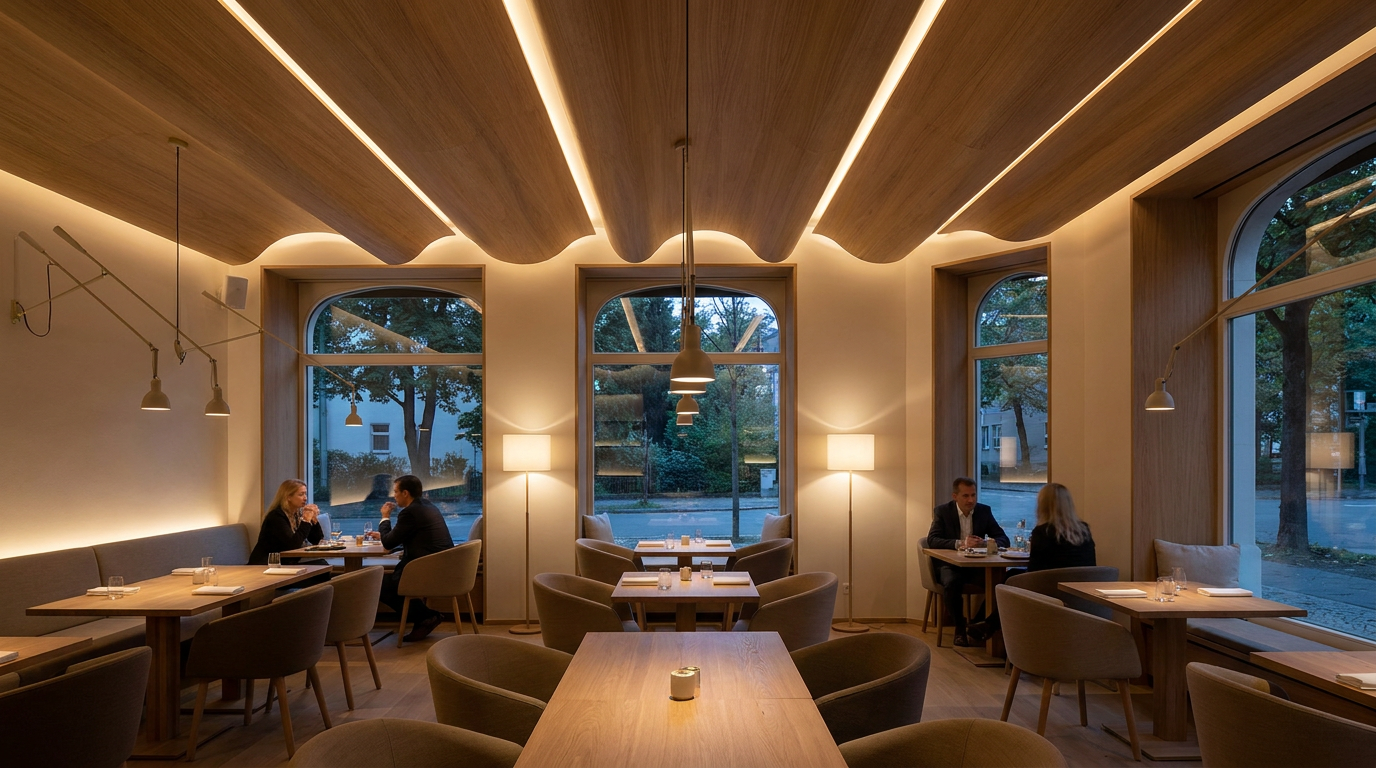
To solve the acoustic problem without returning to the stuffy, heavily carpeted dining rooms of the 1990s, the industry has aggressively embraced the concept of "silent architecture." Interior designers are now retrofitting spaces with hidden acoustic backing, advanced PET panels made from recycled materials, and perforated timber screens. These materials are specifically engineered to absorb and diffuse harsh sound waves while looking exactly like high-end art installations or standard architectural features, allowing restaurants to maintain their sleek, contemporary aesthetics while drastically improving the auditory environment.[3][5]
The ceiling has quickly become the primary canvas for this wave of acoustic innovation. Sculptural ceiling systems, wave-like felt baffles, and concealed acoustic coffers are being deployed to capture rising noise before it can bounce back down to the dining floor. These overhead installations allow a restaurant to maintain a visually striking, modern atmosphere while drastically controlling the room's reverberation, proving that functional sound management can actually enhance, rather than detract from, the overall visual identity of a highly designed hospitality space.[2][5]

The empirical data emerging from these acoustic retrofits is striking. Post-refurbishment acoustic reports at luxury properties like The Ned in London show these architectural interventions consistently dropping peak dining noise by 4 to 7 decibels—a massive reduction in perceived volume. More importantly, they bring the reverberation time (RT60)—the exact time it takes for sound to dissipate in a closed space—down to a highly comfortable 0.6 to 0.9 seconds, ensuring that a table of four can converse normally without shouting over the surrounding din.[3][5]
But the Sensory Certified standard goes far beyond physical architecture, mandating comprehensive neuroinclusive training for all front-of-house staff. Hospitality teams are now trained to proactively offer quieter seating options, adjust localized lighting upon request, and recognize the signs of sensory distress. Crucially, staff are taught that a guest wearing noise-canceling headphones or using a fidget tool is simply managing their environment to enjoy their meal, fostering a culture of empathy and seamless accommodation rather than confusion or judgment.[1][4]
The financial return on these inclusive practices has been immediate, undeniable, and highly lucrative. Restaurants offering sensory-friendly hours or designated low-stimulation zones report a massive surge in advance bookings, fierce brand loyalty, and glowing positive reviews from families who previously felt entirely ignored by the hospitality sector. By making minor operational adjustments, these venues are capturing a highly motivated demographic that actively seeks out and champions businesses that prioritize their comfort and specific neurological needs.[2][6]

Interestingly, the industry-wide push for neuroinclusive dining has revealed a universal truth: almost everyone hates shouting over dinner. The acoustic improvements and calmer atmospheres are proving wildly popular with elderly patrons, business diners conducting meetings, and the general public seeking a relaxing evening out. By designing for the margins and accommodating the most sensitive guests, restaurants have inadvertently created a vastly superior dining experience for the mainstream, driving up table turnover, increasing average spend, and boosting overall profitability.[3][6]
As the Sensory Certified standard continues its rapid global rollout through the remainder of 2026, acoustic design is officially moving from a backstage technicality to a foundational element of modern hospitality. The industry is finally proving that true energy in a dining room comes from human connection, shared experiences, and universal comfort, rather than just sheer, overwhelming volume. Moving forward, the best restaurants in the world won't just be judged by what's on the plate, but by how the room feels—and sounds—to everyone who walks through the door.[1][5]
How we got here
Pre-2020s
The restaurant industry embraces hard surfaces and open kitchens, pushing average dining noise past 80 decibels.
2021–2024
Advocacy groups begin highlighting how deafening restaurants exclude neurodivergent individuals and those with hearing loss.
2025
High-end hotels pioneer 'acoustic luxury,' proving that sound reduction directly increases guest satisfaction and revenue.
June 2026
A global coalition launches the 'Sensory Certified' standard, bringing acoustic wellness to mainstream dining.
Viewpoints in depth
Accessibility Advocates' View
Dining out is a fundamental social right that should not exclude neurodivergent individuals.
Advocacy groups like Autism Speaks and Sensory Friendly Solutions argue that the hospitality industry has long ignored a massive demographic. By equating loud, chaotic environments with 'good energy,' restaurants effectively barred the 1 in 6 people with sensory processing differences from participating in public dining. They view the new certification as a civil rights victory, ensuring that neurodivergent individuals and those with hearing loss can finally enjoy a meal without the threat of sensory assault.
Hospitality Operators' View
Acoustic wellness is a highly profitable operational strategy, not just a charitable accommodation.
For restaurant owners and general managers, the shift toward sensory-friendly dining is driven by the bottom line. Data shows that excessive noise leads to palate fatigue, shorter stays, and plummeting review scores. By investing in acoustic retrofits and neuroinclusive training, operators are tapping into a fiercely loyal, underserved demographic while simultaneously improving the experience for their broader customer base, leading to higher table turnover and increased average spend.
Acoustic Designers' View
Sound management must be integrated into the architecture itself, rather than applied as an afterthought.
Architects and interior designers emphasize the rise of 'silent architecture.' They argue that acoustic comfort should be treated as a primary building material, right alongside lighting and seating. By utilizing innovative materials like recycled PET panels, perforated timber, and sculptural ceiling baffles, designers can achieve strict reverberation targets (RT60) without sacrificing the sleek, modern aesthetics that define contemporary dining.
What we don't know
- Whether small, independent restaurants will be able to afford the architectural retrofits required for certification.
- How the standard will be enforced or audited over time to ensure ongoing compliance.
Key terms
- Reverberation Time (RT60)
- The time it takes for sound to decay by 60 decibels in a closed space; a key metric for measuring echo and acoustic comfort.
- Silent Architecture
- Interior design that seamlessly integrates sound-absorbing materials—like acoustic baffles and PET panels—without compromising visual aesthetics.
- Sensory Overload
- A condition where the brain receives more input from the senses (noise, light, crowds) than it can process, often experienced by neurodivergent individuals.
- Neuroinclusive
- Designing spaces, policies, and services to accommodate and welcome people with neurological differences, such as autism or ADHD.
Frequently asked
What makes a restaurant "Sensory Certified"?
The venue must meet strict acoustic targets, offer adjustable lighting, provide sensory maps, and train staff in neuroinclusive hospitality.
Does this mean restaurants will be completely silent?
No. The goal is "acoustic wellness," which fine-tunes the sound to reduce harsh echoes and background clatter while maintaining a comfortable buzz.
Who benefits from sensory-friendly dining?
While designed for individuals with autism and hearing loss, the quieter environments are universally popular with all diners, including the elderly and business professionals.
Sources
Source coverage
7 outlets
3 viewpoints surfaced







[1]EaterHospitality Operators
The Era of the Deafening Restaurant is Over: Major Chains Adopt 'Sensory Certified' Standards
Read on Eater →[2]Restaurant Business OnlineHospitality Operators
Why 'Acoustic Wellness' is 2026's Most Profitable Dining Trend
Read on Restaurant Business Online →[3]The New York TimesAcoustic Designers
A Quiet Revolution in Dining: How Restaurants Finally Turned Down the Volume
Read on The New York Times →[4]Sensory Friendly SolutionsAccessibility Advocates
What the New Universal Sensory-Friendly Dining Standard Means for Families
Read on Sensory Friendly Solutions →[5]Architectural DigestAcoustic Designers
Silent Architecture: The Invisible Acoustic Baffles Changing Restaurant Design
Read on Architectural Digest →[6]ForbesHospitality Operators
The ROI of Quiet: How Inclusive Acoustics Are Boosting Restaurant Margins
Read on Forbes →[7]Autism SpeaksAccessibility Advocates
Global Restaurant Coalition Pledges to End 'Sensory Overload' in Dining
Read on Autism Speaks →
Every angle. Every day.
Get food drink stories with full source coverage and perspective breakdowns delivered to your inbox.