
How to Navigate Kyoto's 2026 Sustainable Tourism Rules: A Local Guide
As Kyoto introduces sweeping new rules to combat overtourism—from a tenfold tax increase on luxury stays to bans on private alleys—travelers must adapt to a new era of "locally honored tourism."
By Factlen Editorial Team
- Kyoto Residents & Officials
- Prioritizing the livability of the city and the preservation of its cultural heritage over unchecked tourism growth.
- International Travelers
- Navigating a complex web of new costs, strict etiquette rules, and logistical hurdles.
- Local Hospitality Sector
- Adapting business models to comply with strict oversight while managing guest expectations.
What's not represented
- · Rural Japanese towns seeking the tourists Kyoto is turning away
- · Budget backpackers priced out by new taxes
Why this matters
Visitors to Japan's ancient capital face strict new regulations and potential fines in 2026. Understanding these rules ensures a stress-free trip while preserving the city's cultural heritage and respecting the daily lives of local residents.
Key points
- Kyoto is implementing a progressive accommodation tax in March 2026, raising luxury stay levies to ¥10,000 per night.
- Tourists are legally banned from entering private alleys in the Gion district to protect local residents and entertainers.
- The 'Hands-Free Tourism' initiative requires visitors to use luggage forwarding rather than bringing large suitcases on city buses.
- City officials are conducting surprise late-night inspections of short-term rentals to enforce noise and occupancy rules.
- A new 'Blue Ticket' system will issue strict financial fines to tourists who violate cycling laws starting in April 2026.
Japan’s ancient capital is undergoing a profound transformation in how it welcomes the world. After post-pandemic travel pushed Kyoto’s infrastructure to a breaking point, the city has pivoted aggressively from passive sightseeing to a model it calls "locally honored tourism." For travelers planning a visit in 2026, this means navigating a landscape of strict new regulations, steep tax increases, and mandatory etiquette rules. The era of wandering aimlessly through residential neighborhoods with massive suitcases is over. Instead, Kyoto is implementing a comprehensive framework designed to protect its cultural heritage and restore livability for its residents, requiring visitors to actively participate in the city's preservation.[4][5]
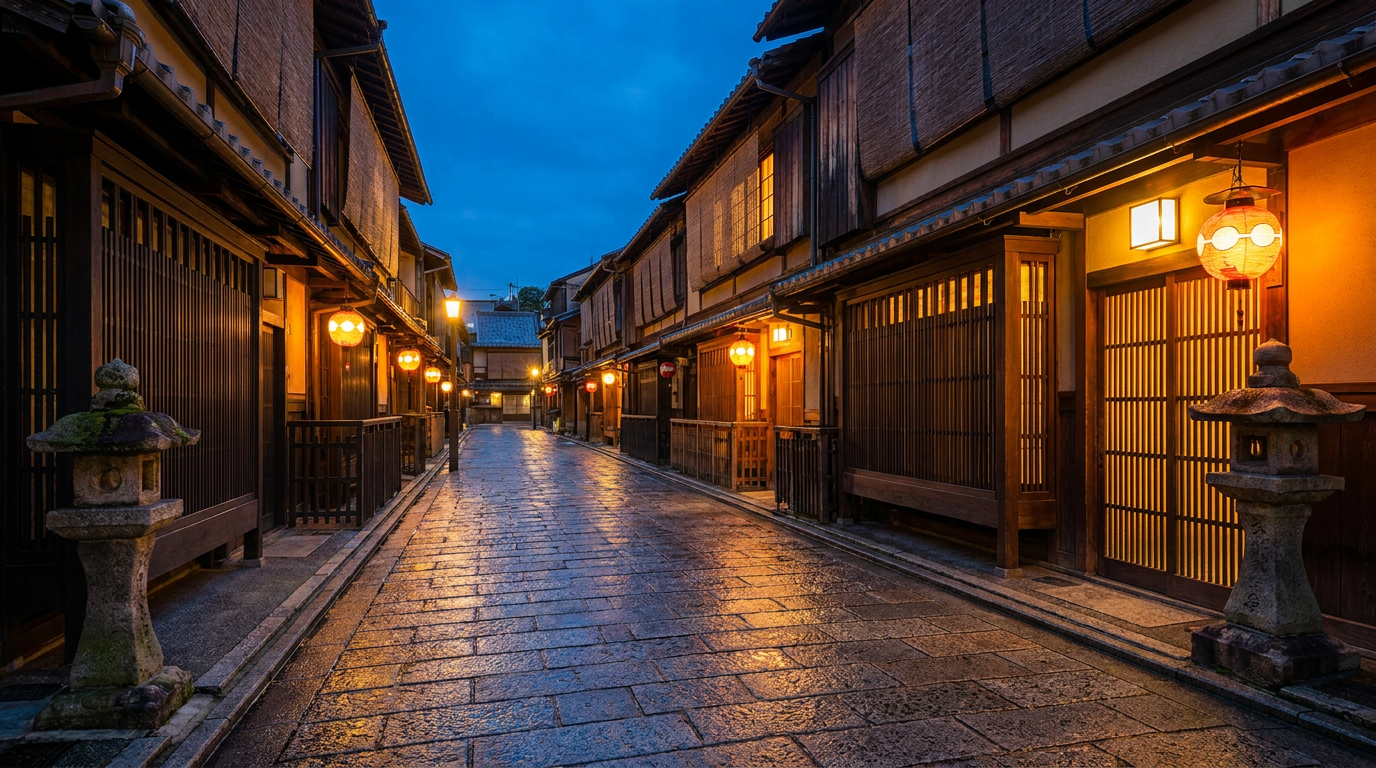
The most visible symbol of this regulatory shift is found in the historic Gion district, famous for its wooden machiya houses and traditional teahouses. Following years of escalating tension, local authorities have officially banned tourists from entering the district's picturesque private alleyways, such as Kosode Koji. While the main public thoroughfare of Hanamikoji Street remains open to all, stepping past the newly installed multilingual "No Entry" signs onto private roads now carries a legally binding fine of ¥10,000. This measure marks a hard line drawn by a local council that previously relied on polite requests and non-binding photography bans.[1][7]
The catalyst for the Gion ban was a pattern of severe misbehavior by a subset of international visitors. Local residents and district officials reported that tourists frequently acted like paparazzi, chasing down geiko (geisha) and their maiko apprentices for photographs. Incidents of trespassing on private property, touching expensive kimonos, and damaging traditional lanterns forced the community's hand. By legally restricting access to the narrow, one-to-two-meter-wide alleys where these entertainers live and work, Kyoto aims to dismantle the "theme park" atmosphere that had overtaken the neighborhood and protect the safety of its residents.[1][7]
Beyond street-level etiquette, Kyoto is fundamentally restructuring the economics of visiting the city. Starting March 1, 2026, the local government is implementing the most significant overhaul of its accommodation tax since the levy was first introduced in 2018. The new ordinance, approved by the Kyoto City Council and the Ministry of Internal Affairs, shifts the financial burden of overtourism directly onto luxury travelers. While budget accommodations will see only minor adjustments, the top end of the market is facing an unprecedented hike designed to fund sweeping infrastructure improvements.[2][3]
Under the revised progressive tax structure, the daily levy scales dramatically with the cost of the room. For standard stays, the tax remains relatively modest. However, for luxury accommodations costing ¥100,000 or more per night, the tax jumps to a staggering ¥10,000 per person, per night—a tenfold increase from the previous ¥1,000 cap. For a couple spending a week at a high-end ryokan, this adds ¥140,000 to the final bill. City officials have been explicit about their rationale: those who can afford premium experiences must contribute proportionally more to the preservation of the city's historic assets.[2][3]

Under the revised progressive tax structure, the daily levy scales dramatically with the cost of the room.
The daily logistics of moving around Kyoto are also subject to strict new expectations, driven by the city's "Hands-Free Tourism" initiative. For years, one of the most acute pain points for Kyoto residents has been the collapse of the local transit system under the weight of tourist luggage. Visitors boarding standard city buses with massive suitcases routinely caused severe congestion, preventing locals from commuting to work or running daily errands. In response, the city has mandated a shift in how travelers handle their baggage.[4][5]
To alleviate this transit gridlock, Kyoto has expanded dedicated luggage forwarding services and introduced specialized transit options like the "Hands Free Bus." Operating from Kyoto Station to major hotel hubs, these dedicated shuttles feature ample trunk space, allowing tourists to bypass the local bus network entirely. Furthermore, the city heavily promotes utilizing storage lockers and delivery services to send luggage directly from the airport or train station to accommodations. Travelers in 2026 are expected to explore the city unburdened, treating public transit as a shared community resource rather than a luggage transport system.[4][5][7]

The push for livability extends deep into Kyoto's residential neighborhoods, where the proliferation of short-term rentals (minpaku) has fundamentally altered the local fabric. Platforms like Airbnb offer thousands of listings across the city, often situated in quiet, non-commercial zones. Between noise complaints, improper garbage disposal, and a transient population disrupting community trust, local frustration reached a boiling point in late 2025. In response, the municipal government has rolled out a stringent new enforcement regime targeting property owners and unruly guests.[3][6]
Rather than waiting for neighbors to file noise complaints, Kyoto authorities have initiated proactive, surprise inspections of short-term rental properties. These checks are specifically timed for late at night or early in the morning—when guests are most likely to be present—to verify compliance with occupancy limits and local ordinances. Property owners are now required to submit regular usage reports, and those found violating the rules face immediate operational suspensions. The message is clear: residential neighborhoods are not unregulated hotel zones.[3][6]

Even the simple act of renting a bicycle for sightseeing is subject to tighter oversight. Beginning April 1, 2026, Kyoto is enforcing the new national Bicycle "Blue Ticket" system. Historically, tourists who committed minor cycling infractions—such as riding on prohibited sidewalks, ignoring traffic signals, or parking illegally—were let off with non-binding warnings. Under the new framework, cyclists aged 16 and older will be issued immediate financial penalties ranging from several thousand yen to over ¥10,000. This zero-tolerance approach aims to bring order to Kyoto's increasingly chaotic streets.[3][7]
The revenue generated from these new taxes and fines is strictly earmarked for sustainable tourism initiatives. The projected ¥12.6 billion in annual accommodation tax revenue will be deployed to maintain Kyoto's iconic stone-paved streets, subsidize the struggling public transit network, and deploy advanced crowd-control technologies at major shrines and temples. Additionally, the funds will support multilingual support staff to guide tourists and enforce the new regulations, ensuring that the economic benefits of tourism are reinvested directly into the community's infrastructure.[2][3]
Ultimately, Kyoto's 2026 regulations represent a blueprint for how historic cities worldwide might manage the realities of modern travel. The city is not closing its doors; rather, it is asking visitors to elevate their standard of behavior. By budgeting for higher taxes, respecting private boundaries in Gion, and utilizing hands-free luggage services, travelers can experience the profound beauty of Japan's ancient capital without degrading the very culture they came to admire.[5][7]
How we got here
October 2018
Kyoto introduces its original accommodation tax, capping out at ¥1,000 per night.
October 2019
A photography ban is introduced on private roads in the Gion district following harassment of geisha.
April 2024
Kyoto escalates the Gion rules, outright banning tourists from entering specific private alleys.
Autumn 2024
The city launches the 'Hands Free Bus' pilot program to alleviate luggage congestion on public transit.
March 2026
The new progressive accommodation tax takes effect, raising the maximum levy to ¥10,000 per night.
April 2026
The Bicycle Blue Ticket system launches, introducing strict fines for cycling violations.
Viewpoints in depth
Kyoto Residents & Officials
Prioritizing the livability of the city and the preservation of its cultural heritage over unchecked tourism growth.
For locals, the influx of post-pandemic tourism pushed the city's infrastructure to a breaking point. Surveys showed that over two-thirds of residents felt inconvenienced by overcrowded buses and road congestion. Officials argue that the new taxes and strict bans are not anti-tourist, but rather necessary survival mechanisms. By forcing visitors to use luggage forwarding services and penalizing trespassing in geisha districts, the city hopes to restore a baseline of daily livability for the people who actually call Kyoto home.
International Travelers
Navigating a complex web of new costs, strict etiquette rules, and logistical hurdles.
Visitors planning trips for 2026 face a steeper learning curve and higher costs than in previous years. The tenfold increase in luxury accommodation taxes adds a significant line item to travel budgets, while the web of 'hands-free' luggage rules requires meticulous pre-planning. Many travelers express support for sustainable tourism in principle, but find the patchwork of private alley bans, bicycle fines, and transit etiquette rules daunting to navigate without making an accidental misstep.
Local Hospitality Sector
Adapting business models to comply with strict oversight while managing guest expectations.
Hotels, ryokans, and short-term rental operators are caught in the middle of Kyoto's regulatory shift. Luxury hotels must now explain the steep ¥10,000 nightly tax to high-end clients, while minpaku (private lodging) owners face the prospect of surprise late-night inspections from city officials. However, some operators see a silver lining: the push for 'quality over quantity' allows them to develop exclusive, high-value cultural experiences that align with the city's new sustainable ethos.
What we don't know
- Whether the tenfold tax increase on luxury stays will actually deter high-end travelers or simply become an accepted premium.
- How effectively the city can enforce the 'Blue Ticket' bicycle fines on short-term international visitors who leave the country shortly after an infraction.
Key terms
- Locally Honored Tourism
- A concept promoted by Kyoto asking travelers to actively reflect on their behavior and prioritize harmony with the daily lives of local residents.
- Minpaku
- Private short-term lodgings or vacation rentals in Japan, similar to Airbnb, which are subject to strict local regulations.
- Geiko and Maiko
- The local Kyoto terms for fully fledged geisha and their apprentices, who are highly skilled traditional entertainers.
- Blue Ticket System
- A traffic violation notification system for cyclists in Japan that issues strict financial fines for minor infractions, taking effect in April 2026.
Frequently asked
When does the new Kyoto accommodation tax take effect?
The revised tax structure goes into effect on March 1, 2026. It applies to all stays from that date forward, regardless of when the booking was made.
Can I still visit the Gion district?
Yes, the main public thoroughfare, Hanamikoji Street, remains open to tourists. However, entering designated private alleys is strictly banned and carries a ¥10,000 fine.
What is 'hands-free' tourism in Kyoto?
It is a city-wide initiative requiring tourists to use luggage forwarding services or store large suitcases at designated facilities rather than bringing them onto crowded public city buses.
Are short-term rentals like Airbnb banned in Kyoto?
No, but they are heavily regulated. In 2026, the city is implementing surprise late-night and early-morning inspections to ensure properties are not violating noise ordinances or guest limits.
Sources
Source coverage
7 outlets
3 viewpoints surfaced







[1]The GuardianKyoto Residents & Officials
Kyoto bans tourists from parts of geisha district amid reports of bad behaviour
Read on The Guardian →[2]Japan SpecialistInternational Travelers
Kyoto Accommodation Tax Increase: What You Need to Know for 2026
Read on Japan Specialist →[3]Arigato TravelInternational Travelers
10 New Things to Know and Explore in Kyoto in 2026
Read on Arigato Travel →[4]Zenbird MediaKyoto Residents & Officials
Kyoto's initiatives for sustainable tourism
Read on Zenbird Media →[5]Kyoto City Official Travel GuideKyoto Residents & Officials
Sustainable Tourism in Kyoto
Read on Kyoto City Official Travel Guide →[6]Engoo Daily NewsLocal Hospitality Sector
Kyoto Plans New Short-Term Stay Rules for Tourists
Read on Engoo Daily News →[7]Factlen Editorial TeamLocal Hospitality Sector
Synthesis by Factlen editorial team
Read on Factlen Editorial Team →

Every angle. Every day.
Get travel stories with full source coverage and perspective breakdowns delivered to your inbox.