
The LISA Mission: How Europe is Building the Largest Observatory in Human History
The European Space Agency's Laser Interferometer Space Antenna (LISA) will launch three spacecraft 2.5 million kilometers apart to detect the low-frequency ripples in spacetime caused by merging supermassive black holes.
By Factlen Editorial Team
- European Space Leadership
- Prioritizes mission security, technological autonomy, and maintaining the 2035 launch timeline.
- Global Astrophysics Community
- Focused on the revolutionary scientific potential of low-frequency gravitational wave detection.
- U.S. Space Policy Critics
- Warns against the long-term scientific and diplomatic costs of cutting NASA's astrophysics budget.
What's not represented
- · Early-career astrophysicists whose future research careers depend on the 2035 launch timeline
- · Taxpayer advocacy groups monitoring the multi-billion-euro cost of the flagship mission
Why this matters
While ground-based detectors can only hear the high-frequency 'chirps' of small black holes, LISA will open an entirely new window into the cosmos. By detecting the low-frequency 'rumble' of supermassive black holes, this mission will allow humanity to peer back to the dawn of galaxy formation and test the very limits of physics.
Key points
- The LISA mission will deploy three spacecraft 2.5 million kilometers apart to detect low-frequency gravitational waves.
- Unlike Earth-based detectors, LISA will operate in the silent vacuum of space, trailing Earth in a heliocentric orbit.
- The observatory will detect the mergers of supermassive black holes, peering back to the dawn of galaxy formation.
- Following its formal adoption in 2024, ESA has begun awarding major hardware contracts to European aerospace firms.
- Recent U.S. budget uncertainties prompted ESA to fund native European development of critical telescope components to protect the 2035 launch date.
In September 2015, humanity gained a new sense. When the Laser Interferometer Gravitational-Wave Observatory (LIGO) detected the collision of two black holes, it proved Albert Einstein's century-old prediction that massive accelerating objects create ripples in the very fabric of spacetime. This breakthrough transformed astrophysics, allowing scientists to "hear" the universe rather than just look at it through electromagnetic light. Yet, for all its revolutionary success, ground-based observatories like LIGO and its European counterpart, Virgo, are fundamentally limited by their environment.[4]
Earth is a noisy planet. Seismic tremors, passing trucks, and even ocean waves create a constant background vibration that drowns out low-frequency gravitational waves. As a result, ground-based detectors can only perceive the high-frequency "chirps" of relatively small objects, such as stellar-mass black holes or neutron stars colliding. To hear the deep, booming rumbles of the universe's most massive events, astronomers realized they had to leave Earth entirely and build an observatory in the silent vacuum of space.[1][4]
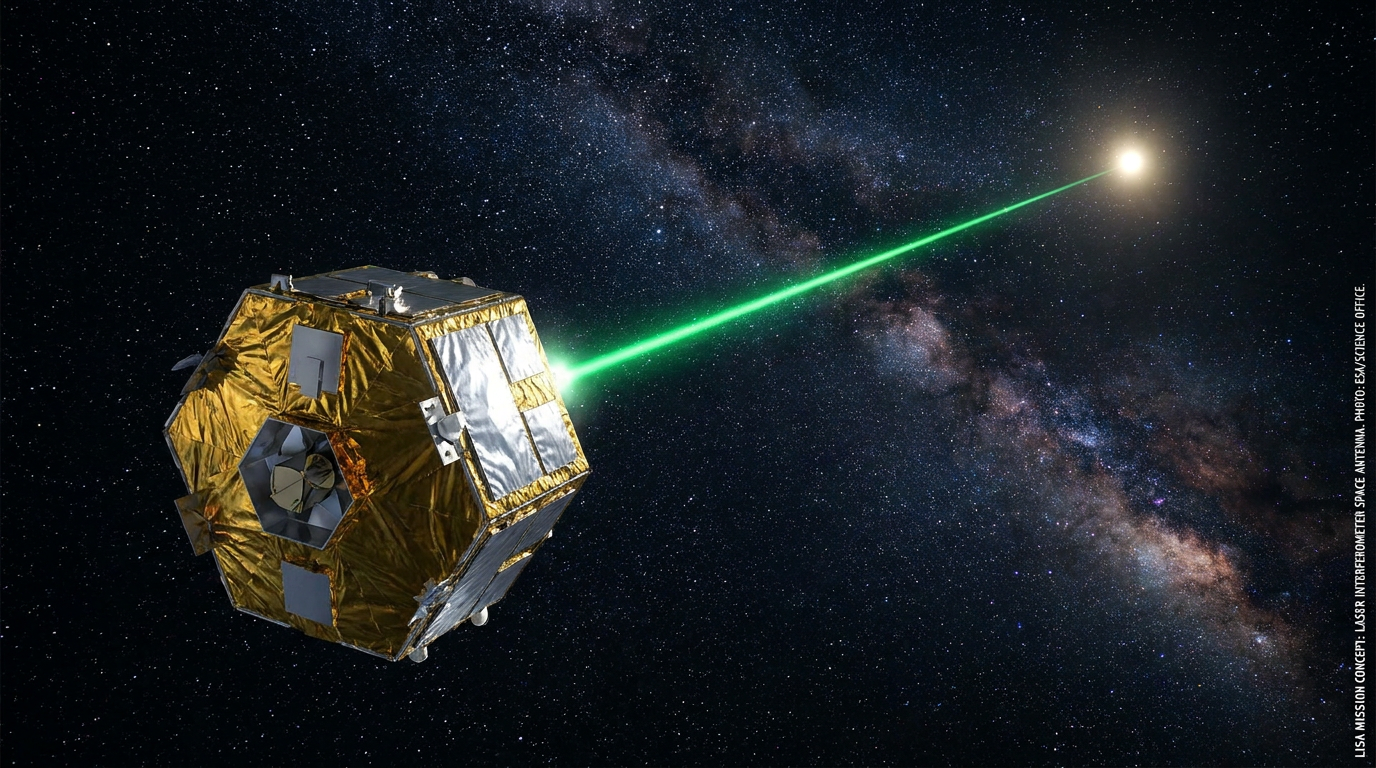
Enter the Laser Interferometer Space Antenna (LISA). Formally adopted by the European Space Agency (ESA) in January 2024, LISA is poised to become the largest scientific instrument ever constructed. Scheduled for launch in 2035, the mission will deploy a constellation of three identical spacecraft flying in a precise equilateral triangle formation. Rather than orbiting Earth, this trio will trail our planet in a heliocentric orbit around the Sun, maintaining a distance of about 50 million kilometers from Earth.[1][3]
The sheer scale of LISA defies standard engineering comprehension. The three spacecraft will be separated by 2.5 million kilometers—more than six times the distance between the Earth and the Moon. Together, they will form a colossal Michelson interferometer in space. As a gravitational wave passes through the solar system, it will stretch and compress the fabric of spacetime, minutely altering the distance between the three distant probes.[1][4]

At the heart of this measurement system are the "test masses"—solid, 46-millimeter cubes made of a gold-platinum alloy, weighing roughly two kilograms each. Two of these cubes will be housed inside each of the three spacecraft. Once in orbit, the spacecraft will essentially release the cubes, allowing them to float freely in a state of perfect free-fall, shielded from the solar wind and radiation pressure by the spacecraft housing built around them.[1]
To detect a passing gravitational wave, LISA will continuously fire highly stable infrared lasers between the spacecraft to measure the exact distance between the free-floating golden cubes. Because gravitational waves interact so weakly with matter, the spatial distortion they cause is almost imperceptibly small. LISA's laser interferometry system must be capable of detecting a shift in distance of just a few picometers—less than the diameter of a single helium atom—across a 2.5-million-kilometer span.[1][4]
Achieving this level of precision requires overcoming staggering technical hurdles. By the time a laser beam travels 2.5 million kilometers from one spacecraft to another, it will have spread out to a width of roughly 20 kilometers. The receiving spacecraft must capture just a few hundred picowatts of this diluted signal, amplify it, and phase-lock a local laser to send the signal back. A time-code embedded in the beams allows the system to monitor the slightest interference patterns.[1]

Achieving this level of precision requires overcoming staggering technical hurdles.
If LIGO opened a window to the high-frequency universe, LISA will throw open the doors to the low-frequency cosmos, operating in the band between 0.1 millihertz and 1 hertz. In this regime, the universe is loud. LISA's primary targets are supermassive black holes—monsters millions to billions of times the mass of our Sun that reside at the centers of nearly all galaxies. When two galaxies collide, their central black holes eventually spiral into one another, releasing a cataclysmic burst of gravitational energy.[1][3]
Because these low-frequency waves can travel across the entire observable universe without being absorbed or distorted by matter, LISA will be able to detect supermassive black hole mergers that occurred when the universe was just a few hundred million years old. This capability will allow cosmologists to trace the history of galaxy formation and finally answer how these colossal black holes grew so large so quickly in the early universe.[1][3]
LISA will also serve as the ultimate testing ground for Einstein's theory of general relativity. The observatory is expected to detect "extreme mass ratio inspirals" (EMRIs)—events where a small stellar-mass black hole falls into a supermassive one. As the smaller object orbits, it acts as a probe, mapping the exact geometry of the highly warped spacetime around the supermassive black hole. Any deviation from Einstein's predictions will be glaringly obvious in the resulting gravitational wave signal.[3][4]

Closer to home, LISA will map tens of thousands of compact binary star systems within our own Milky Way. There are so many pairs of orbiting white dwarfs in our galaxy that their combined gravitational waves will create a constant background "hum" in LISA's data. By filtering out this noise, astronomers will be able to map the distribution of dead stars across the galaxy, including those obscured by dust that optical telescopes can never see.[1][3]
Moving a project of this magnitude from concept to reality requires a massive industrial effort. Following the mission's formal adoption, ESA moved swiftly into the hardware development phase. In June 2025, ESA awarded the prime industrial contract to OHB System AG to build the three spacecraft, while Thales Alenia Space was contracted to provide critical elements, including the highly specialized propulsion subsystem required to maintain the precise orbital formation.[5]
However, the mission's international architecture recently faced significant political headwinds. NASA had long been a crucial partner in the LISA consortium, officially signing a Memorandum of Understanding in March 2024 to supply key components, including the laser systems, the optical telescopes, and the charge management devices that keep the golden cubes electrically neutral.[2][6]
That partnership was thrown into jeopardy in 2025 when proposed White House budgets for NASA's Fiscal Year 2026 and 2027 sought to drastically cut the agency's astrophysics funding, specifically targeting its contributions to ESA's LISA, EnVision, and NewAthena missions. While the U.S. Congress ultimately pushed back and restored some funding, the prolonged uncertainty forced ESA to activate contingency plans to protect the mission's 2035 launch date.[2][6]

Unwilling to let the flagship observatory stall, ESA initiated a series of mitigation efforts to develop the threatened technologies natively in Europe. On May 5, 2026, ESA awarded a €26.1 million contract to Thales Alenia Space to begin the first phase of development for the mission's six optical telescopes. This four-phase contract includes strategic decision points, allowing NASA time to resolve its budget disputes while ensuring Europe has a viable backup plan if the U.S. is forced to withdraw.[2][5][7]
Despite these geopolitical hurdles, the scientific community remains fiercely optimistic. The successful 2015 flight of the LISA Pathfinder mission—a scaled-down prototype that proved the free-floating test mass technology worked flawlessly in space—demonstrated that the fundamental engineering is sound. With construction now actively underway in 2026, the pieces of the largest scientific instrument in human history are finally coming together.[1][7]
When LISA finally powers on its lasers in the mid-2030s, it will mark a permanent shift in how humanity interacts with the cosmos. For thousands of years, our understanding of the universe has been limited by what we could see. By giving us the ability to listen to the deep, structural vibrations of spacetime itself, LISA promises to reveal an invisible universe that has been waiting in the dark since the dawn of time.[3][7]
How we got here
Sept 2015
LIGO makes the first direct detection of gravitational waves, proving Einstein's century-old theory.
June 2017
ESA selects LISA as the third large-class mission in its Cosmic Vision program.
Jan 2024
ESA formally adopts the LISA mission, transitioning it from conceptual design to hardware development.
June 2025
ESA awards the prime industrial contract to OHB System AG to begin building the three spacecraft.
May 2026
ESA awards a €26.1 million contract to Thales Alenia Space to develop telescopes natively, mitigating U.S. budget risks.
2035
Target launch date for the LISA constellation aboard an Ariane 6 rocket.
Viewpoints in depth
European Space Agency (ESA)
Focused on maintaining mission autonomy and pushing the frontier of space science.
For ESA leadership, LISA represents a crown jewel in the Cosmic Vision program. Agency officials view the mission as a necessary leap forward for European space science, ensuring the continent remains at the absolute forefront of astrophysics. While they actively welcome international collaboration, recent budget uncertainties in the U.S. have reinforced ESA's commitment to developing native European capabilities. By awarding contracts for critical components like the optical telescopes to European firms, ESA is prioritizing mission security and ensuring the 2035 launch date is not derailed by external political shifts.
Astrophysicists & Cosmologists
Eager for low-frequency data to solve long-standing mysteries about galaxy formation.
The global astrophysics community views LISA not just as a new telescope, but as an entirely new discipline. Researchers are particularly focused on the 'dark ages' of the universe—the epoch before the first stars ignited. Because gravitational waves pass through matter unimpeded, LISA will allow cosmologists to detect supermassive black hole mergers from the very dawn of time. Theorists also see LISA as the ultimate laboratory for extreme physics, providing the first opportunity to map the exact geometry of spacetime around a supermassive black hole and test Einstein's general relativity in the most extreme gravitational fields imaginable.
U.S. Space Policy Critics
Concerned that budget cuts are threatening America's role in flagship international science.
Within the U.S. aerospace and scientific communities, there is growing frustration over the volatility of NASA's astrophysics budget. Advocates argue that proposing cuts to fundamental contributions—like the lasers and telescopes NASA promised for LISA—damages the United States' reputation as a reliable partner in multi-decade international mega-projects. They warn that if NASA is forced to step back from LISA, American scientists may lose priority access to the mission's groundbreaking data, effectively ceding leadership in the next generation of gravitational wave astronomy to Europe.
What we don't know
- Whether NASA will ultimately secure the funding to provide its originally promised contributions to the mission.
- Exactly how many extreme mass ratio inspirals (EMRIs) LISA will detect, as estimates vary widely based on galaxy models.
- What unexpected phenomena might be discovered in the low-frequency gravitational wave band, which has never been observed before.
Key terms
- Gravitational waves
- Ripples in the fabric of spacetime caused by the acceleration of extremely massive objects, like colliding black holes.
- Interferometry
- A measurement technique that splits a laser beam in two, sends them along different paths, and recombines them to detect incredibly tiny changes in distance.
- Supermassive black hole
- A black hole millions to billions of times the mass of our Sun, typically found at the center of a galaxy.
- Heliocentric orbit
- An orbit centered around the Sun, rather than around the Earth.
- Extreme mass ratio inspiral (EMRI)
- An event where a small object, like a stellar-mass black hole, slowly spirals into a much larger supermassive black hole, emitting complex gravitational waves.
Frequently asked
Why can't we just build a bigger gravitational wave detector on Earth?
Earth is too noisy. Seismic activity, weather, and human infrastructure create constant vibrations that drown out the low-frequency gravitational waves LISA is designed to detect.
What are the golden cubes inside the spacecraft?
They are 46-millimeter test masses made of a gold-platinum alloy. They float freely inside the spacecraft, acting as the reference points for the lasers to measure the stretching of spacetime.
What happens if NASA pulls its funding for the mission?
ESA has already begun mitigation efforts, awarding contracts to European companies like Thales Alenia Space to develop the necessary telescopes and lasers natively, ensuring the mission can proceed regardless.
What will LISA discover that LIGO cannot?
While LIGO detects high-frequency waves from small, stellar-mass black holes, LISA will detect low-frequency waves from supermassive black holes colliding at the centers of merging galaxies.
Sources
Source coverage
7 outlets
3 viewpoints surfaced







[1]European Space AgencyEuropean Space Leadership
LISA factsheet
Read on European Space Agency →[2]European SpaceflightEuropean Space Leadership
ESA begins mitigation efforts for key elements of its LISA mission
Read on European Spaceflight →[3]Max Planck InstituteGlobal Astrophysics Community
ESA gives go-ahead for flagship gravitational-wave observatory in space
Read on Max Planck Institute →[4]BBC Sky at NightGlobal Astrophysics Community
LISA: The Laser Interferometer Space Antenna explained
Read on BBC Sky at Night →[5]Thales Alenia SpaceEuropean Space Leadership
Thales Alenia Space signs contract with OHB to provide critical elements for LISA mission
Read on Thales Alenia Space →[6]Space.comU.S. Space Policy Critics
European Space Agency reveals 3 key space missions threatened by NASA budget cuts
Read on Space.com →[7]Factlen Editorial TeamGlobal Astrophysics Community
Synthesis by Factlen editorial team
Read on Factlen Editorial Team →

Every angle. Every day.
Get science stories with full source coverage and perspective breakdowns delivered to your inbox.