
Smart Ring vs. Smartwatch: The 2026 Wearable Health Tracking Comparison
As wearable technology matures, the choice between smart rings and smartwatches comes down to a trade-off between passive, long-lasting sleep tracking and active, real-time workout data.
By Factlen Editorial Team
- Minimalist Health Trackers
- Advocates for passive, low-friction health monitoring and reduced screen time.
- Active Performance Athletes
- Users who rely on real-time data and GPS to optimize physical training.
- Clinical Data Analysts
- Experts focused on sensor accuracy, signal strength, and medical-grade diagnostics.
What's not represented
- · Traditional Watchmakers
- · Budget-Conscious Consumers
Why this matters
Choosing the right wearable form factor determines whether you will actually wear the device consistently enough to gather useful health data. A mismatched device often ends up abandoned in a drawer, wasting money and leaving you without actionable insights into your sleep, stress, and physical activity.
Key points
- Smart rings offer superior overnight comfort and highly accurate resting heart rate data due to strong finger-based sensor signals.
- Smartwatches provide essential real-time feedback, built-in GPS, and active coaching for performance-focused athletes.
- Rings typically deliver six to eight days of battery life, while most smartwatches require charging every one to two days.
- The lack of a screen on smart rings reduces digital distraction but requires users to rely entirely on a paired smartphone to view data.
- Smartwatches remain the only consumer wearable capable of taking on-demand ECGs to screen for heart arrhythmias.
The wearable technology market in 2026 has fractured into two distinct philosophies of health tracking, forcing consumers to choose between the minimalist appeal of smart rings and the interactive power of smartwatches. As devices from industry leaders like Samsung, Oura, Apple, and Garmin reach unprecedented levels of sensor sophistication, the purchasing decision is no longer about which device is objectively superior in a vacuum. Instead, it has become a deeply personal choice between passive, background health monitoring and active, real-time digital engagement. Understanding the specific trade-offs between these two form factors is essential for finding a device that actually fits your lifestyle.[1][2][7]
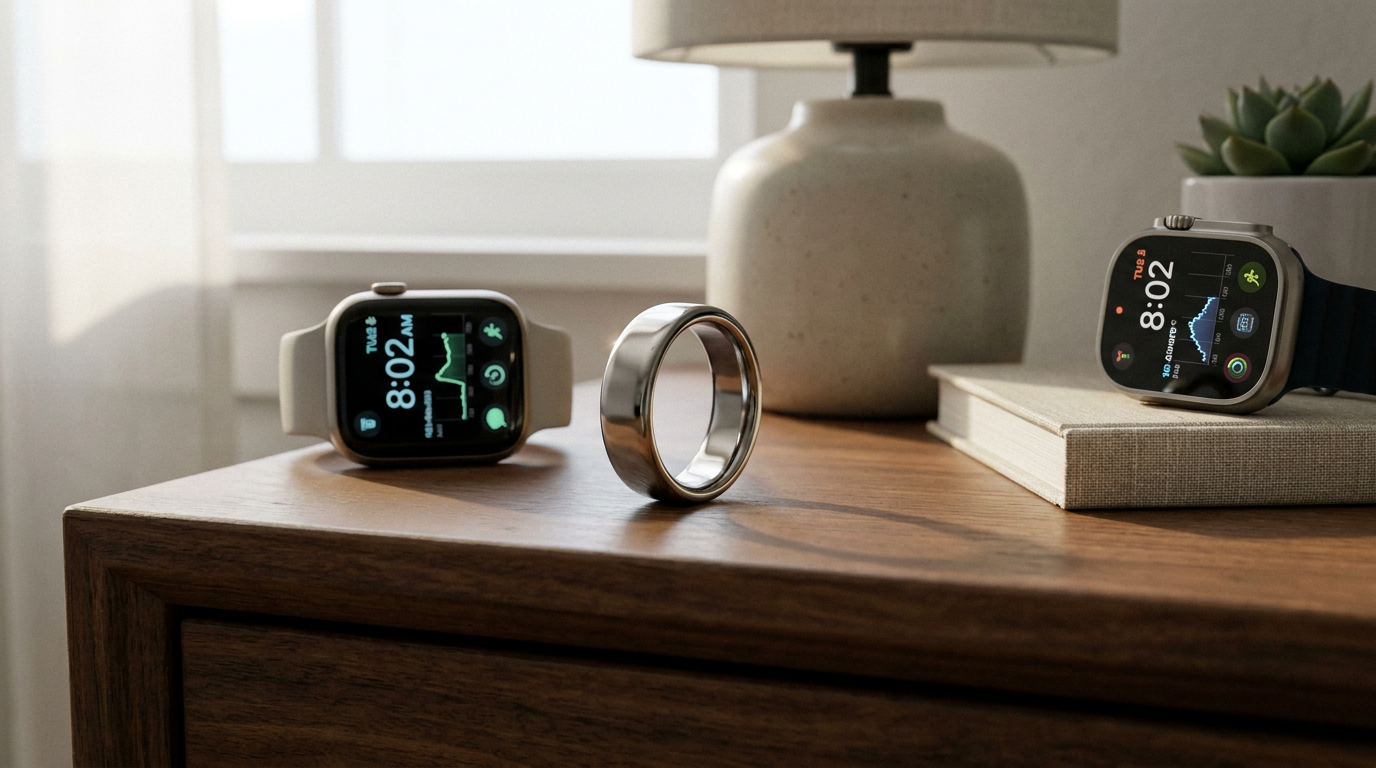
At the core of this comparison is a fundamental trade-off between physical form factor and daily functionality. Smart rings, typically weighing between three and seven grams, are designed to disappear into your daily life, collecting continuous biometric data without ever demanding your conscious attention. Smartwatches, on the other hand, weigh between forty and eighty grams and serve as wrist-mounted digital dashboards. They are engineered to provide immediate visual feedback, push notifications, and standalone connectivity, acting as an extension of your smartphone rather than just a silent observer of your vital signs.[1][6]
When evaluating the argument for smart rings, the primary evidence centers heavily on overnight comfort and the superior quality of resting data. Because human fingers move significantly less than wrists during deep sleep, rings are able to maintain a much more consistent sensor contact throughout the night. This physical advantage translates directly into highly accurate sleep staging and overnight Heart Rate Variability (HRV) tracking. For anyone looking to measure physical recovery, daily readiness, and baseline stress levels, this uninterrupted overnight data is considered the gold standard of consumer health tracking.[1][3]
The clinical evidence supporting the accuracy of smart rings is rooted directly in human anatomy. Finger-based photoplethysmography (PPG) sensors capture a remarkably strong and clean pulse signal from the digital arteries, allowing premium rings to achieve resting heart rate accuracy rates of up to ninety-nine percent. For users whose primary goal is establishing a reliable, long-term baseline for their overall wellness, this passive, high-fidelity data collection is incredibly effective. The device simply does its job in the background, requiring no active input from the user other than wearing it.[3][7]

Conversely, the argument against smart rings highlights their strict dependency on a paired smartphone and their complete inability to provide real-time coaching. Without a built-in display, a smart ring cannot show a runner their current pace, nor can it vibrate to indicate that they have entered a specific heart rate zone during a high-intensity interval workout. Furthermore, the vast majority of smart rings lack built-in GPS antennas due to space constraints, meaning outdoor athletes must still carry their bulky phones if they want to accurately track their distance and route maps.[4][5]
This is exactly where the argument for smartwatches becomes undeniable, built entirely on their capacity for active performance tracking and independent utility. A modern sports smartwatch is a feature-rich powerhouse equipped with high-resolution sampling that can record biometric data at one-minute intervals or faster during vigorous exercise. This instantaneous feedback loop makes them indispensable tools for runners, cyclists, swimmers, and anyone who relies on live metrics to adjust their physical effort on the fly without breaking their stride. The ability to glance at your wrist and instantly know your exact cardiovascular output is a feature that passive trackers simply cannot replicate.[4][5][6]
The evidence supporting smartwatches also extends to their broader array of medical-grade diagnostic sensors. While rings excel at resting PPG measurements, smartwatches are currently the only consumer form factor capable of taking an on-demand electrocardiogram (ECG) to actively screen for atrial fibrillation and other heart arrhythmias. Additionally, the tight, adjustable strap of a watch prevents the device from shifting during vigorous arm movements, resulting in far more accurate heart rate readings during active, sweat-heavy workouts than a loose-fitting ring can reliably provide. For high-impact sports or weightlifting, where grip and wrist flexion are constant, the watch remains the superior and safer choice for continuous tracking.[3][4][5]
The evidence supporting smartwatches also extends to their broader array of medical-grade diagnostic sensors.
However, the primary argument against smartwatches involves their demanding battery life and their physical intrusiveness during rest. The high-resolution, always-on touchscreens and continuous GPS tracking require significant power, limiting most mainstream tech watches to between eighteen and forty-eight hours of battery life per charge. Furthermore, many users find the bulk and weight of a watch deeply uncomfortable to wear to bed, leading to a habit of taking it off at night. This results in highly fragmented sleep tracking data, entirely defeating the purpose of owning a continuous health monitor.[1][2][6]

Quantifying this battery trade-off reveals a stark contrast between the two categories. Because they lack power-hungry screens and rely on highly efficient microelectronics, premium smart rings routinely deliver between six and eight days of continuous use on a single charge. In stark contrast, utilizing continuous GPS tracking on a smartwatch drains the battery ten to fifteen times faster than normal background tracking, often reducing a multi-day charge to mere hours of active use before requiring a wall outlet. This means ring users can travel for a week without packing a charger, while watch users must integrate charging into their daily routine, often sacrificing overnight sleep data to top up the battery.[1][4]
Ultimately, the choice between these devices dictates the user's fundamental relationship with their health data. A smartwatch actively encourages frequent interaction, prompting users to check their daily progress rings, read incoming text messages, and manually log specific workouts. A smart ring operates silently in the background, quietly syncing data to a mobile app that the user reviews only when they actively choose to, thereby significantly reducing overall screen time and mitigating the modern phenomenon of digital notification fatigue. For those seeking to disconnect from the digital world while still monitoring their physical health, this passive approach is a major selling point.[1][5]
A smart ring fits well when the user prioritizes sleep optimization, continuous stress monitoring, and a minimalist, 'barely-there' aesthetic. It is the ideal choice for individuals who want comprehensive, long-term health insights without the constant buzz of wrist notifications. It also serves as the perfect companion for watch enthusiasts who prefer to wear traditional, mechanical timepieces during the day while still secretly tracking their underlying vitals and daily step counts in the background. By blending seamlessly into a wardrobe as a piece of jewelry, the ring removes the technological friction from health tracking.[1][6]
A smart ring does not fit well when the user is a dedicated outdoor athlete who needs live pacing data, built-in GPS mapping, or the ability to leave their smartphone at home during a long run. It is also a remarkably poor fit for anyone who relies on their wearable device for modern conveniences like contactless payments at the grocery store, controlling wireless music playback, or performing quick communication triage without pulling out their phone. If you view your wearable as a tool for active productivity and real-time navigation, the passive nature of a ring will quickly become frustrating.[4][5]

A smartwatch fits well when the user demands an all-in-one digital companion that seamlessly bridges the gap between fitness tracking and daily productivity. It is the definitive, uncompromising choice for performance-focused athletes who require real-time workout dashboards to hit their training goals. It is equally valuable for busy professionals who rely on the convenience of checking urgent messages, answering calls, and managing smart home devices directly from their wrist while on the move. The sheer versatility of a watch makes it the ultimate multi-tool for the modern, connected lifestyle.[2][5]
A smartwatch does not fit well when the user already suffers from severe notification fatigue, finds wrist-worn devices physically uncomfortable while typing at a desk or sleeping, or simply struggles to remember to charge their devices daily. For these individuals, the watch often ends up sitting abandoned on a nightstand or buried in a gym bag, resulting in massive gaps in their health data that render the device's advanced sensors completely useless. If the friction of wearing and maintaining the device outweighs the value of the data it provides, it is the wrong form factor for your lifestyle.[1][3]
Ultimately, the 2026 wearable market proves that there is no single, objective winner in the smart ring versus smartwatch debate. The most effective health device is not necessarily the one with the longest feature list or the brightest screen, but rather the one that seamlessly integrates into your specific daily habits. Whether you choose the passive, long-lasting comfort of a ring or the active, feature-rich power of a watch, the true value lies in finding a device you will actually wear consistently enough to generate meaningful, life-improving insights.[1][7]
Viewpoints in depth
Minimalist Health Trackers
Advocates for passive, low-friction health monitoring.
This perspective argues that the best wearable is the one you forget you are wearing. By removing the screen, smart rings eliminate notification fatigue and digital distraction. Proponents emphasize that consistent, 24/7 wear—especially during sleep—is far more valuable for long-term health trending than the occasional high-resolution workout data provided by a watch.
Active Performance Athletes
Users who rely on real-time data to optimize physical training.
For this camp, a wearable is a dynamic tool for active coaching. They argue that without a display, built-in GPS, and real-time heart rate zone alerts, a device is merely a passive sensor rather than a training aid. They view the smartwatch's shorter battery life as a worthwhile trade-off for the ability to leave their smartphone at home during a run or ride.
Clinical Data Analysts
Experts focused on sensor accuracy and medical-grade diagnostics.
This viewpoint evaluates wearables strictly on the quality of their physiological data. They note that while finger-based PPG sensors in rings capture superior resting Heart Rate Variability (HRV) due to the proximity of digital arteries, wrist-worn smartwatches remain the only consumer option for on-demand ECGs and atrial fibrillation screening. They often recommend using both devices in tandem for a complete health picture.
What we don't know
- Whether upcoming advancements in micro-batteries will allow future smart rings to incorporate standalone GPS without sacrificing their multi-day battery life.
- How long-term consumer retention rates for smart rings will compare to smartwatches over a five-year lifecycle.
- Whether medical regulatory bodies will eventually clear smart rings for the same diagnostic capabilities, such as AFib detection, currently approved for premium smartwatches.
Key terms
- Photoplethysmography (PPG)
- An optical sensor technology that measures changes in blood volume to determine heart rate and blood oxygen levels.
- Heart Rate Variability (HRV)
- The variation in time between consecutive heartbeats, used as a key indicator of physiological stress and physical recovery.
- Electrocardiogram (ECG)
- A medical-grade sensor that records the electrical signal from the heart to check for different conditions, such as atrial fibrillation.
Frequently asked
Can a smart ring track my outdoor runs without a phone?
Generally, no. Most smart rings lack built-in GPS due to size and battery constraints, meaning you must carry a paired smartphone to map your route and distance.
Which device is more accurate for sleep tracking?
Smart rings are widely considered more accurate for sleep tracking. They maintain better sensor contact on the finger and are more comfortable to wear overnight compared to bulkier smartwatches.
Do smart rings require a monthly subscription?
It depends on the brand. Some premium rings require a monthly fee to access detailed health insights, while others provide all data without ongoing costs. Most smartwatches do not require a subscription for basic health tracking.
Can I wear a smart ring while lifting weights?
While durable, wearing a smart ring during heavy weightlifting can be uncomfortable and may scratch the device or interfere with your grip. Many users prefer a smartwatch or chest strap for gym workouts.
Sources
Source coverage
7 outlets
3 viewpoints surfaced







[1]RingConnMinimalist Health Trackers
Smart Ring vs Smartwatch: Which Is Better for Sleep and Health Tracking?
Read on RingConn →[2]Samsung UKClinical Data Analysts
Smart Ring vs Smartwatch | Find the Best Wearable Tech for You
Read on Samsung UK →[3]Wearable Wellness GuideClinical Data Analysts
Stress Tracker Comparison 2026: Ring, Watch & Biofeedback
Read on Wearable Wellness Guide →[4]SmartletActive Performance Athletes
Smartwatch vs connected ring: Why screens and sensors matter
Read on Smartlet →[5]Kospet USActive Performance Athletes
Are Smart Rings Better than Smart Watches? Pros and Cons
Read on Kospet US →[6]RunmefitMinimalist Health Trackers
Smart Rings vs. Smart Watches: Pros, Cons & Future Trends
Read on Runmefit →[7]Factlen Editorial TeamClinical Data Analysts
Synthesis by Factlen editorial team
Read on Factlen Editorial Team →
More in shopping
See all 6 stories →E-Bike Tech
Buying an E-Bike in 2026: The Ultimate Explainer Guide
9 sources

Wi-Fi Tech
Wi-Fi 7 Explained: Is the Upgrade Worth It in 2026?
8 sources

Display Tech
OLED vs. Mini-LED in 2026: Which TV Panel Technology Actually Wins?
6 sources

Motorcycle Safety
The Tech Revolution in Beginner Motorcycles: Why 2026 is the Safest Time to Start Riding
6 sources

Every angle. Every day.
Get shopping stories with full source coverage and perspective breakdowns delivered to your inbox.