
OLED vs. Mini-LED in 2026: Which TV Panel Technology Actually Wins?
As Mini-LED brightness pushes past 4,000 nits and OLEDs adopt new tandem architectures, the gap between the two premium TV technologies has fundamentally shifted. Here is how to choose the right panel for your room, lighting, and viewing habits.
By Factlen Editorial Team
- Dark-Room Purists
- Argue that infinite contrast and pixel-level precision are the only true measures of cinematic picture quality.
- Bright-Room Pragmatists
- Value sustained high brightness, HDR punch, and zero burn-in risk for mixed-use, daylight living rooms.
- Competitive Gamers
- Prioritize instantaneous pixel response times and motion clarity above all other metrics.
What's not represented
- · Budget-Conscious Consumers
- · Environmental Advocates
Why this matters
Choosing the wrong TV panel technology can result in thousands of dollars spent on a display that either washes out in your sunlit living room or suffers permanent burn-in from your daily viewing habits. Understanding the physical trade-offs between OLED and Mini-LED ensures your investment matches your actual environment and lifestyle.
Key points
- OLED and Mini-LED represent the two dominant premium TV technologies in 2026, each utilizing entirely different physics.
- OLED pixels are self-emissive, allowing them to turn off completely for perfect black levels and infinite contrast.
- Mini-LED uses thousands of microscopic backlight zones, allowing it to achieve extreme brightness levels up to 4,000 nits.
- OLED is the superior choice for dark home theaters, wide seating arrangements, and competitive gaming due to its instant response time.
- Mini-LED is the optimal choice for bright, sunlit living rooms and households that watch static news or sports channels all day.
- Mini-LED carries zero risk of permanent burn-in, while modern OLEDs use software mitigation to reduce, but not eliminate, the risk.
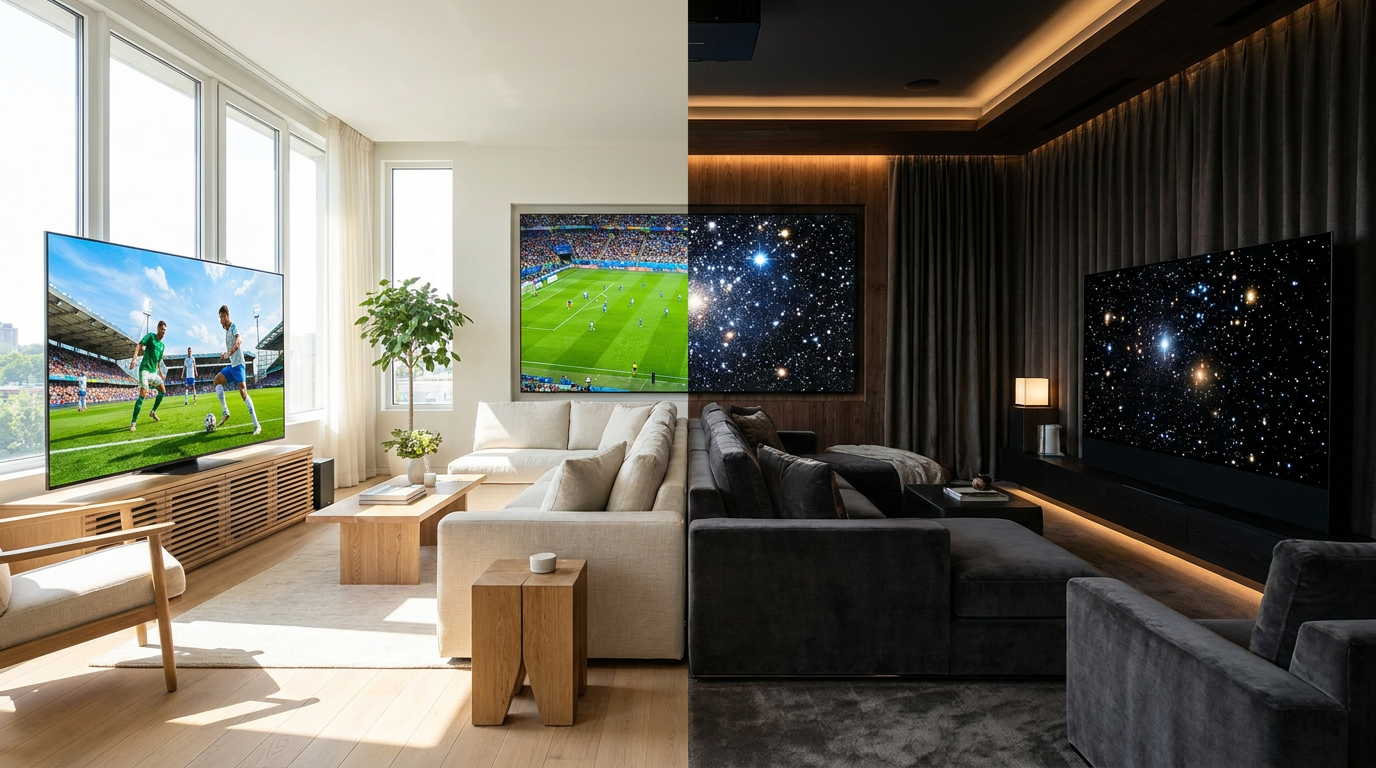
Buying a premium television in 2026 is no longer a simple matter of choosing a preferred brand or a larger screen size; it is fundamentally about choosing a panel architecture. The high-end market has completely bifurcated into two highly advanced, competing frameworks: OLED (Organic Light-Emitting Diode) and Mini-LED. While both technologies promise stunning 4K resolutions and vibrant colors, they achieve their visual results through entirely different laws of physics. This architectural divide means that neither technology is universally perfect. Instead, the decision ultimately dictates how your television will handle glaring afternoon sunlight, cinematic shadows, and fast-paced gaming sessions.[2][3][6]
To understand the trade-offs between the two, one must first look at how the light is actually generated on the screen. OLED is a self-emissive technology, meaning that every single pixel on the display generates its own light and color independently. There is no backlight behind the screen. When an OLED television needs to display absolute black, the processor simply cuts the voltage to that specific pixel, turning it completely off.[1][3]
Because the pixel is entirely deactivated, it emits exactly 0.000 nits of light. This capability yields a mathematically infinite contrast ratio, ensuring that dark cinematic scenes maintain rich depth without the distracting background haze typical of older liquid crystal displays. This pixel-level precision is the foundation of OLED's legendary picture quality, allowing a brilliantly lit star to sit directly next to a perfectly black pixel with zero light bleed.[3][5]
Mini-LED, conversely, represents the ultimate evolution of the traditional liquid crystal display (LCD) design. Instead of relying on self-emissive pixels, it utilizes a sophisticated backlight matrix composed of thousands of microscopic, inorganic diodes. These tiny LED lights are tightly clustered into thousands of individually controlled local dimming zones that sit directly behind the LCD color layer.[3][5]

By dynamically turning off specific backlight zones behind the dark sections of the on-screen content, Mini-LED attempts to mimic the deep, inky blacks of an OLED panel. However, because it utilizes the massive power of traditional semiconductor illumination, it can push significantly more light through the screen than organic pixels can safely manage. This fundamental difference sets the stage for the most noticeable divergence between the two technologies: raw brightness.[3][4]
When evaluating the case for Mini-LED, the evidence lies in sheer luminance and High Dynamic Range (HDR) impact. Modern premium Mini-LED panels routinely hit peak brightness levels between 2,500 and 4,000 nits in small highlights, and can comfortably sustain over 1,000 nits across the entire screen. This extreme light output allows Mini-LED televisions to easily overpower ambient daylight, making them the undisputed champions of sun-drenched living rooms.[4][5][6]
In HDR content, this brightness translates to a physical punch that self-emissive panels simply cannot match. Explosions, sun glare reflecting off the ocean, and neon cityscapes are delivered with a blinding realism. For viewers who watch a lot of daytime sports or have living spaces with large, uncovered windows, the sustained full-screen brightness of a Mini-LED ensures the image never looks washed out or dim.[1][5]
The argument against OLED in this category is rooted in its thermal limitations. While the introduction of Micro Lens Array (MLA) technology and new Tandem OLED architectures in 2026 has pushed peak highlights on flagship models to nearly 2,000 nits, OLEDs still utilize an Auto Brightness Limiter (ABL). This hardcoded safety protocol automatically dims the entire screen when large areas of bright white are displayed, protecting the organic materials from heat degradation.[3][4]

While Mini-LED wins the brightness war, the case for OLED is built entirely on black levels and shadow detail. Because Mini-LED relies on dimming zones that are inherently larger than individual pixels, it cannot entirely prevent light from spilling into adjacent dark areas. When a bright object is displayed against a black background, the zone illuminating that object must turn on, inadvertently lighting up the surrounding black pixels.[1][3]
While Mini-LED wins the brightness war, the case for OLED is built entirely on black levels and shadow detail.
This light leakage is known as blooming or the halo effect. It is most visible when watching movies with letterbox bars, or when bright white subtitles appear over a pitch-black scene. While 2026 Mini-LED algorithms have drastically reduced blooming compared to older models, it is still a physical limitation of the backlight matrix. For dedicated home theaters and dark-room viewing, this blooming can break the immersion of a cinematic experience.[1][5]
For competitive gamers, both technologies offer exceptional 4K 120Hz and 144Hz performance, complete with Variable Refresh Rate (VRR) and Auto Low Latency Mode (ALLM). However, they excel in entirely different performance metrics. OLED provides near-instantaneous pixel response times, often measured at 0.1 milliseconds. This virtually eliminates motion blur during fast-paced action, keeping the image razor-sharp during rapid camera pans in first-person shooters.[1][5]
Mini-LED, while slightly slower in its pixel transition times, offers a distinct advantage for gamers who play in bright rooms or engage in marathon sessions with static on-screen elements. Because Mini-LED uses inorganic materials, it carries absolutely zero risk of permanent burn-in. Gamers can leave static Heads-Up Displays (HUDs), minimaps, or health bars on the screen for hundreds of hours without fear of permanently damaging the panel.[2][5]

Burn-in remains the primary caveat and source of anxiety for OLED ownership. While 2026 OLED models feature highly aggressive mitigation software—such as imperceptible pixel shifting, localized logo dimming, and automatic panel refresh cycles—the risk is not zero. Leaving static news tickers, sports scores, or persistent broadcast logos on an OLED for thousands of hours can still eventually leave permanent ghost images on the screen.[2][5]
Viewing arrangement and room layout also heavily dictate which panel is the ideal choice. OLED maintains perfect color accuracy, contrast, and brightness even when viewed from extreme side angles. If your living room features a wide, U-shaped seating arrangement where multiple guests are sitting off-center, an OLED ensures that the person on the far end of the couch sees the exact same picture quality as the person sitting dead center.[2][5]
Mini-LED panels, particularly those utilizing VA (Vertical Alignment) liquid crystals for better contrast, suffer from noticeable color shifting and increased blooming when viewers sit off-center. As you move away from the direct center of a Mini-LED screen, the image can begin to look washed out, and the haloing around bright objects becomes significantly more pronounced.[1][5]
When evaluating the cost-to-performance ratio, Mini-LED generally offers a more compelling value proposition, particularly in larger screen sizes. While flagship Mini-LEDs can rival OLEDs in price, mid-tier Mini-LED models deliver 80 percent of the premium experience at a fraction of the cost. For budget-conscious buyers looking to maximize screen real estate without sacrificing modern HDR features, Mini-LED is the clear economic winner.[2][4][6]

Ultimately, the comparison between OLED and Mini-LED requires a side-by-side trade-off analysis; there is no single winner without conditions. OLED fits perfectly when you prioritize absolute, uncompromised picture quality and watch the majority of your content in a dimly lit or light-controlled room. It is the definitive choice for cinephiles who want to experience films exactly as the director intended, with perfect shadow detail and infinite contrast.[1][5]
OLED is also the optimal choice for competitive gamers who demand zero motion blur and instantaneous response times, provided they vary their content enough to avoid static image retention. If your primary use case involves evening movie nights, prestige television dramas, and high-end single-player gaming, OLED remains the pinnacle of display technology.[1][2]
Conversely, Mini-LED fits perfectly when the television is placed in a bright, sunlit room with lots of windows. It is the superior choice for households that watch a lot of daytime sports, where the sustained full-screen brightness ensures the playing field looks vibrant and clear regardless of the ambient light pouring into the room.[4][5]

Mini-LED is also the definitive choice for buyers who want maximum HDR impact and absolute peace of mind regarding panel longevity. If your household leaves the television running all day on news channels, or if it serves as a background monitor for persistent graphics, Mini-LED delivers a premium, high-brightness experience that will not degrade under heavy, static use.[3][5][6]
How we got here
2013
The first large-format OLED televisions enter the consumer market, establishing a new benchmark for perfect black levels and infinite contrast.
2019
The first Mini-LED televisions are introduced, offering a high-brightness alternative to OLED with vastly improved local dimming capabilities.
2022
QD-OLED (Quantum Dot OLED) technology launches, combining OLED's perfect blacks with a quantum dot layer for higher color brightness.
2024
Micro Lens Array (MLA) technology is integrated into premium OLEDs, significantly boosting their peak brightness to compete in well-lit rooms.
2026
Mini-LED panels push past 4,000 nits of peak brightness, while Tandem OLED architectures offer enhanced durability and sustained luminance.
Viewpoints in depth
Dark-Room Purists
This camp argues that infinite contrast and pixel-level precision are the only true measures of cinematic picture quality.
For cinephiles and home theater enthusiasts, the mathematical perfection of OLED's 0.000-nit black level is non-negotiable. They argue that the artistic intent of a film is lost if shadow details are washed out by the blooming inherent to Mini-LED backlights. To this group, the extreme peak brightness of Mini-LED is unnecessary in a light-controlled room, and OLED's flawless pixel-level contrast provides a more three-dimensional, immersive experience.
Bright-Room Pragmatists
This camp values sustained high brightness, HDR punch, and zero burn-in risk for mixed-use, daylight living rooms.
Pragmatists point out that most people do not watch television in pitch-black home theaters. In a modern, open-concept living room with windows and overhead lighting, they argue that Mini-LED's ability to sustain 1,500+ nits across the entire screen is far more valuable than perfect black levels. Furthermore, they champion the peace of mind that comes with Mini-LED's immunity to burn-in, making it the safer long-term investment for households that leave the TV on in the background.
Competitive Gamers
This camp prioritizes instantaneous pixel response times and motion clarity above all other metrics.
For players of fast-paced shooters and fighting games, the display's response time is a literal competitive advantage. Gamers favor OLED because its self-emissive pixels can change state almost instantly, resulting in zero motion blur during rapid camera pans. However, a subset of MMO and RPG players within this camp lean toward Mini-LED to avoid the risk of burning static health bars and minimaps into the screen during marathon sessions.
What we don't know
- How quickly Micro Lens Array (MLA) technology will degrade over a 10-year lifespan compared to traditional OLED panels.
- Whether manufacturing costs for Micro-LED—the theoretical successor to both technologies—will drop enough to replace them before 2030.
- The exact long-term burn-in rates for 2026 Tandem OLED architectures under heavy, real-world static usage.
Key terms
- OLED (Organic Light-Emitting Diode)
- A display technology where every individual pixel generates its own light and color, allowing it to turn off completely for perfect black levels.
- Mini-LED
- An advanced LCD backlight system that uses thousands of microscopic diodes grouped into dimming zones to improve contrast and achieve extreme brightness.
- Nits
- A standard unit of measurement for screen brightness; one nit is roughly equivalent to the light of one candle per square meter.
- Local Dimming
- A feature that dynamically dims the backlight behind dark areas of the screen to improve black levels and contrast on LCD televisions.
- Blooming
- A visual artifact where light from a bright object bleeds into surrounding dark areas, creating a halo effect.
- Burn-in
- Permanent image retention caused by leaving static elements, like news tickers or game HUDs, on an OLED screen for thousands of hours.
Frequently asked
Does Mini-LED suffer from burn-in?
No. Because Mini-LED relies on an inorganic backlight matrix rather than organic compounds, it is immune to the permanent image retention that can affect OLED panels under heavy static use.
Is OLED bright enough for a normal living room?
Yes, modern OLEDs with Micro Lens Array (MLA) technology can reach up to 2,000 nits in peak highlights, making them sufficiently bright for most rooms, though they will still dim during full-screen bright scenes to protect the panel.
What is blooming on a TV?
Blooming, or the halo effect, occurs on Mini-LED televisions when the backlight zones illuminate a bright object against a dark background, causing light to spill into the surrounding black pixels.
Which TV technology lasts longer?
Both technologies are rated for tens of thousands of hours of use, but Mini-LED generally offers better longevity for households that leave the TV on all day with static news tickers or sports scores, as it will not burn in.
Sources
Source coverage
6 outlets
3 viewpoints surfaced






[1]RTINGSDark-Room Purists
Mini LED vs OLED TVs
Read on RTINGS →[2]BGRCompetitive Gamers
OLED vs Mini LED: Which TV is better for gaming and movies?
Read on BGR →[3]TechStoryBright-Room Pragmatists
A deep structural analysis of OLED vs Mini LED display technology
Read on TechStory →[4]Data Wire SolutionsBright-Room Pragmatists
Tandem OLED vs QD-OLED vs Mini-LED
Read on Data Wire Solutions →[5]Expert ReviewsDark-Room Purists
OLED vs Mini LED: Brightness, contrast and gaming compared
Read on Expert Reviews →[6]Pixel PrimeCompetitive Gamers
LED vs QLED vs OLED vs Mini LED - The REAL Winner in 2026
Read on Pixel Prime →


Every angle. Every day.
Get shopping stories with full source coverage and perspective breakdowns delivered to your inbox.