
Oil Prices Sink to Three-Month Lows as US-Iran Deal Reopens Strait of Hormuz
Crude oil futures have collapsed as the unwinding of the wartime premium and the reopening of a critical maritime chokepoint fuel bets on a massive supply glut.
By Factlen Editorial Team
- Energy Consumers & Markets
- Focused on the immediate relief from the unwinding war premium and the prospect of lower inflation and cheaper fuel.
- Geopolitical Skeptics
- Cautioning that the MoU is merely a fragile ceasefire and that structural risks to global energy buffers remain high until a final treaty is signed.
- Maritime & Shipping Industry
- Emphasizing the physical and logistical hurdles of demining the strait and securing insurance before normal traffic can resume.
What's not represented
- · Environmental advocates concerned about the return of fossil fuel dominance
- · Regional populations affected by the conflict's economic fallout
Why this matters
The sudden drop in oil prices provides immediate relief to global inflation and consumer energy costs, but the fragile nature of the 60-day ceasefire means the risk of a renewed supply shock remains high.
Key points
- The US and Iran have signed a 14-point interim memorandum to pause the conflict and reopen the Strait of Hormuz.
- Brent crude has fallen to around $76 a barrel, unwinding the massive war premium that pushed prices to $118 in April.
- The International Energy Agency warns that a full return of Middle Eastern oil could create a 5 million barrel per day supply glut by 2027.
- Maritime experts caution that clearing mines and securing insurance will delay the full normalization of shipping traffic for weeks.
The global oil market is undergoing its most violent repricing of the year. Following the signing of a 14-point interim peace memorandum between the United States and Iran, crude oil futures have collapsed to three-month lows.[1][6]
The agreement, brokered with the help of Pakistan and Qatar, effectively pauses a devastating conflict that began in late February. For months, the de facto closure of the Strait of Hormuz choked off more than 11 million barrels per day of Middle Eastern production, sending Brent crude to a peak of nearly $118 a barrel in April.[5][9]
Now, with the stroke of a pen in Switzerland, the massive war premium that had inflated global energy costs is rapidly unwinding. Brent crude has plummeted to around $76 a barrel, while U.S. West Texas Intermediate has sunk below $75, marking a roughly 35 percent decline from their wartime peaks.[1][9]

The mechanism driving this sell-off is a sudden shift in market psychology, transitioning from fears of severe scarcity to the prospect of an impending oversupply. Options traders are aggressively piling into glut bets—niche financial positions that profit if the market becomes flooded with excess crude.[1][9]
These bets are supported by stark warnings from the International Energy Agency. In its latest forward assessment, the agency cautioned that if the U.S.-Iran agreement holds and Gulf producers fully restart their halted output, the world could face a staggering supply glut by 2027.[8]
The agency projects that global oil supply could reach 110 million barrels per day next year, vastly outstripping a projected demand of 105.3 million barrels per day. This theoretical overhang of nearly 5 million daily barrels is driving the current bearish sentiment across trading floors.[1][8]
However, the physical reality on the water is far more complex than the rapid price drops suggest. The 14-point memorandum is a ceasefire architecture, not a comprehensive geopolitical reset.[4][9]
Under the terms of the deal, the United States has committed to immediately lifting its naval blockade of Iranian ports. In exchange, Iran has agreed to reopen the Strait of Hormuz to commercial vessels, toll-free, within a 30-day window.[6][8]
The agreement also initiates a strict 60-day negotiation period aimed at securing a permanent peace treaty and addressing Iran's nuclear enrichment program, while facilitating the release of a $300 billion reconstruction fund.[4][6]

Early signs indicate that the physical logjam is beginning to break. U.S. officials have confirmed that millions of barrels of oil have already begun transiting the strait's southern corridor.[3][7]
Early signs indicate that the physical logjam is beginning to break.
Satellite tracking data corroborates these claims, showing a trickle of supertankers and liquefied natural gas carriers exiting the Persian Gulf after weeks of concealing their movements.[7]
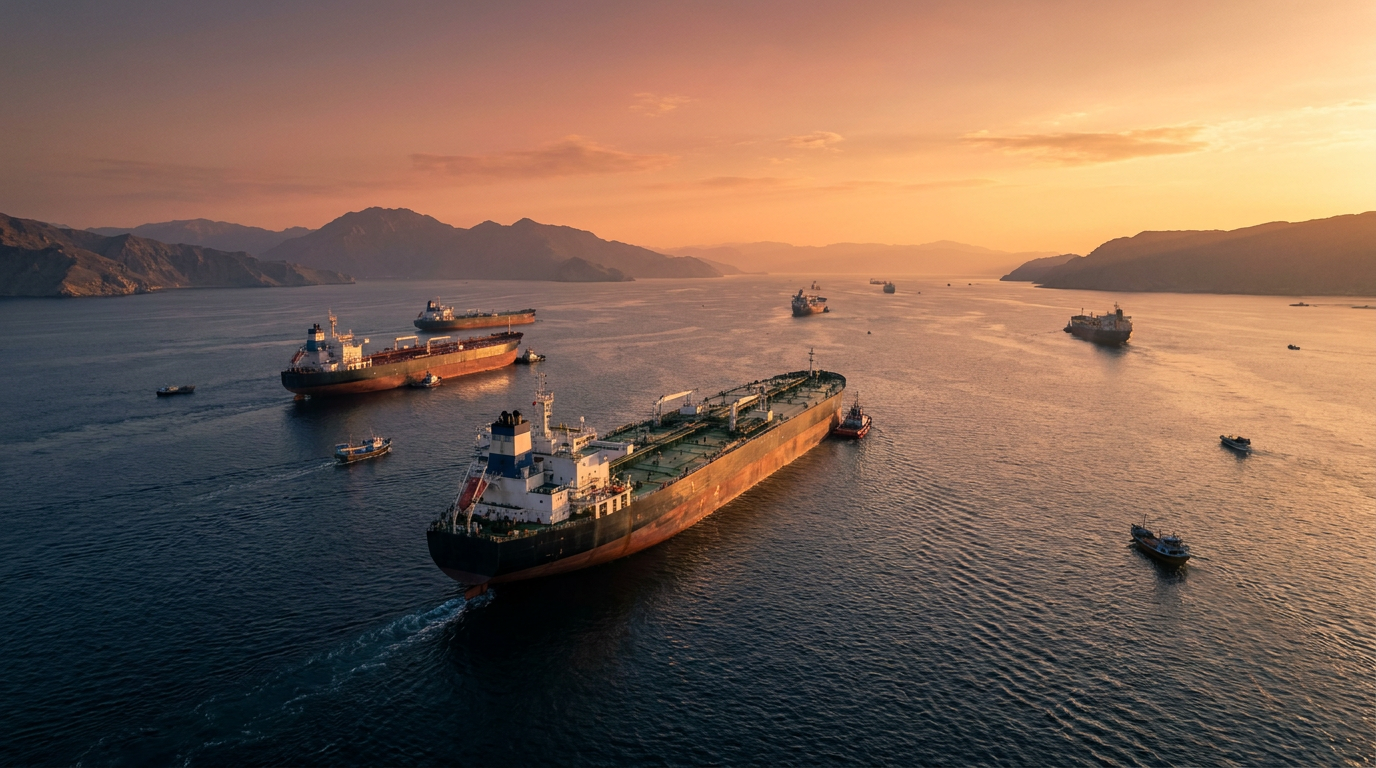
Yet, the maritime and shipping industries remain deeply cautious. Prior to the conflict, the Strait of Hormuz handled roughly 20 percent of the world's seaborne oil and liquefied natural gas. Restoring that volume requires more than political goodwill.[2][5]
Shipping operators and insurers are demanding clear evidence that the waterway has been thoroughly demined and that the threat of drone or missile strikes has been entirely neutralized.[2][5]
The Iranian Persian Gulf Strait Authority has also signaled that vessels must coordinate their transit and obtain valid passage permits, adding a layer of bureaucratic friction to the reopening process.[7]
Consequently, industry experts estimate it could take weeks, if not months, for maritime traffic to return to its pre-war average of 120 daily crossings.[5][7]

Financial institutions are adjusting their models to account for this lag. Goldman Sachs recently trimmed its fourth-quarter Brent crude forecast to $80 a barrel, assuming that Persian Gulf exports will not fully normalize until the end of July.[9]
The broader economic implications of the price drop are profound. The wartime energy spike had fueled a fresh wave of global inflation, complicating central banks' efforts to lower interest rates.[1][6]
A sustained return to $75 oil would provide massive relief to energy-importing nations in Asia and Europe, potentially accelerating economic growth and easing the cost-of-living crisis for millions of consumers.[6][9]

How we got here
Late Feb 2026
The US-Iran conflict erupts, effectively closing the Strait of Hormuz to commercial traffic.
April 2026
Brent crude peaks at nearly $118 a barrel as over 11 million barrels per day of production is shut in.
Mid-June 2026
The US and Iran sign a 14-point interim MoU in Switzerland, initiating a 60-day ceasefire.
June 18, 2026
Oil prices collapse to three-month lows as the first tankers begin exiting the strait.
Viewpoints in depth
Energy Markets' View
Traders are aggressively pricing in a massive return of supply.
Financial markets operate on forward-looking expectations, and traders are currently betting that the worst of the geopolitical supply shock is over. By unwinding the 'war premium' and piling into 'glut bets,' the market is signaling confidence that the millions of barrels of Middle Eastern oil shut in since February will soon flood global inventories. This perspective prioritizes the immediate economic relief of $75 oil over the lingering diplomatic uncertainties in Switzerland.
Maritime Industry's View
Shipping operators remain highly cautious about the physical realities of the reopening.
While politicians announce the immediate reopening of the Strait of Hormuz, the maritime industry faces a much slower reality. Shipowners and insurers are demanding verifiable proof that the waterway has been cleared of mines and that the threat of drone strikes has been neutralized. From this viewpoint, a diplomatic signature does not instantly erase the physical dangers of navigating a recent conflict zone, meaning full normalization of the 120 daily crossings will take weeks or months.
Geopolitical Analysts' View
Experts warn that the interim deal is fragile and structural risks remain.
Foreign policy experts caution against treating the 14-point MoU as a permanent resolution. They emphasize that the agreement is merely a 60-day ceasefire architecture that leaves the core disputes—such as Iran's nuclear enrichment program—unresolved. If the negotiations in Switzerland collapse, the market could face a whiplash effect, as the structural damage to global oil buffers leaves the world highly vulnerable to a renewed supply shock.
What we don't know
- Whether the US and Iran can successfully negotiate a permanent peace treaty within the 60-day window.
- Exactly how long it will take to thoroughly de-mine the Strait of Hormuz and restore the pre-war average of 120 daily crossings.
- How quickly OPEC and other Gulf producers will be able to ramp their shut-in production back to full capacity.
Key terms
- Brent Crude
- A major global benchmark for oil prices, sourced from the North Sea, used to price two-thirds of the world's internationally traded crude oil.
- Strait of Hormuz
- A critical maritime chokepoint between the Persian Gulf and the Gulf of Oman, through which roughly 20 percent of the world's seaborne oil passes.
- War Premium
- The additional cost factored into commodity prices by traders to account for the risk of supply disruptions caused by geopolitical conflict.
- Supply Glut
- An economic situation where the supply of a commodity significantly exceeds the market demand, typically leading to a sharp drop in prices.
- Memorandum of Understanding (MoU)
- A formal agreement between two or more parties outlining the terms and details of an understanding, often serving as the foundation for a legally binding treaty.
Frequently asked
What caused oil prices to drop so suddenly?
The signing of a 14-point interim peace memorandum between the US and Iran, which reopens the Strait of Hormuz and unwinds the 'war premium' that had inflated prices since February.
Is the Strait of Hormuz fully open now?
While the agreement mandates a toll-free reopening within 30 days, maritime experts warn it will take weeks to clear mines and secure insurance before traffic returns to pre-war levels.
What is a 'glut bet' in the oil market?
It is a financial position taken by options traders who believe that the return of Middle Eastern oil will cause global supply to vastly outstrip demand, leading to a surplus.
What happens if the 60-day negotiation window expires?
If the US and Iran fail to reach a comprehensive final treaty within 60 days, the interim ceasefire could collapse, potentially causing oil prices to spike again.
Sources
Source coverage
9 outlets
3 viewpoints surfaced







[1]BloombergEnergy Consumers & Markets
Oil Glut Bets Are Back in Play as Crude Sinks After US-Iran Deal
Read on Bloomberg →Efforts Underway for Safe Evacuation of Strait of Hormuz
Read on Bloomberg →US and Iranian Negotiators Begin Talks in Switzerland
Read on Bloomberg →[4]NPRGeopolitical Skeptics
What could make a peace deal with Iran viable? One expert weighs in
Read on NPR →[5]Financial TimesEnergy Consumers & Markets
Oil sinks below $80 as traders bet Strait of Hormuz flows will return
Read on Financial Times →[6]Al JazeeraGeopolitical Skeptics
Oil prices fall, stocks rally as US, Iran sign framework to end war
Read on Al Jazeera →[7]ReutersMaritime & Shipping Industry
Trump says ships carrying oil are moving out of Strait of Hormuz
Read on Reuters →[8]International Energy AgencyMaritime & Shipping Industry
Oil Market Report - June 2026
Read on International Energy Agency →[9]Goldman SachsEnergy Consumers & Markets
Why Oil Prices Could 'Grind Lower' Amid the US-Iran Deal
Read on Goldman Sachs →
Every angle. Every day.
Get business stories with full source coverage and perspective breakdowns delivered to your inbox.