
How Neuroaesthetics is Rewiring Interior Design for Mental Well-Being
Emerging research at the intersection of neuroscience and architecture reveals how specific interior design choices—from lighting to spatial geometry—measurably impact brain activity and reduce stress.
By Factlen Editorial Team
- Empirical Researchers
- Focuses on quantifying the impact of built environments through brain imaging, biometric data, and evolutionary psychology.
- Residential Designers
- Focuses on translating complex neurological data into accessible, aesthetically pleasing applications for everyday homes.
- Building Standard Certifiers
- Advocates for codifying neuroaesthetic principles into scalable health and wellness certifications for the real estate industry.
- Factlen Editorial
- Synthesizes the intersection of neuroscience, design trends, and practical applications for consumer well-being.
What's not represented
- · Neurodivergent Individuals
- · Affordable Housing Developers
Why this matters
By applying the principles of neuroaesthetics, individuals can transform their living spaces into active tools for mental health intervention. Simple adjustments to lighting, shapes, and textures can measurably lower daily cortisol levels and improve sleep quality.
Key points
- Neuroaesthetics uses brain imaging to understand how interior design affects mental health.
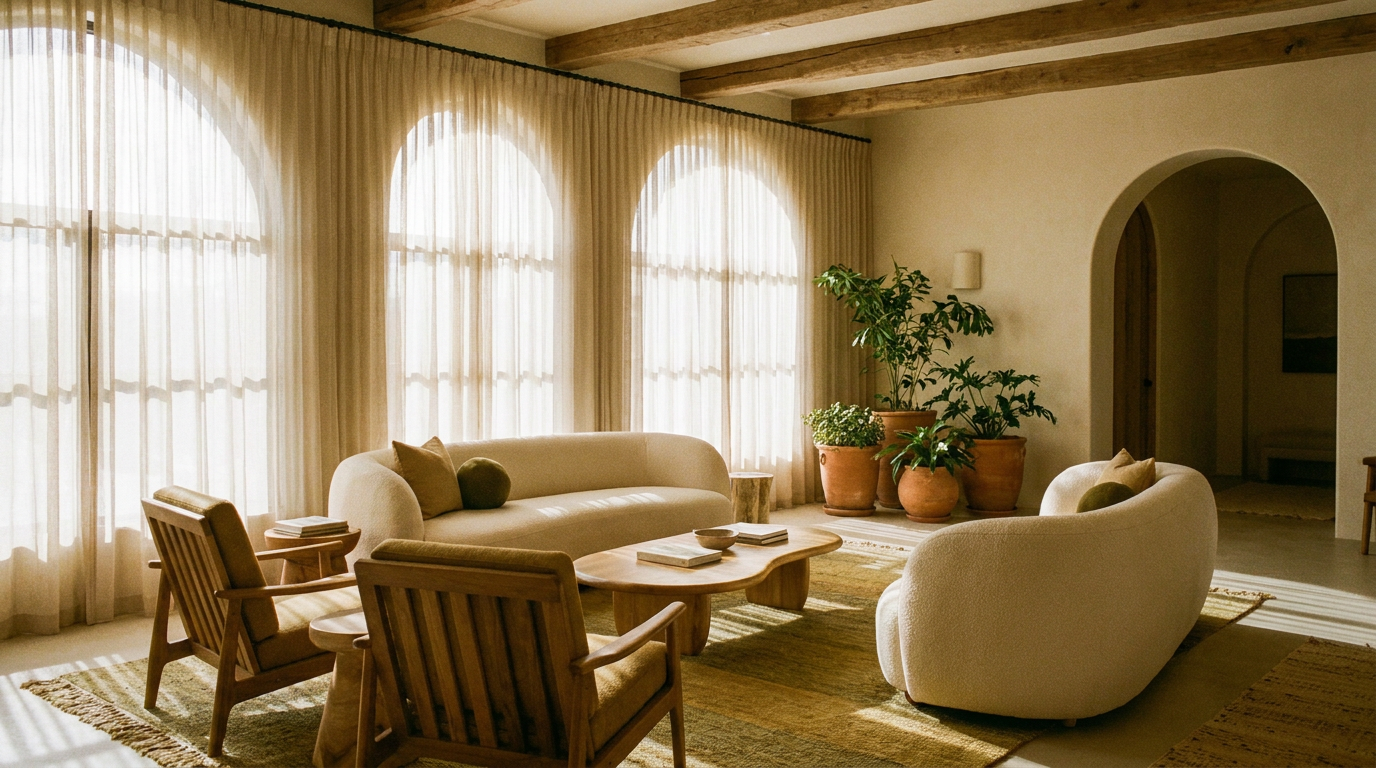
- Curved furniture and arched doorways reduce activation in the brain's threat-detection centers.
- Dynamic lighting that mimics the sun's natural progression helps regulate sleep hormones.
- Natural fractal patterns found in wood and stone require less cognitive energy to process.
- Designers are moving away from stark minimalism toward warm, sensory-rich environments.
The feeling of walking into a room and experiencing an instant sense of relief isn't magic; it is biology. The emerging field of neuroaesthetics is fundamentally changing how we approach interior design, shifting the focus from how a room looks to how it makes the human brain behave.[1][2]
For decades, interior design was largely treated as an art form governed by subjective taste, cultural norms, and fleeting aesthetic trends. Today, thanks to advancements in functional magnetic resonance imaging (fMRI) and wearable biometric tracking, researchers can quantify exactly how spatial geometry, lighting, and texture alter our neurochemistry.[4][6]
Neuroaesthetics is the scientific study of the neural bases for the contemplation and creation of art or design. In the context of the home, it asks a highly practical question: what specific environmental stimuli trigger the parasympathetic nervous system to initiate a state of rest and digest?[4]
One of the most robust findings in neuroarchitecture centers on spatial geometry—specifically, the brain's distinct preference for curves over sharp angles. When human subjects are placed in rooms dominated by rectilinear furniture and sharp corners, brain imaging shows heightened activity in the amygdala, the region associated with fear and threat detection.[3]

Evolutionary psychologists hypothesize that this response is an ancient survival mechanism. In the natural world, sharp, jagged edges often signal danger—thorns, teeth, or shattered rocks—while curves are associated with living organisms, flowing water, and safety.[3][6]
Consequently, residential designers are increasingly abandoning the stark, boxy minimalism of the 2010s in favor of curvilinear sofas, arched doorways, and rounded kitchen islands. This shift isn't merely aesthetic; it is a deliberate strategy to lower baseline cortisol levels in the home environment.[1]
Beyond shape, lighting is arguably the most potent neurological lever in interior design. The human circadian rhythm is governed by the suprachiasmatic nucleus in the brain, which relies heavily on light signals received through the eyes to regulate the production of hormones like cortisol for alertness and melatonin for sleep.[5]
Beyond shape, lighting is arguably the most potent neurological lever in interior design.
Traditional static home lighting—often locked at a single color temperature and brightness—can confuse this biological clock, leading to poor sleep architecture and chronic low-grade anxiety. In response, the integration of dynamic, circadian-mapped lighting systems has become a cornerstone of neuroaesthetic design.[2][5]
These systems automatically transition from cool, blue-enriched light in the morning to warm, amber tones in the evening. By mimicking the natural progression of the sun, these environments actively suppress cortisol production after dusk, preparing the neurological system for restorative sleep.[5][6]
Another critical pillar of neuroaesthetics is biophilic design, which goes far beyond simply placing a potted plant in a corner. True biophilia involves integrating fractal patterns—complex geometric shapes that repeat at different scales, commonly found in tree branches, ocean waves, and leaf veins.[4]

The human visual cortex processes these natural fractals with remarkable efficiency. Studies indicate that viewing natural fractal patterns can reduce physiological stress levels by as much as 60 percent, simply because the brain expends less metabolic energy decoding them compared to chaotic urban environments or hyper-complex artificial patterns.[3][4]
Translating this science into the home involves the use of exposed wood grain, natural stone with visible veining, and textiles that mimic organic textures. These materials provide continuous, low-level sensory nourishment that keeps the brain engaged but not overwhelmed.[1][2]

However, researchers caution that neuroaesthetics is not a one-size-fits-all prescription. The field is increasingly recognizing the importance of neurodiversity, noting that an environment deemed calming for a neurotypical individual might be under-stimulating or over-stimulating for someone with ADHD or autism.[4][6]
For instance, while open-concept floor plans with expansive sightlines might feel liberating to some, they can cause cognitive fatigue for those who require defined, enclosed spaces to focus and regulate their sensory input. As a result, the next frontier of neuroarchitecture focuses on adaptable micro-environments within the home.[2][6]

Ultimately, the rise of neuroaesthetics represents a profound shift in the value proposition of interior design. As building standards evolve to incorporate these scientific insights, the home is being reimagined not just as a shelter or a status symbol, but as a proactive, non-pharmacological tool for mental health intervention.[1][5]
How we got here
1990s
Advancements in fMRI technology allow researchers to observe real-time brain responses to visual stimuli.
2003
The Academy of Neuroscience for Architecture (ANFA) is founded to link scientific research with building design.
2020
The global pandemic forces millions to spend unprecedented time indoors, sparking mainstream interest in the psychological impact of home environments.
2026
Neuroaesthetic principles become standard practice in modern interior design, moving beyond luxury markets into accessible wellness strategies.
Viewpoints in depth
Empirical Researchers
Scientists focused on the measurable biological data behind our aesthetic preferences.
For empirical researchers, interior design is a matter of neurochemistry, not art. They rely on biometric data—such as heart rate variability, galvanic skin response, and fMRI scans—to prove that our environments actively shape our brain function. This camp argues that because human brains evolved outdoors, our modern, angular, artificially lit indoor environments are fundamentally mismatched with our biology, leading to chronic stress. Their goal is to create an evidence-based framework for architecture that treats the built environment as a public health intervention.
Residential Designers
Practitioners applying scientific findings to create beautiful, livable spaces.
Design practitioners serve as the bridge between clinical neuroscience and the consumer. While they value the empirical data, their primary challenge is translating concepts like 'melanopic lux' and 'fractal geometry' into spaces that feel like home rather than a laboratory. This camp emphasizes the tactile and emotional experience of a room, advocating for 'warm minimalism' and biophilic elements that satisfy the brain's neurological needs while maintaining high aesthetic standards and personal expression.
Building Standard Certifiers
Organizations working to codify health-centric design into formal real estate standards.
Organizations like the International WELL Building Institute view neuroaesthetics through the lens of scalability and standardization. They argue that mental well-being should be built into the structural code of a home, much like fire safety or energy efficiency. By creating formal metrics for circadian lighting, acoustic comfort, and biophilic integration, this camp aims to incentivize developers and builders to prioritize human cognitive health in their construction practices, ultimately democratizing access to neuro-supportive environments.
What we don't know
- How the long-term effects of neuroaesthetic design differ across various age groups, particularly in early childhood development.
- The precise threshold at which biophilic design elements (like artificial vs. real plants) trigger a measurable neurological benefit.
- How to perfectly standardize neuroaesthetic guidelines given the vast differences in individual sensory processing and neurodiversity.
Key terms
- Neuroaesthetics
- The scientific study of how the brain processes and responds to art, design, and aesthetic experiences.
- Biophilia
- The innate human instinct to connect with nature and other living systems, often applied in design through natural light, plants, and organic materials.
- Circadian Rhythm
- The body's internal 24-hour clock that regulates the sleep-wake cycle, heavily influenced by environmental light.
- Fractal Patterns
- Complex geometric shapes that repeat at different scales, commonly found in nature, which the human brain processes with high efficiency.
- Amygdala
- A small, almond-shaped structure in the brain primarily responsible for processing emotions, particularly fear and threat detection.
Frequently asked
Do I need to buy new furniture to apply neuroaesthetics?
No. While curved furniture helps, you can apply neuroaesthetic principles by changing your lightbulbs to warmer tones, reducing visual clutter, and introducing natural textures like wood or plants into your space.
How does clutter affect the brain?
Visual clutter forces the visual cortex to work overtime to process the environment, which can elevate cortisol levels and induce a state of chronic, low-grade cognitive fatigue.
What is the best lighting for an office versus a bedroom?
Workspaces benefit from cooler, blue-enriched light (around 4000K-5000K) to stimulate cortisol and alertness, while bedrooms should use warm, amber light (under 2700K) to promote melatonin production.
Is neuroaesthetics only for luxury homes?
While early adoption was seen in high-end design, the core principles—such as maximizing natural light, utilizing color psychology, and arranging furniture to avoid sharp corners—can be applied on any budget.
Sources
Source coverage
6 outlets
4 viewpoints surfaced






[1]Architectural DigestResidential Designers
The Rise of Neuroaesthetics in Home Design
Read on Architectural Digest →[2]Psychology TodayResidential Designers
How Your Living Room Shapes Your Brain
Read on Psychology Today →[3]Journal of Environmental PsychologyEmpirical Researchers
Impact of curvilinear vs. rectilinear interior environments on human psychological responses
Read on Journal of Environmental Psychology →[4]International Arts + Mind LabEmpirical Researchers
Neuroarts Blueprint: The Science of Built Environments
Read on International Arts + Mind Lab →[5]International WELL Building InstituteBuilding Standard Certifiers
WELL v2: Light and Mind Concepts
Read on International WELL Building Institute →[6]Factlen Editorial TeamFactlen Editorial
Synthesis by Factlen editorial team
Read on Factlen Editorial Team →

Every angle. Every day.
Get home stories with full source coverage and perspective breakdowns delivered to your inbox.