
Why Pinterest-Perfect Pantries Are Out, and 'Functional Organizing' Is In
A growing movement of experts and neuroscientists are abandoning 'aesthetic organizing' in favor of functional systems that reduce cortisol and accommodate human behavior.
By Factlen Editorial Team
- Functional Organizers
- Prioritize reducing friction and executive dysfunction, favoring visible, easy-to-maintain systems over visual perfection.
- Neuroscientists
- Focus on the physiological impact of clutter, measuring cortisol spikes and the limits of working memory when faced with visual stimuli.
- Aesthetic Minimalists
- Believe visual harmony and uniformity reduce cognitive load by eliminating visual noise, even if it requires more maintenance.
What's not represented
- · Interior Designers
- · Professional Cleaners
Why this matters
If you constantly feel exhausted by your own home, the problem likely isn't a lack of willpower—it's a mismatch between how your brain works and how your space is designed. Shifting to functional organizing can measurably lower your daily stress hormones and reclaim your free time.
Key points
- Aesthetic organizing prioritizes visual harmony, often requiring high maintenance that can lead to system collapse.
- Functional organizing focuses on reducing friction and placing tools exactly where tasks are performed.
- Every item in a home contributes to a 'silent to-do list,' draining working memory and increasing cognitive load.
- Studies show that living in highly cluttered environments leads to chronically elevated levels of the stress hormone cortisol.
- The 'point of performance' strategy reduces the executive function required to maintain a tidy space.
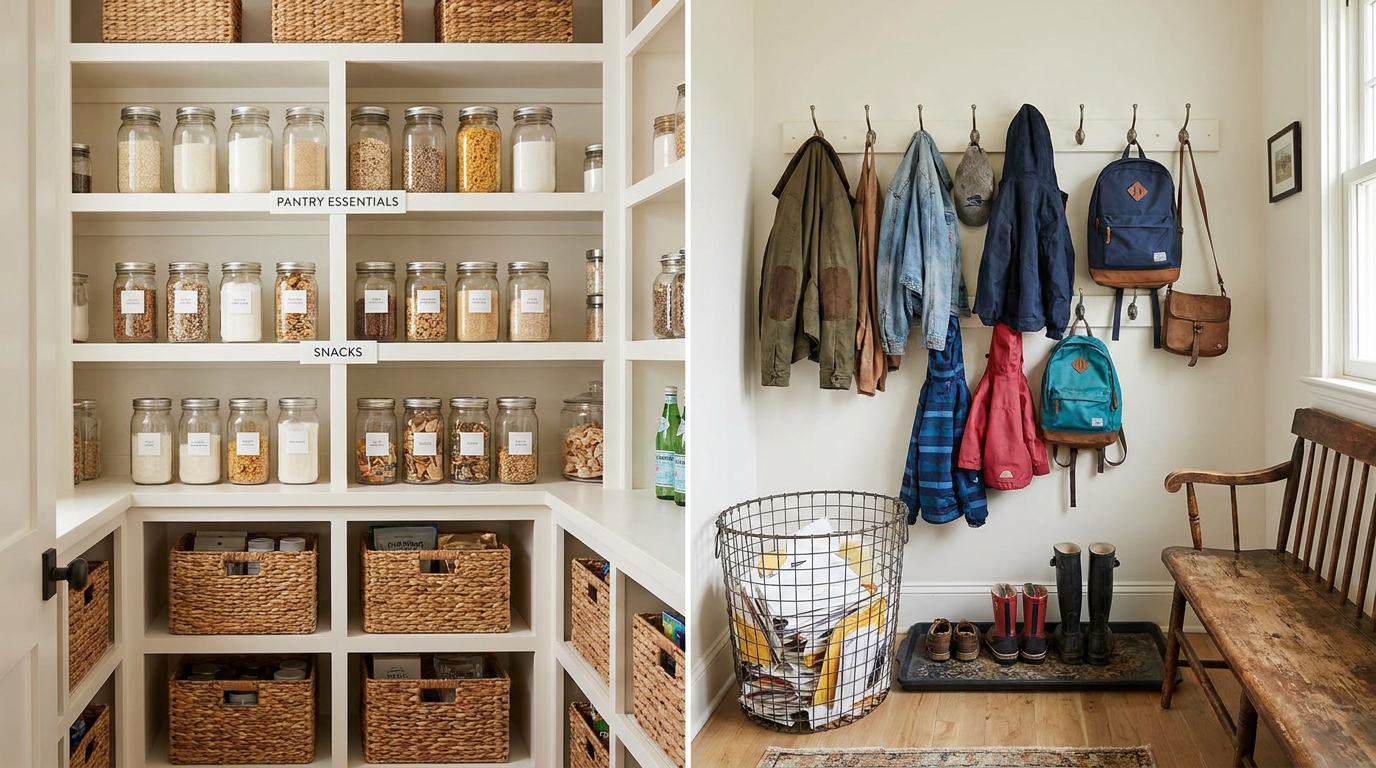
The modern ideal of an organized home has been heavily shaped by social media, where pantries resemble high-end boutiques and every cereal box is decanted into matching acrylic containers. This aesthetic approach promises peace through visual uniformity. Yet, for many, the pursuit of this perfection backfires, creating a secondary layer of household labor that is impossible to maintain.[6]
In response, a quiet rebellion is reshaping how experts approach domestic spaces. The shift moves away from "aesthetic organizing"—which prioritizes how a space looks—toward "functional organizing," which prioritizes how a space operates. This movement borrows heavily from neurodivergent coping strategies, focusing on reducing friction and accommodating human behavior rather than forcing humans to adapt to rigid systems.[3][6]
To understand why aesthetic organizing often fails, it is necessary to examine the psychological weight of our possessions. Japanese author Fumio Sasaki coined the term the "silent to-do list" to describe the phenomenon where every item in a home constantly broadcasts a demand to its owner.[5]
A stack of mail signals that bills need paying; a dying houseplant demands water; a pile of laundry requires folding. Even when a person is not actively focusing on these items, the brain registers their presence and the unfinished tasks they represent. This constant background processing drains cognitive resources and prevents genuine relaxation.[5]

The physiological toll of this silent to-do list is measurable. A landmark study by the UCLA Center on Everyday Lives of Families tracked the stress levels of dual-income households and found a direct correlation between the volume of household objects and the cortisol levels of the residents.[1]
Cortisol, the body's primary stress hormone, typically peaks in the morning and tapers off throughout the day. However, individuals living in highly cluttered environments experienced elevated cortisol levels from morning until night. The home, rather than serving as a sanctuary, functioned as a chronic stressor.[1]

Furthermore, research from the Princeton Neuroscience Institute demonstrates that visual clutter actively competes for the brain's attention. When multiple stimuli are present in a visual field, they restrict the brain's processing capacity, leading to cognitive overload, reduced working memory, and decision fatigue.[2]
Aesthetic organizing attempts to solve this visual noise by hiding it behind uniform labels and matching bins. However, this approach often introduces a new problem: high executive function demands. Executive function refers to the mental skills required to plan, focus attention, remember instructions, and juggle multiple tasks.[3]
Aesthetic organizing attempts to solve this visual noise by hiding it behind uniform labels and matching bins.
Maintaining an aesthetic system—such as unboxing every grocery item, decanting snacks into glass jars, and ensuring labels face forward—requires significant executive function. When life gets busy, or for individuals with conditions like ADHD, the energy required to maintain the aesthetic system exceeds the energy available, leading to system collapse and renewed clutter.[3][6]
Functional organizing abandons the demand for visual perfection in favor of behavioral reality. A core tenet of this approach is the "point of performance," a concept championed by clinical psychologist Dr. Russell Barkley in his work on ADHD.[3][4]
The point of performance dictates that tools, cues, and materials must be stored exactly where the task is executed, rather than where they logically "belong" or look best. If mail is always opened at the kitchen island, the recycling bin and letter opener should live at the kitchen island, not in a home office down the hall.[3]

By placing supports exactly where the action happens, the system eliminates the need to rely on working memory or willpower. It reduces the physical and mental steps required to complete a task, making the desired behavior the path of least resistance.[4]
Another hallmark of functional organizing is the externalization of memory. Because working memory is fragile and easily overwhelmed by daily stress, functional systems rely on physical cues. The "Launch Pad" is a prime example: a designated drop-zone near the primary exit where keys, bags, and coats live.[4][6]
Instead of demanding that a resident remember where they placed their keys the night before, the Launch Pad system automates the routine. The physical space holds the memory, reducing the cognitive load required simply to leave the house in the morning.[4]
Functional organizing also embraces "open storage" for frequently used items. While aesthetic organizers might hide daily toiletries in a drawer to keep counters clear, functional organizers recognize that "out of sight" often means "out of mind." Using a simple, open tray on the counter keeps essential items visible but contained, satisfying both the need for accessibility and the desire for boundary.[3][6]
The transition from aesthetic to functional organizing requires a fundamental mindset shift. It asks individuals to stop organizing for an imaginary, idealized version of themselves and start organizing for the reality of their daily habits.[6]
This does not mean abandoning beauty entirely. Visual organizers—people who genuinely feel calmer when their environment is color-coordinated and symmetrical—can still utilize functional principles. The key is ensuring that the aesthetic choices do not create unnecessary barriers to putting things away. A beautiful basket is only useful if it is easy to toss items into.[6]
Ultimately, the goal of any organizational system is to serve the people living in the space, not the other way around. By understanding the psychology of clutter and the limits of executive function, households can build systems that reduce cortisol, quiet the silent to-do list, and reclaim the home as a place of rest.[1][5]
How we got here
2009
UCLA publishes a landmark study linking household clutter to elevated cortisol levels in dual-income families.
2015
Fumio Sasaki publishes 'Goodbye, Things', introducing the concept of the silent to-do list to a global audience.
2020
The pandemic drives a surge in 'aesthetic organizing' as people spend more time at home and seek visual control.
2024
A cultural shift begins toward 'functional organizing' and ADHD-friendly home systems that prioritize mental health over aesthetics.
Viewpoints in depth
Functional Organizers' view
Systems should be designed around human behavior, not the other way around.
Advocates for functional organizing argue that traditional tidying methods demand too much executive function. By utilizing concepts like the 'point of performance' and externalizing memory through visual drop-zones, they believe homes can be maintained with significantly less willpower. This camp views the aesthetic trend of decanting and micro-organizing as a recipe for burnout, particularly for neurodivergent individuals or busy families.
Aesthetic Minimalists' view
Visual harmony is essential for reducing cognitive load and creating a peaceful sanctuary.
Those who favor aesthetic organizing argue that visual noise is just as damaging as physical clutter. By removing branded packaging, utilizing uniform containers, and maintaining strict color palettes, they believe the brain is spared from processing excess stimuli. While they acknowledge the upfront labor required to maintain these systems, they argue the resulting mental clarity is worth the investment.
Neuroscientists' view
Clutter is a physiological stressor that actively impairs brain function.
Researchers focus on the measurable impacts of disorganized spaces, noting that visual clutter directly competes for the brain's processing power in the visual cortex. Studies have consistently shown that environments with high volumes of objects lead to elevated cortisol levels, reduced working memory, and increased decision fatigue, proving that the effects of a messy room are biological, not just emotional.
What we don't know
- How the long-term psychological effects of digital clutter compare to physical household clutter.
- Whether the cortisol spikes associated with clutter affect children and adults at the same physiological rate.
- The exact threshold at which visual stimuli transition from being 'decor' to 'cognitive overload' for different neurotypes.
Key terms
- Point of Performance
- The exact physical location where a specific task is carried out, which is where the tools for that task should be stored.
- Silent To-Do List
- The subconscious mental burden created by household items that require maintenance, cleaning, or decision-making.
- Executive Function
- The set of mental skills that include working memory, flexible thinking, and self-control, required to plan and execute tasks.
- Decision Fatigue
- The deteriorating quality of decisions made by an individual after a long session of decision-making, often exacerbated by cluttered environments.
- Visual Clutter
- An excess of visual stimuli in an environment that competes for the brain's attention and reduces working memory.
Frequently asked
What is the 'silent to-do list'?
It is a psychological concept describing how every object in your home—like a pile of mail or dirty dishes—silently demands your attention and reminds you of unfinished tasks, draining your mental energy.
Why does a messy room make me feel tired?
Visual clutter competes for your brain's attention, causing cognitive overload. Studies also show that cluttered environments can keep your cortisol (stress hormone) levels elevated, leading to physical and mental fatigue.
What is the 'point of performance'?
It is an organizational strategy where you store the tools you need exactly where you use them, rather than where they logically 'belong.' For example, keeping the coffee grinder, beans, and mugs in one dedicated station.
Does functional organizing mean my house will look messy?
Not necessarily. It simply means prioritizing ease of use over visual perfection. You can still use beautiful baskets and trays, but they should be open and accessible rather than requiring you to unstack bins or decant items.
Sources
Source coverage
6 outlets
3 viewpoints surfaced






[1]UCLA Center on Everyday Lives of FamiliesNeuroscientists
Life at Home in the Twenty-First Century: Cortisol and Clutter
Read on UCLA Center on Everyday Lives of Families →[2]Princeton Neuroscience InstituteNeuroscientists
Interactions of top-down and bottom-up mechanisms in human visual cortex
Read on Princeton Neuroscience Institute →[3]ADDitude MagazineFunctional Organizers
Executive Dysfunction, Explained: How ADHD Affects Behavior and Performance
Read on ADDitude Magazine →[4]Simply PsychologyFunctional Organizers
The Prosthetic Solution: Why You Need an External Brain
Read on Simply Psychology →[5]Goodbye, ThingsAesthetic Minimalists
Goodbye, Things: The New Japanese Minimalism by Fumio Sasaki
Read on Goodbye, Things →[6]Factlen Editorial TeamFunctional Organizers
Synthesis by Factlen editorial team
Read on Factlen Editorial Team →


Every angle. Every day.
Get home stories with full source coverage and perspective breakdowns delivered to your inbox.