
UK Prime Minister Keir Starmer on the Brink as Andy Burnham Mounts Leadership Threat
British Prime Minister Keir Starmer is facing overwhelming pressure from his own cabinet to resign following Andy Burnham's decisive by-election victory. The crisis threatens to inaugurate the UK's seventh prime minister in a decade.
By Factlen Editorial Team
- Burnham Supporters
- Believe Starmer's authority is irreparably broken and that Burnham is the only communicator capable of defeating Reform UK.
- Political Observers
- Focus on the systemic dysfunction of the UK political system and the economic damage caused by constant leadership changes.
- Starmer Loyalists
- Argue that a leadership contest will plunge the party and country into chaos, urging unity behind the elected Prime Minister.
What's not represented
- · International allies concerned about the UK's reliability as a diplomatic and military partner.
- · Financial markets and investors reacting to the prospect of renewed political instability.
Why this matters
The collapse of a G7 leader's administration just two years after a historic landslide victory introduces profound political and economic instability. If Starmer resigns, the UK will see its seventh Prime Minister in ten years, directly impacting international trade relations, domestic economic policy, and the stability of Western alliances.
Key points
- Prime Minister Keir Starmer is reflecting on his future at Chequers amid overwhelming pressure to resign.
- Andy Burnham's victory in the Makerfield by-election allows him to launch a formal leadership challenge.
- Senior cabinet ministers and Labour grandees have publicly and privately urged Starmer to step down.
- Starmer's popularity has plummeted due to economic struggles and controversial appointments.
- If Starmer resigns, the UK will inaugurate its seventh Prime Minister in a decade.
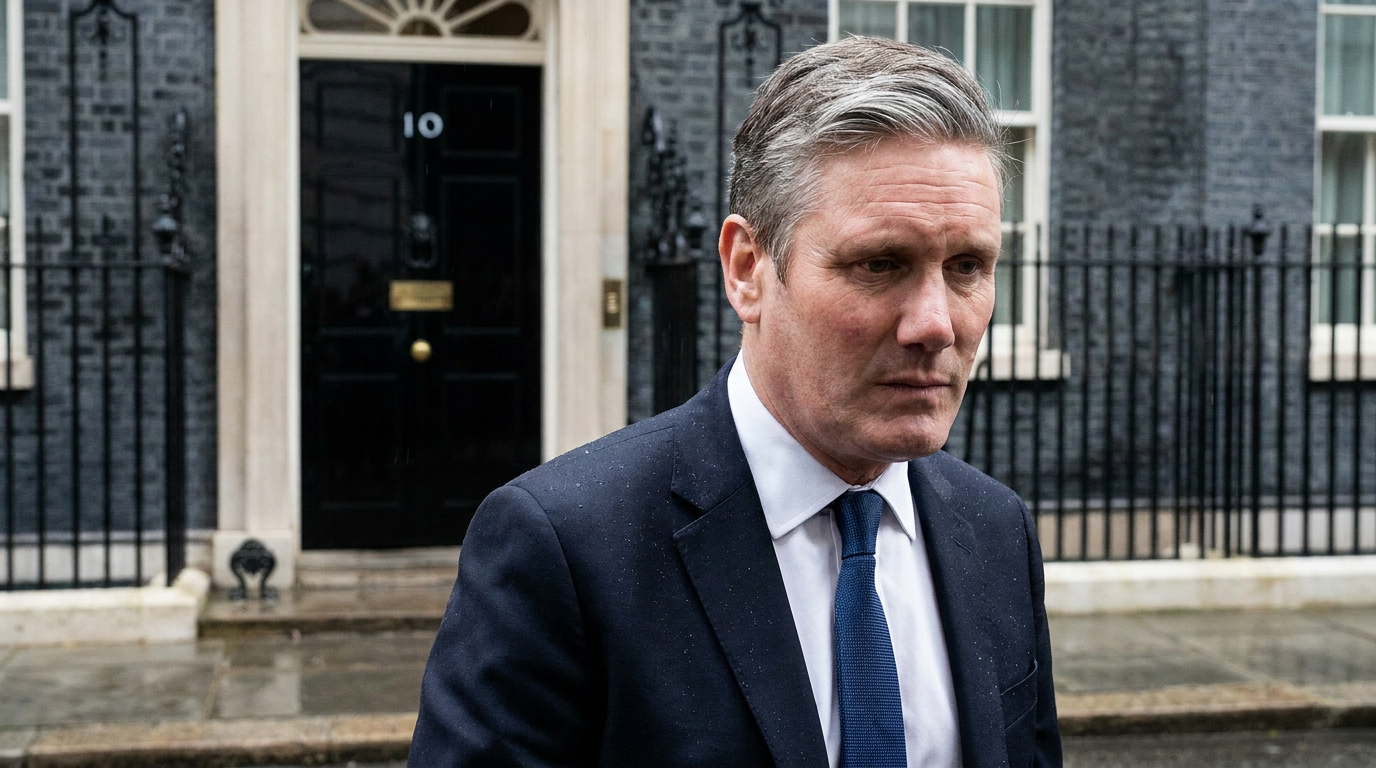
British Prime Minister Keir Starmer is spending the weekend sequestered at his Chequers country residence, facing the imminent collapse of his premiership just two years after securing a historic electoral landslide. The political ground shifted decisively on Thursday when Andy Burnham, the popular Mayor of Greater Manchester, won a crucial by-election in the Makerfield constituency.[3][5]
Burnham's return to the House of Commons is the mechanical catalyst for the current crisis. Under UK parliamentary rules, a politician must be a sitting Member of Parliament to launch a formal leadership challenge or serve as Prime Minister. By securing the Makerfield seat with a commanding 55% of the vote, Burnham cleared the final constitutional hurdle to unseat Starmer.[4][7]
The immediate fallout has been swift and deeply damaging to Downing Street. On Sunday, Business Secretary Peter Kyle appeared on national television and conspicuously declined to repeat the government's previous insistence that Starmer would fight any challenge. Instead, Kyle stated that the Prime Minister was taking time to reflect on the "political realities" and challenges before him.[1][7]

Kyle's carefully chosen words signaled a dramatic shift in the cabinet's posture. Previously, Starmer's allies had maintained a unified front, with the Prime Minister himself vowing on Friday that he would "run and stand" if a contest was triggered. Now, cabinet ministers are publicly acknowledging the sheer force of the political gravity moving against him.[3][5]
Behind the scenes, the pressure is described as overwhelming. Reports indicate that senior cabinet members, including Energy Secretary Ed Miliband and Transport Secretary Heidi Alexander, have privately urged Starmer to set out a timetable for his departure. The consensus among the party elite is that a protracted leadership battle would paralyze the government and further alienate the public.[3][6]
Labour grandees are no longer hiding their discontent. Lord Charlie Falconer, a former justice secretary who previously served in Starmer's shadow cabinet, declared publicly that the Prime Minister has "absolutely no authority" left. Former Home Secretary Alan Johnson was even more blunt in a radio interview, stating simply: "It's over, Keir."[6]
How did a commanding 174-seat parliamentary majority evaporate in just 24 months? The root cause is a profound collapse in public support. Since taking office in July 2024, Starmer's administration has struggled to deliver on its core promises of accelerating economic growth, repairing tattered public services, and easing a stubborn cost-of-living crisis.[5]
How did a commanding 174-seat parliamentary majority evaporate in just 24 months?
The administration's policy struggles have been compounded by severe unforced errors. Most notably, Starmer faced intense backlash over his decision to appoint Peter Mandelson—a political veteran with controversial ties to the late Jeffrey Epstein—as the UK ambassador to the United States. The scandal severely damaged the government's moral authority and alienated liberal voters.[5]
Electorally, the Labour Party is now bleeding support on two distinct fronts. Progressive and younger voters are increasingly defecting to the Green Party, frustrated by what they view as Starmer's overly cautious economic policies. Simultaneously, working-class voters in the post-industrial "Red Wall" are migrating to Nigel Farage's anti-immigration Reform UK party.[4][5]
This dual threat explains why Andy Burnham has suddenly become the consensus savior for panicking Labour MPs. Dubbed the "King of the North," Burnham represents a stark stylistic and political contrast to the famously stiff and lawyerly Prime Minister. He campaigns in open-necked shirts and jeans, and frequently DJs at local events, projecting an amiable, everyman persona.[4]

More importantly, Burnham's decisive victory in Makerfield proved he can neutralize the threat from the political right. In a constituency that overwhelmingly backed Brexit and heavily favored Reform UK in recent local elections, Burnham crushed the Reform candidate by a 20-point margin. He campaigned on a platform of ending "trickle-down economics" and investing in vocational education.[4][7]
The mechanics of a transition are now the primary focus in Westminster. To trigger a formal leadership contest, Burnham needs the backing of 20% of Labour MPs. Given the surge of support following his by-election win, political analysts believe he would easily clear this threshold, setting up a bruising internal battle.[3][4]
However, party elders are desperately pushing for a "coronation"—an agreed transition where Starmer steps down voluntarily, allowing Burnham to take over seamlessly without a formal contest. They argue that a drawn-out fight would plunge the country into chaos and project an image of a ruling party entirely consumed by its own survival.[6]
The stakes for the United Kingdom extend far beyond internal party dynamics. If Starmer departs, Britain will inaugurate its seventh Prime Minister in a single decade. This extraordinary rate of churn has severely damaged the UK's reputation for political stability, complicating international trade negotiations and long-term foreign policy commitments.[3][5]

All eyes are now on Monday. Senior Labour figures expect Starmer to make a definitive statement regarding his future. Whether he chooses to fight an unwinnable war against his own cabinet or orchestrates a dignified exit, the political landscape of the United Kingdom has already been fundamentally altered.[1][3]
How we got here
July 2024
Keir Starmer leads the Labour Party to a historic landslide victory, securing a 174-seat majority.
May 2026
Labour suffers heavy losses in local elections, exposing deep voter dissatisfaction with the government's economic performance.
June 18, 2026
Andy Burnham wins the Makerfield by-election, returning to Parliament and becoming eligible to challenge Starmer.
June 21, 2026
Cabinet ministers publicly acknowledge Starmer is reflecting on 'political realities' as resignation calls mount.
Viewpoints in depth
The Case for a Burnham Premiership
Supporters argue Burnham is the only leader capable of reconnecting with the working class.
Allies of Andy Burnham point to his decisive victory in Makerfield as proof that he possesses a unique political skillset. While Starmer is often criticized as overly managerial and disconnected from the struggles of ordinary voters, Burnham's relaxed communication style and focus on regional inequality resonate deeply in post-industrial areas. His supporters argue that Labour's only path to surviving the next general election is to pivot away from Westminster-centric policies and embrace Burnham's brand of northern populism, which directly neutralizes the appeal of right-wing parties like Reform UK.
The Risk of Perpetual Instability
Critics warn that constantly changing leaders damages the UK's global standing and economic health.
Foreign policy analysts and business leaders view the current crisis with deep alarm. The prospect of inaugurating a seventh Prime Minister in ten years cements the UK's reputation as a politically volatile nation. Critics of the leadership challenge argue that this relentless churn prevents the government from executing long-term economic strategies or maintaining consistent diplomatic relationships. They warn that treating the premiership as a disposable office to solve short-term polling dips ultimately harms the British public by paralyzing the civil service and deterring foreign investment.
The Starmer Camp's Defense
Loyalists maintain that governing requires unpopular decisions that shouldn't trigger immediate panic.
Before the cabinet rebellion gained momentum, Starmer's remaining allies argued that the Prime Minister was simply doing the difficult, unpopular work required to fix a broken country. They point out that Starmer secured a historic 174-seat majority just two years ago, giving him a clear democratic mandate to govern. From this perspective, the current economic pain is the necessary medicine for long-term recovery, and panicking Labour MPs are prioritizing their own short-term electoral survival over the stability of the nation.
What we don't know
- Whether Starmer will resign voluntarily or force Burnham to trigger a formal, drawn-out leadership contest.
- How financial markets will react to the prospect of another sudden change in UK leadership.
- Whether other cabinet ministers will attempt to challenge Burnham for the leadership.
Key terms
- By-election
- A special election held to fill a vacant political office that becomes available between general elections.
- Red Wall
- A set of historically working-class constituencies in the Midlands and Northern England that are crucial to winning a UK general election.
- Reform UK
- A right-wing, anti-immigration political party led by Nigel Farage that has been siphoning voters away from the traditional major parties.
- Leadership Challenge Threshold
- The requirement that a challenger must be a sitting Member of Parliament and secure the backing of 20% of Labour MPs to trigger a contest.
Frequently asked
Why did Andy Burnham have to win a by-election?
Under UK parliamentary rules, a politician must be a sitting Member of Parliament (MP) in the House of Commons to serve as Prime Minister or lead a major party.
When will Keir Starmer make a decision?
Senior Labour figures expect Starmer to announce a timetable for his departure or his intention to fight the challenge as early as Monday, June 22.
Who would take over if Starmer resigns?
Andy Burnham is the overwhelming favorite, though other cabinet ministers have previously indicated interest in a leadership bid.
Sources
Source coverage
7 outlets
3 viewpoints surfaced







[1]The New York TimesStarmer Loyalists
Keir Starmer Reflects on ‘Political Challenges’ as Pressure to Resign Mounts
Read on The New York Times →[2]Al JazeeraPolitical Observers
Pressure mounts on Starmer to quit after Burnham’s by-election win
Read on Al Jazeera →[3]The GuardianBurnham Supporters
Keir Starmer expected to announce departure as prime minister on Monday
Read on The Guardian →[4]Associated PressBurnham Supporters
Who is Andy Burnham, the lawmaker seeking to replace Keir Starmer
Read on Associated Press →[5]The Washington PostPolitical Observers
British Prime Minister Keir Starmer is facing a crucial decision: step down or fight
Read on The Washington Post →[6]City A.M.Burnham Supporters
'No authority': Starmer under pressure to quit after Burnham wins in Makerfield
Read on City A.M. →[7]The Straits TimesStarmer Loyalists
UK PM Starmer reflecting on ‘political realities’ amid leadership threat
Read on The Straits Times →
More in news politics
See all 5 stories →Future of Work
The evidence is in: The four-day workweek boosts well-being without breaking the economy
7 sources

Information Ecosystem
The Evidence Behind Bridging Algorithms: How Decentralized Fact-Checking is Actually Working
7 sources

US-Iran Deal
How the Fragile US-Iran Peace Deal Could Unravel Over Lebanon
8 sources
Every angle. Every day.
Get news politics stories with full source coverage and perspective breakdowns delivered to your inbox.