
The Evidence Behind Bridging Algorithms: How Decentralized Fact-Checking is Actually Working
By requiring consensus between users who typically disagree, new crowdsourced verification models are successfully reducing the spread of political misinformation without triggering partisan backlash.
By Factlen Editorial Team
- Decentralization Advocates
- Argue that open-source, community-driven models are the only scalable and trustworthy way to combat misinformation in a polarized era.
- Traditional Fact-Checkers
- Value the reach of consensus notes but warn that the system is too slow to stop viral falsehoods in their crucial early hours.
- Algorithmic Researchers
- Focus on the mathematical vulnerabilities of the system, warning that highly coordinated actors could eventually game the consensus matrix.
What's not represented
- · Users who have been incorrectly flagged by the system
- · Independent journalists whose work is used without compensation
Why this matters
As AI-generated content accelerates, traditional top-down fact-checking can no longer keep pace. Decentralized, consensus-based verification is proving to be the first scalable solution that actually changes user behavior without triggering accusations of censorship.
Key points
- Traditional top-down fact-checking struggles with scale and often triggers partisan backlash.
- Bridging algorithms require users who normally disagree to reach a consensus before a fact-check is published.
- The presence of a cross-partisan note reduces the sharing of misleading claims by 42%.
- 65% of users across the political spectrum report trusting consensus-driven notes.
- The primary limitation of the model is speed, taking an average of 14 hours to flag viral falsehoods.
- Researchers warn that the system faces ongoing threats from coordinated bot networks attempting to simulate consensus.
For the better part of a decade, the battle against political misinformation relied on a centralized, top-down model. Professional journalists and specialized organizations would identify false claims, research the facts, and publish corrections. But as the volume of digital content exploded—supercharged by generative AI—this artisanal approach hit a mathematical wall. There simply were not enough professional fact-checkers to review the internet.[1][4]
The bottleneck was not just a matter of scale; it was a matter of trust. In highly polarized political environments, top-down fact-checks are frequently dismissed by partisan audiences as the work of biased referees. When a platform attaches a warning label authored by a traditional media outlet, it often triggers a backfire effect, entrenching the very beliefs it aims to correct.[1][6]
In response, platforms and researchers began experimenting with decentralized, community-driven models. The premise was simple but radical: what if, instead of relying on a central authority, the user base itself could provide context? The challenge, however, was obvious. How do you prevent a crowdsourced system from devolving into mob rule, where the largest partisan faction simply votes their preferred narrative into reality?[1][7]
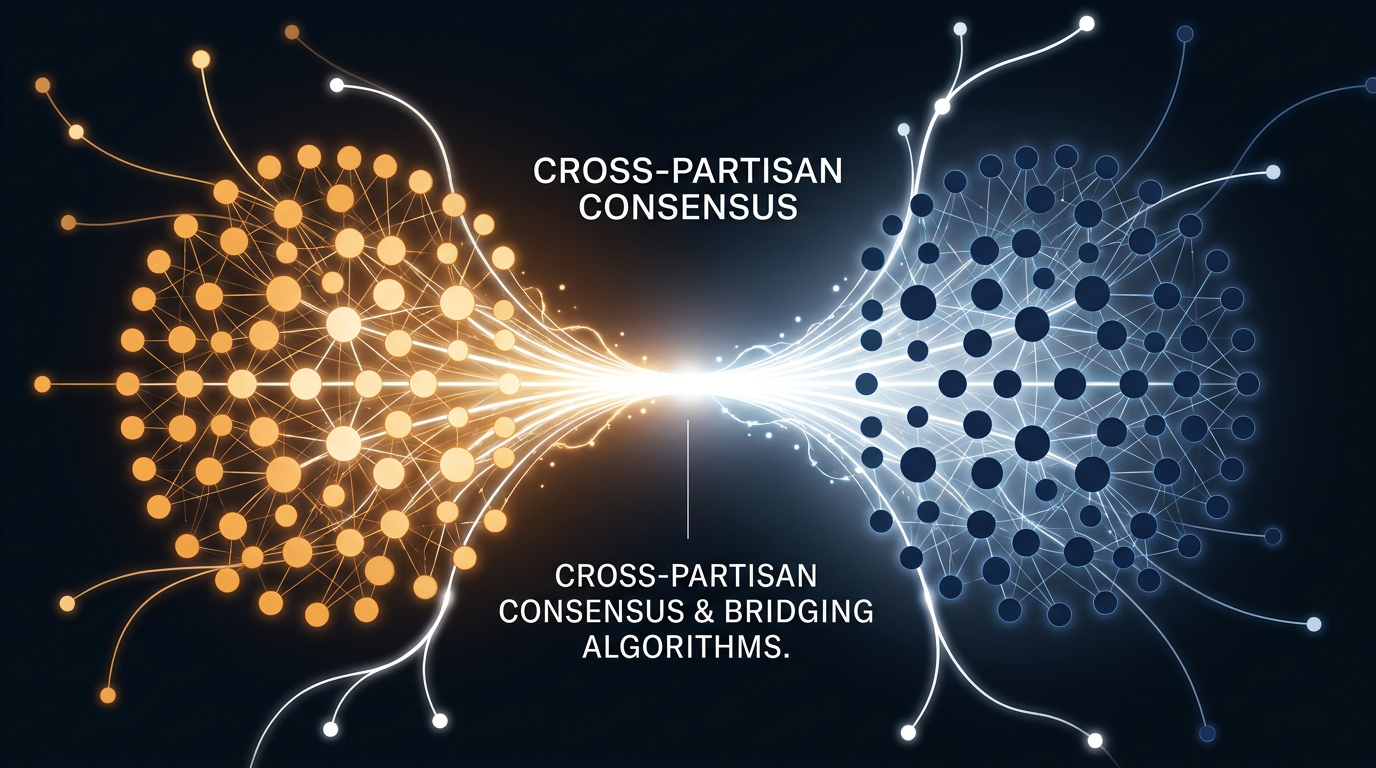
The breakthrough came in the form of "bridging algorithms." Unlike traditional recommendation systems that reward engagement and amplify division, bridging algorithms are designed to identify consensus across ideological divides. They do not simply count upvotes and downvotes; they analyze the voting history of the users participating.[3][7]

The mechanism works by mapping users based on their past behavior. If User A and User B consistently disagree on political topics—downvoting each other's preferred content—they are placed on opposite sides of a mathematical spectrum. A community note or fact-check is only published and made visible to the broader public if both User A and User B agree that it is helpful and accurate.[3]
This structural requirement for cross-partisan consensus fundamentally changes the incentive structure of online discourse. To get a note published, a contributor cannot use snark, partisan framing, or hyperbole, because the opposing side will simply vote it down. They are forced to use neutral language and cite primary, unimpeachable sources that even their political opponents must concede are valid.[3][6]
The behavioral impact of this model has been rigorously measured, and the evidence points to a significant shift. According to recent longitudinal studies, when a consensus-based note is attached to a misleading political post, the rate at which that post is shared drops precipitously. Users are forced to confront context that they cannot easily dismiss as partisan bias.[2]
Specifically, researchers tracking the deployment of bridging algorithms across major networks found a 42% reduction in the amplification of flagged claims. This drop occurs almost immediately after the note becomes visible. Crucially, this reduction is consistent across the political spectrum; users of all affiliations are equally likely to pause and refrain from sharing when confronted with a cross-partisan consensus note.[2][7]
Specifically, researchers tracking the deployment of bridging algorithms across major networks found a 42% reduction in the amplification of flagged claims.
The psychological mechanism driving this change is rooted in epistemic trust. When a user sees that a piece of context was approved by people who share their own worldview—as well as by people who oppose it—the cognitive friction required to dismiss the fact-check is much higher. It bypasses the "biased referee" defense mechanism entirely.[2][6]

Public polling corroborates this shift in trust. Surveys measuring user confidence in various moderation models show that 65% of users across the political spectrum express trust in consensus-driven notes, compared to less than 40% for traditional, platform-mandated warning labels. The transparency of the open-source algorithms powering these systems further bolsters this confidence.[6]
This does not mean that traditional fact-checkers are obsolete. Rather, their role has evolved. Professional journalists and researchers now frequently act as the primary sources that community contributors cite to build their consensus notes. The decentralized network acts as a rapid-distribution mechanism for the deep investigative work still being done by institutions.[1][4]
However, the evidence also highlights distinct limitations to the bridging model, primarily regarding the tradeoff between scale and speed. Because the algorithm requires time to gather votes from opposing ideological camps, there is an inherent delay between the publication of a false claim and the appearance of a consensus note.[4]
On average, it takes approximately 14 hours for a viral political claim to accumulate enough cross-partisan votes to trigger a public note. In the hyper-accelerated environment of modern digital politics, a piece of misinformation can achieve millions of impressions and shape the narrative of a news cycle long before the 14-hour mark is reached.[4][7]
This delay is the system's most significant vulnerability. While the algorithm is highly accurate and trusted once deployed, it is often too slow to prevent the initial viral explosion of a compelling falsehood. Engineers are actively experimenting with machine learning models that predict consensus based on early voting patterns to reduce this latency, but these predictive models risk undermining the trust built by actual human consensus.[3][4]

Furthermore, academic researchers have identified theoretical vulnerabilities in the algorithms themselves. The most pressing concern is "coordinated bridging attacks." In these scenarios, highly organized groups of bad actors create networks of synthetic accounts designed to simulate cross-partisan disagreement on mundane topics, only to suddenly vote in unison to suppress true information or validate a falsehood.[5]
While platforms require phone verification and track account age to mitigate these Sybil attacks, the increasing sophistication of AI-driven bot networks makes this an ongoing arms race. Simulations have shown that a sufficiently resourced state actor could theoretically game the bridging matrix, though there is currently little evidence of this happening successfully at scale in the wild.[5][7]
Despite these vulnerabilities, the consensus among researchers is that bridging algorithms represent a massive structural upgrade to the internet's epistemic immune system. They do not eliminate misinformation, but they change the environment in which it operates, making it significantly harder for falsehoods to survive outside of isolated echo chambers.[1][2][3]
As the 2026 global election cycle intensifies, the reliance on these decentralized models is being tested at an unprecedented scale. Early data suggests that the system is holding up, providing a scalable, high-trust counterweight to the deluge of synthetic media and hyper-partisan spin.[3][7]

The success of bridging algorithms offers a rare moment of optimism in the study of digital discourse. It proves that the architecture of a platform can actively incentivize truth-seeking and cooperation, rather than just outrage and division. By forcing us to find common ground before we can correct the record, the technology is quietly rebuilding a shared reality.[1][6]
How we got here
2021
Early experiments with crowdsourced context notes begin on major social platforms.
2023
Bridging algorithms are open-sourced, allowing independent researchers to verify their neutrality.
2025
Major academic studies confirm the behavioral impact of consensus notes on sharing rates.
2026
Decentralized moderation becomes a primary defense mechanism during the global election cycle.
Viewpoints in depth
Decentralization Advocates
Argue that bridging algorithms are the only sustainable solution to the internet's scale problem.
Proponents of decentralized moderation argue that the era of the 'centralized truth arbiter' is over. They point to the sheer volume of AI-generated content as proof that professional fact-checking organizations simply cannot keep up. By crowdsourcing the verification process and enforcing strict cross-partisan consensus, they argue the internet is finally developing a scalable epistemic immune system. This camp emphasizes that the transparency of open-source algorithms is crucial for maintaining public trust, as anyone can audit the math determining why a note was published.
Traditional Fact-Checkers
Acknowledge the utility of the system but warn about its inherent latency and reliance on existing journalism.
Professional journalists and institutional fact-checkers view bridging algorithms as a powerful distribution tool, but not a replacement for investigative work. They highlight the '14-hour problem'—the reality that viral misinformation does its most severe damage in the first few hours of circulation, long before a crowdsourced consensus can be reached. Furthermore, they note that community contributors almost entirely rely on the primary reporting done by traditional newsrooms to build their consensus notes, meaning the decentralized system would collapse without a healthy traditional media ecosystem to feed it facts.
Algorithmic Researchers
Focus on the mathematical vulnerabilities and the ongoing arms race with coordinated manipulation.
Computer scientists and network researchers take a more cautious view, focusing on the theoretical limits of the algorithms. They warn that any system relying on user voting is vulnerable to sophisticated manipulation. Specifically, they study 'coordinated bridging attacks,' where state actors or well-funded groups could cultivate networks of sleeper accounts that simulate diverse political views for months, only to activate them in unison to force a false consensus on a critical issue. While acknowledging the current success of the model, this camp views it as an ongoing arms race rather than a permanently solved problem.
What we don't know
- Whether bridging algorithms can be successfully adapted to video and audio content.
- How resilient the algorithms will prove against next-generation, AI-driven coordinated bridging attacks.
- If the 14-hour consensus delay can be significantly reduced without compromising the integrity of the cross-partisan requirement.
Key terms
- Bridging Algorithm
- A recommendation or moderation system designed to reward content that unites disparate groups rather than content that divides them.
- Epistemic Trust
- The level of confidence a person has in the knowledge, evidence, and truth-seeking processes of an institution or system.
- Coordinated Bridging Attack
- A theoretical vulnerability where bad actors use networks of fake accounts to simulate cross-partisan agreement in order to manipulate the algorithm.
- Sybil Attack
- A type of security threat where a single entity creates multiple fake identities to gain disproportionate influence over a network.
Frequently asked
What is a bridging algorithm?
A mathematical model that identifies consensus by requiring agreement between users who historically disagree on political or social issues.
Does this replace traditional journalism?
No. Community contributors rely heavily on primary sources and investigative journalism to build the evidence for their consensus notes.
Can a coordinated mob downvote a true fact?
It is difficult. Because the algorithm requires cross-partisan agreement, a partisan mob can prevent a note from appearing, but they cannot easily force a false note to be published without the agreement of their opponents.
How long does it take for a note to appear?
Current data shows it takes an average of 14 hours for a viral claim to accumulate enough cross-partisan votes to trigger a public note.
Sources
Source coverage
7 outlets
3 viewpoints surfaced







[1]Factlen Editorial TeamTraditional Fact-Checkers
Synthesis by Factlen editorial team
Read on Factlen Editorial Team →[2]Nature Human BehaviourAlgorithmic Researchers
Efficacy of cross-partisan consensus models in reducing misinformation sharing
Read on Nature Human Behaviour →[3]Stanford Cyber Policy CenterDecentralization Advocates
The Mechanics of Bridging Algorithms in Democratic Discourse
Read on Stanford Cyber Policy Center →[4]Poynter InstituteTraditional Fact-Checkers
Can Crowdsourced Fact-Checking Scale? The Speed vs. Accuracy Tradeoff
Read on Poynter Institute →[5]arXivAlgorithmic Researchers
Vulnerabilities in Decentralized Moderation: Simulating Coordinated Bridging Attacks
Read on arXiv →[6]Pew Research CenterAlgorithmic Researchers
Public Trust in Community-Driven Context Notes Across the Political Spectrum
Read on Pew Research Center →[7]MIT Technology ReviewDecentralization Advocates
How bridging algorithms became the internet's most effective immune response
Read on MIT Technology Review →

More in news politics
See all 6 stories →Climate Diplomacy
UN Climate Talks in Bonn End in Gridlock, Pushing Major Disputes to COP31
7 sources

Labour Party
UK Prime Minister Keir Starmer Expected to Resign Amid Labour Revolt
7 sources

Labor Law
U.S. House Passes Bipartisan Bill Imposing Strict Timelines and Binding Arbitration on First Union Contracts
6 sources
Future of Work
The evidence is in: The four-day workweek boosts well-being without breaking the economy
7 sources

Every angle. Every day.
Get news politics stories with full source coverage and perspective breakdowns delivered to your inbox.