
How Next-Generation Geothermal Energy is Finally Unlocking the Earth's Heat
By adapting drilling techniques from the oil and gas industry, Enhanced Geothermal Systems (EGS) are moving from experimental pilots to commercial reality, promising a massive new source of 24/7 clean energy.
By Factlen Editorial Team
- Geothermal Developers & Industry
- Focus on rapid commercialization and leveraging oil and gas techniques to unlock baseload clean energy.
- Energy Policy & Grid Analysts
- Focus on geothermal's role in stabilizing the grid and ensuring national energy security.
- Geoscientists & Researchers
- Focus on the mechanics of subsurface heat extraction, safe fracture monitoring, and long-term reservoir viability.
What's not represented
- · Local communities near EGS drilling sites
- · Fossil fuel workers transitioning to geothermal jobs
Why this matters
As artificial intelligence and electrification drive a historic surge in power demand, the grid desperately needs clean energy that runs 24/7. Enhanced geothermal systems promise to unlock a virtually limitless supply of baseload power, fundamentally altering the economics of the green transition.
Key points
- Enhanced Geothermal Systems (EGS) engineer artificial underground reservoirs, allowing geothermal energy to be harvested anywhere there is hot rock.
- Developers are successfully adapting horizontal drilling and fracking techniques from the oil and gas industry to slash geothermal costs.
- Fervo Energy's Cape Station in Utah is set to deliver the first commercial-scale EGS power to the grid in 2026.
- The Department of Energy estimates EGS could expand US geothermal capacity from 4 gigawatts today to 90 gigawatts by 2050.
- Berkeley Lab scientists recently achieved a breakthrough in continuously monitoring the microseismic activity of these artificial reservoirs at 338°F.
The global transition to clean energy has a massive, intermittent blind spot. While solar and wind power have scaled exponentially, they remain fundamentally dependent on the weather, leaving grid operators searching for "firm" baseload power that runs continuously, day and night.[4][8]
For over a century, geothermal energy has offered a tantalizing solution: tapping the virtually limitless heat radiating from the Earth's core. Yet, traditional geothermal power has been geographically stranded, confined to rare volcanic regions like Iceland or specific pockets of the American West where underground heat, water, and porous rock naturally align.[1][4]
In 2026, that geographic lottery is officially ending. A suite of technologies known as Enhanced Geothermal Systems (EGS) is crossing the threshold from experimental pilot projects to commercial-scale deployment, promising to unlock massive amounts of clean energy almost anywhere on the planet.[5][8]
To understand the EGS breakthrough, one must first understand the mechanics of the Earth's crust. Generating geothermal electricity requires three essential elements: hot rock, fluid to carry that heat to the surface, and permeability, which allows the fluid to flow through the rock.[1]

In most places on Earth, the heat is present deep underground, but the rock is dry and impermeable. EGS solves this by engineering the missing conditions. Developers drill deep into hot, dry rock and inject fluid under high pressure to create or open existing fractures—a process known as hydraulic stimulation.[1][4]
Once this artificial reservoir is created, water is circulated down an injection well, heated by the fractured rock, and drawn up through a production well. At the surface, the superheated fluid flashes into steam, driving turbines to generate electricity before being cooled and reinjected in a closed loop.[1][7]
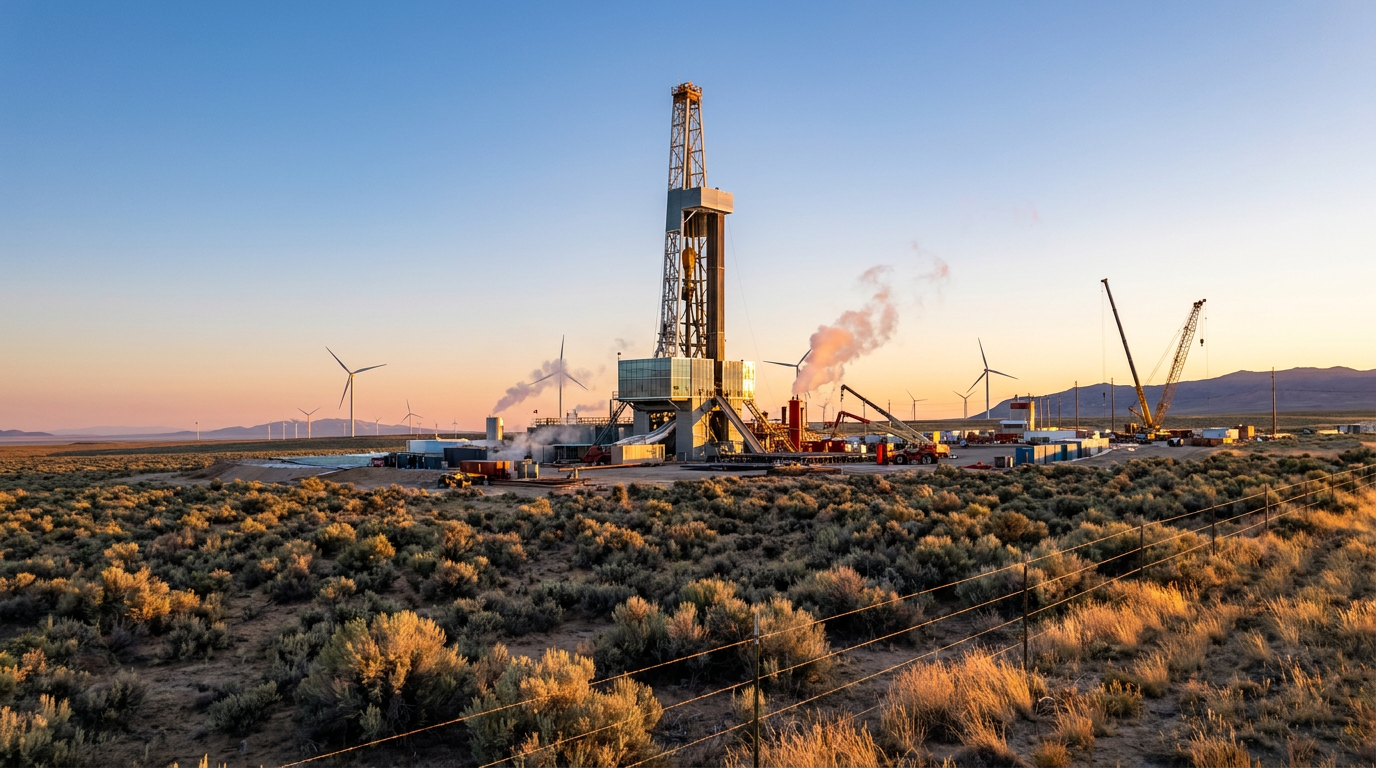
Ironically, the clean energy promise of EGS is being realized using the very tools that fueled the shale boom. Geothermal developers are aggressively adapting horizontal drilling and hydraulic fracturing techniques pioneered by the oil and gas industry over the last two decades.[5][6]
Ironically, the clean energy promise of EGS is being realized using the very tools that fueled the shale boom.
The results of this technology transfer have been staggering. Industry leaders like Houston-based Fervo Energy have slashed drilling costs by nearly half and reduced well completion times by 70 percent in just two years, proving that geothermal can follow a rapid cost-reduction curve.[5]

Fervo's flagship Cape Station project in Utah is currently the epicenter of this geothermal renaissance. Scheduled to begin delivering its first 100 megawatts of power to the grid in 2026, the facility is designed to eventually reach 500 megawatts—enough to power hundreds of thousands of homes.[2][6]
Operating at these extremes requires unprecedented monitoring. At Cape Station, researchers from the Lawrence Berkeley National Laboratory recently achieved a major scientific milestone by continuously monitoring microseismic activity nearly 7,000 feet underground for seven months.[2]
Using custom-built sensors, the Berkeley Lab team successfully tracked fracture formations in environments reaching 338 degrees Fahrenheit. This high-temperature telemetry is critical for understanding how artificial reservoirs behave over time and ensuring they can be scaled safely without triggering disruptive seismic events.[2]
The stakes for scaling this technology are immense. The U.S. Department of Energy estimates that EGS could cost-effectively expand the nation's geothermal capacity from a mere 4 gigawatts today to 90 gigawatts by 2050, fundamentally altering the composition of the American grid.[1][4]

Some industry projections are even more aggressive, suggesting that advanced geothermal could unlock up to 150 gigawatts of capacity in the American Southwest alone, transforming the region into a powerhouse of firm, zero-carbon electricity.[7]
This surge in potential supply is colliding with a historic spike in electricity demand. The rapid expansion of artificial intelligence data centers, industrial electrification, and domestic manufacturing has created an urgent appetite for stable power that EGS is uniquely positioned to fill.[5][6]
Despite the momentum, the industry still faces significant hurdles. EGS projects require massive upfront capital, and the process of hydraulic stimulation carries the risk of induced seismicity—micro-earthquakes that must be carefully managed to avoid surface disruptions and maintain public trust.[2][5]

Furthermore, while drilling costs are falling, EGS currently relies on clean energy mandates and federal subsidies to compete with cheap natural gas and legacy renewables. The true test will be achieving price parity in open energy markets.[5]
Yet, as the technology matures and the oil and gas workforce finds a lucrative pivot into the green economy, the trajectory is clear. Enhanced Geothermal Systems are no longer a distant theoretical hope; they are actively being drilled into reality, offering a foundational pillar for the 21st-century grid.[3][8]
How we got here
1960
The Geysers geothermal field in California begins generating electricity at scale, proving conventional geothermal viability.
2023
Fervo Energy's Cape Station begins serving as a hub for advanced geothermal research in Utah.
July 2025
Berkeley Lab deploys custom high-temperature seismometers 7,000 feet underground to monitor EGS fractures.
2026
The first commercial-scale EGS projects begin delivering continuous baseload power to the US grid.
Viewpoints in depth
Geothermal Developers & Industry
Focus on rapid commercialization and leveraging oil and gas techniques to unlock baseload clean energy.
For geothermal startups and their financial backers, EGS represents the ultimate pivot for the fossil fuel workforce. By repurposing horizontal drilling and hydraulic fracturing, developers argue they can rapidly scale clean, firm power to meet the surging demands of AI data centers. They point to dramatic reductions in drilling times as evidence that geothermal is following the same cost-curve collapse that made solar and wind ubiquitous over the last decade.
Energy Policy & Grid Analysts
Focus on geothermal's role in stabilizing the grid and ensuring national energy security.
Grid planners view EGS as the missing puzzle piece in the renewable transition. Because solar and wind are intermittent, grids currently rely on natural gas or expensive battery arrays to prevent blackouts. Analysts argue that a massive injection of geothermal baseload power—potentially up to 90 GW by 2050—would dramatically lower the overall cost of a zero-carbon grid while reducing reliance on imported critical minerals needed for grid-scale batteries.
Geoscientists & Environmental Monitors
Focus on the mechanics of subsurface heat extraction, safe fracture monitoring, and long-term reservoir viability.
While optimistic about the energy potential, researchers emphasize the need for rigorous, long-term monitoring of artificial reservoirs. The primary concern is induced seismicity—small earthquakes triggered by injecting high-pressure fluids into fault lines. Geoscientists advocate for continuous fiber-optic and seismic telemetry to map fracture networks safely, ensuring that rapid commercial deployment does not outpace subsurface safety protocols.
What we don't know
- Whether the aggressive cost-reduction curves seen in early EGS projects will hold true as the technology scales to different geological formations.
- How local communities and regulators will respond to the widespread use of hydraulic stimulation for clean energy.
Key terms
- Enhanced Geothermal Systems (EGS)
- A next-generation technology that creates artificial underground reservoirs to extract heat from dry rock that lacks natural fluid flow.
- Permeability
- The ability of a material, such as underground rock, to allow fluids to pass through its pores and fractures.
- Baseload Power
- The minimum amount of electric power needed to be supplied to the electrical grid at any given time, requiring energy sources that run continuously.
- Hydraulic Stimulation
- The process of injecting high-pressure fluid into underground rock to create or widen fractures, increasing permeability.
- Induced Seismicity
- Minor earthquakes and tremors that are caused by human activity that alters the stresses and strains on the Earth's crust.
Frequently asked
What is the difference between conventional and enhanced geothermal?
Conventional geothermal relies on naturally occurring underground reservoirs of hot water and permeable rock. Enhanced Geothermal Systems (EGS) create artificial reservoirs by injecting fluid into hot, dry rock to engineer permeability.
Does enhanced geothermal use fracking?
Yes, EGS utilizes hydraulic stimulation—a technique adapted from the oil and gas industry's fracking process—to create or open fractures in deep underground rock.
Can EGS cause earthquakes?
The process of hydraulic stimulation can cause induced seismicity, or micro-earthquakes. These are typically of very low magnitude and rarely felt at the surface, but require continuous monitoring to ensure safety.
Why is geothermal energy suddenly growing now?
A combination of technological breakthroughs in horizontal drilling, a surge in electricity demand from AI data centers, and the need for 24/7 carbon-free power to complement solar and wind has driven rapid investment in EGS.
Sources
Source coverage
8 outlets
3 viewpoints surfaced








[1]U.S. Department of EnergyEnergy Policy & Grid Analysts
Geothermal Power Generation Technologies
Read on U.S. Department of Energy →[2]Lawrence Berkeley National LaboratoryGeoscientists & Researchers
Custom sensor monitors seismicity for months straight more than a mile below ground
Read on Lawrence Berkeley National Laboratory →[3]Massachusetts Institute of TechnologyGeoscientists & Researchers
Geothermal energy at MIT
Read on Massachusetts Institute of Technology →[4]World Resources InstituteEnergy Policy & Grid Analysts
The Promise of Next-Generation Geothermal
Read on World Resources Institute →[5]Information Technology and Innovation FoundationEnergy Policy & Grid Analysts
Accelerating the Rollout of Advanced Geothermal Technologies
Read on Information Technology and Innovation Foundation →[6]CarbonCreditsGeothermal Developers & Industry
Fervo Energy Targets $1.33B IPO as Geothermal Demand Heats Up
Read on CarbonCredits →[7]Switchgear MagazineGeothermal Developers & Industry
Enhanced geothermal systems may unlock up to 150 GW of reliable clean energy
Read on Switchgear Magazine →[8]Factlen Editorial TeamEnergy Policy & Grid Analysts
Synthesis by Factlen editorial team
Read on Factlen Editorial Team →
More in guides
See all 6 stories →Vehicle Buying Guide
EV vs. PHEV vs. Hybrid: The 2026 Electrified Vehicle Guide
6 sources

AI Productivity
Comparing the Top Premium AI Assistants of 2026: ChatGPT Plus, Claude Pro, and Gemini Advanced
7 sources

Local AI
How to Run AI Locally in 2026: The Complete Guide to Offline Models
10 sources

Local AI
A Complete Guide to Running Local AI Models on Your Hardware in 2026
7 sources

Every angle. Every day.
Get guides stories with full source coverage and perspective breakdowns delivered to your inbox.