
The Evidence for Agrivoltaics: How Dual-Use Solar is Reshaping Agriculture
Peer-reviewed data shows that co-locating solar panels and crops can reduce agricultural water use by up to 31% while generating dual revenue streams, though high upfront costs and crop-specific yield variations remain hurdles.
By Factlen Editorial Team
- Agronomists & Crop Scientists
- Focus on the microclimatic benefits, water retention, and the necessity of matching specific shade-tolerant crops to panel designs.
- Renewable Energy Developers
- View agrivoltaics as a critical strategy to overcome local land-use opposition and secure acreage for utility-scale solar expansion.
- Agricultural Economists
- Emphasize the financial stabilization dual-use systems provide to farmers through diversified, weather-independent revenue streams.
- Skeptics & Traditionalists
- Highlight the high upfront capital costs, the operational hurdles for heavy machinery, and the yield penalties for staple commodity crops.
What's not represented
- · Local zoning boards managing rural land-use permits
- · Utility companies integrating decentralized rural power
Why this matters
As the transition to renewable energy accelerates, agrivoltaics offers a rare win-win solution to the escalating conflict over rural land use. By allowing farmers to generate clean electricity without sacrificing food production, it provides a blueprint for stabilizing agricultural economies while meeting global climate goals.
Key points
- Agrivoltaics integrates solar panels and agriculture on the same land, increasing overall land-use efficiency by up to 73%.
- The partial shade from solar panels reduces soil evaporation, cutting crop water requirements by 14% to 31%.
- Shade-tolerant crops like tomatoes and lettuce see yield increases, while sun-loving staples like wheat experience slight declines.
- Dual-use systems provide farmers with a stable secondary income stream, hedging against agricultural market volatility.
- Elevating solar panels to accommodate farm machinery adds a 10% to 20% premium to initial construction costs.
As the global transition to renewable energy accelerates, a fundamental land-use conflict has emerged: the flat, sun-drenched acreage ideal for utility-scale solar farms is often the same land required for agriculture. By 2050, the National Renewable Energy Laboratory projects that solar installations could require up to 10 million acres of U.S. land.[5][7]
In response, a hybrid approach known as agrivoltaics—the co-location of solar photovoltaic panels and active agricultural production on the same parcel—has moved from experimental pilot projects to commercial deployment.[3][6]
This evidence pack evaluates the peer-reviewed data and economic modeling behind agrivoltaics, assessing its impact on crop yields, water retention, farm economics, and the policy mechanisms driving its adoption.[2][7]
The primary metric for evaluating dual-use systems is the Land Equivalent Ratio (LER), which measures the productivity of a combined system against separate plots. The evidence strongly supports the claim that agrivoltaics significantly improves overall land-use efficiency.[2]
A systematic review of 160 peer-reviewed studies published in MDPI Agronomy found that agrivoltaic systems consistently achieve an LER between 1.35 and 1.73. In practical terms, this means a 100-acre agrivoltaic farm can produce the same combined energy and food output that would require 135 to 173 acres if the operations were separated.[2][6]
The efficiency gains are driven by a symbiotic relationship. The crops benefit from the partial shade provided by the panels, while the panels benefit from the crops. As plants release moisture through transpiration, they cool the surrounding air, which can lower the operating temperature of the solar panels above them and marginally increase their photovoltaic efficiency.[1][4]

One of the most robust findings across the literature is the microclimatic benefit of structured shade, particularly in arid and semi-arid regions. Shading reduces water demand and protects against extreme heat.[1][3]
Research published in Frontiers in Sustainable Food Systems demonstrates that the shade from solar arrays reduces both soil temperature and direct solar radiation. This moderates the microclimate, leading to a documented 14% to 31% reduction in evapotranspiration—the process by which water is transferred from the land to the atmosphere by evaporation from the soil and transpiration from plants.[1][6]
For farmers in drought-prone areas, this translates to a substantial reduction in irrigation requirements. A multi-year study in southern France found that agrivoltaic systems reduced irrigation inputs for maize by 19% to 47% compared to open-field controls.[1]
For farmers in drought-prone areas, this translates to a substantial reduction in irrigation requirements.
While the water savings are consistent, the impact on actual crop yields is the most variable factor in agrivoltaic systems, heavily dependent on the shade tolerance of the specific plant. Crop yield impacts are highly species-specific.[1][2]
Shade-tolerant crops often thrive. Trials conducted by the University of Arizona found that tomato production doubled and chiltepin pepper yields tripled under solar panels compared to unshaded controls, as the plants were protected from peak midday heat stress. Leafy greens like lettuce and celery, as well as root vegetables like potatoes, also show yield increases or maintain parity with open-field farming.[4][6]

However, the evidence shows clear limitations for staple commodity crops. Sun-loving crops like wheat, corn, and certain legumes generally experience yield penalties ranging from 5% to 20% under partial shade. This forces farmers to carefully match their crop selection to the specific light transmission rate of their solar array.[1][2]
From a financial perspective, dual-use systems transform farm economics, despite higher initial costs. Agrivoltaics offers a hedge against the inherent volatility of agricultural markets by introducing a fixed, long-term revenue stream from electricity generation.[5][6]
The Institute for Energy Economics and Financial Analysis notes that leasing land for solar can yield $500 to $2,000 per acre annually. When farmers own the array, the electricity generated can offset their own high operational costs—such as irrigation pumping and refrigeration—or be sold back to the grid.[5][6]

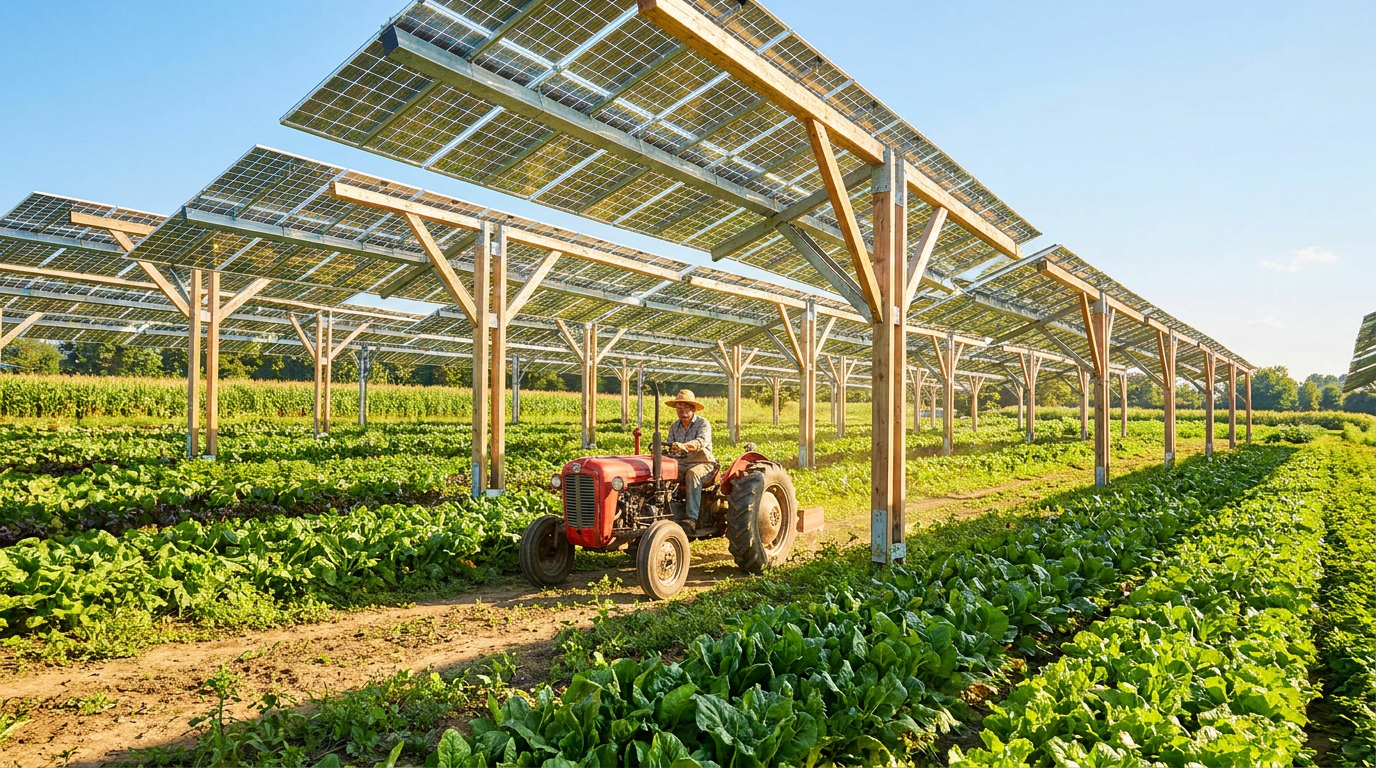
The primary economic barrier is the upfront capital expenditure. Elevating solar panels 10 to 14 feet off the ground to allow standard agricultural machinery to pass underneath requires heavier steel mounting structures and deeper foundations. Industry data indicates this structural requirement adds a 10% to 20% premium to the initial installation cost compared to traditional ground-mounted solar.[6]
To bridge this capital expenditure gap, federal and state policies are accelerating deployment. Policymakers are increasingly deploying targeted financial incentives to make dual-use systems viable for smaller operators.[3][5]
The U.S. Inflation Reduction Act includes provisions that benefit dual-use renewable projects, while the USDA's Rural Energy for America Program provides grants and guaranteed loans to agricultural producers installing renewable energy systems. At the state level, Colorado, Massachusetts, and New Jersey have introduced specific agrivoltaic grant programs and expedited permitting pathways to encourage adoption.[3][7]

Despite the rapid commercialization—growing to an estimated 10 gigawatts of capacity in the U.S. by 2024—significant research gaps remain where the evidence is still weak.[1][5]
The long-term impacts of altered microclimates on soil microbiology and localized biodiversity are not yet fully understood. Furthermore, there is no standardized, integrated modeling software that can accurately predict the complex, three-way interactions between energy generation, water dynamics, and crop yields for a specific geographic site before construction begins.[1][2]
Ultimately, the peer-reviewed consensus suggests that while agrivoltaics is not a universal replacement for traditional farming, it is a highly effective, evidence-backed tool for specific agricultural contexts. By turning a land-use conflict into a symbiotic system, it offers a viable pathway to scale renewable energy without sacrificing food security.[2][5][7]
How we got here
1982
The concept of co-locating solar panels and agriculture is first formally proposed by researchers Adolf Goetzberger and Armin Zastrow.
2011
Early experimental prototypes in France demonstrate significant reductions in water usage for crops grown beneath solar panels.
2019
The University of Arizona publishes landmark research showing that shade-tolerant crops like tomatoes can double their yield under agrivoltaic conditions.
2022
The U.S. Inflation Reduction Act passes, earmarking billions in funding that indirectly supports dual-use renewable energy projects.
2024
Global installed agrivoltaic capacity surpasses 14 gigawatts, transitioning the technology from experimental pilots to commercial scale.
Viewpoints in depth
Agronomists & Crop Scientists
Focus on the microclimatic benefits and the necessity of matching specific shade-tolerant crops to panel designs.
For agricultural researchers, the primary value of agrivoltaics lies in its ability to manipulate the microclimate. By reducing direct solar radiation, the panels lower soil temperatures and drastically cut evapotranspiration, which is critical for farming in increasingly arid regions. However, agronomists caution that this is not a one-size-fits-all solution; the system requires precise crop matching. While leafy greens and certain nightshades thrive in partial shade, staple crops like wheat and corn suffer yield penalties, meaning agrivoltaics fundamentally alters what a specific parcel of land can profitably grow.
Renewable Energy Developers
View agrivoltaics as a critical strategy to overcome local land-use opposition and secure acreage for utility-scale solar expansion.
The solar industry faces a looming land-acquisition bottleneck. As developers push into rural areas, they frequently encounter fierce local opposition to converting productive farmland into industrial solar facilities. Developers view agrivoltaics as the key to unlocking this acreage. By allowing the land to remain agriculturally active, developers can bypass zoning disputes, secure community buy-in, and access state-level dual-use incentives. The slight increase in photovoltaic efficiency from plant transpiration cooling the panels is viewed as an added operational bonus.
Agricultural Economists
Emphasize the financial stabilization dual-use systems provide to farmers through diversified revenue streams.
Economists analyze agrivoltaics as a risk-mitigation tool for rural communities. Traditional farming is highly vulnerable to weather extremes, commodity price fluctuations, and rising input costs. Integrating a solar array introduces a fixed, predictable revenue stream—either through land lease payments or direct electricity sales—that acts as a financial anchor. While economists acknowledge the 10% to 20% premium in initial capital expenditures required to elevate the panels, they argue that the long-term stabilization of farm income justifies the investment, particularly when supported by federal grants.
What we don't know
- The long-term impacts of altered microclimates on soil microbiology and localized biodiversity over decades.
- How to accurately model the complex, three-way interactions between energy generation, water dynamics, and crop yields for specific micro-regions before construction.
- Whether the current premium on structural capital expenditures will decrease as agrivoltaic mounting systems achieve mass-market scale.
Key terms
- Agrivoltaics
- The simultaneous use of areas of land for both solar photovoltaic power generation and agriculture.
- Land Equivalent Ratio (LER)
- A metric used to assess the productivity of a dual-use system, comparing the yield of growing crops and generating solar power on the same land versus doing so on separate plots.
- Evapotranspiration
- The process by which water is transferred from the land to the atmosphere by evaporation from the soil and by transpiration from plants.
- Microclimate
- The climate of a very small or restricted area, which in agrivoltaics is altered by the shade and physical presence of the solar panels.
- Solar Grazing
- A specific type of agrivoltaics where livestock, most commonly sheep, are allowed to graze on the vegetation growing underneath and around solar panels.
Frequently asked
Can standard tractors still be used on an agrivoltaic farm?
Yes, but the solar panels must be elevated higher than standard ground-mounted arrays—typically 10 to 14 feet—and spaced wider apart to accommodate the machinery.
Does growing crops under solar panels save water?
Yes. The shade from the panels reduces soil temperature and evaporation, cutting crop water requirements by 14% to 31% depending on the region and crop.
Do crops grow as well in the shade of solar panels?
It depends entirely on the crop. Shade-tolerant plants like tomatoes, lettuce, and celery often see yield increases, while sun-loving staple crops like wheat and corn typically experience yield reductions.
How much more does an agrivoltaic system cost to build?
Elevating the panels and reinforcing the mounting structures to allow for farming underneath typically adds a 10% to 20% premium to the initial installation cost compared to traditional solar farms.
Sources
Source coverage
7 outlets
4 viewpoints surfaced







[1]Frontiers in Sustainable Food SystemsAgronomists & Crop Scientists
Agrivoltaics: A systematic review of microclimatic shifts and crop performance
Read on Frontiers in Sustainable Food Systems →[2]MDPIAgronomists & Crop Scientists
Global Systematic Review of Agrivoltaic Technologies: Crop Suitability and Modeling
Read on MDPI →[3]U.S. Department of Energy
Agrivoltaics: Solar and Agriculture Co-Location
Read on U.S. Department of Energy →[4]U.S. Department of AgricultureAgricultural Economists
Agrivoltaics in the Northwest
Read on U.S. Department of Agriculture →[5]Institute for Energy Economics and Financial AnalysisAgricultural Economists
Agrivoltaics can align renewable energy and agriculture
Read on Institute for Energy Economics and Financial Analysis →[6]Energy Solutions IntelligenceRenewable Energy Developers
Agrivoltaics 2026: Farming & Solar Dual Income
Read on Energy Solutions Intelligence →[7]Factlen Editorial TeamSkeptics & Traditionalists
Synthesis by Factlen editorial team
Read on Factlen Editorial Team →
Every angle. Every day.
Get energy stories with full source coverage and perspective breakdowns delivered to your inbox.