
Israel Limits Lebanon Actions to Salvage US-Iran Deal, but Refuses to Withdraw
Israel has ordered a tactical pause on offensive operations in Lebanon to protect a fragile regional peace deal, though defense officials insist troops will remain in their established security zone.
By Factlen Editorial Team
- Israeli Security Establishment
- Argues that troops must remain in the buffer zone to protect northern communities and retain the right to self-defense.
- Iranian & Lebanese Leadership
- Demands a complete Israeli withdrawal from Lebanese territory as a precondition for regional stability.
- International Mediators
- Prioritizes salvaging the fragile US-Iran memorandum of understanding by containing the Lebanon border clashes.
What's not represented
- · Lebanese civilians displaced by the ongoing border conflict and occupation.
- · Global shipping companies affected by the closure of the Strait of Hormuz.
Why this matters
The fragile holding pattern on the Israel-Lebanon border is the linchpin for a historic peace deal between the United States and Iran. If the localized ceasefire collapses, it threatens to reignite a region-wide conflict, disrupt global oil markets via the Strait of Hormuz, and derail international nuclear negotiations.
Key points
- Israel ordered a tactical pause on offensive operations in Lebanon to salvage a broader US-Iran peace deal.
- Defense Minister Israel Katz clarified that troops will not withdraw from the 10-kilometer security buffer zone.
- The pause followed a violent weekend where Hezbollah rocket fire and Israeli retaliatory strikes killed dozens.
- Iran temporarily closed the Strait of Hormuz and delayed nuclear talks in response to the Israeli strikes.
- International mediators are working to enforce the localized ceasefire to protect the overarching regional agreement.
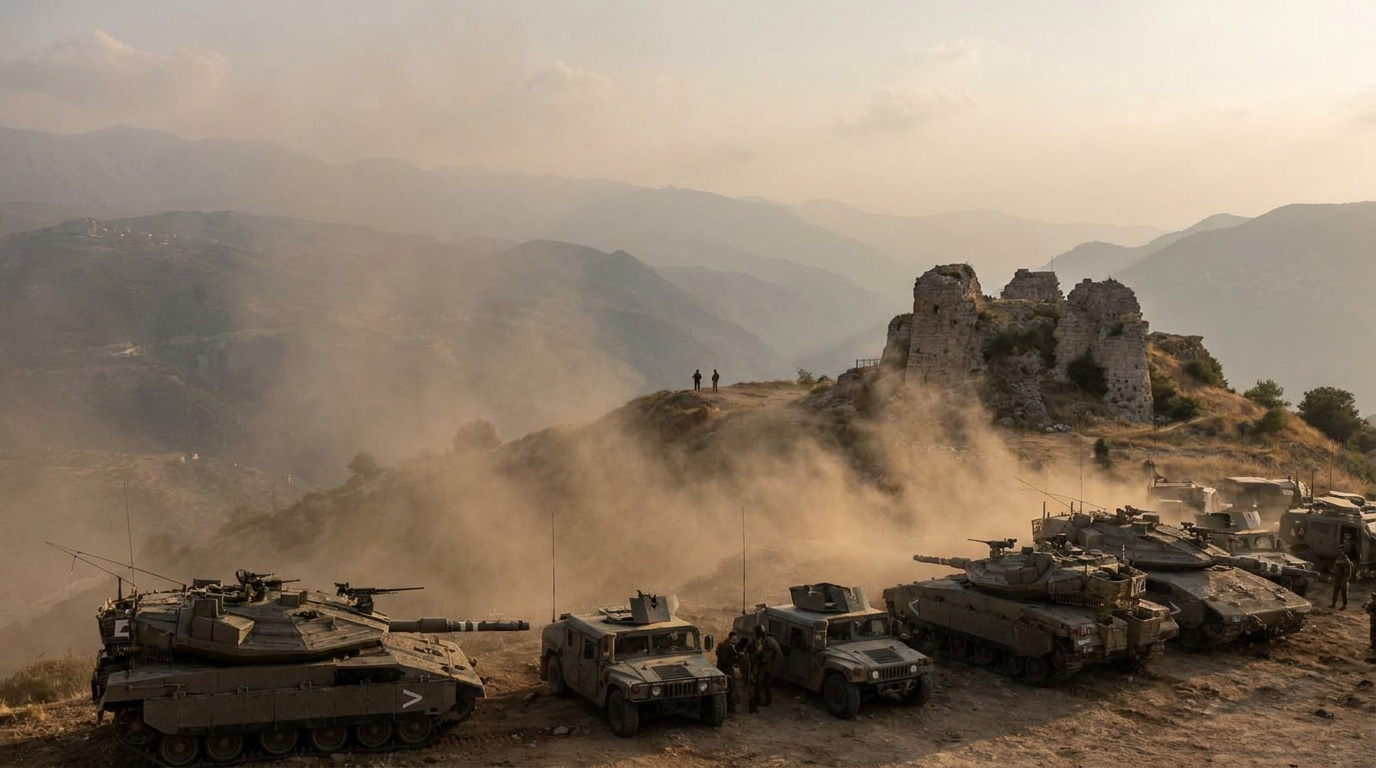
Israel has directed its military to temporarily limit offensive operations in southern Lebanon to salvage a fragile, US-brokered regional ceasefire, even as Israeli officials insist troops will not withdraw from their established security zone.[1]
The tactical pause, ordered by Prime Minister Benjamin Netanyahu and Defense Minister Israel Katz over the weekend, followed a dangerous flare-up that threatened to derail a landmark memorandum of understanding between the United States and Iran.[2][4]
The crisis began late Friday, just hours after a renewed truce took effect. Hezbollah launched over 50 projectiles at Israeli positions in southern Lebanon, killing one Israel Defense Forces (IDF) soldier and injuring over a dozen more.[2]
In response, Israeli warplanes and artillery struck more than 80 targets across southern Lebanon and the Bekaa Valley. Lebanese health officials reported that the retaliatory strikes killed at least 47 people and wounded nearly 100 others.[4][5]

The sudden escalation immediately reverberated across the region. In a pressure tactic aimed at Washington, Iranian officials abruptly closed the Strait of Hormuz to commercial shipping and postponed planned nuclear negotiations in Switzerland.[2][4]
The sudden escalation immediately reverberated across the region.
Facing the collapse of the broader Middle East diplomatic framework, Netanyahu and Katz ordered the IDF to hold its fire on Saturday. The directive aimed to de-escalate the immediate border crisis and allow US, Qatari, and Iranian mediators to rescue the overarching peace deal.[1][2]
However, the Israeli government faces intense domestic pressure not to concede ground. Far-right National Security Minister Itamar Ben Gvir publicly demanded a crushing military response, declaring that "all of Lebanon must burn" to ensure Israeli security.[3]
Navigating this political tightrope, Defense Minister Katz issued a clarifying statement on Sunday. He emphasized that while offensive sweeps are paused, IDF soldiers have "no restrictions" on eliminating immediate, tactical threats they encounter on the ground.[3]

Katz further drew a hard line on Israel's territorial posture, declaring that the military will not withdraw from the roughly 10-kilometer (six-mile) security buffer zone it currently occupies in southern Lebanon.[3][6]
This stance directly collides with the demands of Hezbollah and Tehran. Iranian officials have repeatedly argued that the US-Iran memorandum of understanding requires a "complete ceasefire," which they interpret as a full Israeli withdrawal from Lebanese territory.[5][6]
Lebanese President Joseph Aoun echoed this sentiment in a weekend call with US Secretary of State Marco Rubio, insisting that a comprehensive halt to hostilities and the restoration of Lebanon's territorial sovereignty are fundamental prerequisites for advancing peace talks.[7]

For now, the border remains in a tense, unofficial holding pattern. US Vice President JD Vance and other international diplomats are scrambling to reschedule the postponed Swiss talks, hoping the localized pause in Lebanon holds long enough to secure a permanent regional settlement.[4]
How we got here
June 14-15
The US and Iran sign a memorandum of understanding aimed at ending regional hostilities.
June 19
A renewed ceasefire between Israel and Hezbollah takes effect, but is quickly broken by a Hezbollah rocket barrage.
June 20
Israel launches retaliatory strikes; Iran closes the Strait of Hormuz, prompting Israel to order a tactical hold on fire.
June 21
Israel's Defense Minister clarifies that troops will not withdraw from the Lebanese security zone.
Viewpoints in depth
Israeli Security Establishment
Argues that maintaining a physical buffer zone in Lebanon is non-negotiable for protecting northern Israeli communities.
Israeli defense officials, including Defense Minister Israel Katz, maintain that the IDF must retain the operational freedom to neutralize immediate threats, regardless of broader diplomatic agreements. They view the 10-kilometer security zone as a necessary shield against Hezbollah incursions and rocket fire, arguing that withdrawing forces would simply invite a repeat of past attacks. For the Israeli right wing, any concession in Lebanon is seen as a capitulation to Iranian pressure.
Iranian & Lebanese Leadership
Demands a complete Israeli withdrawal from Lebanese territory as a prerequisite for regional peace.
Tehran and Beirut interpret the US-brokered ceasefire framework as requiring an immediate and total halt to Israeli military operations and a full withdrawal from Lebanese soil. Hezbollah justifies its continued rocket fire as legitimate resistance against an occupying force. Iranian officials have explicitly linked the Lebanon theater to their broader negotiations with Washington, using their control over the Strait of Hormuz as leverage to force an Israeli retreat.
International Mediators
Focuses on containing the Lebanon border clashes to salvage the historic US-Iran memorandum of understanding.
Diplomats from the United States, Qatar, and the United Nations view the Israel-Hezbollah skirmishes as a dangerous spoiler that could unravel months of delicate regional negotiations. Their primary objective is to enforce a localized pause in fighting, preventing a cycle of retaliation that could collapse the broader US-Iran nuclear and trade agreements. Mediators are pressuring both sides to accept a holding pattern while technical talks proceed in Switzerland.
What we don't know
- Whether Hezbollah will accept the continued presence of Israeli troops in the 10-kilometer buffer zone.
- When the postponed US-Iran nuclear negotiations in Switzerland will officially resume.
- If the Israeli government can withstand domestic political pressure demanding a harsher military response.
Key terms
- Strait of Hormuz
- A crucial maritime chokepoint between the Persian Gulf and the Gulf of Oman, through which a significant portion of the world's oil supply passes.
- Security Buffer Zone
- A roughly 10-kilometer strip of territory in southern Lebanon currently occupied by Israeli forces to prevent cross-border attacks.
- Memorandum of Understanding (MoU)
- The preliminary diplomatic agreement between the US and Iran intended to de-escalate conflicts across the Middle East.
Frequently asked
Why did Israel pause its offensive operations in Lebanon?
Prime Minister Benjamin Netanyahu ordered a temporary halt to fire to prevent the collapse of a broader US-Iran peace deal, after Iran closed the Strait of Hormuz in response to Israeli strikes.
Is the Israeli military withdrawing from Lebanon?
No. Defense Minister Israel Katz stated that troops will remain in the 10-kilometer security buffer zone and retain the authority to eliminate immediate threats.
How does this affect the US-Iran peace talks?
The border clashes caused Iran to temporarily postpone planned nuclear negotiations in Switzerland, forcing international mediators to scramble to salvage the diplomatic framework.
Sources
Source coverage
7 outlets
3 viewpoints surfaced







[1]The New York TimesInternational Mediators
Israel directs its military to limit its actions in Lebanon, though tensions persist.
Read on The New York Times →[2]The Jerusalem PostIsraeli Security Establishment
Hezbollah launches over 50 projectiles at IDF; Netanyahu orders forces to hold fire
Read on The Jerusalem Post →[3]The Times of IsraelIsraeli Security Establishment
Katz: IDF troops operating in southern Lebanon have 'no restrictions' to remove threats
Read on The Times of Israel →[4]The Washington PostInternational Mediators
Clashes in Lebanon seemed to imperil the U.S.-Iran peace deal
Read on The Washington Post →[5]Associated PressInternational Mediators
Continued fighting in Lebanon could unravel the newly signed deal
Read on Associated Press →[6]Al JazeeraIranian & Lebanese Leadership
Netanyahu vows to continue Israel's occupations of Lebanese and Syrian territory
Read on Al Jazeera →[7]The GuardianInternational Mediators
Israel and Hezbollah agree to renew their ceasefire
Read on The Guardian →
More in news politics
See all 5 stories →Future of Work
The evidence is in: The four-day workweek boosts well-being without breaking the economy
7 sources

Information Ecosystem
The Evidence Behind Bridging Algorithms: How Decentralized Fact-Checking is Actually Working
7 sources

US-Iran Deal
How the Fragile US-Iran Peace Deal Could Unravel Over Lebanon
8 sources
Every angle. Every day.
Get news politics stories with full source coverage and perspective breakdowns delivered to your inbox.