
How Trackless Trams Are Bridging the Gap Between Buses and Light Rail
Autonomous Rapid Transit (ART) promises the capacity and smooth ride of a light rail at a fraction of the cost, but critics argue the technology's hidden infrastructure requirements complicate its global rollout.
By Factlen Editorial Team
- Urban Planners & Proponents
- Argue that trackless trams offer a revolutionary, cost-effective way to spur transit-oriented development without the disruption of laying steel rails.
- Transit Skeptics
- View the technology as an over-marketed 'gadgetbahn' that causes severe road damage and inflates its capacity metrics.
- Municipal Governments
- Focus on adapting the technology to real-world constraints, such as elevating the routes to avoid street-level traffic congestion.
- Editorial Synthesis
- Provides a balanced overview of the technology's promises and its hidden infrastructure costs.
What's not represented
- · Local residents living along proposed ART corridors
- · Traditional bus drivers facing potential automation
Why this matters
As cities struggle with crippling traffic and underfunded public transit, trackless trams offer a potential middle-ground solution that could drastically reduce commute times and carbon emissions. Understanding this technology helps taxpayers evaluate whether their local governments are investing in a genuine transit revolution or just a brilliantly marketed bus.
Key points
- Trackless trams use optical sensors and lidar to follow painted lines on city streets.
- They promise the ride quality of a light rail at a fraction of the installation cost.
- Critics argue the heavy vehicles cause severe road rutting, requiring expensive concrete reinforcements.
- Despite the 'autonomous' branding, the vehicles currently require human drivers.
- Malaysia is adapting the technology into an elevated system to bypass street-level traffic.
Cities worldwide face a persistent transit dilemma: buses are cheap but often unpopular and slow, while light rail and subways are highly efficient but prohibitively expensive. In the United States, only a tiny fraction of commuters use mass rapid transit, largely because building a new subway line can cost billions of dollars and take decades. To bridge this gap, urban planners are increasingly looking toward a "mid-tier" solution that promises the best of both worlds. Enter the trackless tram, a hybrid technology designed to deliver the capacity and smooth ride of a train without the staggering infrastructure costs.[4][7]
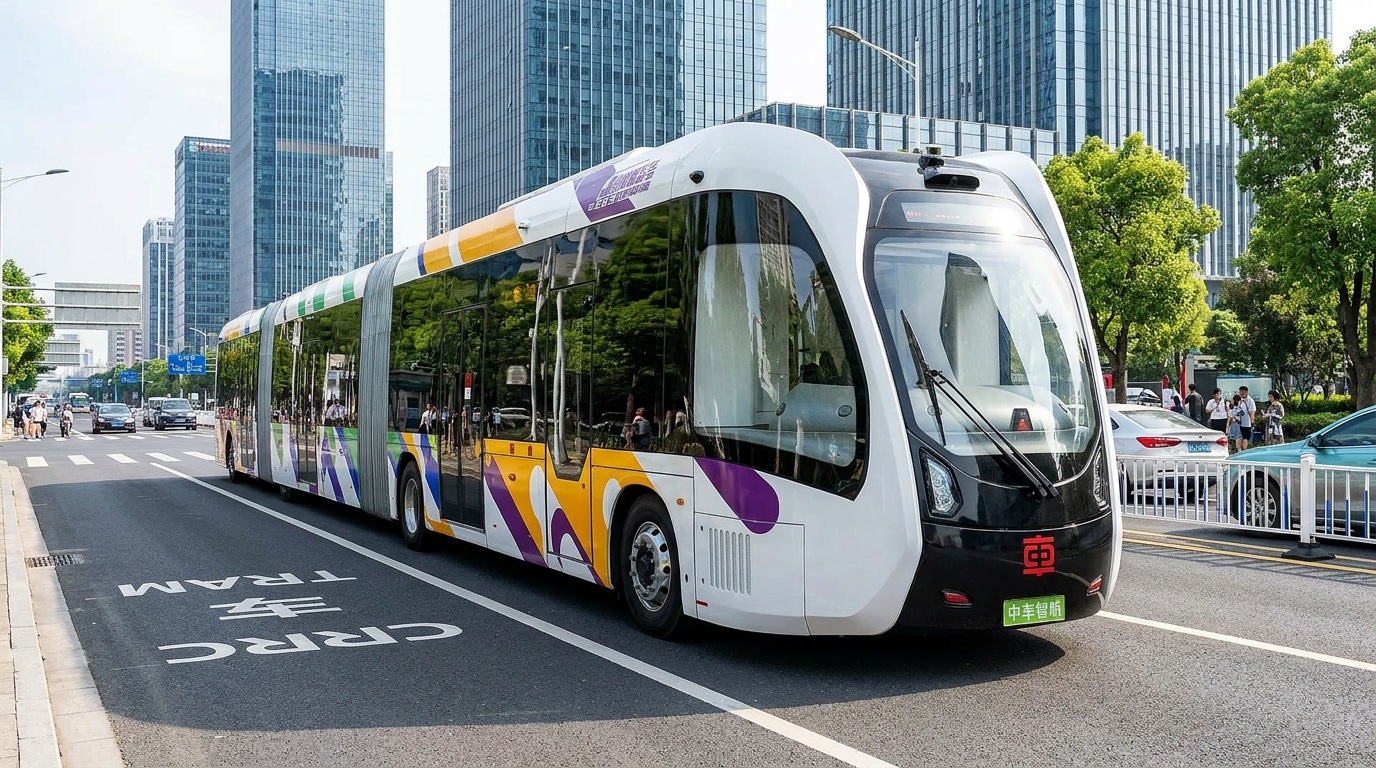
Formally known as Autonomous Rapid Transit (ART), the trackless tram is essentially a multi-articulated electric bus that mimics the behavior of a light rail vehicle. Instead of running on steel tracks embedded in the street, ART vehicles run on rubber tires and follow painted lines on the road using a sophisticated array of optical sensors, lidar, and GPS. The technology was first unveiled in 2017 by CRRC, a major Chinese state-owned rolling stock manufacturer, and entered commercial service in the city of Zhuzhou the following year.[1][2][7]
The primary appeal of the trackless tram lies in its dramatic cost savings. Traditional light rail transit (LRT) requires tearing up city streets to lay steel tracks and install overhead electrical wires, a disruptive process that can cost anywhere from $50 million to over $130 million per kilometer. In contrast, proponents estimate that a trackless tram system can be installed for as little as $10 million per kilometer. Because the vehicles operate on existing roadways and use roof-mounted batteries that fast-charge at stations, cities can bypass years of agonizing construction.[2][3][4]
Beyond the balance sheet, ART aims to solve the comfort issues that plague traditional bus networks. CRRC adapted stabilization technology originally developed for high-speed rail to control the sway and swerve of the rubber-tired vehicles. Active suspension systems and multi-axle steering allow the long, multi-carriage trams to make tight turns along narrow urban corridors while providing a ride quality that feels distinctly like a train. A standard three-carriage ART vehicle stretches over 30 meters long, can travel at speeds up to 70 kilometers per hour, and is designed to carry up to 300 passengers.[1][2][3][4]

This combination of low cost and high quality has made trackless trams a focal point for urban regeneration strategies. Transit-oriented development (TOD) relies on the permanence of a transit line to attract private investment; developers are historically hesitant to build dense housing or retail around a bus route because a bus line can be moved overnight. Trackless trams, with their dedicated lanes and substantial station infrastructure, project the same permanence as a light rail, theoretically unlocking the same economic uplift for surrounding neighborhoods.[3][4][7]
The technology's promise has sparked global interest far beyond China. Trackless tram projects and feasibility studies have been launched in cities across Australia, the United Arab Emirates, Malaysia, and Pakistan. In Perth, Australia, local governments have aggressively studied the technology as a way to connect suburbs to the broader rail network without bankrupting municipal budgets.[1][3][4]
The technology's promise has sparked global interest far beyond China.
However, as the technology moves from controlled demonstrations to global deployment, a vocal contingent of transit skeptics has emerged. Critics argue that the term "trackless tram" is a marketing masterclass designed to obscure a simple reality: it is, fundamentally, a very long bus. By rebranding an optically guided bus as a "tram," manufacturers have successfully bypassed the stigma associated with bus travel, but skeptics warn that cities may be buying into a "gadgetbahn"—a proprietary, over-engineered solution to a problem that standard Bus Rapid Transit (BRT) already solves.[1][6]
The most significant hidden cost of the trackless tram lies in the very roads it drives on. A fully loaded three-carriage ART vehicle weighs approximately 51 tonnes. Because the optical guidance system forces the vehicle's rubber tires to travel over the exact same millimeter of asphalt on every single trip, the concentrated weight can cause severe rutting and erosion of standard roadways.[3][6][7]

This phenomenon is not entirely unprecedented. Older guided bus systems in Europe experienced similar roadway degradation, forcing municipalities to undertake expensive repairs. To prevent trackless trams from destroying city streets, transit authorities often must excavate the route and install heavily reinforced concrete roadbeds. Once the cost of this specialized road reconstruction is factored in, the financial advantage over traditional light rail begins to narrow significantly.[6][7]
The "autonomous" branding of the ART system has also faced real-world friction. While the vehicles are equipped with advanced sensors and can technically follow a painted line without steering input, they still require human operators for safety and complex traffic navigation. In 2024, Indonesia tested an ART system in its future capital city, Nusantara, but ultimately halted the project and returned the vehicles to China after determining they could not operate with the promised level of autonomy.[1][6]
Capacity claims have also been scrutinized. While manufacturers advertise that a three-carriage vehicle can hold over 300 passengers, transit authorities in countries like New Zealand have pointed out that this figure assumes a density of eight people per square meter—a crowding standard typical of a Chinese rush hour but rarely accepted in Western transit systems. When recalculated using a more comfortable standard of four passengers per square meter, the capacity drops closer to 170, which is only marginally higher than a standard articulated bus.[6]

Despite these hurdles, cities are finding creative ways to adapt the technology to their specific needs. In Malaysia, the state of Johor initially planned a ground-level ART system to alleviate severe traffic bottlenecks. However, after traffic impact assessments revealed that dedicating existing road lanes to the trams would only worsen street-level congestion, the government pivoted.[5]
In May 2026, the Malaysian federal government approved a restructured Elevated Autonomous Rapid Transit (E-ART) system for Johor. By placing the rubber-tired trackless trams on a dedicated elevated viaduct, the city aims to achieve the grade-separated efficiency of a monorail or subway, but at a lower cost and with lighter infrastructure requirements than a traditional heavy rail viaduct.[5]
The evolution of the trackless tram highlights the broader growing pains of mid-tier transit. As cities desperately seek alternatives to the binary choice between cheap buses and exorbitant subways, hybrid technologies will inevitably face intense scrutiny. Whether ART is viewed as a revolutionary leap in urban mobility or simply a brilliantly marketed bus, it has undeniably forced urban planners to rethink what is possible in the space between the sidewalk and the steel rail.[2][4][7]
How we got here
2017
CRRC unveils the first Autonomous Rapid Transit (ART) vehicle.
2018
The first commercial ART line begins operations in Zhuzhou, China.
2021
The first ART vehicle arrives in Malaysia for regional testing.
2024
Indonesia halts an ART trial in its new capital, Nusantara, over autonomy issues.
May 2026
Malaysia approves an Elevated ART (E-ART) system for Johor to bypass street-level congestion.
Viewpoints in depth
Urban Planners & Proponents
Advocates see trackless trams as a financial lifeline for mid-sized cities.
For proponents, the trackless tram is a necessary evolution in urban mobility. By eliminating the need to excavate streets for steel rails and overhead wires, cities can deploy high-capacity transit in a fraction of the time and at a fraction of the cost. Furthermore, the substantial station infrastructure and dedicated lanes project a sense of permanence that traditional bus routes lack, which is crucial for attracting private investment and spurring Transit-Oriented Development (TOD).
Transit Skeptics
Critics argue the technology is a proprietary marketing gimmick with hidden costs.
Skeptics view the 'trackless tram' label as a clever rebranding of an optically guided bus. They point out that the concentrated weight of the 51-tonne vehicles running over the exact same path inevitably destroys standard asphalt, forcing cities to install heavily reinforced concrete roadbeds. Once these hidden infrastructure costs are factored in, critics argue that the financial advantage over traditional light rail evaporates, leaving cities locked into a proprietary 'gadgetbahn' ecosystem.
Municipal Adapters
Local governments are modifying the technology to fit real-world urban constraints.
Rather than accepting the technology exactly as designed, some municipalities are adapting it to solve local bottlenecks. In Johor, Malaysia, traffic impact assessments revealed that dedicating existing street lanes to trackless trams would paralyze local traffic. In response, the government pivoted to an Elevated Autonomous Rapid Transit (E-ART) system, placing the rubber-tired vehicles on a dedicated viaduct to achieve the efficiency of a monorail without the heavy infrastructure costs of a traditional train.
What we don't know
- Whether the long-term maintenance costs of reinforced concrete roadbeds will ultimately erase the initial savings over light rail.
- How quickly the technology can achieve true Level 4 or Level 5 autonomy without human operators.
- If Western transit agencies will adopt the technology given the proprietary nature of the CRRC vehicles.
Key terms
- Autonomous Rapid Transit (ART)
- A multi-articulated, electric transit vehicle that runs on rubber tires but uses optical sensors to follow a precise path.
- Lidar
- A remote sensing method that uses light in the form of a pulsed laser to measure ranges, used by ART vehicles to navigate.
- Transit-Oriented Development (TOD)
- Urban planning that maximizes the amount of residential, business, and leisure space within walking distance of public transport.
- Gadgetbahn
- A derogatory term used by transit critics to describe proprietary, over-engineered transportation concepts that offer little practical advantage over conventional trains or buses.
Frequently asked
Do trackless trams have drivers?
Yes. Despite the "autonomous" name, current deployments still require human operators for safety and complex traffic navigation.
How are they powered?
They are fully electric, using roof-mounted batteries that receive rapid booster charges at dedicated stations, eliminating the need for overhead wires.
Do they damage the roads?
Because they are heavy and follow the exact same path every time, they can cause severe rutting on standard asphalt, often requiring reinforced concrete roadbeds.
Sources
Source coverage
7 outlets
4 viewpoints surfaced







[1]WikipediaTransit Skeptics
Autonomous rapid transit
Read on Wikipedia →[2]World Economic ForumUrban Planners & Proponents
How trackless trams could help revitalize city suburbs
Read on World Economic Forum →[3]Journal of Transportation TechnologiesUrban Planners & Proponents
The Trackless Tram: Is It the Transit and City Shaping Catalyst We Have Been Waiting for?
Read on Journal of Transportation Technologies →[4]WSPUrban Planners & Proponents
Examining the Emerging Potential of Trackless Rapid Transit
Read on WSP →[5]The Edge MalaysiaMunicipal Governments
Johor's elevated autonomous rapid transit to be developed via public-private partnership
Read on The Edge Malaysia →[6]ReinvantageTransit Skeptics
Reinventing the wheel
Read on Reinvantage →[7]Factlen Editorial TeamEditorial Synthesis
Synthesis by Factlen editorial team
Read on Factlen Editorial Team →
Every angle. Every day.
Get automotive stories with full source coverage and perspective breakdowns delivered to your inbox.