
Why a 4-Digit Smartphone PIN is Now Safer Than a 16-Character Password
Passkeys are rapidly replacing passwords across the internet, using public key cryptography to eliminate the threat of phishing and data breaches.
By Factlen Editorial Team
- Cybersecurity Experts
- Argue that passkeys are the definitive solution to phishing because they eliminate shared secrets.
- Enterprise IT Leaders
- Focus on the operational ROI of passkeys, such as fewer password reset tickets and reduced account takeover costs.
- Consumer Privacy Advocates
- Value the local-only biometric approach but emphasize the need for secure recovery options if a device is lost.
What's not represented
- · Elderly users navigating new authentication flows
- · Users without access to modern biometric smartphones
Why this matters
Passwords are the weakest link in digital security, responsible for the vast majority of account takeovers and identity theft. Understanding how passkeys work empowers you to lock down your digital life using a method that is both faster to use and mathematically impossible to phish.
Key points
- Passkeys replace vulnerable passwords with a pair of cryptographic keys, keeping the private key locked on your device.
- Because no secret is ever transmitted to the server, passkeys are mathematically immune to phishing and data breaches.
- A local smartphone PIN or biometric scan is safer than a password because it only unlocks the device locally and is never sent over the internet.
- Global adoption has surged, with an estimated 5 billion passkeys currently in active use across 15 billion capable accounts.
The question recently posed by a reader to The Guardian captures a perfectly rational modern anxiety: How can a simple four-digit PIN or a quick facial scan on a smartphone possibly be safer than a complex, 16-character password packed with symbols and numbers? For decades, the golden rule of digital security has been complexity. Users have been trained to memorize convoluted strings of text, rotate them frequently, and lock them behind two-factor authentication apps. Yet, despite these exhausting mental gymnastics, data breaches and account takeovers continue to surge. The confusion stems from a fundamental misunderstanding of how digital theft actually works in the modern era. Hackers are rarely sitting at a keyboard guessing passwords character by character. Instead, they are tricking users into handing over their credentials via sophisticated phishing sites, or they are stealing massive databases of passwords directly from corporate servers. The vulnerability of a password has nothing to do with its length or complexity; the vulnerability lies in the fact that it is a shared secret.[1][8]
To understand why the technology industry is aggressively moving away from passwords, one must look at the architectural flaw of the "shared secret" model. When you create a password, you are forced to give that exact secret to the website or application you want to access. The website must store it—hopefully in a securely hashed format, but often not securely enough. If that company's servers are breached, your secret is exposed. Worse, if a malicious actor builds a fake website that looks identical to your bank's login page, and you type your password into it, you have just handed the keys to your digital life directly to a criminal. The password model relies entirely on the user's ability to perfectly identify legitimate websites and the corporation's ability to perfectly secure their databases. In practice, both of these defenses fail with alarming regularity.[4][5][8]
Enter the passkey, a fundamentally different approach to digital identity developed by the FIDO Alliance—an industry consortium that includes heavyweights like Apple, Google, and Microsoft. Instead of relying on a shared secret, passkeys utilize public key cryptography. When you register for a new account using a passkey, your device generates a unique pair of cryptographic keys. One is a public key, which is sent to the website's server and stored there. Think of the public key as a padlock. The other is a private key, which remains securely locked inside the cryptographic hardware of your specific device, such as the secure enclave of an iPhone or the TPM chip of a Windows laptop. The private key is the only thing in the world that can open that specific padlock, and crucially, it is never transmitted over the internet.[3][6][8]

The login process with a passkey is an elegant mathematical exchange rather than a dangerous transmission of secrets. When you attempt to sign in, the website's server sends a cryptographic "challenge"—essentially a complex mathematical puzzle—down to your device. Your device uses its hidden private key to solve the puzzle and sign the challenge, sending only the mathematical proof back to the server. The server uses the public key it has on file to verify that the signature is authentic. Because the private key itself never leaves your phone or computer, there is absolutely nothing for a hacker to intercept in transit. Even if a cybercriminal manages to breach the company's central servers, all they will find is a database of public keys, which are completely useless without the corresponding private keys safely stored in users' pockets.[4][5][6]
The login process with a passkey is an elegant mathematical exchange rather than a dangerous transmission of secrets.
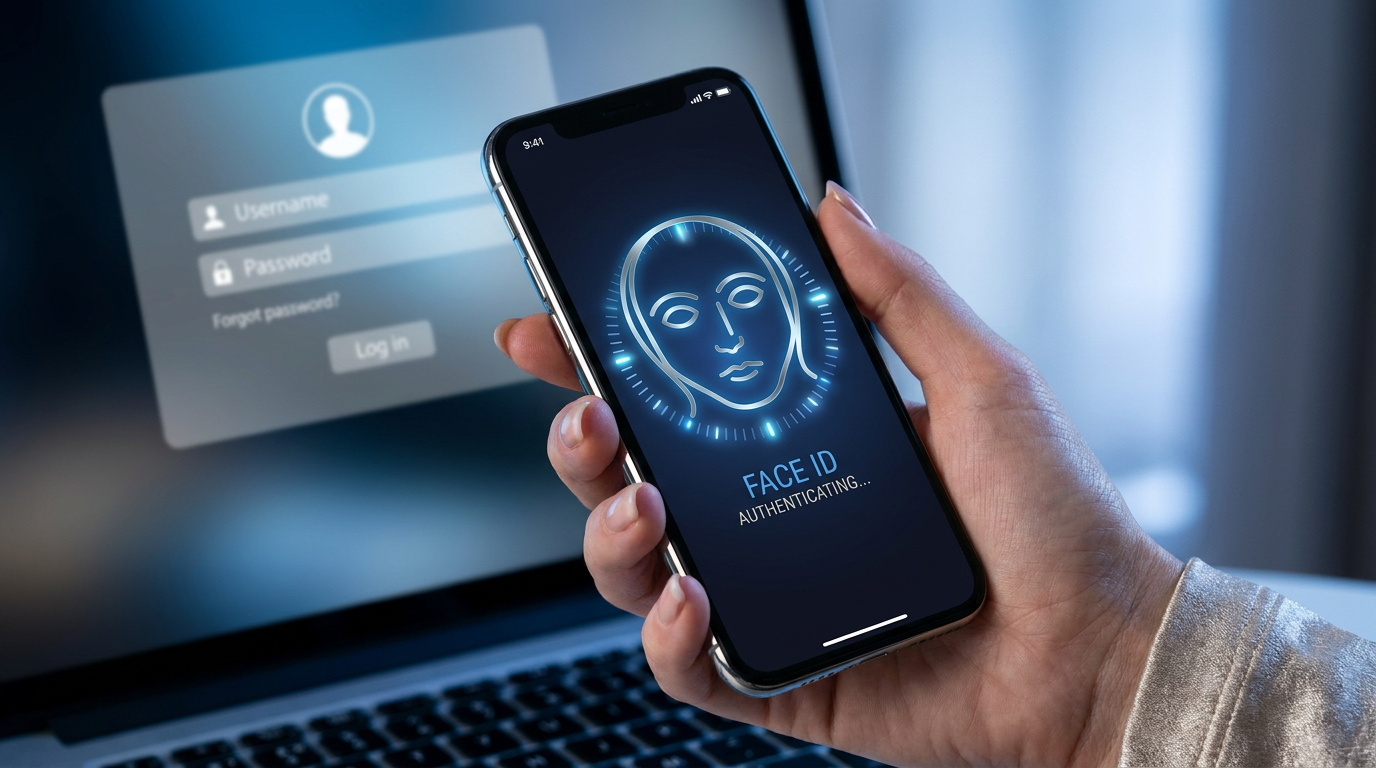
This cryptographic architecture directly answers the anxiety of The Guardian reader regarding the safety of a simple smartphone PIN. When a website prompts you to authenticate a passkey, your phone asks for your Face ID, Touch ID, or device PIN. It is vital to understand that this biometric data or PIN is never sent to the website. The PIN's only job is to tell your phone's local operating system, "Yes, the authorized owner is holding this device right now; you have permission to use the private key to sign the server's challenge." Because the PIN is only verified locally against the physical hardware in your hand, a hacker sitting in another country cannot brute-force or guess it. They would need to physically steal your phone and know your PIN to access your accounts, shifting the threat model from scalable, automated global cyberattacks to localized, physical theft.[1][6][8]

The transition away from passwords is no longer a theoretical future; it is a rapidly accelerating present. According to the FIDO Alliance's 2026 State of Passkeys report, there are now an estimated 5 billion passkeys in active use globally. The consortium's research, which surveyed thousands of consumers and enterprise decision-makers, reveals that awareness has reached a tipping point. Fully 90 percent of consumers are now aware of passkeys, and 75 percent have enabled a passkey on at least one of their online accounts. Major digital platforms—including Amazon, PayPal, LinkedIn, and WhatsApp—have integrated passkey support, allowing users to bypass the traditional login screen entirely. The infrastructure to support this shift is massive, with the FIDO Alliance noting that over 15 billion accounts across the internet are now technically capable of utilizing passkey authentication.[3][8]
In the enterprise and commercial sectors, the adoption of passkeys is being driven by the sheer financial cost of password-related vulnerabilities. Data from authentication provider MojoAuth highlights a stark divide in how different industries are rolling out the technology. The fintech and banking sector is leading the charge, with approximately 60 percent of eligible users actively signing in with passkeys. This aggressive adoption is fueled by the high cost of account takeover incidents in the financial sector, which can range from hundreds to thousands of dollars per breach. E-commerce platforms follow with a 35 percent active adoption rate, while business-to-business software sits at 28 percent. Media and streaming services lag behind at roughly 18 percent, largely due to the technical friction of implementing passkey authentication on shared living-room devices like smart TVs.[7][8]

Despite the clear security advantages, the shift to passkeys introduces new logistical questions for consumers, chief among them: What happens if a device is lost, destroyed, or stolen? If the private key lives exclusively on the hardware, losing the phone would seemingly mean losing access to the account. To solve this, major ecosystem providers have implemented secure cloud syncing. Apple's iCloud Keychain and Google's Password Manager automatically back up and synchronize passkeys across all of a user's trusted devices. If an iPhone is dropped in a lake, the user simply logs into their iCloud account on a new device, and their passkeys are restored. Furthermore, if a device is stolen, the thief cannot use the passkeys without bypassing the local biometric lock or PIN, giving the victim ample time to remotely wipe the device or revoke the keys.[1][2][5]

The remaining friction in the passkey revolution largely centers on cross-ecosystem compatibility. While syncing passkeys between an iPhone, an iPad, and a Mac is seamless, moving a passkey from an Apple device to a Windows PC or an Android phone can still feel clunky, often requiring the user to scan a QR code with their phone to bridge the gap. Independent password managers like Bitwarden and Dashlane have stepped in to fill this void, offering third-party vaults that store and sync passkeys across any operating system or browser. As these interoperability wrinkles are ironed out by the tech giants, the fundamental promise of the passkey remains intact. By replacing a vulnerable shared secret with a localized cryptographic proof of possession, the technology industry is finally fixing the internet's oldest architectural flaw, making digital life simultaneously faster and fundamentally more secure.[4][5][8]
How we got here
2012
The FIDO Alliance is formed by leading tech companies with the goal of eliminating passwords.
2014
The first UAF and U2F protocols are introduced, laying the groundwork for hardware-based security keys.
2022
Apple, Google, and Microsoft announce native operating system support for passkeys, bringing the technology to the mainstream.
May 2026
The FIDO Alliance reports that global passkey usage has reached 5 billion active credentials.
Viewpoints in depth
Cybersecurity Experts
The architectural shift from shared secrets to asymmetric cryptography is the only way to defeat phishing.
Security professionals emphasize that the internet's original sin was relying on a 'shared secret' model for authentication. As long as users have to transmit a password to a server, there will always be a way for criminals to intercept it or steal it from the database. Passkeys solve this by ensuring the private key never leaves the user's physical device. By shifting the authentication burden to public key cryptography, the industry is effectively rendering credential stuffing and phishing attacks mathematically impossible.
Consumer Privacy Advocates
While the security benefits are clear, the reliance on device ecosystems raises concerns about lock-in and recovery.
Privacy and consumer advocates celebrate the end of password anxiety, noting that users are no longer burdened with memorizing complex strings of characters. However, they point out that passkeys tie digital identity more closely to physical hardware and specific corporate ecosystems. If a user loses their device and hasn't properly configured cloud syncing, recovering access can be significantly harder than clicking a 'forgot password' link. Furthermore, moving passkeys seamlessly between competing platforms—such as from an Apple ecosystem to an Android one—remains a friction point that advocates want to see fully resolved.
Enterprise IT Leaders
Passkeys are primarily an operational cost-saving measure that reduces support tickets and breach liabilities.
For corporate IT departments, the push toward passkeys is driven by the bottom line. Passwords are incredibly expensive to maintain; they account for a massive percentage of IT helpdesk tickets due to forgotten credentials and forced resets. More importantly, compromised passwords are the leading cause of corporate data breaches and ransomware attacks. By deploying passkeys, enterprises can drastically reduce their cyber insurance premiums, eliminate password reset overhead, and secure their remote workforces against the most common vectors of attack.
What we don't know
- How quickly legacy systems and older government portals will be able to upgrade their infrastructure to support passkey authentication.
- Whether a universal standard for seamlessly transferring passkeys between competing ecosystems (like Apple to Android) will be fully realized without relying on third-party password managers.
Key terms
- FIDO Alliance
- An open industry association formed by major tech companies to develop and promote authentication standards that reduce reliance on passwords.
- Public Key Cryptography
- A cryptographic system that uses pairs of keys: public keys which may be disseminated widely, and private keys which are known only to the owner.
- Phishing
- A cyberattack where criminals impersonate legitimate organizations to trick users into revealing sensitive information like passwords.
- WebAuthn
- A web standard published by the World Wide Web Consortium (W3C) that allows servers to register and authenticate users using public key cryptography instead of a password.
- Credential Stuffing
- A cyberattack where stolen account credentials from one data breach are used to gain unauthorized access to user accounts on other websites.
Frequently asked
What happens if I lose my phone?
Passkeys are securely backed up to cloud services like Apple's iCloud Keychain or Google Password Manager, allowing you to restore them on a new device.
Can a fake website steal my passkey?
No. Passkeys are cryptographically bound to the specific website they were created for, making them completely immune to phishing attacks.
Do I still need a password manager?
Yes. Most modern password managers now store and sync passkeys alongside your legacy passwords, making cross-platform logins easier.
Are passkeys the same as two-factor authentication?
Passkeys inherently act as two-factor authentication because they require both something you have (your physical device) and something you are (your biometric scan or PIN).
Sources
Source coverage
8 outlets
3 viewpoints surfaced








[1]The GuardianConsumer Privacy Advocates
Readers reply: Experts say we should use passkeys, but can a smartphone pin really be safer than a password?
Read on The Guardian →[2]Consumer AffairsConsumer Privacy Advocates
What are passkeys? Hint: They're faster and safer than passwords
Read on Consumer Affairs →[3]FIDO AllianceCybersecurity Experts
The State of Passkeys 2026: Global Consumer and Workforce Report
Read on FIDO Alliance →[4]AuthgearCybersecurity Experts
Passkey vs Password: Are Passkeys Safer? (2026 Guide)
Read on Authgear →[5]BitwardenEnterprise IT Leaders
Are passkeys safer than passwords?
Read on Bitwarden →[6]SentinelOneCybersecurity Experts
How Do Passkeys Work? Authentication Flow Guide
Read on SentinelOne →[7]MojoAuthEnterprise IT Leaders
Passkey Adoption Rates by Industry in 2026
Read on MojoAuth →[8]Factlen Editorial TeamCybersecurity Experts
Synthesis by Factlen editorial team
Read on Factlen Editorial Team →


Every angle. Every day.
Get technology stories with full source coverage and perspective breakdowns delivered to your inbox.