
Time-Restricted Eating vs. Caloric Tracking: What the Latest Science Says About Weight Loss
Recent large-scale clinical trials reveal that while both time-restricted eating and continuous caloric restriction are highly effective for weight loss, they offer distinct behavioral and metabolic trade-offs.
By Factlen Editorial Team
- Time-Restricted Eating Advocates
- Focus on circadian alignment and the metabolic benefits of fasting periods.
- Clinical Nutritionists
- Advocate for personalized approaches and combining methodologies for sustainability.
- Caloric Tracking Proponents
- Emphasize the immutable laws of thermodynamics and dietary flexibility.
What's not represented
- · Individuals with a history of eating disorders
- · Overnight shift workers
Why this matters
Choosing the right nutritional approach is the difference between a temporary diet and a lifelong health transformation. Understanding the scientific trade-offs between meal timing and calorie tracking allows you to select the method that best fits your psychology and daily routine.
Key points
- Time-Restricted Eating (TRE) limits food intake to a set daily window, naturally reducing calories without tracking.
- Continuous Caloric Restriction (CCR) requires tracking daily intake to maintain a consistent energy deficit.
- Both methods result in nearly identical weight loss (4-5%) over a 12-month period when calories are equated.
- TRE offers behavioral simplicity but can cause social friction during fasting periods.
- CCR offers dietary flexibility but can lead to psychological tracking fatigue over time.
- Combining a generous eating window with a mild caloric deficit is increasingly recommended by clinical nutritionists.
For decades, the weight loss industry has been dominated by fleeting trends and restrictive fads. But in recent years, clinical nutrition has coalesced around two heavily researched, evidence-backed methodologies. The debate has shifted from searching for "magic foods" to a more fundamental question of human metabolism: is it better to control exactly when you eat, or exactly how much you eat?
This question pits Time-Restricted Eating against Continuous Caloric Restriction. Both approaches have amassed mountains of clinical data, passionate advocates, and proven track records for improving cardiometabolic health. Yet, they demand entirely different psychological and behavioral commitments from the people practicing them.
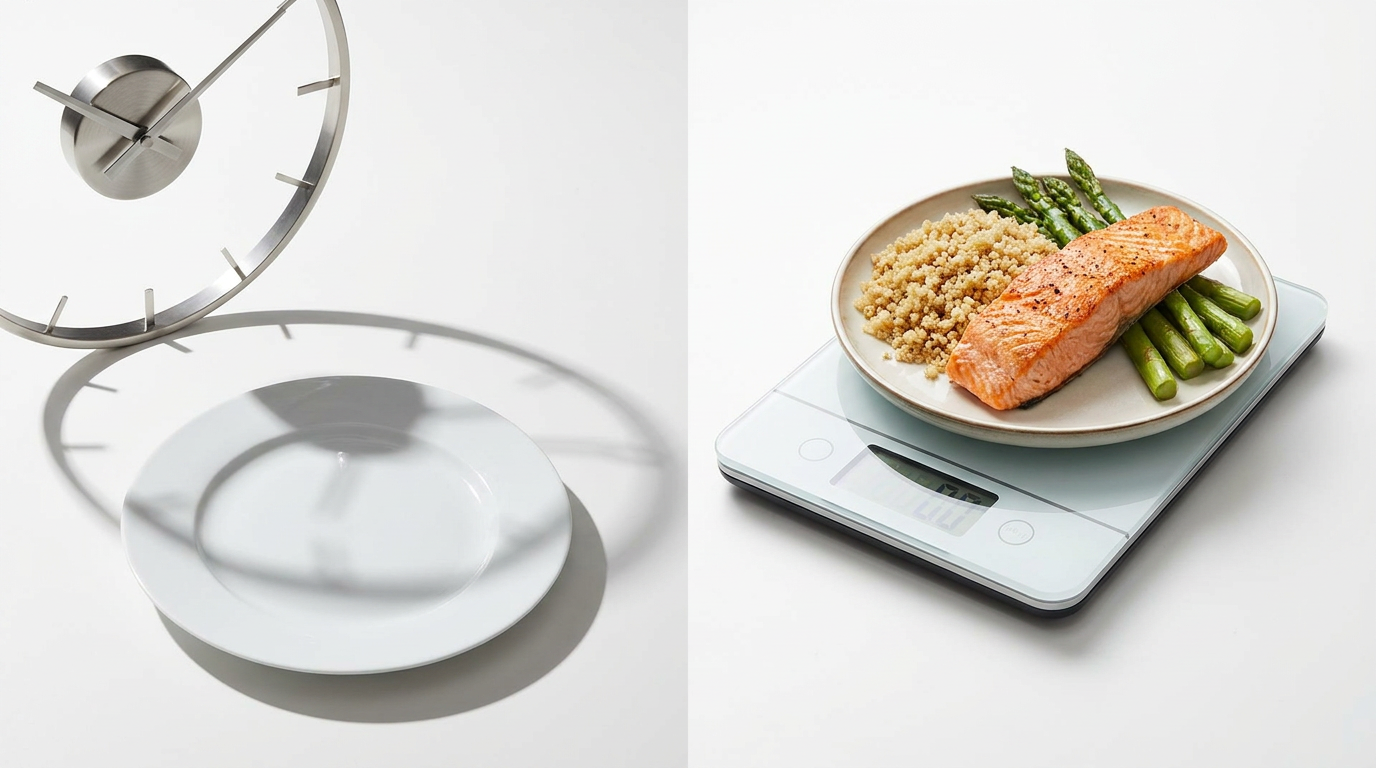
Time-Restricted Eating, often colloquially referred to as intermittent fasting, operates on the principle of the clock. Practitioners limit their daily food intake to a specific window—typically six to ten hours—and consume zero calories during the remaining fasting period. The underlying mechanism is deeply tied to human circadian rhythms, aiming to align food intake with the body's peak metabolic efficiency during daylight hours.
On the other side of the spectrum is Continuous Caloric Restriction, the modern evolution of traditional dieting. Often practiced today via "macro tracking" on smartphone apps, this method relies on the immutable laws of thermodynamics. It requires a person to calculate their total daily energy expenditure and consistently eat at a 20 to 40 percent deficit, meticulously logging every gram of protein, carbohydrate, and fat.

The case for Time-Restricted Eating centers heavily on behavioral simplicity. For many, the cognitive load of weighing food and logging ingredients into an app is exhausting and ultimately unsustainable. Time-Restricted Eating eliminates this math. By simply closing the kitchen at 7:00 PM and skipping breakfast, many individuals naturally eliminate late-night snacking and unintentionally achieve a caloric deficit without ever opening a tracking app.
However, the argument against Time-Restricted Eating highlights the social friction it creates. Human culture is deeply intertwined with food, and strict eating windows can make family breakfasts or late dinners with friends socially isolating. Furthermore, some individuals experience a "scarcity mindset" during their eating window, leading to binge eating that entirely negates the benefits of the fasting period.
The clinical evidence for Time-Restricted Eating is robust. A massive 2025 network meta-analysis published in The BMJ, which reviewed 99 randomized clinical trials, found that intermittent fasting strategies reliably result in significant body weight reduction. The data showed that these clock-based interventions also deliver meaningful improvements in blood pressure, glucose control, and lipid profiles, proving that the method is far more than a placebo.[1]
Conversely, the case for Continuous Caloric Restriction is built on ultimate flexibility and precision. Proponents argue that no specific food or mealtime needs to be off-limits, provided it fits within the daily energy budget. This allows for a highly customized diet that can accommodate a slice of birthday cake or a late-night meal, so long as the math balances out by the end of the day.
Conversely, the case for Continuous Caloric Restriction is built on ultimate flexibility and precision.
The primary argument against this tracking-heavy approach is the psychological fatigue it induces. Logging every morsel of food requires a level of vigilance that can border on obsessive. Critics point out that while Continuous Caloric Restriction is the gold standard in a controlled laboratory setting, free-living humans often abandon the practice after a few months due to the sheer tedium of data entry.
Yet, the evidence supporting Continuous Caloric Restriction remains the bedrock of nutritional science. Long-term studies, including 12-month trials analyzed in recent medical journals, consistently show that a sustained caloric deficit yields a reliable 4 to 5 percent reduction in total body weight. When adherence is maintained, the metabolic improvements—ranging from reduced systemic inflammation to lower cholesterol—are undeniable.[3]

When these two heavyweights are tested head-to-head, the results are illuminating. In trials like the Time2Eat study, researchers directly compared early time-restricted eating against daily caloric restriction over a 39-week period. The findings revealed that both groups lost nearly identical amounts of weight. When total calories are equated, the timing of the meals does not magically accelerate fat loss.[4]
However, there may be a metabolic tie-breaker depending on the specific health condition. Recent systematic reviews in Frontiers in Nutrition suggest that Time-Restricted Eating might offer a slight advantage in reducing liver fat for patients with metabolic dysfunction-associated steatotic liver disease. The prolonged fasting window appears to drive insulin levels lower than continuous restriction, offering a unique benefit for severe insulin resistance.[2]
The debate also extends into muscle preservation. Athletes and fitness professionals often lean toward Continuous Caloric Restriction because it allows for "protein pacing"—spreading protein intake evenly across four or five meals to maximize muscle protein synthesis. Trying to consume 150 grams of protein within a tight six-hour window can be gastrointestinally uncomfortable and sub-optimal for retaining lean mass during weight loss.
Recognizing the strengths of both, many clinical nutritionists now advocate for a combination approach. Recent trials have shown that pairing a generous eight-to-ten-hour eating window with a mild, tracked caloric deficit can yield the best of both worlds. This hybrid model provides the circadian benefits of fasting while ensuring the mathematical certainty of a calorie deficit.[5][6]

Ultimately, choosing between the two requires an honest assessment of lifestyle and personality. Time-Restricted Eating fits remarkably well when a person prefers hard boundaries, struggles with late-night snacking, and wants to avoid the cognitive burden of tracking apps. It is highly effective for those who thrive on simple, binary rules: you are either in the eating window, or you are not.
Conversely, Time-Restricted Eating does not fit well when an individual has a history of disordered eating, works erratic shift hours, or prioritizes a highly social lifestyle centered around evening meals. It is also less ideal for competitive athletes who require frequent protein feedings to sustain rigorous training volumes.
Continuous Caloric Restriction fits perfectly when a person values dietary flexibility above all else. It is the superior choice for those who want to understand the exact nutritional composition of their food, individuals trying to optimize body composition while preserving maximum muscle mass, and those who do not mind the daily routine of weighing and logging their meals.
On the other hand, Continuous Caloric Restriction does not fit well when a person is prone to perfectionism or anxiety surrounding food numbers. If logging a meal feels like a stressful chore rather than an empowering tool, the tracking fatigue will inevitably lead to burnout and a rebound in weight.
The scientific consensus in 2026 is clear: there is no single physiological winner between the clock and the scale. Both Time-Restricted Eating and Continuous Caloric Restriction are scientifically validated, highly effective tools for improving human health. The true winner is simply the method that a person can seamlessly integrate into their life, transforming a temporary diet into a permanent lifestyle.[6]
How we got here
2010s
Caloric restriction and macro tracking dominate the fitness industry with the rise of smartphone logging apps.
2019
Time-restricted eating gains mainstream popularity as animal studies show profound metabolic benefits.
2022
Early human trials confirm TRE leads to weight loss, sparking debate over whether it works independently of calorie reduction.
2025
Large-scale meta-analyses confirm that while both methods are highly effective, their long-term weight loss results are nearly identical when calories are matched.
Viewpoints in depth
Time-Restricted Eating Advocates
Focus on circadian alignment and the metabolic benefits of fasting periods.
This camp argues that human biology is not a simple calculator, and that hormone regulation—specifically insulin—plays a massive role in fat storage. By restricting the eating window, they point to evidence showing improved insulin sensitivity and cellular repair (autophagy) that occurs during fasting. They believe that simplifying the rules of eating to a clock is far more sustainable for the general public than weighing every ounce of food.
Caloric Tracking Proponents
Emphasize the immutable laws of thermodynamics and dietary flexibility.
Advocates for continuous caloric restriction maintain that weight loss ultimately comes down to energy balance: calories in versus calories out. They argue that time-restricted eating only works because it inadvertently causes a caloric deficit. By tracking macros, this camp believes individuals gain true nutritional literacy, allowing them to enjoy a flexible diet that includes their favorite foods while optimizing protein intake for muscle preservation.
Clinical Nutritionists
Advocate for personalized approaches and combining methodologies.
Medical professionals and dietitians increasingly view the debate as a false dichotomy. They emphasize that adherence is the single most important factor in any diet's success. Many in this camp now recommend a hybrid approach, utilizing a generous time-restricted window (like 10 hours) to curb late-night snacking, combined with a loose awareness of total caloric intake to ensure the patient remains in a mild, sustainable deficit.
What we don't know
- Whether time-restricted eating provides unique longevity benefits in humans independent of weight loss, as seen in animal models.
- The exact optimal eating window duration that balances metabolic benefits with long-term psychological sustainability.
Key terms
- Time-Restricted Eating (TRE)
- A dietary strategy that limits daily food intake to a specific window of time, typically 6 to 10 hours, with fasting during the remaining hours.
- Continuous Caloric Restriction (CCR)
- A dietary approach focused on reducing total daily energy intake by a specific percentage, regardless of when the meals are consumed.
- HOMA-IR
- A widely used metric to estimate insulin resistance and beta-cell function from fasting blood glucose and insulin levels.
- Circadian Rhythm
- The body's internal 24-hour clock that regulates the sleep-wake cycle, hormone release, and metabolism.
Frequently asked
Does time-restricted eating work if I overeat during my window?
Generally, no. While restricting your eating window often leads to an unintentional reduction in calories, consistently eating in a caloric surplus during that window will prevent weight loss.
Can I build muscle while doing time-restricted eating?
Yes, but it requires careful planning. You must ensure you consume adequate protein and engage in resistance training, which can be challenging to fit into a shorter eating window.
Which method is better for long-term maintenance?
The best method is the one you can sustain. Studies show that at the 12-month mark, both methods yield similar weight loss, meaning long-term success depends entirely on personal adherence and lifestyle fit.
Is it safe to combine both methods?
Yes. In fact, many clinical trials combine a time-restricted window with a calculated caloric deficit, which can optimize both metabolic health and weight loss, provided the deficit isn't too extreme.
Sources
Source coverage
6 outlets
3 viewpoints surfaced






[1]The BMJClinical Nutritionists
Intermittent fasting strategies and their effects on body weight and other cardiometabolic risk factors
Read on The BMJ →[2]Frontiers in NutritionTime-Restricted Eating Advocates
Intermittent fasting versus continuous energy restriction in MASLD: a systematic review and meta-analysis
Read on Frontiers in Nutrition →[3]MDPICaloric Tracking Proponents
Time-Restricted Eating Versus Daily Calorie Restriction: Effects on Inflammatory Markers over 12 Months in Adults with Obesity
Read on MDPI →[4]ClinicalTrials.govClinical Nutritionists
Time Restricted Eating vs. Caloric Restriction for Obesity (Time2Eat Trial)
Read on ClinicalTrials.gov →[5]PubMedTime-Restricted Eating Advocates
The impact of intermittent fasting on body composition and cardiometabolic outcomes in overweight and obese adults
Read on PubMed →[6]Factlen Editorial TeamClinical Nutritionists
Synthesis by Factlen editorial team
Read on Factlen Editorial Team →



Every angle. Every day.
Get fitness stories with full source coverage and perspective breakdowns delivered to your inbox.