
The Ultimate Guide to Furniture Materials: How to Tell Solid Wood from Veneer and MDF
Understanding the difference between solid wood, veneers, and engineered materials like MDF can save buyers from costly furniture mistakes. This guide breaks down the visual tests, joinery techniques, and environmental impacts of modern furniture construction.
By Factlen Editorial Team
- Heritage Woodworkers
- Advocate for traditional solid wood construction and interlocking joinery, emphasizing that furniture should be built to last for generations and be easily repairable.
- Sustainable Manufacturing Advocates
- Highlight the resource efficiency of engineered woods like MDF, which utilize sawmill waste and prevent usable wood fibers from ending up in landfills.
- Value-Oriented Consumers
- Focus on the balance between aesthetics and affordability, utilizing visual tests to find the best possible quality within a realistic household budget.
What's not represented
- · Commercial Furniture Retailers
- · Forestry Management Officials
Why this matters
Furniture is one of the most significant investments in a home, yet modern manufacturing techniques make it incredibly difficult to judge quality by eye alone. Knowing how to identify true materials and structural joinery empowers consumers to buy pieces that will last generations rather than ending up in a landfill after a few years.
Key points
- Solid wood furniture is cut directly from trees, offering superior durability and the ability to be sanded and refinished.
- MDF is an engineered material made from compressed wood fibers and resin, often covered with a thin wood veneer.
- Buyers can identify solid wood by checking for continuous grain patterns over edges and looking for unique, non-repeating wood knots.
- Traditional joinery, like mortise and tenon or dovetail joints, indicates higher quality construction than metal screws and cam locks.
- While MDF utilizes recycled sawmill waste, solid wood's multi-generational lifespan often gives it a lower annualized environmental impact.
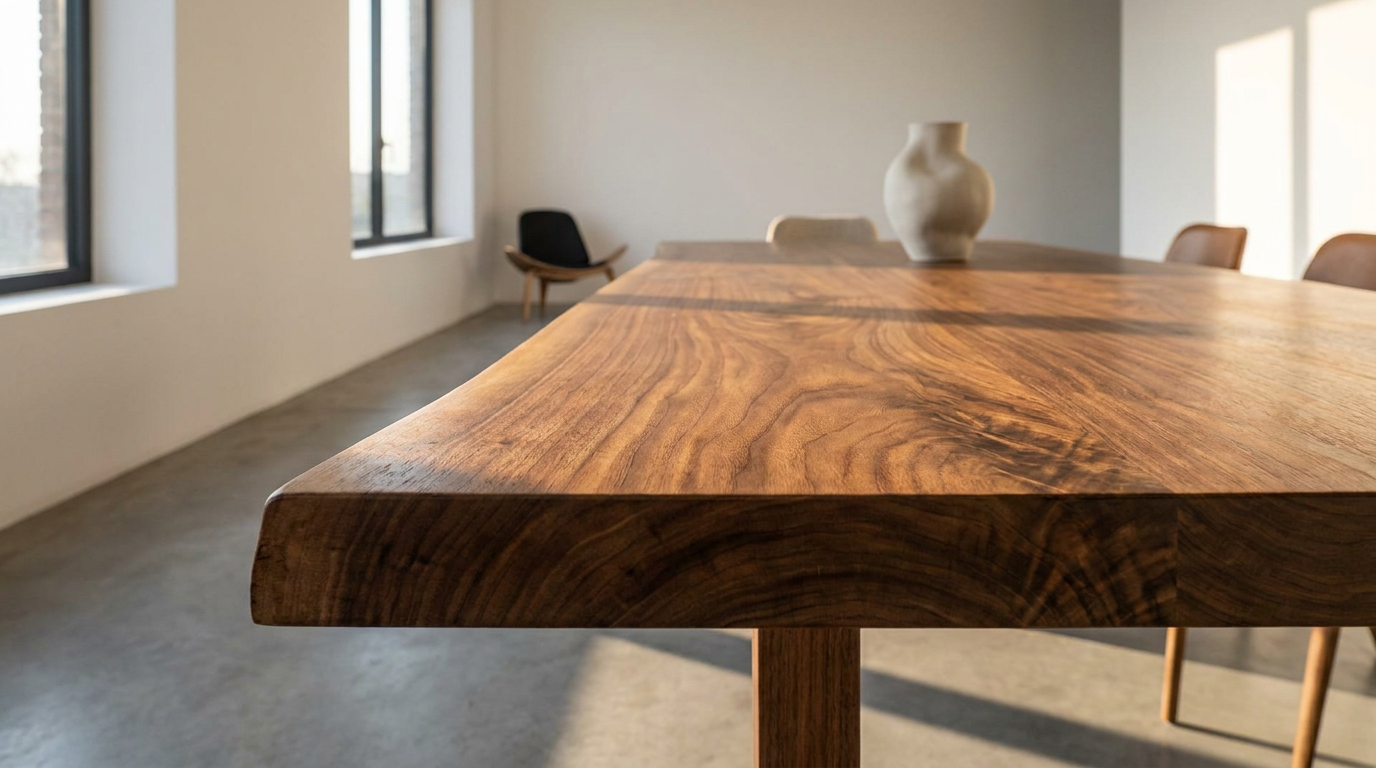
Walking through a modern furniture showroom can feel like an exercise in optical illusions. A sleek, heavy-looking walnut dining table might be exactly what it appears to be—a solid slab of hardwood—or it might be a masterclass in modern manufacturing, composed of compressed sawdust wrapped in a millimeter-thin slice of real wood. As the quality of artificial finishes improves, the line between heirloom craftsmanship and disposable fast-furniture has never been blurrier.[1][7]
To navigate this landscape, buyers must first understand the three primary materials dominating the market: solid wood, Medium Density Fiberboard (MDF), and wood veneers. Solid wood is exactly what it sounds like—lumber cut directly from a tree, retaining the natural grain, density, and structural integrity of the original plant. It is the historical gold standard for furniture making, prized for its strength and ability to be repaired over decades.[6][7]
On the other end of the spectrum is MDF, an engineered wood product created by breaking down hardwood or softwood residuals into wood fibers. These fibers are combined with wax and a resin binder, then formed into panels by applying high temperature and pressure. MDF is incredibly smooth, resists warping, and is highly cost-effective, making it the backbone of the modern flat-pack furniture industry.[4][5]
Because raw MDF is visually unappealing, manufacturers cover it with a veneer—a razor-thin slice of natural wood glued to the surface. This allows a piece of furniture to showcase the beautiful grain of expensive species like mahogany or teak while keeping the core material cheap. While veneered MDF can look stunning on a showroom floor, it lacks the deep structural durability of solid timber.[1][6]

So, how can a consumer tell the difference without cutting the table in half? The first and most immediate test is weight. Solid wood is remarkably dense and heavy. If a large dresser or dining table can be easily lifted or pushed across the floor with one hand, it is almost certainly constructed from a lighter engineered core.[1][7]
The next step is the "grain wrap" test. On a piece of solid wood, the grain pattern naturally continues over the edges and ends of the board, just as it would in the tree. If you look at the edge of a table and the grain suddenly stops, changes direction unnaturally, or reveals a subtle seam where two surfaces meet, you are looking at a veneer applied over an engineered core.[1][7]
Buyers should also perform a "repeat scan." Nature never repeats itself perfectly. If you notice two cabinet doors or drawer fronts with an identical, mirrored grain pattern, it is a clear sign of manufactured veneer. Real wood features unique knots, pores, and asymmetrical variations that cannot be perfectly duplicated.[1][6]
Buyers should also perform a "repeat scan." Nature never repeats itself perfectly.
When in doubt, experts recommend the "underside audit." Manufacturers rarely waste expensive wood veneers on surfaces the customer will never see. By reaching underneath a table or pulling out a drawer to check the unexposed back panel, buyers can often spot the raw, unfinished MDF or plywood core, instantly revealing the piece's true construction.[1][7]
However, material is only half the equation; the invisible skeleton of the furniture—the joinery—dictates how long it will survive daily use. Mass-produced MDF furniture typically relies on metal fasteners, screws, and cam locks. Over time, as the furniture shifts, these metal pieces can strip out of the soft fiberboard, leading to wobbly chairs and sagging shelves.[2][6]
Heirloom-quality solid wood furniture, by contrast, relies on traditional joinery techniques that interlock the wood itself. The most fundamental of these is the mortise and tenon joint. Used for thousands of years, this technique involves cutting a projecting peg (the tenon) on the end of one board, which fits perfectly into a corresponding hole (the mortise) carved into another. This creates a massive surface area for wood glue, resulting in a 90-degree connection that can withstand immense stress.[2][3]

For drawers and cabinetry, the hallmark of quality is the dovetail joint. This technique features a series of interlocking, trapezoidal "pins" and "tails" that fit together like puzzle pieces. Because of their flared shape, dovetail joints are nearly impossible to pull apart, ensuring that a drawer face will never detach no matter how heavily it is loaded or how many times it is yanked open.[1][2]
The choice between solid wood and MDF also carries significant environmental implications, though the debate is more nuanced than it appears. MDF is highly resource-efficient; it utilizes sawmill waste, shavings, and small-diameter trees that would otherwise be discarded or burned. By turning this waste into usable panels, the MDF industry keeps a massive amount of material out of landfills.[5][7]

However, the resins used to bind MDF often contain formaldehyde and other chemicals, which can off-gas into a home and complicate the recycling process at the end of the furniture's life. Solid wood requires harvesting mature trees—which can take 18 to 22 years to grow—but when sourced from responsibly managed, FSC-certified forests, it acts as a long-term carbon sink.[4][5]
Ultimately, the environmental and economic value of solid wood lies in its longevity. Solid wood furniture lasts three to five times longer than its MDF counterparts. More importantly, when a solid wood table gets scratched, dented, or water-stained, it can be sanded down and completely refinished. When a veneered MDF table suffers water damage, the fiberboard swells and the veneer peels, usually rendering the piece unrepairable and destined for the curb.[4][6]
Armed with the knowledge of grain patterns, joinery techniques, and material properties, consumers can walk into any showroom and see past the polished finishes. Whether opting for the budget-friendly practicality of engineered wood or investing in the multi-generational durability of solid timber, buyers can finally make choices based on structural truth rather than surface-level aesthetics.[1][7]

Viewpoints in depth
Heritage Woodworkers
Advocate for traditional solid wood construction and interlocking joinery.
Traditional craftspeople argue that furniture should be viewed as a multi-generational investment rather than a disposable commodity. They emphasize that the true value of a piece lies beneath the finish, specifically in the joinery. Techniques like the mortise and tenon or the dovetail joint rely on the natural expansion and contraction of wood, creating bonds that outlast metal screws. For this camp, the inability to sand down and repair engineered wood makes it fundamentally flawed for long-term household use.
Sustainable Manufacturing Advocates
Highlight the resource efficiency and waste-reduction benefits of engineered woods.
Proponents of modern manufacturing point out that the global demand for furniture cannot be met solely by harvesting mature hardwood trees, which take decades to grow. They champion MDF and particleboard for their ability to utilize sawmill waste, wood shavings, and small-diameter trees that would otherwise be burned or sent to landfills. By maximizing the yield of every harvested tree, engineered wood provides an affordable, highly stable material that democratizes access to well-designed interiors.
Value-Oriented Consumers
Focus on balancing aesthetics, practical durability, and realistic household budgets.
For the average consumer, the debate often comes down to practical economics. While acknowledging the superior lifespan of solid wood, this camp recognizes that outfitting an entire home with heirloom pieces is financially out of reach for many. Instead, they focus on strategic buying: investing in solid wood for high-use, load-bearing items like dining tables and bed frames, while accepting high-quality veneered MDF for low-impact items like media consoles or decorative shelving.
What we don't know
- How upcoming regulations on formaldehyde emissions will alter the cost and formulation of future MDF products.
- Whether the rising cost of raw timber will eventually push solid wood furniture entirely out of the mass-market retail sector.
Key terms
- Solid Wood
- Lumber cut directly from a tree, retaining the natural grain, density, and structural integrity of the original wood throughout the entire piece.
- MDF (Medium Density Fiberboard)
- An engineered wood product made by breaking down wood residuals into fibers, combining them with wax and resin, and forming them into panels under high heat and pressure.
- Veneer
- A very thin slice of natural wood that is glued onto the surface of a cheaper core material, like MDF or plywood, to give the appearance of solid wood.
- Mortise and Tenon
- A strong, traditional woodworking joint where a projecting peg (tenon) on one piece of wood fits exactly into a corresponding hole (mortise) on another.
- Grain Wrap
- A visual test for solid wood where the natural lines of the wood grain can be seen continuing seamlessly over the edge or end of a board.
Frequently asked
Is all heavy furniture made of solid wood?
Not necessarily. While solid wood is generally heavier than engineered wood, high-density fiberboard (HDF) can also be quite heavy. Weight is a good initial indicator, but should be combined with visual grain tests.
Can MDF furniture be repaired if it gets scratched?
Minor surface scratches on the veneer can sometimes be disguised with markers, but if the MDF core is exposed or swells from water damage, it cannot be sanded down and refinished like solid wood.
Why do some high-end pieces use veneer?
Veneer isn't always a sign of low quality. Some high-end designers use veneers of rare, exotic woods over a stable core to prevent the piece from warping, or to achieve complex geometric patterns that would be impossible with solid slabs.
What is a dovetail joint?
A dovetail joint is a traditional woodworking technique used primarily in drawers, featuring interlocking, flared wooden 'pins' and 'tails' that prevent the drawer front from pulling away from the sides.
Sources
Source coverage
7 outlets
3 viewpoints surfaced







[1]FunCycledValue-Oriented Consumers
How to Identify Solid Wood Furniture on the Spot
Read on FunCycled →[2]Solid Wood SuperstoreHeritage Woodworkers
What Joinery Reveals About Solid Wood Quality
Read on Solid Wood Superstore →[3]FindBuyTool
The Basics of the Mortise and Tenon Joint
Read on FindBuyTool →[4]Oak & LoomValue-Oriented Consumers
Material Properties at a Glance: Solid Wood vs. Engineered Wood
Read on Oak & Loom →[5]Espaço VIPSustainable Manufacturing Advocates
Environmental Impact: MDF vs. Solid Wood
Read on Espaço VIP →[6]Executive WoodHeritage Woodworkers
Why Solid Wood is the Superior Choice Over MDF
Read on Executive Wood →[7]Factlen Editorial Team
Synthesis by Factlen editorial team
Read on Factlen Editorial Team →

Every angle. Every day.
Get home stories with full source coverage and perspective breakdowns delivered to your inbox.