
The Science of Pilates: How Low-Impact Resistance Reshapes the Body and Brain
Once a niche conditioning routine for dancers, Pilates has evolved into an evidence-based clinical tool for core stabilization, injury rehabilitation, and longevity.
By Factlen Editorial Team
- Clinical Rehabilitation Experts
- Physiotherapists and medical researchers focused on injury recovery and pain management.
- Biomechanics & Sports Science
- Researchers analyzing the neuromuscular and kinematic effects of the Reformer.
- Public Health & Longevity
- Advocates focused on aging, bone density, and holistic well-being.
- Factlen Editorial Synthesis
- The overarching analytical framework connecting biomechanics to clinical outcomes.
What's not represented
- · Traditional Strength Coaches
- · Yoga Practitioners
Why this matters
Understanding the biomechanics of Pilates reveals why it has become a frontline medical tool for treating back pain, preventing age-related physical decline, and building functional strength that traditional gym workouts often miss.
Key points
- Pilates targets deep stabilizing muscles like the transversus abdominis rather than superficial abdominal muscles.
- The unstable carriage of the Reformer forces core muscles to activate milliseconds before limb movement.
- Clinical Pilates is increasingly prescribed by physiotherapists to treat chronic lower back pain.
- The spring resistance provides weight-bearing exercise that helps increase bone mineral density.
- Consistent practice improves dynamic balance and proprioception, reducing the risk of falls in older adults.
- Pilates is not a high-intensity cardiovascular workout and should be paired with aerobic exercise.
For decades, Pilates was largely viewed through the lens of boutique fitness—a specialized conditioning routine favored by professional dancers and celebrities. But in recent years, the practice has quietly undergone a medical renaissance. Today, it is increasingly prescribed by physiotherapists, studied by biomechanists, and utilized as a frontline defense against the physical decline associated with aging.[1]
The shift from fitness trend to clinical tool is driven by a growing body of empirical evidence. Researchers are discovering that the precise, controlled movements of Pilates do something that traditional gym workouts often miss: they fundamentally rewire how the brain communicates with the body's deepest stabilizing muscles.[1][4]
To understand the science of Pilates, one must first look at the anatomy of the core. Traditional abdominal exercises, like crunches and sit-ups, primarily target the rectus abdominis—the superficial "six-pack" muscle. While visually prominent, this muscle does relatively little to stabilize the spine or pelvis during complex, everyday movements.[2][5]
Pilates, by contrast, targets a hidden muscular corset. The practice forces the activation of the transversus abdominis, which wraps horizontally around the lower torso, and the multifidus, a series of small muscles attached directly to the spinal column. These deep stabilizers act as the body's internal scaffolding, absorbing shock and maintaining structural integrity.[5]

Electromyography (EMG) studies have provided a window into this mechanism. When researchers attach sensors to the abdominal walls of subjects performing Pilates, the data reveals a distinct firing pattern. Unlike conventional floor exercises, Pilates movements trigger these deep stabilizers to contract simultaneously, creating a functional, full-body engagement that protects the lumbar spine.[4][5]
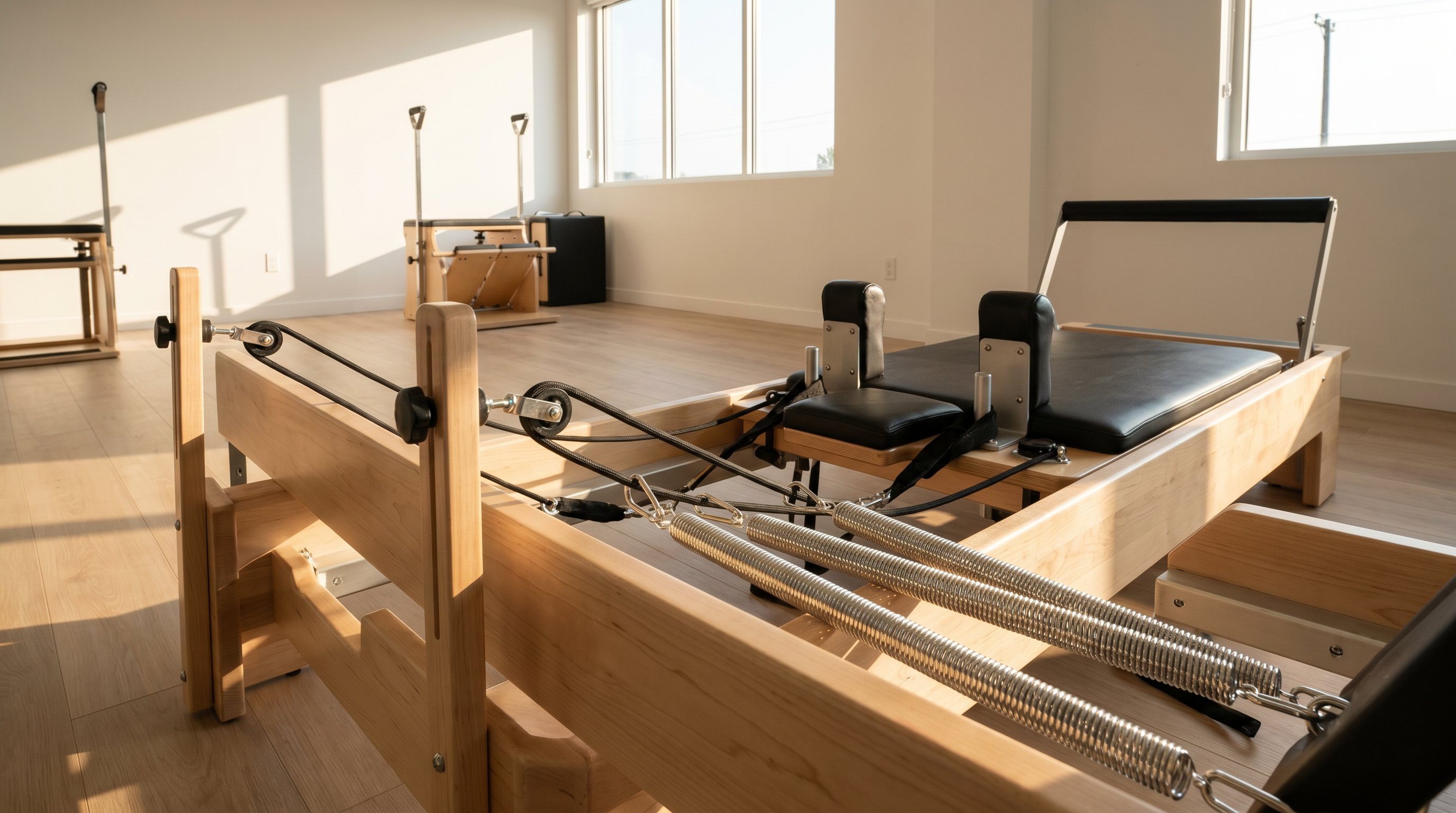
This neuromuscular adaptation is particularly pronounced when using a Reformer—the specialized apparatus invented by Joseph Pilates in the 1920s. The Reformer consists of a sliding carriage attached to a system of springs, ropes, and pulleys. This setup creates a unique biomechanical environment: controlled instability combined with variable resistance.[4][8]
The genius of the Reformer lies in its moving carriage. Because the surface beneath the user is inherently unstable, the central nervous system must constantly adjust to maintain balance. Biomechanical analyses have shown that during Reformer exercises, the deep core muscles actually activate approximately 30 milliseconds before the limbs begin to move, anticipating the need for spinal stabilization.[5]

This anticipatory firing is a hallmark of a healthy, injury-resistant musculoskeletal system. When this timing is delayed—often due to sedentary lifestyles or previous injuries—the superficial muscles are forced to overcompensate, leading to chronic pain and movement dysfunction. By retraining this precise firing sequence, the Reformer effectively recalibrates the body's motor control.[1][5]
This physiological mechanism has given rise to a specialized branch known as Clinical Pilates. Unlike standard group fitness classes, Clinical Pilates is typically led by physiotherapists and tailored specifically for rehabilitation. It strips away the aesthetic goals of fitness in favor of targeted, evidence-based interventions for musculoskeletal issues.[6]
This physiological mechanism has given rise to a specialized branch known as Clinical Pilates.
The most robust clinical evidence for Pilates centers on chronic lower back pain, a condition that affects hundreds of millions of people globally. A systematic review by the Cochrane Library found that core strengthening through Pilates significantly reduces both the intensity and frequency of lower back pain, often outperforming general exercise programs and standard medical care.[6][7]
By addressing the root cause of the pain—muscular imbalances and poor spinal support—rather than just the symptoms, Clinical Pilates offers a sustainable path to recovery. Patients recovering from joint replacements, spinal surgeries, and sports injuries are increasingly directed toward the Reformer to safely rebuild strength without placing undue stress on healing tissues.[6]

Beyond rehabilitation, the scientific community is increasingly interested in Pilates as a tool for longevity. As the body ages, it naturally loses muscle mass, bone density, and proprioception (the ability to sense one's position in space). This triad of decline dramatically increases the risk of falls and fractures in older adults.[3][8]
The spring resistance of the Reformer provides a low-impact form of weight-bearing exercise, which research from the National Institutes of Health indicates is effective in increasing bone mineral density. This makes it a vital intervention for counteracting osteoporosis and osteoarthritis, conditions that often preclude older adults from higher-impact strength training.[8]
Furthermore, the focus on precise, controlled movement yields measurable improvements in dynamic balance. Studies have documented that older adults participating in consistent Reformer programs experience significantly greater improvements in postural stability and gait compared to those doing mat-based exercises alone, underscoring the specific therapeutic value of the equipment.[3][5]
The benefits of Pilates also extend beyond the musculoskeletal system into mental health. The practice requires intense concentration and deliberate, rhythmic breathing, creating a mindful state that bridges the gap between physical exertion and meditation.[2][3]
Clinical trials have demonstrated that consistent Pilates practice is effective in reducing symptoms of depression and anxiety. The controlled breathing patterns stimulate the parasympathetic nervous system, lowering cortisol levels and mitigating the physiological effects of chronic stress, while the physical exertion triggers the release of mood-elevating endorphins.[2]

Despite its extensive benefits, sports scientists are quick to point out what Pilates is not. It is not a high-intensity cardiovascular workout. Research indicates that from an aerobic standpoint, a standard Pilates session is roughly equivalent to walking at a moderate pace, meaning it should be paired with aerobic exercise for comprehensive heart health.[3]
Similarly, its role in weight loss is nuanced. While meta-analyses of multiple trials show that Pilates can reduce body fat percentage and improve body composition—largely by building lean muscle mass that increases resting metabolic rate—it is not a massive calorie-burner. Experts caution against viewing it as a standalone weight-loss solution.[3][4]
To maximize the benefits of Pilates, the principle of progressive overload must be applied. The science suggests that as the neuromuscular system adapts, the spring resistance and the complexity of the exercises must be continually adjusted. Without this progression, the body reaches a plateau, and the stabilizing benefits begin to diminish.[5]
Ultimately, the growing body of research confirms what practitioners have claimed for decades: Pilates is a highly efficient system for human movement. By prioritizing deep stability over superficial strength, and controlled precision over sheer force, it offers an evidence-based blueprint for building a body that is not only stronger, but fundamentally more resilient.[1][8]
How we got here
1920s
Joseph Pilates develops his exercise method and the Reformer apparatus, initially to rehabilitate bedridden soldiers and later adopted by professional dancers.
Late 1990s
Pilates experiences a massive surge in mainstream popularity, transitioning from a niche dancer's secret to a staple of boutique fitness studios.
2010s
The rise of 'Clinical Pilates' as physiotherapists increasingly integrate the Reformer into evidence-based rehabilitation protocols for musculoskeletal injuries.
2016
The Cochrane Library publishes a major systematic review confirming the effectiveness of Pilates for reducing chronic lower back pain.
2021
Advanced biomechanical studies using EMG confirm that Reformer Pilates activates deep core stabilizers significantly earlier and more intensely than traditional floor exercises.
Viewpoints in depth
Clinical Rehabilitation Experts
Physiotherapists and medical researchers focused on injury recovery and pain management.
This camp views Pilates primarily as a highly effective intervention for musculoskeletal dysfunction. They point to systematic reviews showing that Clinical Pilates outperforms general exercise for chronic lower back pain. For these experts, the value lies in the method's ability to retrain the central nervous system, correcting postural imbalances and restoring proper motor control before loading the body with heavy weights.
Biomechanics & Sports Science
Researchers analyzing the neuromuscular and kinematic effects of the Reformer.
Sports scientists focus on the measurable data produced by electromyography (EMG) and kinematic tracking. They emphasize that the Reformer's moving carriage creates a unique environment of controlled instability, forcing deep stabilizers like the transversus abdominis to fire milliseconds before movement occurs. This camp advocates for Pilates as a foundational tool to enhance athletic performance and prevent injury through superior core activation.
Public Health & Longevity
Advocates focused on aging, bone density, and holistic well-being.
Public health experts highlight the accessibility and long-term benefits of Pilates for the aging population. Because it is low-impact but weight-bearing (due to spring resistance), they champion it as a critical tool for increasing bone mineral density and preventing osteoporosis. Furthermore, they emphasize its role in improving dynamic balance, which significantly reduces the risk of debilitating falls in older adults.
What we don't know
- The exact threshold of spring resistance required to maximize bone density improvements in osteoporotic patients.
- Whether the long-term cardiovascular benefits of Pilates can match those of moderate aerobic exercise if performed at high tempos.
Key terms
- Transversus Abdominis
- The deepest layer of abdominal muscle that wraps horizontally around the torso, acting as an internal corset to stabilize the spine and pelvis.
- Multifidus
- A series of small, deep muscles attached directly to the spinal column that provide crucial support and stability to the vertebrae during movement.
- Clinical Pilates
- A specialized, evidence-based adaptation of Pilates led by physiotherapists, designed specifically for injury rehabilitation and managing musculoskeletal conditions.
- Reformer
- A specialized Pilates apparatus consisting of a sliding carriage attached to springs, ropes, and pulleys, providing variable resistance and controlled instability.
- Electromyography (EMG)
- A diagnostic technique used to measure and record the electrical activity produced by skeletal muscles, revealing how and when specific muscles activate.
Frequently asked
Is Pilates better than traditional weightlifting?
They serve different purposes. Pilates excels at training deep stabilizing muscles, improving posture, and enhancing neuromuscular control, while traditional weightlifting is generally superior for building absolute strength and large muscle hypertrophy.
Can Pilates help with lower back pain?
Yes. Systematic reviews show that Clinical Pilates is highly effective for reducing chronic lower back pain by strengthening the deep core muscles that support the lumbar spine and correcting postural imbalances.
What is the difference between Mat and Reformer Pilates?
Mat Pilates relies solely on body weight and gravity on a stable surface. Reformer Pilates uses a machine with a sliding carriage and springs, providing both variable resistance and an unstable surface that forces greater neuromuscular adaptation.
Is Pilates an effective way to lose weight?
While Pilates can improve body composition by building lean muscle mass, it is not a high-calorie-burning cardiovascular exercise. Experts recommend pairing it with aerobic workouts and a healthy diet for significant weight loss.
Sources
Source coverage
8 outlets
4 viewpoints surfaced








[1]Factlen Editorial TeamFactlen Editorial Synthesis
Synthesis by Factlen editorial team
Read on Factlen Editorial Team →[2]WebMDPublic Health & Longevity
Pilates: Overview, Pros and Cons, Benefits, and More
Read on WebMD →[3]Everyday HealthPublic Health & Longevity
Pilates: Health Benefits, How to Get Started, and How to Get Better
Read on Everyday Health →[4]Frontiers in PhysiologyBiomechanics & Sports Science
Effects of 12-week pilates reformer training on biomechanics
Read on Frontiers in Physiology →[5]International Journal of Environmental Research and Public HealthBiomechanics & Sports Science
The Relationship of Trunk Muscle Activation and Core Stability: A Biomechanical Analysis of Pilates-Based Stabilization Exercise
Read on International Journal of Environmental Research and Public Health →[6]Journal of Back and Musculoskeletal RehabilitationClinical Rehabilitation Experts
Clinical Pilates significantly outperforms general exercise programmes in reducing back pain
Read on Journal of Back and Musculoskeletal Rehabilitation →[7]Cochrane LibraryClinical Rehabilitation Experts
Pilates for low back pain: A systematic review
Read on Cochrane Library →[8]National Institutes of HealthPublic Health & Longevity
The impact of Pilates exercises on bone mineral density
Read on National Institutes of Health →

More in fitness
See all 36 stories →Recovery Science
The Science of Cold Plunges and Saunas: Which Accelerates Muscle Recovery?
7 sources

Fitness Science
The Science of Rucking: Why Weighted Walking is 2026's Defining Fitness Trend
8 sources

Diet Science
Intermittent Fasting vs. Daily Calorie Restriction: Which Actually Works Better?
6 sources

Strength Tech
The Science of Digital Resistance: How Smart Home Gyms Compare to Free Weights
6 sources
Every angle. Every day.
Get fitness stories with full source coverage and perspective breakdowns delivered to your inbox.