
The Science and Psychology of Aquascaping: How Underwater Gardens Boost Mental Health
The art of aquascaping merges ecology, chemistry, and design to create thriving underwater landscapes. Beyond its aesthetic appeal, a growing body of research shows that cultivating these miniature ecosystems significantly reduces stress and anxiety.
By Factlen Editorial Team
- Aquatic Botanists & Scientists
- Focuses on the precise chemical and biological balance required to sustain the ecosystem, emphasizing the nitrogen cycle and CO2 injection.
- Mental Health Researchers
- Highlights the psychological benefits of the hobby, pointing to empirical data on heart rate reduction and Attention Restoration Theory.
- Nature Aquarium Artists
- Views the tank as a living canvas, prioritizing aesthetic harmony, Wabi-sabi principles, and the emotional impact of the underwater landscape.
What's not represented
- · Traditional Fish Keepers
- · Marine Biologists
Why this matters
In a fast-paced, screen-heavy world, aquascaping offers a scientifically backed method to lower blood pressure, reduce anxiety, and practice mindfulness through the cultivation of a living ecosystem.
Key points
- Aquascaping blends ecology, chemistry, and art to create living underwater landscapes.
- The hobby requires establishing a biological nitrogen cycle to safely process organic waste.
- High-tech setups use pressurized CO2 and intense lighting to accelerate plant growth and oxygen production.
- Observing planted aquariums has been scientifically linked to lowered heart rates and reduced anxiety.
- The practice fosters mindfulness by requiring patience and a disconnect from digital environments.
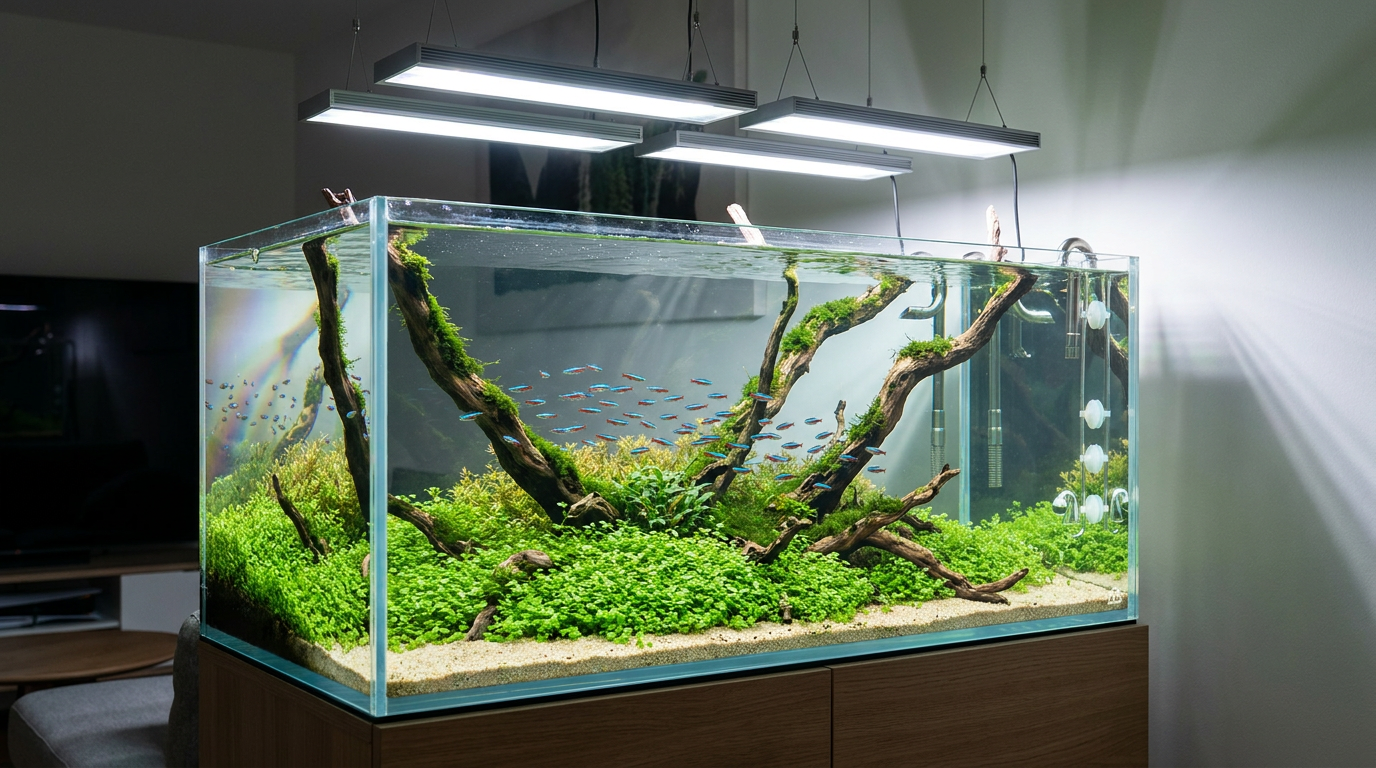
In the corner of a quiet room, a miniature ecosystem breathes. Lush carpets of vibrant green flora stretch beneath the gentle sway of stem plants, while a school of tiny, iridescent fish darts through a meticulously arranged canyon of driftwood and stone. This is not a standard fish tank adorned with neon gravel and plastic castles. It is an aquascape—a living, underwater landscape that merges the precision of chemistry with the aesthetics of fine art.[1]
Over the past decade, aquascaping has quietly evolved from a niche offshoot of the aquarium hobby into a global phenomenon. Enthusiasts spend hours, sometimes months, designing and cultivating these submerged gardens. But beyond the striking visual appeal, the practice is increasingly recognized for its profound psychological and physiological benefits.[1][4]
At its core, aquascaping is an exercise in applied ecology. To maintain a pristine underwater world, hobbyists must master a delicate balancing act involving lighting spectrums, carbon dioxide saturation, and microbial biology. It is a hobby that demands patience and rewards its practitioners with a tangible, daily connection to nature.[1]
The modern iteration of this craft owes its existence largely to one man: Takashi Amano. A Japanese professional track cyclist turned environmental photographer, Amano revolutionized the aquarium industry in the 1990s. Frustrated by the artificial look of traditional fish tanks, he began applying the principles of Japanese gardening—specifically the concepts of Wabi-sabi and Zen rock arrangement—to underwater environments.[3][6]

Amano introduced the "Nature Aquarium" concept, which prioritized the cultivation of aquatic plants over the mere housing of fish. His 1992 photo book, "Glass no Naka no Daishizen" (Nature in Glass), showcased breathtaking underwater forests and mountains, fundamentally changing how the world viewed aquariums.[3]
Amano's legacy is perhaps best encapsulated by his final masterpiece: "Forests Underwater," a staggering 160,000-liter exhibit at the Lisbon Oceanarium. Though he passed away in 2015, his philosophy of bringing "untouched nature" indoors continues to drive the industry's explosive growth today.[3][6]
But creating a Nature Aquarium requires more than an artistic eye; it requires a functioning biological engine. The invisible foundation of every successful aquascape is the nitrogen cycle. When fish produce waste, or when organic matter decays, it releases ammonia into the water—a compound that is highly toxic to aquatic life.[1]
To combat this, aquascapers cultivate colonies of beneficial bacteria within their filters and substrate. The first strain of bacteria, Nitrosomonas, consumes the toxic ammonia and converts it into nitrite. While nitrite is slightly less lethal, it remains dangerous. A second strain of bacteria, Nitrobacter, then steps in to convert the nitrite into nitrate, a relatively benign compound that aquatic plants eagerly absorb as fertilizer.[1]

This microscopic assembly line is what keeps the enclosed ecosystem from collapsing. Establishing this cycle—a process known in the hobby as "cycling a tank"—can take weeks of careful monitoring and water testing before a single fish can be safely introduced.[1]
This microscopic assembly line is what keeps the enclosed ecosystem from collapsing.
Once the biological foundation is set, the focus shifts to the chemistry of plant growth. In the wild, aquatic plants have access to virtually unlimited carbon dioxide and sunlight. In the confined space of a glass box, these elements must be artificially supplied and strictly regulated.[5]
High-tech aquascapes rely on pressurized CO2 injection systems. As carbon dioxide dissolves into the water, it forms carbonic acid, which can lower the water's pH. Aquascapers must carefully balance this injection rate with the water's carbonate hardness (KH) to prevent sudden, lethal pH swings.[5]
When the balance of intense lighting, precise nutrients, and CO2 is struck perfectly, a magical phenomenon occurs: "pearling." The plants photosynthesize so rapidly that the surrounding water becomes supersaturated with oxygen. Tiny, diamond-like bubbles of pure oxygen form on the leaves and gently float to the surface, signaling a thriving, hyper-oxygenated environment.[5][6]

The meticulous nature of this maintenance might sound stressful, but research suggests the exact opposite. A growing body of scientific literature points to the profound mental health benefits of keeping and observing planted aquariums.[4][7]
According to the Attention Restoration Theory, modern humans suffer from mental fatigue caused by the prolonged, directed focus required by screens and stressful work environments. Natural environments, however, engage our "soft fascination"—a state of effortless attention that allows the brain to rest and recover.[4]
Studies published in journals like Environment and Behavior have demonstrated that even brief exposure to natural environments like aquariums can significantly lower anxiety. Researchers have recorded average anxiety reductions of 12% among participants observing an aquarium.[2][7]
The physiological responses are equally measurable. Controlled experiments have shown that watching a stocked, planted aquarium can reduce an observer's heart rate by up to 7% and noticeably lower blood pressure. The more biodiverse the tank—featuring a variety of plant and fish species—the stronger the calming effect.[7]
Beyond passive observation, the physical ritual of aquascaping—trimming overgrown stems, testing water parameters, and cleaning glass—fosters a deep sense of mindfulness. It forces the practitioner to slow down, disconnect from digital distractions, and engage entirely with the present moment.[4]
However, the hobby is not without its frustrations. The delicate balance of light and nutrients is easily tipped. A slight miscalculation in CO2 levels or a spike in organic waste can result in aggressive algae blooms, turning a pristine underwater garden into a murky green swamp. Controlling algae is often described as the true test of an aquascaper's patience and scientific understanding.[5]
Some hobbyists circumvent the high-tech arms race entirely by adopting the "Walstad Method," pioneered by ecologist Diana Walstad. This low-tech approach relies on natural soil and a heavy plant load to balance the ecosystem without artificial CO2 or intense lighting, though it requires accepting a slower, wilder growth pattern.[6]
Whether utilizing high-tech precision or low-tech ecology, aquascaping offers a rare antidote to the modern world. It is a hobby that cannot be rushed. In an era defined by instant gratification, cultivating a thriving underwater landscape is a quiet rebellion—a testament to the enduring rewards of patience, science, and a profound connection to the natural world.[1][4]

How we got here
1960s
The first all-glass aquariums are constructed using newly available silicone sealants.
1971
The first pressurized CO2 system for aquariums is patented in Germany, laying the groundwork for high-tech plant growth.
1992
Takashi Amano publishes 'Glass no Naka no Daishizen', introducing the world to the 'Nature Aquarium' style.
2015
The massive 160,000-liter 'Forests Underwater' exhibit opens at the Lisbon Oceanarium, cementing aquascaping as a mainstream art form.
2019–Present
Research increasingly validates the mental health benefits of the hobby, linking it to reduced anxiety and improved mindfulness.
Viewpoints in depth
Aquatic Botanists & Scientists
Focuses on the precise chemical and biological balance required to sustain the ecosystem.
For aquatic botanists, an aquascape is a living laboratory. The primary concern is the stability of the nitrogen cycle and the precise manipulation of water chemistry. By carefully balancing carbonate hardness (KH), pH levels, and macronutrients, scientists and advanced hobbyists can push aquatic plants to their biological limits. They view algae not merely as a nuisance, but as a biological indicator of an imbalance in light, CO2, or nutrient levels.
Mental Health Researchers
Highlights the psychological benefits of the hobby and its ability to alleviate modern stress.
Psychologists and mental health professionals view aquascaping through the lens of the biophilia hypothesis and Attention Restoration Theory. They argue that the modern human brain is overtaxed by screens and artificial environments. The act of observing a thriving, biodiverse aquarium engages 'soft fascination,' allowing the nervous system to reset. Empirical data supporting drops in blood pressure and anxiety levels positions the hobby as a legitimate, accessible form of daily therapy.
Nature Aquarium Artists
Views the tank as a living canvas, prioritizing aesthetic harmony and emotional impact.
Following the philosophy of Takashi Amano, Nature Aquarium artists treat the glass box as a frame for a living painting. They are less concerned with maximizing plant growth speed and more focused on the principles of Wabi-sabi—finding beauty in imperfection and natural decay. For these artists, the placement of a single stone or the angle of a piece of driftwood is a meditative act designed to evoke the serenity of a terrestrial forest or mountain range underwater.
What we don't know
- The long-term psychological differences between maintaining high-tech setups versus low-maintenance, low-tech aquariums.
- How specific spectrums of LED aquarium lighting might independently affect human circadian rhythms while viewing the tank.
Key terms
- Aquascaping
- The craft of arranging aquatic plants, rocks, cavework, or driftwood in an aesthetically pleasing manner within an aquarium.
- Nitrogen Cycle
- The biological process where beneficial bacteria convert toxic ammonia from fish waste into nitrite, and then into less harmful nitrate.
- Attention Restoration Theory
- A psychological theory suggesting that exposure to natural environments can alleviate mental fatigue and improve concentration.
- CO2 Injection
- The process of artificially introducing carbon dioxide into an aquarium to accelerate plant photosynthesis and growth.
- Wabi-sabi
- A Japanese aesthetic principle centered on the acceptance of transience and imperfection, heavily utilized in natural aquarium design.
Frequently asked
Do I need a massive tank to start aquascaping?
No. Many hobbyists begin with "nano tanks" (under 10 gallons), which require less space and materials, though they do demand careful water parameter monitoring.
Can an aquascape survive without CO2 injection?
Yes. "Low-tech" setups use hardy plants like Java Fern and Anubias that thrive without supplemental CO2, though they grow much slower than high-tech tanks.
How does an aquascape differ from a regular fish tank?
Traditional aquariums focus primarily on housing fish, whereas aquascaping prioritizes the cultivation of a balanced, aesthetically designed underwater landscape where plants are the main feature.
Sources
Source coverage
7 outlets
3 viewpoints surfaced







[1]Factlen Editorial TeamAquatic Botanists & Scientists
Synthesis by Factlen editorial team
Read on Factlen Editorial Team →[2]Environment and BehaviorMental Health Researchers
The impact of natural environments and aquariums on stress reduction
Read on Environment and Behavior →[3]Aqua Design Amano (ADA)Nature Aquarium Artists
Takashi Amano Biography and the Origin of the Nature Aquarium
Read on Aqua Design Amano (ADA) →[4]The Ornamental Aquatic Trade Association (OATA)Mental Health Researchers
Exploring the mental health benefits of aquarium keeping
Read on The Ornamental Aquatic Trade Association (OATA) →[5]Horizon AquaticsAquatic Botanists & Scientists
Optimising CO₂ in Planted Aquariums: Science, Precision & Balance
Read on Horizon Aquatics →[6]ScapeCrunchNature Aquarium Artists
A Brief and Incomplete History of Aquascaping
Read on ScapeCrunch →[7]Buce PlantMental Health Researchers
The Benefits of Aquariums on Health and Mood
Read on Buce Plant →

Every angle. Every day.
Get lifestyle stories with full source coverage and perspective breakdowns delivered to your inbox.