
The Quantum Computing Tipping Point: How 2026 Became the Year of the 'Logical Qubit'
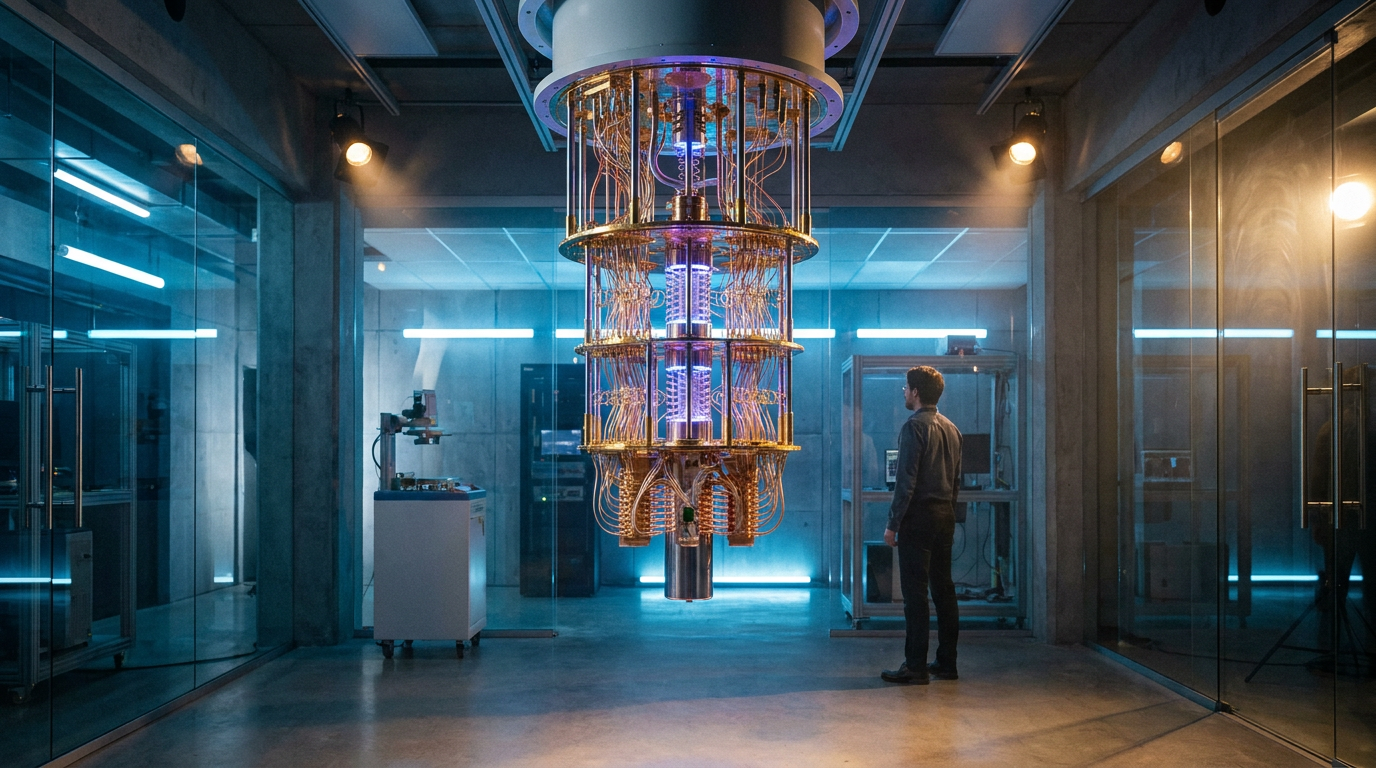
Recent breakthroughs in error correction have shifted quantum computing from a theoretical physics problem to a scalable engineering discipline. By successfully grouping unstable physical qubits into reliable "logical" qubits, researchers have crossed the threshold into the fault-tolerant era.
By Factlen Editorial Team
- Hardware Pioneers
- Focused on achieving fault tolerance through massive scaling of physical qubits and advanced error correction codes.
- Enterprise Pragmatists
- Prioritize hybrid quantum-classical workflows that deliver immediate commercial value without waiting for perfect quantum hardware.
- Industry Observers
- Monitor the timeline of quantum advantage, separating theoretical hype from measurable engineering milestones.
- Editorial Synthesis
- Evaluates the broad paradigm shift from physics research to scalable engineering.
What's not represented
- · Cryptographers preparing for post-quantum decryption threats
- · Regulators monitoring the geopolitical race for quantum supremacy
Why this matters
Quantum computers are no longer decades away from usefulness. The ability to correct errors at scale means industries like pharmaceuticals, aerospace, and finance will soon have the computational power to simulate molecules, discover new materials, and optimize supply chains in ways classical supercomputers never could.
Key points
- Quantum computing has shifted from a theoretical physics challenge to a scalable engineering discipline.
- The primary hurdle of qubit fragility is being solved through Quantum Error Correction (QEC).
- Researchers successfully proved that scaling up physical qubits can exponentially decrease logical error rates.
- The industry has abandoned the idea of standalone quantum computers in favor of hybrid quantum-classical cloud architectures.
- Enterprise sectors like pharmaceuticals and aerospace are already testing hybrid workflows for complex simulations.
For decades, quantum computing has been trapped in a perpetual state of "almost there." The machines were marvels of theoretical physics, yet too fragile to solve real-world problems. But in 2026, the narrative fundamentally shifted. The industry crossed a critical threshold, transforming quantum computing from a delicate laboratory experiment into a scalable engineering discipline.[5][7]
The core bottleneck has always been the extreme fragility of quantum bits, or qubits. Unlike classical bits, which are locked into a stable 0 or 1, qubits operate in a delicate state of superposition. The slightest environmental interference—a stray photon, a microscopic vibration, or a fraction of a degree of heat—can cause "decoherence," destroying the calculation instantly.[4][6]
This fragility created a paradoxical scaling problem. To solve complex problems, engineers needed to build processors with more qubits. However, historically, adding more physical qubits simply introduced more noise into the system. The larger the quantum computer grew, the more error-prone and unreliable it became.[1][4]
The solution to this paradox is Quantum Error Correction (QEC). In classical computing, error correction is straightforward: data is copied multiple times, and if one bit flips erroneously, the system takes a "majority vote" to fix it. Because the laws of quantum mechanics forbid the exact copying of an unknown quantum state, researchers had to develop entirely new, highly complex mathematical architectures to protect information.[1][2]

This led to the concept of the "logical qubit." Instead of relying on a single, unstable physical qubit to hold information, engineers group dozens or even hundreds of physical qubits together into a single, highly stable "virtual" qubit. These physical qubits constantly monitor each other, detecting and correcting errors in real-time without measuring—and thereby destroying—the underlying quantum data.[1][4]
The theoretical math behind logical qubits has existed for years, but 2026 marked the moment the hardware finally caught up. Google's Quantum AI division delivered a watershed milestone with its Willow processor, a 105-physical-qubit superconducting chip.[1][6]
With Willow, Google demonstrated "below-threshold" error correction at scale. For the first time, researchers proved that as they increased the size of the error-correcting grid, the logical error rate actually decreased exponentially. Specifically, the error rate dropped by a factor of roughly 2.14 with each increase in the lattice size, proving that fault-tolerant quantum computing obeys the scaling curves theorists had long predicted.[1][5]

With Willow, Google demonstrated "below-threshold" error correction at scale.
Google was not alone in this breakthrough. The quantum ecosystem saw parallel victories across different hardware architectures. QuEra Computing successfully demonstrated a 30-logical-qubit system using neutral atoms, proving that fault-tolerant computing is now an active engineering pipeline rather than a distant theoretical goal.[4][5]
IBM, a pioneer in superconducting quantum processors, accelerated its own roadmap with the introduction of bivariate bicycle codes, a form of quantum low-density parity check (qLDPC). This advanced mathematical approach provides the same level of error protection as older methods but requires ten times fewer physical qubits, dramatically lowering the hardware overhead required to build a useful machine.[2]
Meanwhile, Microsoft partnered with Atom Computing to launch a commercial system based on neutral atom qubits, while continuing to develop its proprietary "topological" qubits. Topological qubits leverage a distinct state of matter to provide inherent, physical resistance to errors, representing a completely different path to the same fault-tolerant destination.[3]

As the hardware matures, the way the industry envisions using these machines has also crystallized. The fantasy of a standalone "quantum laptop" has been entirely discarded. Instead, 2026 cemented the era of Hybrid Quantum-Classical Computing.[5]
In a hybrid architecture, classical supercomputers and quantum processing units (QPUs) work in tandem. Standard CPUs and GPUs handle the bulk of a software application, orchestrating the workflow and managing data. When the classical system encounters an exponentially complex bottleneck—such as simulating the electron interactions in a novel molecule—it outsources that specific calculation to the QPU via the cloud.[5][7]
This hybrid model is already unlocking tangible value for enterprise adopters. Pharmaceutical companies are actively testing molecular simulation workflows on cloud-based QPUs, aiming to drastically reduce the time and cost of drug discovery. By accurately modeling how proteins fold and interact at a quantum level, researchers can identify viable drug candidates years faster than classical trial-and-error methods allow.[5]

The aerospace and logistics sectors are following suit. Boeing and other manufacturing giants have launched multi-million-dollar projects to apply hybrid quantum workflows to complex challenges like aircraft corrosion modeling and global supply chain optimization. These are problems with so many variables that they choke even the world's fastest classical supercomputers.[3][5]
However, the rapid maturation of logical qubits also accelerates a looming cybersecurity crisis. Modern encryption relies on mathematical problems that are practically impossible for classical computers to solve, but relatively trivial for a mature, fault-tolerant quantum computer. The 2026 breakthroughs have added immense urgency to the global transition toward post-quantum cryptography, as adversaries are already harvesting encrypted data today with the intent to decrypt it once quantum hardware is fully scaled.[5]
Ultimately, the transition from 2025 to 2026 will be remembered as the tipping point. The fundamental physics questions that haunted the field for decades have largely been answered. The hardware works, the error correction scales, and the integration with classical infrastructure is standardizing. Quantum computing has officially entered its fault-tolerant foundation era, and the race to build the applications of tomorrow has begun.[4][7]
How we got here
2019
Google claims 'quantum supremacy' with its 53-qubit Sycamore processor, completing a benchmark task faster than classical supercomputers.
Feb 2023
Google Quantum AI publishes early evidence that scaling a surface code can suppress logical errors.
2024
IBM introduces quantum low-density parity check (qLDPC) codes, drastically reducing the number of physical qubits needed for error correction.
Late 2025
Microsoft and Atom Computing announce a commercial quantum computer based on neutral atom qubits.
2026
The industry broadly crosses the 'fault-tolerant threshold,' proving that scaling up physical qubits exponentially decreases logical error rates.
Viewpoints in depth
Hardware Pioneers
Focused on achieving fault tolerance through massive scaling of physical qubits and advanced error correction codes.
For the companies building the physical machines—Google, IBM, Microsoft, and specialized startups—the primary metric of success is no longer raw physical qubit count, but the stability of logical qubits. These pioneers argue that without crossing the fault-tolerant threshold, quantum computing would remain a laboratory curiosity. Their massive capital investments are currently directed at refining error-correction codes, improving fabrication yields, and discovering new states of matter (like topological qubits) that offer inherent resistance to environmental noise.
Enterprise Pragmatists
Prioritize hybrid quantum-classical workflows that deliver immediate commercial value without waiting for perfect quantum hardware.
Enterprise adopters in finance, logistics, and pharmaceuticals are less concerned with the underlying physics and more focused on immediate optimization. This camp argues that businesses cannot afford to wait until 2030 for perfect, standalone quantum supercomputers. Instead, they are aggressively adopting hybrid architectures, using classical supercomputers to run the bulk of their applications while outsourcing only the most intractable mathematical bottlenecks to cloud-based quantum processors. For them, the revolution is already here in the form of accelerated simulation and discovery.
What we don't know
- Which underlying hardware architecture (superconducting, neutral atom, trapped ion, or topological) will ultimately become the industry standard.
- Exactly when a quantum computer will be powerful enough to break current RSA encryption protocols (the so-called 'Q-Day').
- How quickly the high costs of cloud-based quantum processing will drop to allow access for smaller enterprises and researchers.
Key terms
- Qubit
- The fundamental unit of quantum information, capable of existing in multiple states simultaneously due to superposition.
- Logical Qubit
- A stable, error-corrected "virtual" qubit created by grouping dozens or hundreds of fragile physical qubits together.
- Decoherence
- The loss of a quantum state due to environmental interference, such as heat or electromagnetic noise.
- Fault Tolerance
- The ability of a quantum computer to continue operating reliably even when individual physical components fail or produce errors.
- Hybrid Quantum-Classical Computing
- An architecture where standard supercomputers handle most tasks, outsourcing only the most complex calculations to a quantum processor.
Frequently asked
Will a quantum computer replace my laptop?
No. Quantum computers are highly specialized machines designed for specific, exponentially complex problems. They will work alongside classical computers in hybrid cloud environments, not replace personal devices.
What is the difference between a physical and a logical qubit?
A physical qubit is the actual hardware component (like a superconducting circuit). A logical qubit is a stable, error-free unit of data created by networking many physical qubits together to correct each other's mistakes.
When will quantum computers become practically useful?
With the 2026 breakthroughs in error correction, the industry has entered the fault-tolerant era. Practical, commercial advantage in fields like chemistry and materials science is expected within the next three to four years.
Sources
Source coverage
7 outlets
4 viewpoints surfaced







[1]Google Quantum AIHardware Pioneers
Suppressing quantum errors by scaling a surface code logical qubit
Read on Google Quantum AI →[2]IBM QuantumHardware Pioneers
Realizing large-scale, fault-tolerant quantum computing
Read on IBM Quantum →[3]Microsoft Azure QuantumHardware Pioneers
Advancing commercial quantum computing with Atom Computing
Read on Microsoft Azure Quantum →[4]SpinQuantaIndustry Observers
2026 Qubit Breakthroughs: Quantum Computing Enters the Fault-Tolerant Foundation Era
Read on SpinQuanta →[5]BQP SimulationEnterprise Pragmatists
The five defining breakthroughs of 2026 and what each means for industry
Read on BQP Simulation →[6]Quantum ZeitgeistIndustry Observers
The Complete 2026 Guide to the Quantum vs Classical Milestone
Read on Quantum Zeitgeist →[7]Factlen Editorial TeamEditorial Synthesis
Synthesis by Factlen editorial team
Read on Factlen Editorial Team →
Every angle. Every day.
Get technology stories with full source coverage and perspective breakdowns delivered to your inbox.