
The Mechanics of Turning Empty Offices Into Apartments
As cities grapple with vacant downtowns and housing shortages, office-to-residential conversions are surging. But deep floor plates and complex plumbing make the architectural reality far more difficult than it seems.
By Factlen Editorial Team
- Urban Planners & Municipalities
- Focuses on revitalizing downtowns, stabilizing tax bases, and increasing housing supply to create resilient, 24/7 neighborhoods.
- Real Estate Developers & Architects
- Emphasizes the physical and structural realities, noting that engineering constraints make many buildings unviable without subsidies.
- Market Analysts & Financiers
- Tracks the viability of projects strictly through the lens of ROI, interest rates, and the bid-ask spread on commercial property valuations.
What's not represented
- · Existing Commercial Tenants
- · Low-Income Housing Advocates
Why this matters
Adaptive reuse is reshaping the future of downtowns worldwide. Understanding the physical and financial hurdles of these conversions explains why solving the housing crisis requires more than just empty commercial space.
Key points
- Over 70,700 office spaces are scheduled to be converted into apartments in 2025 and 2026, a massive increase from 2022.
- Deep commercial floor plates make it difficult to meet residential building codes that require natural light for bedrooms.
- Drilling through concrete for new plumbing and HVAC systems pushes conversion costs to $300–$500 per square foot.
- Cities are increasingly offering tax abatements to subsidize conversions and prevent the economic decay of downtown districts.
Across the globe, the post-pandemic era has left urban centers grappling with a dual crisis: a historic surplus of empty office buildings and a severe shortage of affordable housing. To the casual observer, the solution seems obvious. If downtown towers are sitting vacant while residents struggle to find apartments, why not simply convert the cubicles into living rooms?[2]
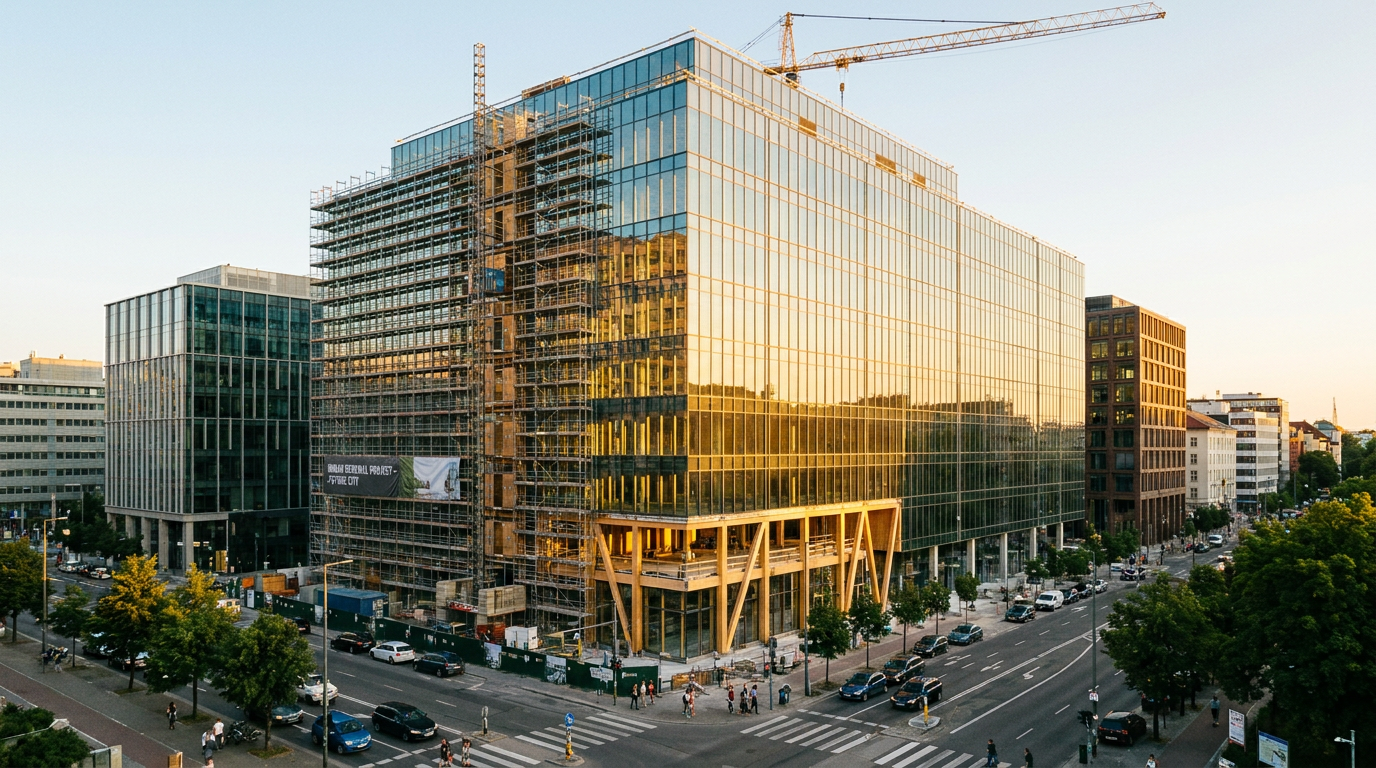
What began as a niche architectural experiment has rapidly evolved into a structural shift in global real estate. According to industry tracking, the number of office spaces scheduled to become apartments in the United States alone has surged, with over 70,700 units in the development pipeline for 2025 and 2026—a massive leap from just 23,100 in 2022. Major metropolitan areas like New York, Washington D.C., and Los Angeles are leading the charge, attempting to turn stranded commercial assets into vibrant, mixed-use neighborhoods.[1][7]
But transforming a mid-century corporate headquarters into a livable residential community is far more complex than putting up drywall and installing kitchen appliances. Developers and architects face a gauntlet of structural, regulatory, and financial hurdles that dictate whether a building can be saved or must be demolished. Industry analysts estimate that only 20% to 40% of existing office buildings possess the right "bones" to be viable candidates for adaptive reuse.[4][5]

The most immediate structural hurdle is the "floor plate" problem. Modern office buildings were designed to maximize square footage, often featuring deep floor plates that stretch 40 to 60 feet from the exterior glass to the central elevator core. However, residential building codes universally require that habitable spaces—specifically bedrooms—have direct access to natural light and ventilation, typically mandating a window within 28 feet.[4][5][7]
To solve this geometry problem, architects are forced to get creative. In some conversions, developers physically carve out the center of the building, creating a massive open-air atrium that turns a solid block of concrete into a "donut," allowing light to penetrate the interior units. In other cases, designers lean into the depth, creating long, loft-style apartments with interior home offices or dens that do not legally qualify as bedrooms but appeal to remote workers.[4][7]

Beyond light and air, the hidden infrastructure of a commercial tower presents a massive engineering challenge. Office buildings are built with centralized heating, cooling, and plumbing systems designed to service communal bathrooms and open-plan floors. A residential building, by contrast, requires individualized climate control and dense webs of plumbing to support dozens of private kitchens, bathrooms, and laundry machines on every single level.[3][5]
Beyond light and air, the hidden infrastructure of a commercial tower presents a massive engineering challenge.
Installing this new infrastructure requires drilling thousands of holes through the existing concrete floors to create "wet stacks"—the vertical shafts that carry water and waste. This is highly perilous in buildings constructed with post-tensioned concrete slabs, which are reinforced with high-tension steel cables. Striking a single cable during drilling can cause it to snap with explosive force, compromising the building's structural integrity and adding tens of thousands of dollars in repair costs per strike.[5][7]
Because of these immense technical challenges, the economics of office-to-residential conversions are notoriously tight. A full gut conversion in a major metropolitan area can cost anywhere from $300 to over $500 per square foot. When factoring in environmental remediation, structural reinforcements, and entirely new mechanical systems, the cost of adapting an old office tower can quickly rival the price tag of building a brand-new residential high-rise from the ground up.[1][5]
For the math to work, developers must acquire the vacant office buildings at a steep discount. However, many commercial landlords have been reluctant to sell at rock-bottom prices, holding out hope for a corporate return-to-office mandate or waiting for interest rates to shift. This valuation standoff has historically bottlenecked the conversion pipeline, leaving many structurally viable buildings in financial limbo.[2][3][7]

Recognizing that the free market alone cannot absorb the cost of these conversions, municipal governments are aggressively stepping in. Empty downtowns lead to eroding property tax bases and struggling local businesses, prompting city planners to view adaptive reuse as an existential necessity. Cities are increasingly offering financial lifelines to developers willing to take on the risk of conversion.[2][3][6]
In Boston, the city launched a dedicated conversion program offering property tax abatements of up to 75% for developers who repurpose office space into housing, provided they meet certain affordability thresholds. Similar initiatives are underway globally, from Washington D.C.'s tax incentives to Calgary's downtown development grants, all designed to bridge the financial gap and streamline the notoriously slow zoning and permitting processes.[1][6]

When the structural math and the financial incentives align, the results can be transformative. In Pittsburgh, a former 1904 department store that later served as a corporate headquarters was successfully converted into the LiveWell Apartments, yielding 253 units with 14-foot ceilings and oversized windows. In Manhattan's Financial District, Gensler's Pearl House project turned an underutilized 1970s office block into a thriving residential community, proving that even aging corporate architecture can find a second life.[3][4]
Ultimately, office-to-residential conversions will not single-handedly solve the global housing shortage. The structural constraints rule out too many buildings for it to be a universal remedy. However, as cities transition away from the single-use business districts of the 20th century toward neighborhoods where people live, work, and play in the same area, adaptive reuse stands as a critical, sustainable tool for urban reinvention.[2][5][7]
How we got here
Pre-2020
Office-to-residential conversions are a niche architectural practice, mostly limited to historic pre-war buildings.
2020–2022
The pandemic normalizes remote work, leading to a historic surge in vacant downtown office space.
2023–2024
Cities begin facing a 'doom loop' of falling commercial property values and eroding tax revenues, prompting early rezoning efforts.
2025–2026
The conversion pipeline surges to over 70,000 planned units as municipalities roll out aggressive tax abatements to subsidize the high costs of adaptive reuse.
Viewpoints in depth
Urban Planners & Municipalities
Focuses on the macro-level benefits of conversions for civic health.
For city planners, incentivizing conversions is less about maximizing developer profit and more about stabilizing the civic ecosystem. They argue that empty downtowns create a 'doom loop' of falling tax revenues, failing local businesses, and reduced public transit ridership. By subsidizing adaptive reuse, municipalities aim to increase the housing supply and create resilient, 24/7 neighborhoods that do not rely solely on commuter foot traffic.
Real Estate Developers & Architects
Focuses on the physical and structural realities of the built environment.
Architects and developers emphasize that while the public demands conversions, the engineering constraints make the majority of existing office buildings financially and physically unviable. They point to 'kill factors' such as deep floor plates, post-tensioned concrete slabs, and massive HVAC overhauls. Without significant public subsidies or architectural compromises, they argue that demolishing and rebuilding is often more practical than retrofitting.
Market Analysts & Financiers
Focuses on the underlying economics and asset valuations.
Financial analysts argue that the conversion trend is ultimately bottlenecked by the bid-ask spread between what current office landlords are willing to sell for and what developers can afford to pay. Given the $300-to-$500 per square foot conversion costs, financiers track the viability of these projects strictly through the lens of ROI, interest rates, and the availability of municipal tax abatements to bridge the funding gap.
What we don't know
- Whether commercial property valuations will drop low enough to make conversions profitable without heavy government subsidies.
- How many of the 70,700 planned units will actually reach completion given the volatile costs of construction and financing.
- If the influx of converted luxury apartments will have a meaningful impact on middle- and low-income housing affordability.
Key terms
- Adaptive Reuse
- The process of repurposing an existing building for a use other than what it was originally designed for, such as turning an office tower into an apartment complex.
- Floor Plate
- The total leasable square footage of a single floor in a commercial building, which dictates how far interior spaces are from the exterior windows.
- Post-Tension (PT) Slab
- A concrete floor reinforced with high-tension steel cables, which makes drilling new holes for residential plumbing highly risky and expensive.
- Wet Stack
- The vertical alignment of plumbing pipes for water supply and drainage that must run continuously through every floor of a residential building.
Frequently asked
Why can't we just put beds in empty offices?
Residential building codes require bedrooms to have access to natural light and ventilation. Most commercial buildings have deep floor plates that leave interior spaces windowless, and they lack the dense plumbing networks needed for individual kitchens and bathrooms.
Is converting an office cheaper than building from scratch?
Not always. Due to the need for structural retrofits, new mechanical systems, and environmental remediation, conversion costs can reach $300 to $500 per square foot, which often rivals the cost of new construction.
Will office conversions solve the housing crisis?
While conversions add valuable units and help revitalize downtowns, they are not a silver bullet. Industry experts estimate that only 20% to 40% of existing office buildings are structurally suitable for residential adaptation.
Why are cities offering tax breaks for these projects?
Empty office buildings lead to eroding property tax bases and struggling downtown businesses. Cities are offering tax abatements to bridge the financial gap for developers, viewing conversions as an existential necessity to maintain civic revenue and vibrancy.
Sources
Source coverage
7 outlets
3 viewpoints surfaced







[1]RentCafeMarket Analysts & Financiers
Office-to-Apartment Conversions Surge to 70,000 in 2025
Read on RentCafe →[2]Brookings InstitutionUrban Planners & Municipalities
Optimizing office-to-residential policy and practice
Read on Brookings Institution →[3]J.P. MorganMarket Analysts & Financiers
A versatile strategy for creating housing: Office-to-residential conversion
Read on J.P. Morgan →[4]GenslerReal Estate Developers & Architects
Office-to-Residential Conversions: Mandates, Myths, and Possibilities
Read on Gensler →[5]IscanoReal Estate Developers & Architects
Office-to-Residential Conversions: The “Feasibility Scan” Guide (2026)
Read on Iscano →[6]City of BostonUrban Planners & Municipalities
Office to Residential Conversion Program
Read on City of Boston →[7]Factlen Editorial Team
Synthesis by Factlen editorial team
Read on Factlen Editorial Team →
Every angle. Every day.
Get real estate stories with full source coverage and perspective breakdowns delivered to your inbox.