
The Evidence on Office-to-Residential Conversions: Can Empty Towers Solve the Housing Crisis?
As post-pandemic office vacancies persist, cities are heavily subsidizing the conversion of commercial buildings into apartments. A review of the latest economic and architectural data reveals the true potential—and the hard limits—of adaptive reuse.
By Factlen Editorial Team
- Urban Planners & Policymakers
- View conversions as a necessary intervention to save downtown tax bases and increase housing supply, justifying the use of public subsidies.
- Real Estate Developers
- Focus on the financial feasibility of projects, noting that high conversion costs and interest rates make subsidies essential for profitability.
- Architectural Analysts
- Emphasize the physical constraints of commercial buildings, focusing on the design innovations required to make deep floor plates livable.
- Housing & Economic Researchers
- Analyze the macroeconomic impact, stressing that conversions are a niche solution that must be paired with affordability mandates to benefit the working class.
What's not represented
- · Commercial Landlords
- · Downtown Small Business Owners
Why this matters
Transforming empty downtown offices into housing addresses two of the decade's biggest urban crises simultaneously. Understanding the data behind these conversions reveals whether local tax dollars are being spent efficiently to lower housing costs, or simply bailing out commercial landlords.
Key points
- For the first time since 2018, more U.S. office space is being demolished or converted than newly constructed.
- Only about 11% of downtown office buildings are physically suitable for residential conversion due to floor plate constraints.
- High conversion costs mean projects rarely pencil out financially without significant public subsidies or tax abatements.
- Cities like New York and Boston are offering decades-long tax breaks to developers who include affordable housing in their conversions.
- Converting offices to co-living spaces can house nearly four times as many people per public subsidy dollar compared to traditional studios.
- Adaptive reuse produces 50 to 75 percent fewer carbon emissions than demolishing and building from scratch.
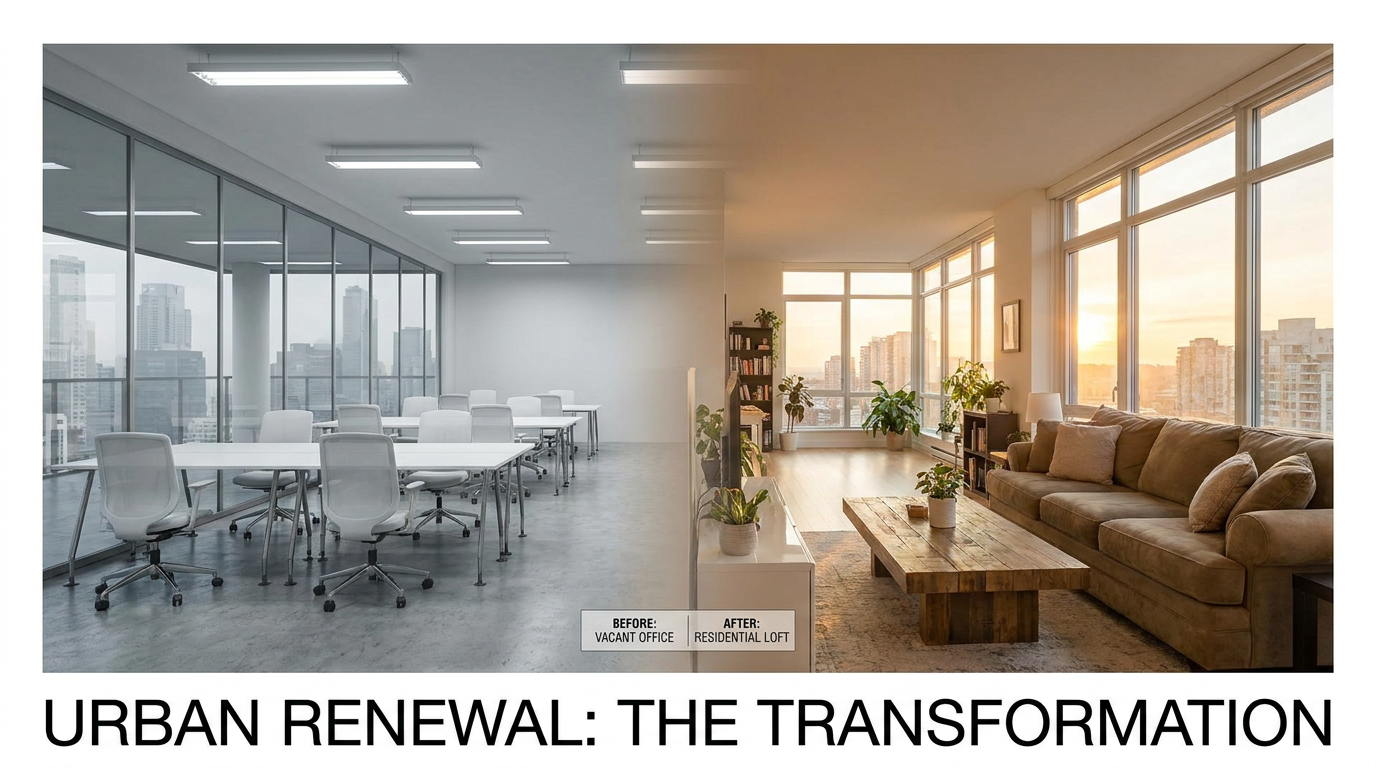
The premise is almost irresistibly intuitive: American cities are grappling with a severe shortage of residential housing, while simultaneously staring down millions of square feet of vacant commercial office space. The obvious solution is to convert the latter into the former. Yet for years, the real estate industry cautioned that adaptive reuse was a niche endeavor, constrained by stubborn architectural realities and unforgiving financial math. Now, a critical mass of post-pandemic data, alongside aggressive new municipal policies, suggests the market has finally crossed a tipping point.[8]
The scale of the shift is now visible in national commercial real estate metrics. According to a recent analysis by CBRE, 2025 and 2026 mark the first years since at least 2018 where more office space is being removed from the U.S. market than added to it. Across the 58 largest markets, 23.3 million square feet of office space is slated for demolition or conversion this year, easily outpacing the 12.7 million square feet of new construction. The national conversion pipeline has swelled to 81 million square feet of planned and active projects, representing nearly 2 percent of total U.S. office inventory.[1]
Despite this momentum, the evidence clearly shows a physical ceiling to the trend. A comprehensive study by the National Bureau of Economic Research (NBER) evaluated commercial properties across the 105 largest U.S. cities to determine their architectural viability for residential use. The researchers found that only about 11 percent of existing office buildings are physically suitable for conversion. If all of these viable properties were transformed, it would add approximately 400,000 new apartments to the national housing stock.[2]

The primary barrier is the shape of the buildings themselves. Many office towers constructed in the 1970s and 1980s feature massive, deep floor plates designed for sprawling cubicle farms. Because residential building codes strictly require operable windows and natural light in every bedroom, the deep, windowless interiors of these structures become dead space. To make these buildings work, developers must employ aggressive architectural interventions.[1][6]
Design firms have developed a playbook to circumvent these physical limitations. Architects frequently carve "blind shafts" straight down through the core of a building, sacrificing total square footage to create new interior facades that allow sunlight to reach deeper into the structure. Alternatively, the windowless core of a deep floor plate can be programmed with shared amenities—such as fitness centers, theaters, and coworking lounges—preserving the valuable perimeter space for the actual apartments.[6]

Even when a building is physically suited for conversion, the financial mechanics remain daunting. The Brookings Institution notes that in most markets, office-to-residential conversions do not make economic sense on their own. There is frequently a gap between the current acquisition value of the office building plus the high cost of conversion—which generally ranges from $250 to $650 per square foot—and the projected revenue the new apartments will generate. High interest rates have further compressed these margins.[1][4]
Even when a building is physically suited for conversion, the financial mechanics remain daunting.
To bridge this financial gap, local governments have begun deploying massive public subsidies, viewing conversions as a necessary tool to save downtown tax bases and increase housing supply. In New York, zoning reforms under the "City of Yes" initiative were paired with a new state tax abatement known as 467-m. This program offers developers up to a 35-year property tax exemption if they convert non-residential buildings into rentals and reserve 25 percent of the units as income-restricted affordable housing.[5][6]
The policy intervention in New York has triggered a gold rush. The city is on track to start roughly 9.5 million square feet of office-to-residential conversions in 2026 alone, more than double the volume seen in the previous year. Developers are racing to secure their change-of-use permits before the initial legislative deadlines expire, proving that when the financial math is subsidized, the private sector can move with remarkable speed.[5][6]
Other major metros are following suit with their own tailored incentives. The Boston Planning & Development Agency launched a Payment in Lieu of Taxes (PILOT) program that provides an average tax abatement of up to 75 percent for up to 29 years. In exchange for the fast-tracked permitting and tax relief, developers must ensure that 17 percent of the newly created units are deed-restricted for households making up to 60 percent of the Area Median Income.[7]
The requirement for affordable housing highlights a central tension in the conversion boom: without mandates, adaptive reuse overwhelmingly produces luxury apartments. Because conversion costs are so high, developers naturally target the upper end of the rental market to recoup their investment. Housing advocates argue that public subsidies must be strictly tied to affordability requirements, lest cities spend taxpayer dollars to build housing that the average resident cannot afford.[4][8]
Recent data suggests that altering the type of housing produced can stretch those public dollars significantly further. Research from The Pew Charitable Trusts indicates that converting obsolete offices into "co-living" apartments—where residents have private bedrooms but share kitchens and living spaces—reduces construction costs by 25 to 35 percent compared to traditional conversions. More importantly, because the per-unit cost is lower, public subsidies go much further.[3]
According to Pew's analysis across ten major cities, utilizing the co-living model allows policymakers to house nearly four times as many residents for the same affordable housing budget compared to subsidizing traditional studio apartments. In cities like Seattle and Chicago, this multiplier effect offers a highly efficient mechanism for local governments to maximize the impact of their limited housing funds.[3]

Beyond the economic and social metrics, the environmental case for adaptive reuse is overwhelmingly strong. The NBER study highlights that rehabilitating an existing building produces 50 to 75 percent fewer carbon emissions than demolishing it and constructing a new residential tower from scratch. By preserving the concrete and steel superstructure, cities can add density without the massive carbon penalty associated with ground-up development.[2]
Ultimately, the evidence suggests that office-to-residential conversions are not a silver bullet for the national housing shortage. The physical limitations of existing commercial real estate mean that adaptive reuse will only ever account for a fraction of the millions of homes the country needs. However, as a targeted strategy to revitalize hollowed-out commercial districts, reduce carbon emissions, and generate localized housing supply, it has proven to be a highly effective tool when backed by the right policy incentives.[4][8]
Viewpoints in depth
Urban Planners & Policymakers
City officials view conversions as a critical tool to save downtown economies and boost housing supply.
For municipal governments, the persistence of remote work poses an existential threat to downtown tax bases. Empty office buildings lead to reduced property tax revenues and less foot traffic for local businesses. Planners argue that heavily subsidizing residential conversions is a necessary investment to transition central business districts into mixed-use neighborhoods. By offering tax abatements like New York's 467-m or Boston's PILOT program, cities are attempting to engineer a soft landing for commercial real estate while simultaneously chipping away at severe local housing shortages.
Real Estate Developers
Developers emphasize that without public subsidies, the math for adaptive reuse rarely works.
The private sector points out that converting an office building is often as complex and expensive as building from scratch. Developers face acquisition costs, high interest rates, and conversion expenses that can reach $650 per square foot. Furthermore, retrofitting 1980s office towers requires expensive architectural workarounds, such as coring out the center of a building to create light wells. Consequently, developers argue that without significant tax incentives or zoning relief, they cannot secure the financing required to undertake these massive, high-risk projects.
Housing & Economic Researchers
Analysts caution that conversions are a niche solution that must be carefully managed to produce affordable housing.
Economic researchers stress that adaptive reuse is not a panacea. Studies from the NBER and Brookings indicate that only a small fraction of buildings are physically suitable, yielding a maximum of roughly 400,000 units nationally—a drop in the bucket compared to the millions of homes needed. Furthermore, researchers warn that because conversion costs are so high, the free market will exclusively produce luxury apartments. Organizations like The Pew Charitable Trusts advocate for tying public subsidies to innovative, high-density models like co-living to ensure taxpayer dollars actually benefit low- and middle-income renters.
What we don't know
- Whether the newly converted downtown apartments will attract enough long-term residents to support local retail and grocery businesses.
- How the expiration of temporary tax abatements in 20-30 years will impact the financial stability of these converted properties.
- If the push for co-living models will gain broad acceptance among renters outside of the youngest demographic cohorts.
Key terms
- Adaptive Reuse
- The process of repurposing an existing building for a use other than what it was originally designed for, such as turning an office tower into an apartment complex.
- Floor Plate
- The total leasable square footage of a single floor in a commercial building. Deep floor plates make it difficult for natural light to reach the center of the building.
- Co-Living
- A residential model where tenants rent private bedrooms but share common areas like kitchens and living rooms, allowing for higher density and lower per-person rent.
- Payment in Lieu of Taxes (PILOT)
- An agreement where a property owner pays a negotiated, often reduced, fixed amount to a municipality instead of standard property taxes, usually to incentivize development.
Frequently asked
Why can't all empty office buildings become apartments?
Many office buildings, particularly those built in the 1970s and 1980s, have massive floor plates. Residential codes require bedrooms to have natural light and operable windows, making the deep, windowless interiors of these buildings unusable for housing without major structural changes.
Do office conversions actually lower rent prices?
On their own, conversions usually produce luxury apartments because developers need to recoup high construction costs. However, cities are increasingly offering tax breaks on the condition that a percentage of the new units are deed-restricted as affordable housing.
Is it cheaper to convert a building than to build a new one?
Not always. The cost of acquiring the building, upgrading the plumbing and electrical systems, and altering the facade can rival new construction. However, conversions are generally faster to complete and produce significantly fewer carbon emissions.
Sources
Source coverage
8 outlets
4 viewpoints surfaced







[1]CBREReal Estate Developers
U.S. Office Conversions and Demolitions Outpace New Construction
Read on CBRE →[2]National Bureau of Economic ResearchHousing & Economic Researchers
Converting Brown Offices to Green Apartments
Read on National Bureau of Economic Research →[3]The Pew Charitable TrustsHousing & Economic Researchers
Converting Obsolete Offices to Small Co-Living Apartments Could Help Ease U.S. Housing Shortage
Read on The Pew Charitable Trusts →[4]Brookings InstitutionHousing & Economic Researchers
Simulating the impacts of office-to-residential conversion on neighborhood demographics
Read on Brookings Institution →[5]NYC.govUrban Planners & Policymakers
The Affordable Housing from Commercial Conversions (467-m) Program
Read on NYC.gov →[6]GenslerArchitectural Analysts
Five Strategies That Make Office-to-Residential Conversions Viable
Read on Gensler →[7]Boston Planning & Development AgencyUrban Planners & Policymakers
Office to Residential Conversion Program
Read on Boston Planning & Development Agency →[8]Factlen Editorial TeamHousing & Economic Researchers
Synthesis by Factlen editorial team
Read on Factlen Editorial Team →
Every angle. Every day.
Get real estate stories with full source coverage and perspective breakdowns delivered to your inbox.