
The End-to-End Revolution: How AI is Rewriting the Rules of Autonomous Driving
The autonomous vehicle industry is abandoning decades of hand-coded rules in favor of unified neural networks that learn to drive by mimicking humans. This architectural shift is rapidly accelerating the deployment of self-driving cars across the globe.
By Factlen Editorial Team
- End-to-End AI Pioneers
- Advocates for replacing all hand-coded rules with a single neural network.
- Interpretability Researchers
- Experts focused on solving the 'black box' problem of neural networks.
- Commercial Automakers
- Prioritize software-defined intelligence layers that can be integrated into mass-market vehicles.
- Data Infrastructure Analysts
- Specialists tracking the massive computational cost of the AI transition.
What's not represented
- · Traditional driving instructors
- · Urban planners
- · Pedestrian safety advocates
Why this matters
The transition to end-to-end AI is the breakthrough that will finally bring self-driving cars out of geofenced test zones and onto everyday roads. By allowing vehicles to learn from human intuition rather than rigid programming, this technology promises to drastically reduce traffic fatalities and reshape global transportation.
Key points
- The autonomous driving industry is shifting from modular, rule-based programming to end-to-end neural networks.
- Instead of relying on explicit code, end-to-end systems learn to drive by mimicking millions of hours of human driving video.
- This 'AV 2.0' approach eliminates compounding errors caused by traditional perception and planning modules.
- Companies like Tesla, Wayve, and NVIDIA are pioneering this architecture to scale autonomous fleets globally.
- Researchers are integrating language models to solve the 'black box' problem, allowing the AI to explain its decisions.
For the better part of fifteen years, the autonomous vehicle industry operated on a shared, unquestioned premise: driving is a problem of logic. Engineers believed that if they could write enough rules, they could teach a machine to navigate the physical world. They wrote explicit instructions for every conceivable scenario—how to yield at a crosswalk, how to navigate a roundabout, how to edge around a double-parked delivery truck.[3][8]
This approach, often referred to as 'AV 1.0,' required massive, hand-coded software stacks. A typical self-driving system contained hundreds of thousands of lines of carefully crafted C++ code. But as vehicles encountered the infinite unpredictability of real-world streets, the rule-based paradigm hit a wall. The sheer volume of 'edge cases'—bizarre, one-off scenarios that programmers hadn't anticipated—proved impossible to hardcode.[2][3][4][8]
Today, the industry is undergoing a radical architectural shift. Automakers and AI researchers are abandoning decades of modular programming in favor of 'end-to-end' neural networks. Instead of relying on explicit rules, these systems learn to drive by watching millions of hours of human driving data, mimicking our intuition and judgment. It is a transition that is rapidly accelerating the deployment of autonomous vehicles, fundamentally rewriting the rules of robotics.[1][3][4][8]
To understand why this shift is so revolutionary, we have to look at how traditional autonomous systems were built. Historically, the driving problem was decomposed into discrete, specialized modules. A 'perception' module would use cameras and radar to identify objects. A 'prediction' module would guess where those objects were going. A 'planning' module would calculate a safe path, and a 'control' module would execute the steering and braking.[4][6][8]

This modular design made sense on paper because it was interpretable and allowed different engineering teams to work in parallel. But it harbored a fatal flaw: compounding errors. If the perception module misclassified a pedestrian as a shadow, that missing information was permanently lost to the planning module. The rigid interfaces between these separate systems stripped away the rich, contextual nuances of the physical world.[4][8]
End-to-end architectures solve this by collapsing the entire pipeline into a single, unified neural network. Raw sensor data—the pixels from a camera or the point clouds from a LiDAR—flows into one end of the model, and vehicle control commands, like steering angle and acceleration, flow directly out the other. There are no intermediate, human-engineered steps. The system jointly discovers what to perceive, how to predict, and when to act.[2][4][6][8]
This 'photon-to-control' philosophy mirrors the breakthroughs we have seen in large language models. Just as ChatGPT learns the structure of language by ingesting vast amounts of text, an end-to-end driving model learns the physics and social contract of the road by ingesting vast amounts of video. It is essentially 'imitation learning' at a massive scale.[6][8]
This 'photon-to-control' philosophy mirrors the breakthroughs we have seen in large language models.
Tesla became the most visible proponent of this approach with the release of its Full Self-Driving (FSD) version 12. In a sweeping overhaul, the company deleted over 300,000 lines of explicit control code, replacing them with a neural network trained on vast amounts of real-world video collected from its global fleet. The result was a system that exhibited noticeably more fluid, human-like driving behavior, capable of handling complex intersections without rigid, pre-programmed hesitation.[2][4][8]
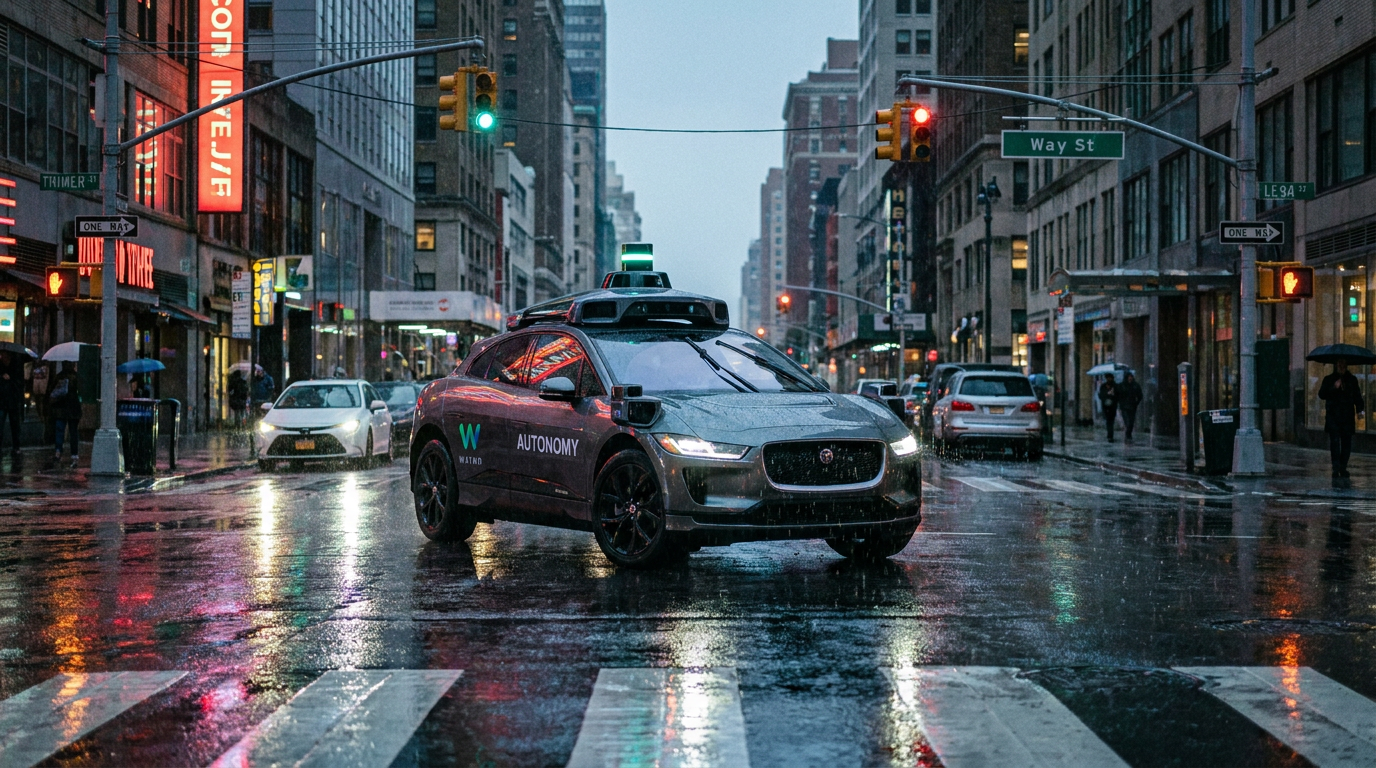
But Tesla is far from alone. Wayve, a London-based AI company, was founded in 2017 on the contrarian bet that end-to-end deep learning would eventually beat modular stacks. Wayve's 'AV 2.0' approach focuses on building foundation models for autonomy that do not rely on high-definition maps or geofencing. Because the intelligence lives entirely within the neural network, their vehicles can be dropped into entirely new cities and navigate successfully without prior mapping.[3][8]
The broader industry is now racing to adopt this paradigm. Waymo, long the champion of modular, LiDAR-heavy systems, recently published research on EMMA, an end-to-end multimodal model built on Google's Gemini architecture. Meanwhile, hardware giants are building the infrastructure to support this massive computational load. NVIDIA's DRIVE platform now centers on end-to-end reasoning models, providing automakers with the supercomputing power required to train and deploy these massive networks.[1][4][8]
The economic implications of this shift are staggering. The global market for end-to-end neural network autonomous driving systems, valued at roughly $671 million in 2025, is projected to surge to $2.5 billion by 2035. By reducing the need for expensive, city-by-city mapping and complex sensor retrofits, end-to-end AI dramatically lowers the barrier to scaling autonomous fleets. Automakers are already partnering with AI firms to integrate these software-defined intelligence layers directly into their next-generation vehicles.[3][5][8]

However, the transition to end-to-end AI is not without its challenges. The most persistent criticism of neural networks is their 'black box' nature. When a traditional modular system makes a mistake, engineers can look at the code and pinpoint exactly which rule failed. When an end-to-end model makes a mistake, it can be incredibly difficult to understand why the neural network chose a specific trajectory.[7][8]
To solve this interpretability problem, researchers are developing Vision-Language-Action (VLA) models. These advanced systems combine the spatial awareness of driving models with the reasoning capabilities of large language models. NVIDIA's Alpamayo and Wayve's LINGO are pioneering this space, allowing the AI to literally explain its driving decisions in natural language. If the car suddenly brakes, the VLA model can output a text explanation detailing exactly what hazard it anticipated.[1][3][7][8]

This layer of causal reasoning is crucial for building trust with both regulators and passengers. It proves that the AI is not just blindly memorizing patterns, but actively understanding the physical dynamics and social cues of the environment. By interacting with generative world models—simulations that predict how a scene will unfold—these systems can even anticipate hazards before they happen.[3][7][8]
The shift to end-to-end neural networks represents the maturation of physical AI. We are moving away from machines that require us to painstakingly translate the world into code, and toward machines that can observe, learn, and navigate the world on their own. As these models continue to scale, the dream of ubiquitous, safe, and adaptable autonomous transportation is finally moving out of the laboratory and onto the open road.[2][4][5][8]
How we got here
2017
Wayve is founded with the contrarian vision of replacing modular autonomous stacks with end-to-end deep learning.
Late 2023
Tesla begins rolling out FSD v12, replacing over 300,000 lines of C++ code with a single neural network.
June 2024
NVIDIA's end-to-end driving model, Hydra-MDP, wins the CVPR Autonomous Grand Challenge.
October 2024
Waymo publishes research on EMMA, an end-to-end multimodal model built on Google's Gemini architecture.
Early 2026
Automakers accelerate partnerships with AI firms to integrate Vision-Language-Action (VLA) models into production vehicles.
Viewpoints in depth
The End-to-End AI Pioneers
Advocates for replacing all hand-coded rules with a single neural network.
Proponents of the 'AV 2.0' approach argue that the physical world is simply too complex to be captured by explicit programming. By feeding millions of hours of human driving video into a single neural network, they believe the system can develop an intuitive understanding of the road that surpasses human capability. This camp points to the rapid generalization of these models—such as their ability to navigate entirely new cities without high-definition maps—as proof that imitation learning is the only viable path to ubiquitous autonomy.
The Interpretability Researchers
Experts focused on solving the 'black box' problem of neural networks.
While acknowledging the performance leaps of end-to-end systems, this camp warns against deploying models that cannot explain their actions. If an autonomous vehicle makes a catastrophic error, regulators and engineers need to know why. To bridge this gap, these researchers are championing Vision-Language-Action (VLA) models. By integrating large language models into the driving stack, they aim to force the AI to generate a 'chain of thought' reasoning process, allowing the vehicle to articulate exactly what hazards it sees and why it is choosing a specific maneuver.
Data Infrastructure Analysts
Specialists tracking the massive computational cost of the AI transition.
For this camp, the transition to end-to-end autonomy is fundamentally a story about data infrastructure. Training a single neural network to drive requires ingesting petabytes of high-quality video and running millions of simulated scenarios. These analysts point out that the competitive moat in the autonomous vehicle industry is no longer about who can write the best C++ code, but who has access to the largest fleets for data collection and the most powerful GPU supercomputers for model training.
What we don't know
- How quickly global regulators will approve 'black box' neural networks that lack explicit, hardcoded safety rules.
- Whether the massive computational costs of training end-to-end models will consolidate the industry around a few tech giants.
- How these systems will perform in extreme, unprecedented weather events that are entirely absent from their training data.
Key terms
- End-to-End Neural Network
- An AI architecture where raw sensor data is fed directly into a single model that outputs driving commands, bypassing intermediate processing steps.
- AV 1.0
- The first generation of autonomous vehicle technology, characterized by modular, rule-based software stacks and heavy reliance on high-definition maps.
- AV 2.0
- The next generation of self-driving technology, driven by end-to-end deep learning and foundation models that generalize to new environments without explicit programming.
- Vision-Language-Action (VLA) Model
- An advanced AI system that combines visual perception, natural language reasoning, and physical control, allowing the vehicle to explain its decisions.
- Imitation Learning
- A training method where an AI learns to perform a task by observing and mimicking vast amounts of human behavior.
Frequently asked
Why are companies abandoning traditional self-driving software?
Traditional systems rely on hundreds of thousands of hand-coded rules, which struggle to handle unpredictable real-world 'edge cases.' End-to-end AI solves this by learning directly from human driving data.
What makes an end-to-end system different?
Instead of breaking driving down into separate modules for perception, planning, and control, an end-to-end system uses a single neural network to instantly translate raw camera pixels into steering and braking commands.
How do these AI models learn to drive?
They use imitation learning, ingesting millions of hours of video from human drivers to understand the physics of the road, traffic laws, and complex social interactions at intersections.
What is the 'black box' problem in autonomous driving?
Because neural networks learn through massive data patterns rather than explicit rules, it can be difficult for engineers to understand exactly why the AI made a specific driving decision.
Sources
Source coverage
8 outlets
4 viewpoints surfaced






[1]NVIDIAInterpretability Researchers
End-to-End Deep Learning for Self-Driving Cars
Read on NVIDIA →[2]MediumEnd-to-End AI Pioneers
Tesla FSD Unlocked: The Neural Revolution in Autonomous Driving
Read on Medium →[3]WayveEnd-to-End AI Pioneers
How End-to-End Learning Created Autonomous Driving 2.0
Read on Wayve →[4]Avala ResearchData Infrastructure Analysts
End-to-End Autonomous Driving Is Rewriting the Rules of Data Infrastructure
Read on Avala Research →[5]Global Market InsightsCommercial Automakers
End-to-End Neural Network Autonomous Driving System Market Size
Read on Global Market Insights →[6]EEWorldCommercial Automakers
End-to-end: The ultimate form of autonomous driving?
Read on EEWorld →[7]ResearchInChinaInterpretability Researchers
End-to-End Autonomous Driving Research Report, 2025
Read on ResearchInChina →[8]Factlen Editorial TeamEnd-to-End AI Pioneers
Synthesis by Factlen editorial team
Read on Factlen Editorial Team →
Every angle. Every day.
Get automotive stories with full source coverage and perspective breakdowns delivered to your inbox.