
The End of the Walled Garden: How Social Media Interoperability Finally Clicked
After years of fragmentation, open protocols are bridging the divide between platforms, allowing users to communicate seamlessly across different social networks.
By Factlen Editorial Team
- Digital Commons Advocates
- Argue that social media must be treated as public infrastructure, governed by open protocols rather than corporate boards.
- Decentralization Pragmatists
- Believe that mainstream adoption requires seamless aggregators and polished user experiences, not just ideological purity.
- Protocol Architects
- Focus on the technical friction of bridging different standards, prioritizing secure and scalable data portability.
What's not represented
- · Legacy Platform Executives
- · Mainstream Advertisers
Why this matters
Instead of losing your friends, followers, and digital history when a platform changes its rules or shuts down, interoperability means you finally own your social graph. It transforms social media from a series of locked corporate vaults into an open communication network, much like email or text messaging.
Key points
- Open protocols like ActivityPub and the AT Protocol are breaking down the barriers between isolated social media platforms.
- Bridging technologies now allow users on Mastodon and Bluesky to follow and interact with each other seamlessly.
- The shift enables users to own their social graphs, preventing the loss of connections if a single platform shuts down.
- Major tech figures and platforms, including Meta's Threads and WordPress, are increasingly adopting interoperable standards.
- Multi-client aggregators are emerging to abstract the technical complexity, making decentralized social media accessible to mainstream users.
For the better part of two decades, social media has operated under a strict set of borders. If you built an audience on one platform, those connections were locked inside a corporate vault. Leaving meant starting over from scratch, abandoning years of digital history and community building.[6]
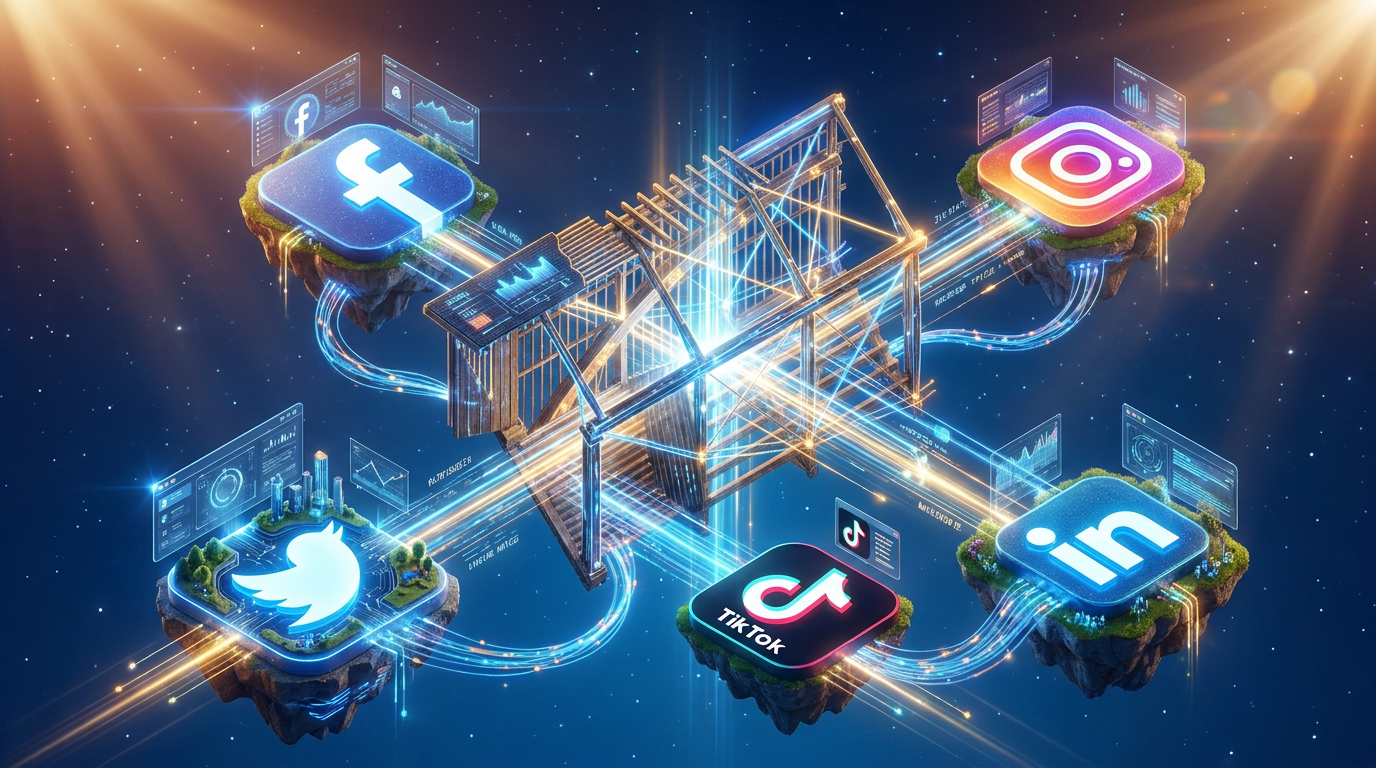
But in 2026, the architecture of the internet is undergoing a quiet, profound renovation. The era of the "walled garden" is giving way to the interoperable social web—a landscape where different apps, servers, and protocols can finally talk to one another seamlessly.[1]
Think of it like email. You do not need a Gmail account to send a message to an Outlook user; the underlying protocols ensure the mail gets delivered regardless of the software. Social media is finally adopting this exact model, prioritizing user freedom over corporate enclosure.[5]
The momentum is being driven by two major open-source protocols. The first is ActivityPub, the World Wide Web Consortium (W3C) standard that powers Mastodon and the broader "Fediverse." The second is the AT Protocol, the engine behind Bluesky, which was built specifically to allow users to pack up their digital identity and move it anywhere.[1][4]

For years, these two networks operated as parallel universes. A user on Mastodon could not natively follow a user on Bluesky, creating a frustrating "protocol divide" that threatened to fracture the decentralized web before it even reached the mainstream.[4]
But recent breakthroughs in bridging technology have effectively translated the languages between the two networks. Services like Bridgy Fed now act as universal translators. By following a specific bridging account, a Bluesky user's profile is automatically mirrored onto the Fediverse, allowing Mastodon users to follow, like, and reply to their posts without ever leaving their preferred app.[5]
This technical milestone has profound implications for digital ownership. It enables a philosophy known as POSSE: Post Own Site, Syndicate Elsewhere. Instead of renting space on a billionaire's server, users can host their own content and broadcast it across the entire decentralized web.[5]
This technical milestone has profound implications for digital ownership.
Major legacy platforms are also being forced to adapt to this new reality. Meta's Threads, which boasts hundreds of millions of users, has integrated ActivityPub sharing. While initially limited, this integration means that an independent blogger on a self-hosted server can theoretically reach a massive mainstream audience without agreeing to Meta's algorithmic feed.[5]

The shift is catching the attention of major tech figures who are exhausted by the toxicity of centralized platforms. Ethereum co-founder Vitalik Buterin recently announced that 2026 would be the year he fully transitions to decentralized social media, abandoning legacy networks entirely.[2]
Buterin noted that centralized platforms prioritize algorithmic engagement over user well-being, turning global discourse into an "information warzone." By moving to a shared data layer, the internet can foster real competition, allowing developers to build better interfaces without having to bootstrap a new network of users from scratch.[2]
To navigate this new landscape, power users are turning to aggregators. Applications like Firefly act as multi-client interfaces, pulling feeds from legacy networks, Mastodon, Bluesky, and Farcaster into a single, unified dashboard. This abstracts the complexity of protocols entirely, letting users focus on the conversation rather than the plumbing.[2][6]
The infrastructure is also expanding beyond traditional microblogging. WordPress, which powers a massive portion of the open web, has made deep ActivityPub integration a core part of its 2026 roadmap, signaling a massive expansion of the Fediverse's footprint.[3]
By turning individual blogs into federated social nodes, WordPress allows readers on Mastodon or Threads to follow a blog, receive full articles in their feed, and leave comments that sync directly back to the author's website. The web is becoming a two-way street again.[3]

To solve the "empty feed" problem that historically plagued decentralized networks, developers are rolling out "Starter Packs"—curated, shareable lists of accounts that help new users instantly plug into vibrant communities without having to hunt for interesting voices.[3]
Regulatory pressure is also accelerating the trend. In Europe, the Digital Markets Act (DMA) is scheduled for a 2026 review that advocates hope will mandate interoperability for all major social networking platforms, legally preventing tech giants from locking users in.[1]
We are witnessing the maturation of the social web. The focus has shifted from finding a single "Twitter killer" to building a resilient, interconnected ecosystem where no single CEO can unilaterally change the rules of public discourse.[4][6]

How we got here
2018
ActivityPub is officially published as a W3C standard.
2023
Bluesky launches its beta, introducing the AT Protocol for account portability.
2024
Meta's Threads begins rolling out opt-in ActivityPub integration.
2025
Bridgy Fed launches, allowing cross-communication between Bluesky and Mastodon.
2026
WordPress deepens Fediverse integration; multi-client aggregators gain mainstream traction.
Viewpoints in depth
The Protocol Purists
Advocates who believe social media must be built on decentralized, server-to-server networks like ActivityPub.
This camp argues that true digital sovereignty only comes when no single entity controls the network. By using ActivityPub, the Fediverse operates much like email—if one server shuts down or changes its rules, users can simply migrate to another without the entire ecosystem collapsing. They view corporate adoption of open protocols with cautious optimism, warning that giants like Meta might attempt to 'embrace, extend, and extinguish' the open web.
The Portability Pragmatists
Developers and users who prioritize account portability and user experience over strict server decentralization.
Supporters of Bluesky's AT Protocol argue that average users do not want to manage servers; they just want their apps to work smoothly. This viewpoint emphasizes 'composable moderation' and decentralized identifiers (DIDs). In their view, as long as a user can pack up their followers and move to a different app interface instantly, the underlying server architecture can remain relatively centralized for the sake of speed and reliability.
The Aggregator Approach
Power users who believe the future lies in multi-client dashboards that abstract the protocols entirely.
For this group, the protocol wars are a distraction. They point to tools like Firefly, which pull feeds from legacy networks, Mastodon, Bluesky, and Farcaster into a single unified interface. They argue that mainstream adoption will only happen when users no longer have to think about whether their friends are on ActivityPub or the AT Protocol. The goal is to make cross-platform communication as frictionless as sending a text message.
What we don't know
- How aggressively regulators in the EU and US will mandate interoperability for legacy platforms like X and TikTok.
- Whether decentralized moderation tools can scale effectively to handle coordinated harassment across bridged networks.
- How smaller, independent servers will fund the rising infrastructure costs of processing millions of cross-platform interactions.
Key terms
- ActivityPub
- An open, decentralized social networking protocol that allows different platforms to share posts and interactions, much like how email servers communicate.
- AT Protocol
- The underlying technology powering Bluesky, designed specifically to allow users to move their accounts and followers seamlessly between different apps.
- Interoperability
- The ability of different computer systems, software, or social networks to connect and exchange information with one another.
- Walled Garden
- A closed platform that restricts users from interacting with people or content outside of its own corporate ecosystem.
Frequently asked
What is the Fediverse?
The Fediverse is a network of independent social media servers that can communicate with each other using a shared open language called ActivityPub.
Can I follow a Bluesky user from Mastodon?
Yes. Through bridging services like Bridgy Fed, users on different protocols can now follow, like, and reply to each other seamlessly across platforms.
Do I need to understand protocols to use this?
No. In 2026, multi-client apps and native integrations make cross-platform posting as simple and frictionless as sending an email.
What does POSSE mean?
It stands for 'Post Own Site, Syndicate Elsewhere.' It is a strategy where you publish content on your own website first, then automatically push it out to various social networks.
Sources
Source coverage
6 outlets
3 viewpoints surfaced






[1]Open Future FoundationDigital Commons Advocates
A Public, Interoperable Social Media Space
Read on Open Future Foundation →[2]ForkLogDecentralization Pragmatists
Vitalik Buterin to Reembrace Decentralised Social Networks by 2026
Read on ForkLog →[3]WordPressDigital Commons Advocates
Roadmap 2026 — Charting the stars of the open social web
Read on WordPress →[4]Silphium DesignProtocol Architects
The Future of Interoperability Between Mastodon and Bluesky: A 2026 Comprehensive Examination
Read on Silphium Design →[5]Electronic Frontier FoundationDigital Commons Advocates
A Bridge to Somewhere: How to Link Your Mastodon, Bluesky, or Other Federated Accounts
Read on Electronic Frontier Foundation →[6]Factlen Editorial TeamDecentralization Pragmatists
Synthesis by Factlen editorial team
Read on Factlen Editorial Team →

More in technology
See all 56 stories →Web Interoperability
The Era of User-Controlled Social Media: How Interoperability and Custom Algorithms Are Rewriting the Internet
7 sources
Right to Repair
The Evidence Pack: Do 'Right to Repair' Mandates Actually Reduce E-Waste and Save Money?
8 sources

Wearable Tech
Engineers Develop a Wearable Jacket That Pulls Drinking Water From Thin Air
7 sources

Agentic AI
How Microsoft and Xiaomi Are Turning Plain Text Into Trainable AI Parameters
10 sources

Every angle. Every day.
Get technology stories with full source coverage and perspective breakdowns delivered to your inbox.