
The 2026 Office-to-Residential Boom: Evidence on the Feasibility of Adaptive Reuse
A record 90,300 empty office units are currently being converted into apartments across the U.S. While not a universal cure for the housing shortage, new data reveals the precise architectural and economic conditions required to successfully turn obsolete commercial towers into vibrant residential neighborhoods.
By Factlen Editorial Team
- Urban Planners & Architects
- Argue that adaptive reuse is a sustainable way to revitalize empty downtowns and solve the housing crisis through design innovation.
- Real Estate Economists
- Focus on the financial viability of conversions, noting that high costs and structural limits mean only a fraction of buildings are suitable.
- Municipal Policymakers
- View conversions as a necessary tool to protect city tax bases and mandate affordable housing through targeted zoning incentives.
What's not represented
- · Commercial office landlords facing foreclosure
- · Suburban residents opposing density increases
Why this matters
The permanent shift to hybrid work has left downtowns empty while housing costs soar. Understanding the viability of office conversions reveals whether your city's vacant commercial towers will become engines of affordable housing or remain stranded assets.
Key points
- The U.S. pipeline for office-to-residential conversions hit a record 90,300 units in early 2026, a 28% increase from the previous year.
- Economic research indicates that approximately 11% to 25% of existing office buildings possess the structural dimensions required for residential conversion.
- The trend is being accelerated by a looming wall of commercial debt, with roughly $213 billion in office loans maturing by the end of the year.
- While conversions offer significant environmental benefits by preserving embodied carbon, high retrofitting costs mean most projects require municipal tax incentives to be financially viable.
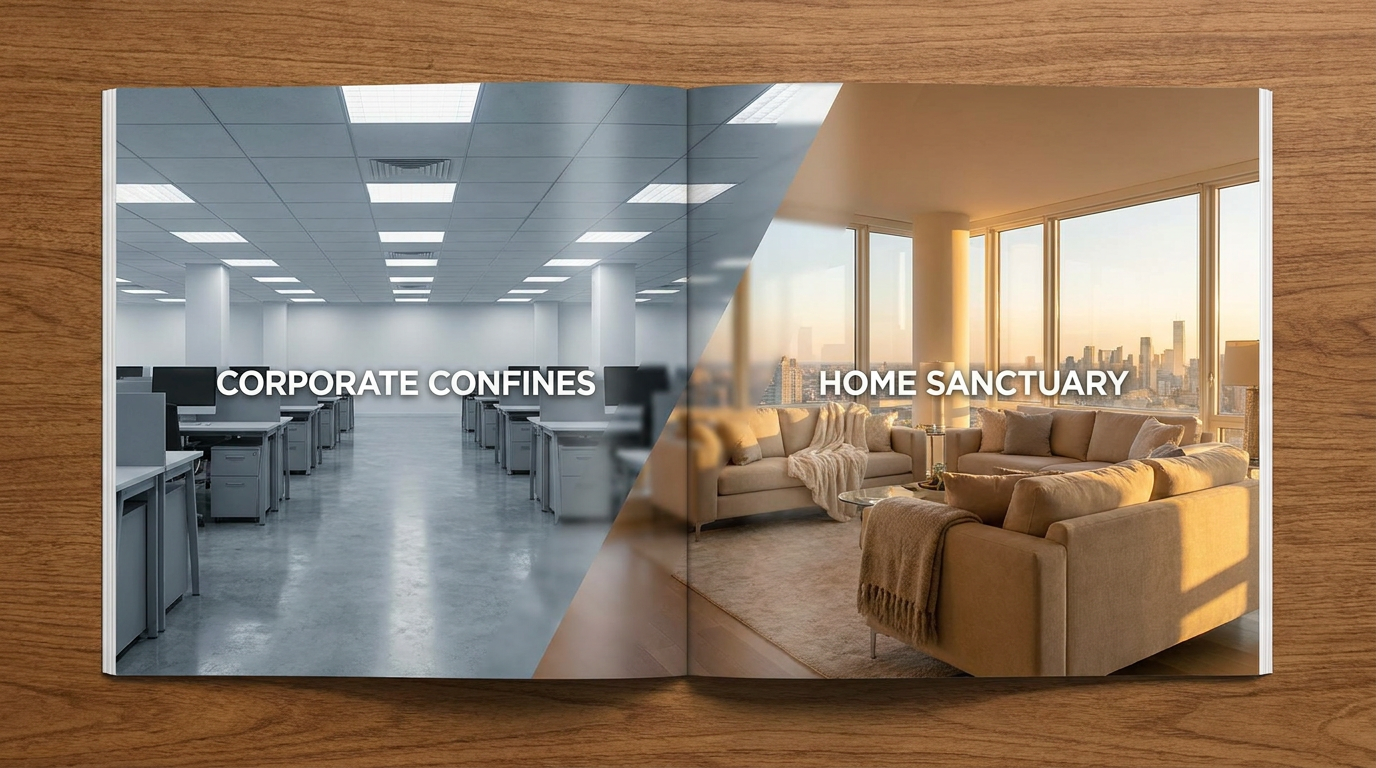
The American downtown is undergoing its most profound physical transformation since the post-war construction boom. Driven by the permanent entrenchment of hybrid work and shifting corporate footprints, millions of square feet of commercial real estate currently sit vacant in city centers across the country. But rather than signaling terminal urban decay, this unprecedented surplus of empty space is fueling a historic wave of adaptive reuse. Developers, architects, and city planners are increasingly collaborating to turn obsolete cubicles and empty boardrooms into much-needed residential neighborhoods, fundamentally reimagining the purpose of the central business district.[6]
At the start of 2026, the pipeline for office-to-residential conversions reached a record 90,300 units nationwide, according to industry tracking data. This represents a staggering 28% year-over-year increase and is nearly four times the volume of conversions recorded just four years ago in 2022. What was once considered a niche architectural novelty—typically reserved for historic bank buildings or boutique loft projects—has rapidly matured into a mainstream, large-scale development strategy. Major institutional investors and regional developers are now actively hunting for distressed commercial assets specifically to strip them down to their concrete bones and rebuild them as modern apartment complexes.[1][4]
The momentum behind this shift is born of a dual crisis: a commercial real estate market burdened by excess capacity and a severe national housing shortage. With national office vacancy rates hovering around 19%, municipalities are desperate to restore daily foot traffic, support local small businesses, and preserve their commercial tax bases. Simultaneously, the United States faces a structural deficit of millions of homes, pushing basic affordability out of reach for many essential urban workers and young families who want to live near transit hubs.[2][4]

The financial catalyst accelerating this architectural trend is a looming wall of commercial debt. Roughly $213 billion in commercial office loans are scheduled to mature by the end of 2026. Facing persistently higher interest rates and severely diminished rent rolls from fleeing corporate tenants, many property owners find themselves backed into a corner. Rather than default on their loans or attempt to refinance half-empty buildings at punitive rates, owners are increasingly choosing to pivot to residential use, viewing conversion as the only viable path to salvage the underlying value of their real estate.[4]
However, the empirical evidence clearly shows that not every glass tower can seamlessly become a home. A landmark working paper from the National Bureau of Economic Research (NBER) established a rigorous set of physical and economic criteria for conversion viability. The researchers analyzed the commercial districts of the 105 largest cities in the United States, filtering out buildings with incompatible dimensions or long-term corporate tenants still in place. They concluded that only about 11% of existing office buildings across the country possess the necessary structural characteristics to make a residential transition physically and economically feasible.[2]
While 11% may sound like a narrow slice of the market, the absolute scale of that fraction is massive. If fully realized, converting just this structurally optimal 11% could add approximately 400,000 new apartments to the national housing stock. The NBER economic model highlights that these conversions become financially feasible primarily when the obsolete office buildings change hands at significantly reduced fair market values. In other words, the original commercial landlord must often take a substantial loss, resetting the cost basis low enough for a residential developer to absorb the massive capital costs of a retrofit.[2]

Architectural firms have developed even more granular assessment tools to identify these prime candidates. Gensler, a global design and architecture firm, created a proprietary algorithm to score commercial buildings based on floor plates, building form, elevator core placement, and facade constraints. Their expanded 2025 analysis of over 1,000 North American sites found a slightly more optimistic outlook, determining that roughly 25% of aging office buildings meet the baseline architectural criteria for adaptive reuse. This data-driven approach allows developers to quickly separate viable projects from structural money pits.[3]
Architectural firms have developed even more granular assessment tools to identify these prime candidates.
The primary physical hurdle in almost every conversion project is the 'deep floor plate.' Modern office buildings, particularly those constructed in the 1970s and 1980s, were designed with massive, sprawling floors illuminated entirely by artificial fluorescent light. Residential building codes, however, strictly require bedrooms and living spaces to have operable windows and direct access to natural light. This geometric reality leaves developers with vast, dark interior spaces at the core of the building that are incredibly difficult to monetize as traditional, code-compliant apartments.[3][5]
Rather than abandoning these deep-core buildings, innovative design is turning this spatial constraint into a competitive advantage. Architects are deploying creative solutions, such as carving out massive central atriums from the roof down to the lobby to bring sunlight into the interior core of the building. Alternatively, developers are utilizing the deep, windowless interior spaces to house premium, sprawling residential amenities that ground-up apartment buildings rarely have the square footage to offer—including multi-lane bowling alleys, expansive co-working lounges, soundproofed home theaters, and commercial-grade fitness centers.[3]

The environmental evidence strongly favors this adaptive approach over the traditional cycle of demolition and new construction. The NBER study explicitly frames the trend as a vital mechanism for converting 'brown offices to green apartments.' Rehabilitating an existing structure preserves the massive amount of embodied carbon trapped within the original concrete foundation and steel frame. Studies show that adaptive reuse produces 50% to 75% fewer carbon emissions than demolishing a tower, hauling away the debris, and building a comparable residential structure from scratch on the same site.[2]
Geographically, the conversion boom is highly concentrated in specific urban markets that feature a perfect storm of older building stock and intense housing demand. New York City currently leads the nation by a wide margin, with over 16,000 units currently in the conversion pipeline. Washington D.C. follows closely behind with nearly 8,500 units underway. However, the trend is rapidly expanding beyond the coastal gateways; cities like Chicago, Los Angeles, and Dallas are also seeing significant pipeline growth as local developers recognize the untapped potential in their aging downtown skylines.[1][4]
The success of conversions in these specific cities is not purely organic; it is heavily engineered and subsidized by municipal policy. The Brookings Institution notes that in most places, the raw economics of conversion still do not pencil out without targeted government intervention. The cost of replacing commercial curtain walls and coring through concrete floors for hundreds of new residential bathrooms is simply too high. Consequently, proactive cities are deploying aggressive property tax abatements, expedited permitting processes, and zoning exemptions to bridge the financial gap and incentivize developers to take on the risk.[4][5][6]

Beyond the pure economics of housing supply, there is also a compelling demographic and social dimension to the conversion trend. Simulations conducted by the Brookings Institution suggest that office-to-residential conversions, if managed equitably, can serve as a powerful tool for urban desegregation. By introducing dense new housing supply into traditionally commercial, high-opportunity downtown census tracts, cities have a unique opportunity to affirmatively further fair housing goals, bringing diverse populations into neighborhoods that previously had almost zero permanent residents.[5]
Despite the widespread optimism surrounding the 2026 pipeline, significant uncertainties remain regarding the long-term scalability of the trend. The data indicates that current conversions are heavily skewed toward Class B and C office buildings—older, less desirable properties that are highly vulnerable to market shifts and tenant flight. It remains entirely unclear if the current rapid pace of conversion can be sustained once the most obvious, structurally compliant 'low-hanging fruit' has been successfully redeveloped, leaving behind only the most difficult and expensive architectural challenges.[1][6]
Furthermore, while adaptive reuse undeniably adds crucial supply to constrained markets, it is not a standalone panacea for the affordable housing crisis. The exceptionally high capital costs associated with retrofitting commercial HVAC systems, upgrading electrical grids, and replacing facades mean that the vast majority of resulting units must be priced at market or luxury rates just to break even. Unless these projects are explicitly subsidized by local governments in exchange for deed-restricted affordable units, they primarily serve high-income renters rather than the working-class families most impacted by the housing shortage.[2][5]
Ultimately, the accumulated evidence suggests that office-to-residential conversion is a highly effective, localized surgical tool rather than a blanket cure for the national housing deficit. As the record-breaking 2026 pipeline matures from architectural blueprints to occupied homes, these projects stand to fundamentally rewrite the DNA of the American downtown. By replacing empty cubicles with living rooms, cities are slowly transforming sterile, 9-to-5 commercial districts into vibrant, 24-hour neighborhoods equipped to thrive in the era of hybrid work.[5][6]
How we got here
Pre-2020
Office-to-residential conversions are a niche architectural practice, largely limited to historic or boutique buildings.
2020–2022
The pandemic normalizes remote work, causing downtown office vacancy rates to climb steadily.
August 2023
The NBER publishes a landmark study identifying that 11% of US office buildings are physically viable for green apartment conversions.
2024–2025
Major cities like New York and Washington D.C. introduce aggressive tax incentives and zoning reforms to spur adaptive reuse.
Early 2026
The conversion pipeline hits a record 90,300 units nationwide, a 28% increase from the previous year.
Viewpoints in depth
The Architectural Optimists
Designers and urban planners who see obsolete offices as a blank canvas for sustainable urban renewal.
For architectural firms and urban planners, the structural quirks of aging office buildings are not dealbreakers, but opportunities for innovation. They argue that the deep floor plates of 1980s commercial towers—often cited as the biggest hurdle to residential conversion—can be repurposed into premium communal amenities or carved out to create light-filled central atriums. Furthermore, they emphasize the environmental imperative: rehabilitating an existing structure preserves massive amounts of embodied carbon compared to demolishing a tower and building a new one from scratch.
The Economic Realists
Analysts who caution that the math of adaptive reuse only works under very specific, subsidized conditions.
Real estate economists and financial analysts offer a more measured view, pointing out that only 11% to 25% of the nation's office stock is physically suitable for conversion. They argue that the sheer cost of retrofitting commercial HVAC systems, plumbing, and facades often exceeds the value of the finished apartments. From this perspective, the current boom is largely driven by distress—specifically, billions in maturing commercial loans—and heavily dependent on municipal tax abatements. Without significant government subsidies, they warn, conversions will remain a niche luxury product rather than a scalable solution to the affordable housing shortage.
What we don't know
- Exactly how many of the 90,300 planned units will successfully secure the complex financing required to reach completion.
- Whether suburban office parks will see the same conversion success as dense downtown high-rises.
- The long-term impact on municipal tax revenues if commercial property values permanently reset at lower residential conversion valuations.
Key terms
- Adaptive Reuse
- The process of repurposing an existing building for a use other than what it was originally designed for, such as turning an office into apartments.
- Floor Plate
- The total leasable square footage of a single floor in a commercial building, which dictates how far interior spaces are from natural light.
- Embodied Carbon
- The greenhouse gas emissions associated with the manufacturing, transportation, and installation of building materials, which are largely saved during a conversion.
Frequently asked
Can any empty office building become an apartment?
No. Only about 11% to 25% of office buildings have the right structural dimensions, plumbing access, and window layouts to meet residential building codes.
Is it cheaper to convert an office or build from scratch?
It depends on the building, but adaptive reuse can reduce development costs by 30% to 50% per square foot compared to ground-up construction, while also saving significant time.
Does this solve the affordable housing crisis?
Partially. While it adds crucial supply, the high cost of conversion means many resulting units are market-rate or luxury, unless developers receive specific government tax incentives to include affordable tiers.
Sources
Source coverage
6 outlets
3 viewpoints surfaced






[1]RentCafe / Yardi MatrixReal Estate Economists
Adaptive reuse surges to record 25K apartments, Chicago overtakes Manhattan as top city for conversions
Read on RentCafe / Yardi Matrix →[2]National Bureau of Economic ResearchReal Estate Economists
Converting Brown Offices to Green Apartments
Read on National Bureau of Economic Research →[3]GenslerUrban Planners & Architects
New Study Offers Data-Driven Approach for Office-to-Housing Conversions
Read on Gensler →[4]BisnowReal Estate Economists
Office-To-Resi Conversions Up 28% From Last Year's Record Levels
Read on Bisnow →[5]Brookings InstitutionUrban Planners & Architects
The promises—and realities—of converting offices into housing
Read on Brookings Institution →[6]Factlen Editorial TeamMunicipal Policymakers
Synthesis by Factlen editorial team
Read on Factlen Editorial Team →
Every angle. Every day.
Get real estate stories with full source coverage and perspective breakdowns delivered to your inbox.