
The 2026 Guide to Cold-Climate Heat Pumps: Economics, Efficiency, and Retrofits
Advances in cold-climate technology and shifting energy economics have made heat pumps the default replacement for aging gas furnaces. This guide breaks down the real-world costs, efficiency metrics, and installation realities for homeowners in 2026.
By Factlen Editorial Team
- Electrification Advocates
- Argue for the complete phase-out of residential fossil fuels to meet climate targets.
- HVAC Contractors
- Prioritize practical, reliable comfort and manageable installation costs via hybrid systems.
- Energy Economists
- Focus on the raw math of utility rates, upfront costs, and long-term payback periods.
What's not represented
- · Natural gas utility companies facing declining residential demand.
- · Renters who cannot control their building's HVAC infrastructure.
Why this matters
Heating and cooling account for roughly half of a typical home's energy use. Understanding the new economics of cold-climate heat pumps can save homeowners thousands of dollars over a system's lifespan while significantly reducing their carbon footprint.
Key points
- Modern cold-climate heat pumps can operate efficiently in temperatures as low as -25°F.
- Heat pumps achieve 300% to 400% efficiency by moving heat rather than generating it.
- Federal and state incentives can reduce the upfront installation cost by thousands of dollars.
- The financial benefit of switching depends heavily on local electricity versus natural gas rates.
The residential heating landscape has crossed a tipping point in 2026. Driven by rising energy costs, stricter efficiency standards, and technological breakthroughs, heat pumps have moved from an alternative option to the default replacement for aging gas furnaces.[7]
The North American market for cold-climate heat pumps is projected to reach $3.57 billion this year, reflecting a massive shift in how homeowners approach climate control. For decades, the conventional wisdom held that heat pumps were only suitable for mild, southern climates. Today, that conventional wisdom is entirely obsolete.[8]
The fundamental advantage of a heat pump lies in its mechanism: it moves heat rather than creating it. Traditional gas furnaces burn fuel to generate warmth, a process inherently limited by the laws of physics.[9]
Even the most advanced, top-of-the-line condensing furnaces max out at 96% efficiency, meaning 4% of the energy consumed is inevitably lost as exhaust gas vented outside the home.[3]

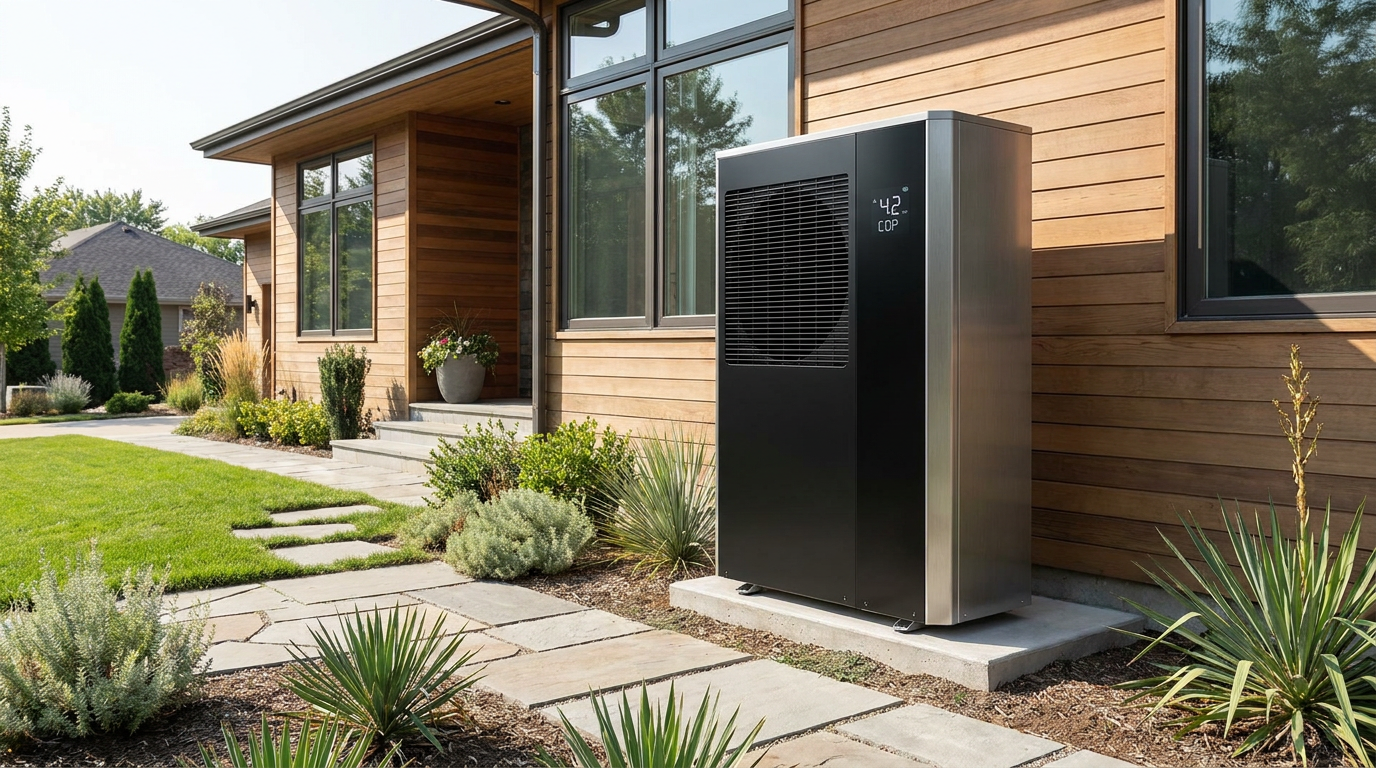
Heat pumps, conversely, use a closed-loop refrigerant cycle to extract ambient thermal energy from the outside air, compress it to raise its temperature, and transfer it indoors. Because they are merely relocating existing heat, modern systems routinely achieve 300% to 400% efficiency.[3][9]
In practical terms, this means that for every single unit of electricity the system consumes, it delivers three to four units of heating energy to the home's interior. This massive efficiency multiplier is the core reason heat pumps are aggressively displacing fossil fuel systems.[4][5]
Historically, this efficiency plummeted when outdoor temperatures dropped below freezing, as older single-stage compressors struggled to extract heat from frigid air. That limitation has been effectively engineered away by the advent of cold-climate heat pumps (CCHPs).[1]
The latest CCHPs utilize variable-speed, inverter-driven compressors that dynamically adjust their output. Instead of simply turning on and off, they ramp up their speed to maintain consistent heating even in extreme weather, operating effectively at temperatures as low as -15°F to -25°F.[7]
A multi-year pilot program in Maine recently proved the technology's viability in deep freezes. The state successfully installed over 100,000 heat pumps, with homeowners reporting 40% to 60% savings over traditional oil heating and an 89% satisfaction rate—even during a severe -15°F polar vortex.[1]

A multi-year pilot program in Maine recently proved the technology's viability in deep freezes.
Another major shift in 2026 is the industry-wide transition to next-generation refrigerants. Driven by environmental regulations aimed at reducing greenhouse gases, manufacturers have largely phased out older chemicals like R-410A.[4]
The industry has moved toward low-GWP (Global Warming Potential) alternatives like R-32, R-454B, and R-290. R-290, which is highly refined propane, is particularly notable for its ability to produce higher flow temperatures, making it much easier to retrofit older homes equipped with traditional hot-water radiators.[4]
Despite the operational savings and environmental benefits, the upfront cost remains a significant hurdle for many families. A full ducted cold-climate heat pump installation typically ranges from $8,000 to $15,000 before incentives.[1]
Furthermore, older homes may require electrical system upgrades to handle the increased load. Upgrading a 100-amp electrical panel to a 200-amp service can add $2,000 to $5,000 to the total project cost, complicating the return on investment.[8]
To bridge this financial gap, federal and state incentives have fundamentally altered the math. Under the Inflation Reduction Act, U.S. homeowners can claim a 25C tax credit of up to $2,000 annually for qualifying heat pump installations.[3][5]
When combined with state-level rebates—which can reach up to $8,000 for income-qualified households under the HEEHRA program—the net out-of-pocket cost of a high-efficiency heat pump often drops below that of a standard gas furnace and air conditioner replacement.[1][4]
However, the decision to switch ultimately depends on local utility rates. Industry analysts in 2026 rely on a specific decision matrix: if a region's electricity-to-gas price ratio is below 3.5 to 1, the heat pump almost always wins on operating costs.[5]

Generally, if electricity is below $0.16 per kilowatt-hour and natural gas is above $0.85 per therm, the heat pump is the clear financial victor, saving homeowners hundreds of dollars annually.[2]
In areas with exceptionally cheap natural gas or unusually high electricity rates, the math becomes tighter. For these regions, HVAC contractors are increasingly recommending dual-fuel or hybrid systems.[5][6]
These hybrid setups use a high-efficiency heat pump for the vast majority of the winter, automatically switching to a backup gas furnace only during the coldest stretches when the heat pump's efficiency dips, offering the best of both worlds.[6]

As the 2026 heating season approaches, the consensus among building scientists and energy economists is clear. Between the environmental imperative, the technological leaps in cold-weather performance, and the heavy thumb of government incentives, heat pumps have cemented their status as the smartest investment in home comfort.[4][8]
How we got here
2022
The Inflation Reduction Act passes, introducing the 25C tax credit for heat pump installations.
2024
Maine successfully hits its pilot program target of installing 100,000 heat pumps, proving cold-climate viability.
January 2026
New environmental regulations phase out high-GWP refrigerants, prompting a shift to R-32 and R-290 in new units.
Viewpoints in depth
Electrification Advocates
Argue for the complete phase-out of residential fossil fuels to meet climate targets.
Groups focused on decarbonization emphasize that heat pumps are essential for meeting climate targets. They argue that even on a fossil-fuel-heavy electric grid, the 300% efficiency of a heat pump results in lower total emissions than burning gas on-site, and they push for full home electrification rather than hybrid compromises.
HVAC Contractors
Prioritize practical, reliable comfort and manageable installation costs via hybrid systems.
Many installers favor dual-fuel or hybrid systems, especially in older homes or deep-freeze climates. They point out that keeping an existing gas furnace as a backup avoids the need for expensive electrical panel upgrades and guarantees heat during extreme polar vortex events when heat pump efficiency drops.
Energy Economists
Focus on the raw math of utility rates, upfront costs, and long-term payback periods.
This camp evaluates the transition purely on return on investment. They emphasize that the viability of a heat pump is hyper-local, depending entirely on the ratio of electricity to natural gas prices in a specific zip code, and warn that high upfront costs can negate operational savings in regions with expensive power.
What we don't know
- How quickly the electrical grid in colder regions can adapt to the increased winter demand from widespread heat pump adoption.
- Whether federal tax incentives will be extended or modified after their current expiration dates.
Key terms
- COP (Coefficient of Performance)
- A metric of heat pump efficiency, representing the ratio of heat output to electrical energy input.
- AFUE (Annual Fuel Utilization Efficiency)
- A measure of a gas furnace's efficiency, indicating the percentage of fuel converted into usable heat.
- Inverter Compressor
- A variable-speed motor in modern heat pumps that adjusts its output dynamically, rather than just turning on and off.
- Dual-Fuel System
- A hybrid HVAC setup that uses a heat pump for moderate weather and a gas furnace for extreme cold.
Frequently asked
Do heat pumps work in freezing weather?
Yes. Modern cold-climate heat pumps use advanced variable-speed compressors to extract heat from the air even when temperatures drop to -15°F or lower.
Will I need to upgrade my electrical panel?
It depends on your home. Switching from gas to electric heating increases your home's electrical load, which may require upgrading an older 100-amp panel to a 200-amp service.
Are heat pumps cheaper to run than gas furnaces?
In most regions, yes. If your local electricity rates are relatively low compared to natural gas prices, the extreme efficiency of a heat pump will lower your monthly utility bills.
Sources
Source coverage
9 outlets
3 viewpoints surfaced









[1]The Daily ExplainerElectrification Advocates
Is a heat pump right for your home? Complete 2026 guide
Read on The Daily Explainer →[2]Building TalksEnergy Economists
Heat pump vs furnace cost 2026 — the decision matrix
Read on Building Talks →[3]NuWatt EnergyEnergy Economists
Heat Pump vs Gas Furnace: Annual Running Cost Comparison
Read on NuWatt Energy →[4]EcoHomeElectrification Advocates
Heat pump grants and incentives: maximizing your 2026 savings
Read on EcoHome →[5]AC DirectHVAC Contractors
Heat Pump vs Gas Furnace: Annual Running Cost Comparison
Read on AC Direct →[6]Ecco SupplyHVAC Contractors
Heat pumps go mainstream, and “hybrid” becomes a normal option
Read on Ecco Supply →[7]Quality Comfort SolutionsHVAC Contractors
Heat Pumps Leading the Market
Read on Quality Comfort Solutions →[8]Market Data ForecastEnergy Economists
North America Residential Cold Climate Heat Pump Market
Read on Market Data Forecast →[9]Inverter CoolEnergy Economists
Comparing gas furnace vs heat pump costs
Read on Inverter Cool →
Every angle. Every day.
Get home stories with full source coverage and perspective breakdowns delivered to your inbox.