
Steam Deck OLED vs. ROG Ally X: Which Handheld Gaming PC Wins in 2026?
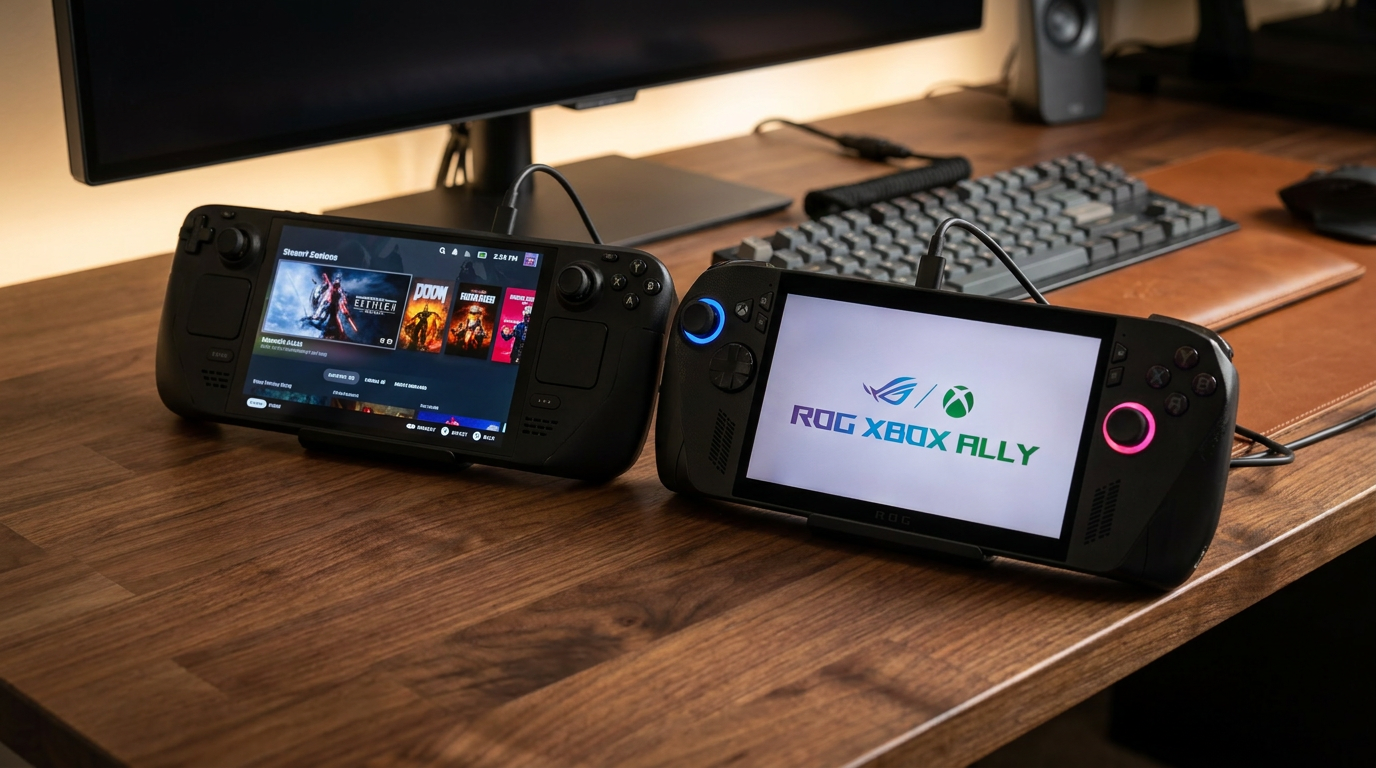
As the handheld PC market matures, Valve's frictionless Steam Deck OLED and ASUS's powerhouse ROG Ally X offer two radically different paths for portable gaming.
By Factlen Editorial Team
- Console Purists
- Argue for the frictionless, plug-and-play experience of SteamOS and the visual fidelity of the OLED screen.
- Performance Enthusiasts
- Value raw computational power, high refresh rates, and the flexibility to run any Windows application or game launcher.
- Value-Conscious Gamers
- Focus on the price-to-performance ratio, weighing the high cost of premium handhelds against their actual daily utility.
What's not represented
- · Game Developers
- · Cloud Gaming Advocates
Why this matters
Choosing a handheld gaming PC is no longer a niche experiment; it is a $500 to $800 investment that can entirely replace a traditional console or desktop. Understanding the specific trade-offs between battery life, operating systems, and raw power ensures players buy the device that actually fits their lifestyle.
Key points
- The Steam Deck OLED excels in battery efficiency, console-like ease of use, and visual fidelity thanks to its HDR display.
- The ASUS ROG Ally X dominates in raw performance, offering 15 to 40 percent faster frame rates in demanding AAA titles.
- Windows 11 on the Ally X provides native access to Xbox Game Pass and anti-cheat software, but introduces desktop friction.
- The Steam Deck's 50Wh battery outlasts the Ally X's 80Wh battery in real-world gaming due to its highly tuned, lower-wattage architecture.
- Buyers must choose between Valve's frictionless, curated ecosystem and ASUS's powerful, unrestricted PC experience.
The handheld PC market in 2026 has matured from a niche hardware experiment into a legitimate, highly competitive alternative to traditional desktop gaming. As components become more efficient and screens grow more vibrant, the gap between portable convenience and AAA performance has effectively vanished.[1][2]
Two heavyweights currently dominate the conversation and consumer wallets: Valve's Steam Deck OLED and the ASUS ROG Ally X. Rather than simply competing on spec sheets, these two devices represent fundamentally different philosophies about what a portable gaming computer should be.[4][6]
Valve's approach with the Steam Deck OLED is the complete console-ification of the PC. Running on a custom, Linux-based operating system called SteamOS, the device prioritizes a frictionless, plug-and-play experience that shields the user from the traditional complexities of computer gaming.[3][5]
The case for the Steam Deck OLED rests heavily on its stunning display and unmatched efficiency. The device features a 7.4-inch OLED screen that delivers infinite contrast, deep blacks, and HDR capabilities that standard IPS panels simply cannot replicate, making atmospheric and story-driven games look spectacular.[4][6]
The evidence for Valve's efficiency is striking. Thanks to a meticulously tuned APU and a 50Wh battery, the Steam Deck OLED routinely delivers three to eight hours of playtime for indie titles and lighter workloads, making it the undisputed champion for long flights and daily commutes.[2][6]

The argument against the Steam Deck OLED centers on its performance ceiling and software limitations. It struggles to push modern, demanding AAA titles past 30 to 40 frames per second, and its Linux foundation means that games relying on kernel-level anti-cheat software—like many popular multiplayer shooters—simply will not run without cumbersome workarounds.[4][5]
On the other side of the spectrum, the ASUS ROG Ally X represents raw, unbridled Windows power. It is essentially a high-performance gaming laptop shrunk into a controller chassis, designed for players who refuse to compromise on frame rates or ecosystem access.[1][3]
The case for the ROG Ally X is built entirely on its brute-force hardware. Powered by the AMD Ryzen Z1 Extreme processor and a massive 24GB of RAM, the device is engineered to power through demanding titles that make the Steam Deck stutter.[2][6]
The case for the ROG Ally X is built entirely on its brute-force hardware.
Evidence of this power is abundantly clear in benchmark testing. The Ally X routinely delivers 15 to 40 percent faster frame rates in CPU-bound scenarios, allowing it to take full advantage of its crisp 1080p, 120Hz variable refresh rate display for competitive, high-speed gameplay.[5][6]

Furthermore, because it runs native Windows 11, the Ally X offers complete ecosystem flexibility. Users have immediate, native access to Xbox Game Pass, the Epic Games Store, and every anti-cheat-heavy multiplayer game on the market, requiring zero Linux translation layers.[4][5]
The argument against the ROG Ally X is the inherent friction of running Windows 11 on a seven-inch touchscreen. Users must frequently contend with background updates, occasional sleep-mode crashes, and a desktop user interface that was never designed to be navigated with thumbsticks.[4][5]
Additionally, while ASUS upgraded the Ally X with a massive 80Wh battery—the largest in its class—the power-hungry architecture means that running AAA games at a maximum 30-watt TDP will still drain the device in under two hours, limiting its true portability.[2][6]
Ergonomics and hardware features also present distinct trade-offs for prospective buyers. The Steam Deck features dual trackpads, which are a revelation for playing strategy and simulation games, while the Ally X counters with dual USB-C ports, including Thunderbolt support for connecting external desktop GPUs.[1][6]

Price remains a significant dividing line in this trade-off analysis. The Steam Deck OLED offers a highly accessible entry point for budget-conscious gamers, while the ROG Ally X demands a premium price tag that pushes it into the territory of mid-range gaming laptops.[4][5]
Ultimately, the Steam Deck OLED fits perfectly when a user wants a seamless, console-like experience, prioritizes battery life for frequent travel, and primarily plays single-player adventures or indie titles from their existing Steam library.[3][6]
The Steam Deck OLED does not fit well when a player relies heavily on Xbox Game Pass subscriptions, demands 60 frames per second in the latest AAA releases, or spends their time in competitive multiplayer games requiring strict anti-cheat compatibility.[4][5]
Conversely, the ASUS ROG Ally X fits perfectly when a user wants the absolute highest portable frame rates, needs native Windows compatibility for diverse game launchers, and treats their handheld as a primary gaming PC that can be docked to a monitor.[1][5]

How we got here
February 2022
Valve releases the original LCD Steam Deck, proving the viability of the modern handheld PC market.
June 2023
ASUS launches the original ROG Ally, introducing a high-power Windows alternative to the Steam Deck.
November 2023
Valve releases the Steam Deck OLED, featuring a vastly improved screen, better battery life, and refined thermals.
July 2024
ASUS releases the ROG Ally X, addressing battery and RAM limitations of their original model.
Mid-2026
The handheld market matures with both devices dominating their respective niches of efficiency and raw power.
Viewpoints in depth
Console Purists
Advocates for a frictionless, plug-and-play gaming experience.
This camp argues that a handheld device should feel like a dedicated gaming console, not a shrunken desktop computer. They praise Valve's SteamOS for eliminating the need to update drivers, manage background tasks, or navigate clunky desktop interfaces with thumbsticks. For these users, the OLED screen's visual fidelity and the device's ability to suspend and resume gameplay instantly are far more valuable than raw frame rates.
Performance Enthusiasts
Gamers who prioritize raw computational power and ecosystem flexibility.
Performance enthusiasts view the ROG Ally X as the ultimate portable machine, willing to trade the simplicity of SteamOS for the unrestricted freedom of Windows 11. They point to the Ally X's ability to run demanding AAA games at higher frame rates, utilize variable refresh rate technology, and natively support Xbox Game Pass and Epic Games Store. For this group, the occasional Windows troubleshooting is a small price to pay for a device that can double as a fully functional desktop PC.
Value-Conscious Gamers
Consumers focused on the price-to-performance ratio and real-world utility.
This perspective carefully weighs the high cost of premium handhelds against their actual daily use. They argue that while the ROG Ally X offers superior hardware, the Steam Deck OLED provides a more complete, reliable package at a significantly lower entry price. They often caution against overspending on portable power that will ultimately be bottlenecked by battery life, suggesting that the Steam Deck remains the smartest financial choice for the average player.
What we don't know
- Whether Valve will eventually release a dual-boot wizard to make installing Windows on the Steam Deck a frictionless process.
- How upcoming next-generation APUs from AMD and Intel will shift the balance of power and battery life in future handheld iterations.
Key terms
- APU
- Accelerated Processing Unit, a single chip that combines both the central processor (CPU) and graphics processor (GPU).
- SteamOS
- A custom, Linux-based operating system developed by Valve specifically for gaming and the Steam Deck.
- TDP
- Thermal Design Power, a measure of how much electrical power a chip is allowed to draw, which directly affects both performance and battery life.
- Variable Refresh Rate (VRR)
- A display technology that syncs the screen's refresh rate with the game's frame rate to prevent screen tearing and stuttering.
- Anti-cheat software
- Security programs used by multiplayer games to prevent hacking, many of which are incompatible with Linux-based systems like the Steam Deck.
Frequently asked
Can I play Xbox Game Pass on the Steam Deck OLED?
Not natively. You must either stream the games via Xbox Cloud Gaming or undergo a complex process to install Windows on the device.
Does the ROG Ally X have a better battery than the Steam Deck?
The Ally X has a larger 80Wh battery compared to the Deck's 50Wh, but because Windows and the Z1 Extreme chip draw more power, real-world battery life is often similar or shorter during intense gaming.
Which handheld is better for competitive multiplayer games?
The ROG Ally X is better for multiplayer games because its native Windows 11 operating system supports the kernel-level anti-cheat software required by games like Call of Duty and Valorant.
Can I connect these handhelds to a TV or monitor?
Yes, both devices can be docked to external displays. The ROG Ally X even includes Thunderbolt support for connecting external desktop graphics cards.
Sources
Source coverage
6 outlets
3 viewpoints surfaced






[1]Rock Paper ShotgunConsole Purists
The best handheld PCs in 2026
Read on Rock Paper Shotgun →[2]Tom's HardwarePerformance Enthusiasts
Best Handheld Gaming PCs 2026
Read on Tom's Hardware →[3]PC GamerConsole Purists
The best handheld gaming PC
Read on PC Gamer →[4]NoobFeedValue-Conscious Gamers
Steam Deck OLED vs. Xbox ROG Ally X in 2026: Performance, Price and Value Compared
Read on NoobFeed →[5]EnebaPerformance Enthusiasts
ROG Ally vs Steam Deck: Performance
Read on Eneba →[6]Windows ForumValue-Conscious Gamers
Final analysis: which wins the 2026 handheld war?
Read on Windows Forum →

Every angle. Every day.
Get gaming esports stories with full source coverage and perspective breakdowns delivered to your inbox.